|
Author |
Message |
|
TAGS:
|
|
|
SVP
Joined: 07 Nov 2007
Posts: 1840
Location: New York
Followers: 20
Kudos [?]:
292
[0], given: 5
|
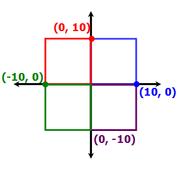
lexis wrote: A certain square is to be drawn on a coordinate plane. One of the vertices must be on the origin, and the square is to have an area of 100. If all coordinates of the vertices must be integers, how many different ways can this square be drawn? 4 6 8 10 12 12 one vertice must be on (0,0) each quadrant find how many points (integer points which makes the line with side 10 ) (0,10) , (8,6), (6,8).. So you can draw 3 squares in each quadrant . Answer 4*3=12 Figure is on the way
Attachments

sqrs.gif [ 4.08 KiB | Viewed 810 times ]
_________________
Your attitude determines your altitude Smiling wins more friends than frowning
|
|
|
|
|
|
|
Senior Manager
Joined: 29 Mar 2008
Posts: 351
Followers: 2
Kudos [?]:
33
[1] , given: 0
|
1
This post received KUDOS
lexis wrote: A certain square is to be drawn on a coordinate plane. One of the vertices must be on the origin, and the square is to have an area of 100. If all coordinates of the vertices must be integers, how many different ways can this square be drawn? 4 6 8 10 12 (E) One of the vertices of the square is fixed. Think of it as a pivot. One of the points that comes easily is (0,10) since 10 should be the length of one side ( Area being 100). Now let the point (0,0 ) act as a hinge and sweep the other parallel vertex across the quadrands. Now, since one side is 10 (use that as hypotenuse) and find the other sides of the right triangle - 8 and 6. Now you can find the combination of the points as follows: (0,10), (0,-10), (10,0), (-10, 0), (8,6), (-8,6), (-8,-6), (8,-6), (6,8), (-6,8), (-6,-8), (6,-8) Total is 12.
_________________
To find what you seek in the road of life, the best proverb of all is that which says: "Leave no stone unturned." -Edward Bulwer Lytton
|
|
|
|
|
|
Director
Joined: 12 Jul 2008
Posts: 523
Schools: Wharton
Followers: 11
Kudos [?]:
72
[1] , given: 0
|
1
This post received KUDOS
lexis wrote: A certain square is to be drawn on a coordinate plane. One of the vertices must be on the origin, and the square is to have an area of 100. If all coordinates of the vertices must be integers, how many different ways can this square be drawn? 4 6 8 10 12 E You can think of this problem as a right triangle problem. With the hypotenuse of the right triangle going out to (x,y) from the origin and one of the sides perpendicular to one of the axes. In these cases, x is the length of the base of the triangle and y is the height. So the question can be rephrased what are all possible integers x and y such that x^2 + y^2 = 10^2. (10,0), (-10,0), (0,10), (0,-10), (8,6), (8,-6), (-8,6), (-8,-6), (6,8), (6,-8), (-6,8), (-6, -8)
|
|
|
|
|
|
Senior Manager
Joined: 16 Jul 2008
Posts: 291
Schools: INSEAD Dec'10
Followers: 2
Kudos [?]:
14
[1] , given: 4
|
1
This post received KUDOS
My solution: 100 = 10x10 = 2x5x2x5. There are 3 ways to arrange 2x5x2x5 into two integers. Then, multiply by 4, because the square can be in any of the 4 quadrants. Also, this is a good question for guessing. The answer must be divisible by 4, and answers A and C assume only 1 and 2 ways, respectively, in which the square can be drawn in a given quadrant. So E is left.
_________________
http://applicant.wordpress.com/
|
|
|
|
|
|
Manager
Affiliations: Beta Gamma Sigma
Joined: 14 Aug 2008
Posts: 211
Schools: Harvard, Penn, Maryland
Followers: 4
Kudos [?]:
19
[0], given: 3
|
yes that makes a lot of sense, I guess you could just kind of figure out which numbers squared equals 10 squared, which are 8 and 6. I assume this is like an 800 level question?
|
|
|
|
|
|
Intern
Joined: 02 Aug 2008
Posts: 29
Followers: 0
Kudos [?]:
2
[0], given: 0
|
When the top left vertex moved to (6,8), did you check if the diagonal vertex coordinates are integer or not? i still feel there are only 4 solutions.
|
|
|
|
|
|
VP
Joined: 05 Jul 2008
Posts: 1442
Followers: 28
Kudos [?]:
152
[0], given: 1
|
Re: Number of squares [#permalink]
14 Sep 2008, 15:44
pallavi79us wrote: A certain square is to be drawn on a coordinate plane. One of the vertices must be on the origin, and the square is to have an area of 100. If all coordinates of the vertices must be integers, how many different ways can this square be drawn? 4 6 8 10 12 Please explain how you arrive at a solution. OA will follow.
thanks, We need to find out coordinates such that the distance between (0,0) and (x,y) is 10 (since area is 100, side =10) (0,0) (10,0) 4 such squares in 4 Quadrants (0,0) (8,6) 4 such squares (8,-6) ( -8,6) (-8,-6) (0,0) (6,8) 4 such squares (6,-8) (-6,8) and (-6,-8) Total 12
|
|
|
|
|
|
SVP
Joined: 17 Jun 2008
Posts: 1593
Followers: 7
Kudos [?]:
131
[0], given: 0
|
This is previously posted.
For co-ordinates to be integers, possible co-ordinates for one of the vertices are (6,8), (8,6), (10,0) in one quadrant. Multiply this number of three different co-ordinates with four quadrants....and hence the answer should be 12.
|
|
|
|
|
|
Manager
Joined: 22 Sep 2008
Posts: 124
Followers: 1
Kudos [?]:
34
[0], given: 0
|
Hey dude I am not getting how you come with (6,8) and (8,6) as valid vertices point.
As per my knowledge... if we have one vertices to be (0,0) then one of vertices will lie on X axis (10,0) and other one must lie on Y axis (0,10) ..
So we are left with only one choice for fourth vertices... (10,10)
This is for 1 quadrants , as we have total 4 quadrants answer should be 4 .
Hope i have not done anything wrong here and i had understand question.
Please correct me if i am wrong
Thanks Vishal Shah
|
|
|
|
|
|
SVP
Joined: 17 Jun 2008
Posts: 1593
Followers: 7
Kudos [?]:
131
[0], given: 0
|
vr4indian wrote: Hey dude I am not getting how you come with (6,8) and (8,6) as valid vertices point.
As per my knowledge... if we have one vertices to be (0,0) then one of vertices will lie on X axis (10,0) and other one must lie on Y axis (0,10) ..
So we are left with only one choice for fourth vertices... (10,10)
This is for 1 quadrants , as we have total 4 quadrants answer should be 4 .
Hope i have not done anything wrong here and i had understand question.
Please correct me if i am wrong
Thanks Vishal Shah Distance between (0,0) and (6,8) or (8,6) will be 10.
|
|
|
|
|
|
Intern
Joined: 04 Feb 2009
Posts: 1
Followers: 0
Kudos [?]:
0
[0], given: 0
|
Geometry Question - need help [#permalink]
04 Feb 2009, 08:00
I've been having a hard time understanding the solution to this problem. Can anyone offer a simple explanation? Thanks in advance.
A certain square is to be drawn on a coordinate plane. One of the vertices must be on the origin, and the square is to have an area of 100. If all coordinates of the vertices must be integers, how many different ways can this square be drawn?
***The Answer is 12 but I don't understand why.
|
|
|
|
|
|
CEO
Joined: 29 Aug 2007
Posts: 2530
Followers: 41
Kudos [?]:
358
[0], given: 19
|
Re: Geometry Question - need help [#permalink]
04 Feb 2009, 09:11
srpradhan wrote: I've been having a hard time understanding the solution to this problem. Can anyone offer a simple explanation? Thanks in advance.
A certain square is to be drawn on a coordinate plane. One of the vertices must be on the origin, and the square is to have an area of 100. If all coordinates of the vertices must be integers, how many different ways can this square be drawn?
***The Answer is 12 but I don't understand why. Look for the clue: If all coordinates of the vertices must be integers. How is a squre with area 100 possible? If its sides are each 10. How is a side with 10 is possible subject to the coordinates that make the the side 10? Its possible only with 6 abd 8 coordinates. So possibilities are: first qd: i: 10 and 0 ii: 8 and 6 ii: 6 and 8 Second qd: i: 0 and 10 ii: -6 and 8 ii: -8 and 6 similarly there are 3 more in each of 3rd and 4th quadrant. so altogather 12 possibilities.
_________________
Verbal: new-to-the-verbal-forum-please-read-this-first-77546.html Math: new-to-the-math-forum-please-read-this-first-77764.html Gmat: everything-you-need-to-prepare-for-the-gmat-revised-77983.html
GT
|
|
|
|
|
|
SVP
Joined: 07 Nov 2007
Posts: 1840
Location: New York
Followers: 20
Kudos [?]:
292
[0], given: 5
|
Re: Geometry Question - need help [#permalink]
04 Feb 2009, 09:12
srpradhan wrote: I've been having a hard time understanding the solution to this problem. Can anyone offer a simple explanation? Thanks in advance.
A certain square is to be drawn on a coordinate plane. One of the vertices must be on the origin, and the square is to have an area of 100. If all coordinates of the vertices must be integers, how many different ways can this square be drawn?
***The Answer is 12 but I don't understand why. http://gmatclub.com/forum/7-p509129?t=69095&hilit=A+certain+square+is+to+be+drawn+on+a+coordinate+plane.#p509129
_________________
Your attitude determines your altitude Smiling wins more friends than frowning
|
|
|
|
|
|
Current Student
Joined: 03 Aug 2006
Posts: 119
Location: Next to Google
Schools: Haas School of Business
Followers: 3
Kudos [?]:
66
[1] , given: 3
|
Re: coordinate geometry [#permalink]
17 Jun 2009, 20:09
1
This post received KUDOS
The answer is E.
Asking:
Number of squares in the xy-coordinate plane with the following criteria. 1. Total area of the square = 100 i.e. each side = 10 2. One of the vertices must be on the origin 3. All coordinates of the vertices must be integers
The first four are quite obvious. Four squares, one in each quadrant, with x and y axis as the two sides with the following vertices:
1. (0,0) (10,0) (0,10) (10,10) 2 (0,0) (-10,0) (0,10) (-10,10) 3. (0,0) (-10,0) (0,-10) (-10,-10) 4. (0,0) (10,0) (0,-10) (10,-10)
Now lets see which the remaining 8 are.
As each side is 10, if you rotate the side of the first square that falls on (0,0) and (10,0) in the counter clockwise direction with the vertex (0,0) fixed, the whole square will be rotated in the same direction.
Now if we think of this side as the hypotenuse of the right angle triangle that can be created by drawing a perpendicular from the rotating vertex to the x-axis then there are two points in the first quadrant where the rotating vertex has xy co-ordinates that are integers and they can be calculated using the Pythagorean formula.
x^2+y^2=10^2
the two values for x and y where x,y are integers and x^2+y^2=10^2 are (8,6) and (6,8)
8^2+6^2=10^2
6^2+8^2=10^2
Two additional squares can be created with the vertices for the bases as (0,0) (8,6) & (0,0) (6,8) in the first quadrant.
Similarly if you continue rotating the base counter-clockwise you can create two additional squares in quadrant II [bases (0,0) (-6,8) and (0,0) (-8,6)], two more in quadrant III [bases (0,0) (-6,-8) and (0,0) (-8,-6)] and the last two in quadrant IV [bases (0,0) (6,-8) and (0,0) (8,-6)] for a total of 8 additional squares.
Total squares = 4 + 8 = 12
|
|
|
|
|
|
Senior Manager
Joined: 25 Mar 2009
Posts: 305
Followers: 6
Kudos [?]:
41
[0], given: 6
|
Re: square is to be drawn [#permalink]
30 Jul 2009, 13:43
I know this answer b/c I reviewed it a few times from MGMAT so I won't go into detail and let others try. I got it wrong during the actual test.
|
|
|
|
|
|
Current Student
Status: What's your raashee?
Joined: 12 Jun 2009
Posts: 1847
Location: United States (NC)
Concentration: Strategy, Finance
Schools: UNC (Kenan-Flagler) - Class of 2013
GMAT 1: 720 Q49 V39
WE: Programming (Computer Software)
Followers: 20
Kudos [?]:
176
[0], given: 52
|
Re: square is to be drawn [#permalink]
30 Jul 2009, 14:08
i would like to know too... I tried to draw it out besides the 4 and i could draw some diamonds on the 4 directions but to get a side of 10 on the square in the 1-1-sqrt(2) format the x and y need to be 5*sqrt(2) which isnt integer... my guess would be B...
_________________
If you like my answers please +1 kudos!
|
|
|
|
|
|
Senior Manager
Joined: 16 Apr 2009
Posts: 252
Schools: Ross
Followers: 1
Kudos [?]:
10
[0], given: 10
|
Re: square is to be drawn [#permalink]
30 Jul 2009, 16:05
I am neonate in coordinate geometry. I think A is the answer. Area = 100 each side=10 as one vertex is at the origin, one vertex is a x intercept and another y intercept.the fourth can be on the four coordinates.
_________________
Keep trying no matter how hard it seems, it will get easier.
|
|
|
|
|
|
Current Student
Status: What's your raashee?
Joined: 12 Jun 2009
Posts: 1847
Location: United States (NC)
Concentration: Strategy, Finance
Schools: UNC (Kenan-Flagler) - Class of 2013
GMAT 1: 720 Q49 V39
WE: Programming (Computer Software)
Followers: 20
Kudos [?]:
176
[0], given: 52
|
Re: square is to be drawn [#permalink]
30 Jul 2009, 18:06
i say 10 because i can draw 8 shapes and there's prob 2 special ones...
_________________
If you like my answers please +1 kudos!
|
|
|
|
|
|
Senior Manager
Joined: 25 Jun 2009
Posts: 318
Followers: 2
Kudos [?]:
56
[0], given: 6
|
Re: square is to be drawn [#permalink]
31 Jul 2009, 02:33
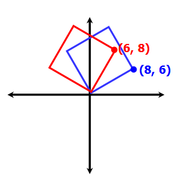
noboru wrote: certain square is to be drawn on a coordinate plane. One of the vertices must be on the origin, and the square is to have an area of 100. If all coordinates of the vertices must be integers, how many different ways can this square be drawn? 4 6 8 10 12 first + 1 for posting a good question ! IMO It should be e, We can 4 simple squares with 2 sides on the X and Y coordinates as shown ( 1 in each Quadrant ) And now Lets consider one side of the square as OA and try moving it. OA = 10, Lets consider OA as hypotenuse of a right angled triangle with one side X axis as one coordinate, A can have integers as it coordinates only when either x= 8 or 6 and Y as 6 or 8 .. as OA^2 = X^2 + Y^2 ( 10 x10 = 8x8 + 6x6) for any other combination A will no be having its coordinates as integers for eg if X =9 and then y = sqrt 19. So , This way we can have 2 squares in 1st quadrant and similarly total 8 in 4 quadrants. Hence total no. of squares will 8 + 4 =12. Let me know if this is correct. ! Cheers
Attachments

untitled.JPG [ 15.13 KiB | Viewed 456 times ]
|
|
|
|
|
|
SVP
Joined: 16 Jul 2009
Posts: 1635
Schools: CBS
WE 1: 4 years (Consulting)
Followers: 25
Kudos [?]:
119
[0], given: 2
|
Re: square is to be drawn [#permalink]
31 Jul 2009, 03:47
nitishmahajan wrote: noboru wrote: certain square is to be drawn on a coordinate plane. One of the vertices must be on the origin, and the square is to have an area of 100. If all coordinates of the vertices must be integers, how many different ways can this square be drawn? 4 6 8 10 12 first + 1 for posting a good question ! IMO It should be e, We can 4 simple squares with 2 sides on the X and Y coordinates as shown ( 1 in each Quadrant ) And now Lets consider one side of the square as OA and try moving it. OA = 10, Lets consider OA as hypotenuse of a right angled triangle with one side X axis as one coordinate, A can have integers as it coordinates only when either x= 8 or 6 and Y as 6 or 8 .. as OA^2 = X^2 + Y^2 ( 10 x10 = 8x8 + 6x6) for any other combination A will no be having its coordinates as integers for eg if X =9 and then y = sqrt 19. So , This way we can have 2 squares in 1st quadrant and similarly total 8 in 4 quadrants. Hence total no. of squares will 8 + 4 =12. Let me know if this is correct. ! Cheers Each side of the square must have a length of 10. If each side were to be 6, 7, 8, or most other numbers, there could only be four possible squares drawn, because each side, in order to have integer coordinates, would have to be drawn on the x- or y-axis. What makes a length of 10 different is that it could be the hypotenuse of a Pythagorean triple, meaning the vertices could have integer coordinates without lying on the x- or y-axis. For example, a square could be drawn with the coordinates (0,0), (6,8), (-2, 14) and (-8, 6). (It is tedious and unnecessary to figure out all four coordinates for each square). If we label the square abcd, with a at the origin and the letters representing points in a clockwise direction, we can get the number of possible squares by figuring out the number of unique ways ab can be drawn. a has coordinates (0,0) and b could have the following coordinates: (-10,0) (-8,6) (-6,8) (0,10) (6,8) (8,6) (10,0) (8, -6) (6, -8) (0, 10) (-6, -8) (-8, -6) There are 12 different ways to draw ab, and so there are 12 ways to draw abcd. The correct answer is E.
_________________
The sky is the limit 800 is the limit
Find out what's new at GMAT Club - latest features and updates
|
|
|
|
|
|
|
Re: square is to be drawn
[#permalink]
31 Jul 2009, 03:47
|
|
|
|
|
|
|
|
|
|
|