|
Author |
Message |
|
TAGS:
|
|
|
SVP
Joined: 05 Jul 2006
Posts: 1565
Followers: 4
Kudos [?]:
63
[0], given: 34
|
Re: coordinate geometry [#permalink]
03 Aug 2009, 15:31
Jozu wrote: A certain square is to be drawn on a coordinate plane. One of the vertices must be on the origin, and the square is to have an area of 100. If all coordinates of the vertices must be integers, how many different ways can this square be drawn?
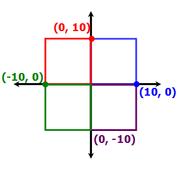
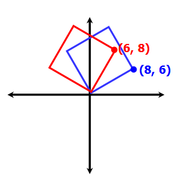
(A) 4 (B) 6 (C) 8 (D) 10 (E) 12 i think the question boiles down to the following (a,b) is a coordinate pair that must satisfy the following criteria intigers as well as a^2+b^2 = 100 (10,10),(-10,10),(10,-10),(-10,-10) (8,6),(6,8),(-8,-6),(-6,-8),(-8,6),(6,-8),(-6,8),(8,-6) total number = 12
|
|
|
|
|
|
|
Senior Manager
Joined: 17 Jul 2009
Posts: 305
Followers: 1
Kudos [?]:
20
[0], given: 6
|
Re: coordinate geometry [#permalink]
03 Aug 2009, 17:08
E, so sides must be 10, with either x, y to be a +-10 and 0 pair, or x^2+y^2 = 10^2, so x could be +-6, +-8, and y could be +- 8, +- 6 so that's 12 different starting lines, 12 different squares
|
|
|
|
|
|
Manager
Joined: 29 May 2008
Posts: 119
Followers: 1
Kudos [?]:
5
[0], given: 0
|
Re: Tuesday Q1 - # of Squares [#permalink]
13 Oct 2009, 07:24
hogann wrote: A certain square is to be drawn on a coordinate plane. One of the vertices must be on the origin, and the square is to have an area of 100. If all coordinates of the vertices must be integers, how many different ways can this square be drawn? 1. 4 2. 6 3. 8 4. 10 5. 12
OA to come this afternoon Well I think they are only 4 ways so the answer is A (or 1. in this case) it says that there must be one vertice on the origin so you can draw a square in each of the cuadrants having 4 in total.
|
|
|
|
|
|
Senior Manager
Joined: 16 Apr 2009
Posts: 252
Schools: Ross
Followers: 1
Kudos [?]:
10
[1] , given: 10
|
Re: Tuesday Q1 - # of Squares [#permalink]
13 Oct 2009, 07:54
1
This post received KUDOS
IMO, OA is 12 We can draw 12 squares with one vertix at the origin. The regular 4 squares with all vertices on the x and y coordinates - 4 squares Tilt the side of a square to 45 degrees - 4 squares Tilt the side of the square to 60 degrees - 4 squares
_________________
Keep trying no matter how hard it seems, it will get easier.
|
|
|
|
|
|
Manager
Joined: 07 Jun 2009
Posts: 210
Followers: 1
Kudos [?]:
9
[0], given: 5
|
Re: Tuesday Q1 - # of Squares [#permalink]
13 Oct 2009, 08:02
vannu wrote: IMO, OA is 12 We can draw 12 squares with one vertix at the origin. The regular 4 squares with all vertices on the x and y coordinates - 4 squares Tilt the side of a square to 45 degrees - 4 squares Tilt the side of the square to 60 degrees - 4 squares Hmm... thanks. I didn't think of tilting the squares.. +1
_________________
"Always....Read between the lines"
|
|
|
|
|
|
Intern
Joined: 29 Sep 2009
Posts: 7
Schools: ISB, Wharton
Followers: 0
Kudos [?]:
0
[0], given: 0
|
Re: Tuesday Q1 - # of Squares [#permalink]
13 Oct 2009, 08:11
I will go with 12 We can draw 12 squares with one vertix at the origin. Since \sqrt{100} = \sqrt{36 + 64} we can have 2 points with distance 10 from origin. (8,6) and (6,8). Also not to forget (10,0). So in all 3 valid points in first quadrant. As we rotate this square in each quadrant we will have 3*4 = 12 So the answer is 12.
_________________
Thanks, Just think differently, there is a easier solution:)
|
|
|
|
|
|
Manager
Affiliations: CFA Level 2 Candidate
Joined: 29 Jun 2009
Posts: 228
Schools: RD 2: Darden Class of 2012
Followers: 1
Kudos [?]:
20
[0], given: 2
|
Re: Tuesday Q1 - # of Squares [#permalink]
13 Oct 2009, 11:29
RJAGmat wrote: I will go with 12
We can draw 12 squares with one vertix at the origin.
Since \sqrt{100} = \sqrt{36 + 64}
we can have 2 points with distance 10 from origin. (8,6) and (6,8). Also not to forget (10,0). So in all 3 valid points in first quadrant. As we rotate this square in each quadrant we will have 3*4 = 12
So the answer is 12. Perfect explanation above - OA is 12
|
|
|
|
|
|
Manager
Joined: 05 Jun 2009
Posts: 77
Followers: 1
Kudos [?]:
2
[0], given: 1
|
maybe this is to simple, but if its a square than all sides have to be the same. And if there are 4 vertices of a square and you cant change the size of the square than wouldnt there be four options? Drawing a square in each of the 4 quadrants?
|
|
|
|
|
|
Intern
Joined: 26 Feb 2009
Posts: 13
Location: Nairobi
Schools: HBS
Followers: 1
Kudos [?]:
5
[0], given: 0
|
Gmatter111 wrote: Is there a quick way to solve this:
A certain square is to be drawn on a coordinate plane. One of the vertices must be on the origin, and the square is to have an area of 100. If all coordinates of the vertices must be integers, how many different ways can this square be drawn? 4 6 8 10 12 In short, this question is asking how many combinations of integers x & y that form the relationship (x)squared * (y)squared = 100 they are (0,10),(6,8) and (8,6) Ignoring the other vertices, this shows the 3 options of one vertix in a single quadrant. Now multiply this by the number of quadrants i.e. 4 You get the number of ways of drawing the square will be 3*4 = 12!
|
|
|
|
|
|
CEO
Status: Nothing comes easy: neither do I want.
Joined: 12 Oct 2009
Posts: 2758
Location: Malaysia
Concentration: Marketing, Entrepreneurship
GMAT 1: 670 Q49 V31 GMAT 2: 710 Q50 V35
Followers: 123
Kudos [?]:
634
[0], given: 221
|
yes its 12 3 in each quadrant and total = 12 x^2 +y^2 = 10 only comes when x,y = 0,10 ; 6,8 ; 8,6 note: x:y 0,10 will have 10,0 on another vertex so we will take it once only
_________________
Fight for your dreams :For all those who fear from Verbal- lets give it a fight
Money Saved is the Money Earned 
Jo Bole So Nihaal , Sat Shri Akaal
Support GMAT Club by putting a GMAT Club badge on your blog/Facebook 
Find out what's new at GMAT Club - latest features and updates
Gmat test review : 670-to-710-a-long-journey-without-destination-still-happy-141642.html
|
|
|
|
|
|
Intern
Status: Every achievement is not an end, but the beginning of a new jounrney.
Joined: 13 Sep 2009
Posts: 20
Location: INDIA
Schools: NY Stern, INSEAD, UCLA, Darden
WE 1: Deputy Manager -- Oil & Gas -- Base Refinery Operations
WE 2: Engineer -- Honeywell Process Solutions
Followers: 0
Kudos [?]:
4
[0], given: 1
|
It should be 4 simply 4. I fail to understand the concept of three in each quadrant, 6,8, 8,6 etc. Dear gurpreetsingh, please elaborate.
Thank you -Sunny.
|
|
|
|
|
|
CEO
Status: Nothing comes easy: neither do I want.
Joined: 12 Oct 2009
Posts: 2758
Location: Malaysia
Concentration: Marketing, Entrepreneurship
GMAT 1: 670 Q49 V31 GMAT 2: 710 Q50 V35
Followers: 123
Kudos [?]:
634
[0], given: 221
|
Consider quadrant I area of square = 100 side of square = 10 now x^2 + y^2 must be equal to 10. only 10,0 ; 0,10 ; 6,8; 8,6 satisfy this. If you take x,y = 10,0.....x,y =0,10 has been already satisfied on other vertex. thus you are left with 3 options only Since this can be same for all the 4 quadrants, total possibilities are 3*4 = 12 I hope you got the concept now.
_________________
Fight for your dreams :For all those who fear from Verbal- lets give it a fight
Money Saved is the Money Earned 
Jo Bole So Nihaal , Sat Shri Akaal
Support GMAT Club by putting a GMAT Club badge on your blog/Facebook 
Find out what's new at GMAT Club - latest features and updates
Gmat test review : 670-to-710-a-long-journey-without-destination-still-happy-141642.html
|
|
|
|
|
|
Senior Manager
Joined: 13 Dec 2009
Posts: 269
Followers: 8
Kudos [?]:
67
[0], given: 13
|
Re: Geometry Question - need help [#permalink]
11 Mar 2010, 06:14
srpradhan wrote: I've been having a hard time understanding the solution to this problem. Can anyone offer a simple explanation? Thanks in advance.
A certain square is to be drawn on a coordinate plane. One of the vertices must be on the origin, and the square is to have an area of 100. If all coordinates of the vertices must be integers, how many different ways can this square be drawn?
***The Answer is 12 but I don't understand why. one of the vertex is origin so (0,0) now area is 100 to get 100 the length of the side can be 10, the set of coordinates on x and y plane dat can have hypotenuse as 10 from origin (0,10), (10,0), (0,-10), (-10, 0) (6,8),(-6,-8), (-6,8), (6,-8), (8,6), (-8,6), (8,-6), (-8,-6), hence 12 ways...
_________________
My debrief: done-and-dusted-730-q49-v40
|
|
|
|
|
|
Senior Manager
Joined: 13 Dec 2009
Posts: 269
Followers: 8
Kudos [?]:
67
[0], given: 13
|
Re: Geometry Question - need help [#permalink]
11 Mar 2010, 06:23
djveed wrote: Hi all. Taking the GMATs tomorrow. Needed some help for the day. Geometry: stmt1: QR = RS, => <RQS = <RSQ not suff to find angle x stmt2: ST = TU, => <TSU = <TUS not suff to find angle x if we use both in quad PQSU, => <p+<q+<s+<u = 360 => 90+180 - <RQS+x+180 - <SUT = 360 =>90+x-<RSQ-<TSU = 0 since <RQS = <RSQ and <TSU = <TUS but x+<RSQ+TSU = 180 => <RSU+<TSU = 180 - x replace this in above equation 90+x-180+x = 0 => 2x-90=0 => x is 45 so both the stmts are required.
_________________
My debrief: done-and-dusted-730-q49-v40
|
|
|
|
|
|
Director
Status: Apply - Last Chance
Affiliations: IIT, Purdue, PhD, TauBetaPi
Joined: 18 Jul 2010
Posts: 694
Schools: Wharton, Sloan, Chicago, Haas
WE 1: 8 years in Oil&Gas
Followers: 13
Kudos [?]:
50
[1] , given: 15
|
Re: Number of Squares [#permalink]
14 Aug 2010, 09:33
1
This post received KUDOS
I saw this answer somewhere. Basically the diagonal is length 10 sqrt{2}, so x^2+y^2=200, If you imagine a stick rotating around (0,0) then the places where the other end of the stick will encounter integers and still satisfy this condition are (14,2), (2,14), (10,10), there are 3more quadrants = 4x3=12
_________________
Consider kudos, they are good for health
Last edited by mainhoon on 15 Aug 2010, 15:51, edited 1 time in total.
|
|
|
|
|
|
Manager
Joined: 20 Apr 2010
Posts: 239
Location: Hyderabad
WE 1: 4.6 years Exp IT prof
Followers: 7
Kudos [?]:
23
[0], given: 34
|
Re: need help counting prob with geometry [#permalink]
21 Aug 2010, 13:30
Answer is 4 If area is 100 than to calculate length of the side of area:10 Co-ordinates Square1 (0,0),(10,0)(10,10)(0,10) Co-ordinates Square2 (0,0),(-10,0)(-10,-10)(0,-10) Co-ordinates Square3 (0,0),(-10,0)(-10,10)(0,10) Co-ordinates Square4 (0,0),(10,0)(10,-10)(0,-10) Let me know If you didn't get it
_________________
I will give a Fight till the End
"To dream anything that you want to dream, that is the beauty of the human mind. To do anything that you want to do, that is the strength of the human will. To trust yourself, to test your limits, that is the courage to succeed." - Bernard Edmonds
A person who is afraid of Failure can never succeed -- Amneet Padda
Don't Forget to give the KUDOS
|
|
|
|
|
|
Intern
Joined: 04 Aug 2010
Posts: 22
Schools: Dartmouth College
Followers: 5
Kudos [?]:
16
[2] , given: 0
|
Re: need help counting prob with geometry [#permalink]
21 Aug 2010, 21:37
2
This post received KUDOS
Here are the conditions: Each side of every square must have a length of 10. Each square must have a vertex at the origin. The coordinates of the other vertices must be integers. A length of 10 always should make us think of a 6-8-10 triangle. To satisfy the conditions above, we have two options: Make each side of every square horizontal or vertical. Make each side of every square the hypotenuse of a 6-8-10 triangle. Please see the attached file for a picture of the 12 squares that can be drawn. Hope this helps! Mitch Hunt GMAT tutor and instructor New York, NY
_________________
GMAT Tutor and Instructor GMATGuruNY@gmail.com New York, NY
|
|
|
|
|
|
Math Forum Moderator
Joined: 20 Dec 2010
Posts: 2100
Followers: 108
Kudos [?]:
655
[0], given: 376
|
Re: MGMAT How many squares? [#permalink]
05 Feb 2011, 04:55
4 apparent squares; with one of the vertices as: (0,10),(10,0),(-10,0)(0,-10). Then, I took the square in the first quadrant and slowly moved anticlockwise. I could guess that finding integral co-ordinates for just one of the other vertices in the square( other than 0,0) would suffice and I did find all the required points, {(8,6),(6,8)(-6,8)(-8,6)(-8,-6)(-6,-8)(6,-8)(8,-6)} using pythagoras theorem. However, I still couldn't formulate how the remaining two points will be integers as well. By what principle of Geometry can we conclude that, in an xy plane; if two points of a square are integers, such as (0,0) and (8,6); the other two vertices will be all integers as well without explicitly solving for specific values of those vertices.
_________________
~fluke
Find out what's new at GMAT Club - latest features and updates
|
|
|
|
|
|
Director
Status: Admitted
Affiliations: Chicago Booth
Joined: 03 Feb 2011
Posts: 947
Followers: 10
Kudos [?]:
143
[0], given: 123
|
Re: MGMAT How many squares? [#permalink]
01 Mar 2011, 20:21
fluke Principle of the triplets. 3:4:5 or 6:8:10. Karishma's assumptions are correct. She is the best. 8 squares are obvious and NOT tilted. With one vertex on the origin. 4 are tilted with diagonals on the x and y axis. With one vertex on the origin. Hope that helps ! Btw if this question comes in real exam, I will recall that answer is 12. fluke wrote: By what principle of Geometry can we conclude that, in an xy plane; if two points of a square are integers, such as (0,0) and (8,6); the other two vertices will be all integers as well without explicitly solving for specific values of those vertices.
|
|
|
|
|
|
Manager
Joined: 07 Jun 2010
Posts: 89
Followers: 1
Kudos [?]:
5
[0], given: 0
|
Re: MGMAT How many squares? [#permalink]
01 Mar 2011, 22:20
This is doable in a minute or so. 4 on the vertices should come fairly quickly. Then, once you realize that 10 is a multiple of a 3-4-5 triagle, you should recognize more are possible. I drew just one, by arbitrarily picking one to draw. My choice was (-6, -8) from the origin. Recognize that You can do the same shape in the other four quadrants, and can flip to (-8, -6). 12 total.
|
|
|
|
|
|
|
Re: MGMAT How many squares?
[#permalink]
01 Mar 2011, 22:20
|
|
|
|
|
|
|
|
|
|
|