|
Author |
Message |
|
TAGS:
|
|
|
Intern
Joined: 18 Sep 2009
Posts: 3
Location: Belarus
Followers: 0
Kudos [?]:
0
[0], given: 1
|
Can you prove my answer?
|
|
|
|
|
|
|
GMAT Club team member
Joined: 02 Sep 2009
Posts: 11563
Followers: 1795
Kudos [?]:
9569
[0], given: 826
|
|
|
|
|
|
|
Senior Manager
Joined: 01 Feb 2010
Posts: 275
Followers: 1
Kudos [?]:
30
[0], given: 2
|
Bunuel wrote: msv3763 wrote: For every positive even integer n, the function h(n) is defnied to be the product of all the even integers from 2 to n, inclusive. If p is the smallest prime factor of h(100)+1, then p is
Any help on how to get the correct answer? Thanks!
Answer: greater than 40 Welcome to the Gmat Club. Below is the solution for your question: h(100)+1=2*4*6*...*100+1=2^{50}*(1*2*3*..*50)+1=2^{50}*50!+1Now, two numbers h(100)=2^{50}*50! and h(100)+1=2^{50}*50!+1 are consecutive integers. Two consecutive integers are co-prime, which means that they don't share ANY common factor but 1. For example 20 and 21 are consecutive integers, thus only common factor they share is 1. As h(100)=2^{50}*50! has all numbers from 1 to 50 as its factors, according to above h(100)+1=2^{50}*50!+1 won't have ANY factor from 1 to 50. Hence p ( >1), the smallest factor of h(100)+1 will be more than 50. Answer: More than 50. Hope it helps. P.S. Can you please: post one question per topic, tag the questions you post, and also post the whole questions with answer choices. Good explanation.
|
|
|
|
|
|
Intern
Joined: 21 Aug 2009
Posts: 42
Followers: 1
Kudos [?]:
2
[0], given: 5
|
Bunuel wrote: msv3763 wrote: For every positive even integer n, the function h(n) is defnied to be the product of all the even integers from 2 to n, inclusive. If p is the smallest prime factor of h(100)+1, then p is
Any help on how to get the correct answer? Thanks!
Answer: greater than 40 Welcome to the Gmat Club. Below is the solution for your question: h(100)+1=2*4*6*...*100+1=2^{50}*(1*2*3*..*50)+1=2^{50}*50!+1Now, two numbers h(100)=2^{50}*50! and h(100)+1=2^{50}*50!+1 are consecutive integers. Two consecutive integers are co-prime, which means that they don't share ANY common factor but 1. For example 20 and 21 are consecutive integers, thus only common factor they share is 1. As h(100)=2^{50}*50! has all numbers from 1 to 50 as its factors, according to above h(100)+1=2^{50}*50!+1 won't have ANY factor from 1 to 50. Hence p ( >1), the smallest factor of h(100)+1 will be more than 50. Answer: More than 50. Hope it helps. P.S. Can you please: post one question per topic, tag the questions you post, and also post the whole questions with answer choices. Very nice way of solving the problem. Bunuel, you make the problem look easy.
|
|
|
|
|
|
GMAT Instructor
Joined: 24 Jun 2008
Posts: 973
Location: Toronto
Followers: 167
Kudos [?]:
443
[1] , given: 3
|
1
This post received KUDOS
ThePower wrote: Can you prove my answer? There's no way to prove it without a computer; factoring large integers is one of the most time-consuming mathematical operations (unless they have very obvious factors). The fact that it is so time consuming to factor large numbers is actually the basis of internet encryption systems; you can hack the encryption, but you'd need 10,000 years of computing time to break down the large numbers involved. So Number Theory is the reason you can do banking, shopping or private email on the web.
_________________
Nov 2011: After years of development, I am now making my advanced Quant books and high-level problem sets available for sale. Contact me at ianstewartgmat at gmail.com for details.
Private GMAT Tutor based in Toronto
|
|
|
|
|
|
Manager
Joined: 18 Oct 2009
Posts: 53
Location: Alberta, Canada
Schools: Queen's E-MBA
Followers: 0
Kudos [?]:
10
[0], given: 7
|
an after thought.......
Cannot understand why according to above h (100)+1 won't have ANY factor from 1 to 50. Let's take the example of 20 & 21; is it true that 21 doesn't have any factor till 20? They won't have common factors like factors for 20 are 2 & 5 while of 21 are 7 & 3, but 21 does have factors less than 20.
Pl enlighten.
|
|
|
|
|
|
GMAT Club team member
Joined: 02 Sep 2009
Posts: 11563
Followers: 1795
Kudos [?]:
9569
[1] , given: 826
|
1
This post received KUDOS
ExecMBA2010 wrote: an after thought.......
Cannot understand why according to above h (100)+1 won't have ANY factor from 1 to 50. Let's take the example of 20 & 21; is it true that 21 doesn't have any factor till 20? They won't have common factors like factors for 20 are 2 & 5 while of 21 are 7 & 3, but 21 does have factors less than 20.
Pl enlighten. Not sure I understood your question correctly. Anyway: given that p is the smallest prime factor of h(100)+1=2^{50}*50!+1. The point here is that consecutive integers do not share ANY common factor but 1. Two numbers h(100)=2^{50}*50! and h(100)+1=2^{50}*50!+1 are consecutive integers, hence these two integers do not share any common factor but 1. h(100)=2^{50}*50! naturally has all factors from 2 to 50, which means that h(100)+1=2^{50}*50!+1 does not have any of these factors. So, p, which is the prime factor of h(100)+1=2^{50}*50!+1 must be more than 50.
_________________
PLEASE READ AND FOLLOW: 11 Rules for Posting!!!
RESOURCES: [GMAT MATH BOOK]; 1. Triangles; 2. Polygons; 3. Coordinate Geometry; 4. Factorials; 5. Circles; 6. Number Theory
COLLECTION OF QUESTIONS: PS: 1. Tough and Tricky questions; 2. Hard questions; 3. Hard questions part 2; 4. Standard deviation; 5. Tough Problem Solving Questions With Solutions; 6. Probability and Combinations Questions With Solutions; 7 Tough and tricky exponents and roots questions; 8 12 Easy Pieces (or not?); 9 Bakers' Dozen; 10 Algebra set. NEW!!!
DS: 1. DS tough questions; 2. DS tough questions part 2; 3. DS tough questions part 3; 4. DS Standard deviation; 5. Inequalities; 6. 700+ GMAT Data Sufficiency Questions With Explanations; 7 Tough and tricky exponents and roots questions; 8 The Discreet Charm of the DS ; 9 Devil's Dozen!!!; 10 Number Properties set. NEW!!!
 What are GMAT Club Tests? 25 extra-hard Quant Tests
Find out what's new at GMAT Club - latest features and updates
|
|
|
|
|
|
Manager
Joined: 18 Oct 2009
Posts: 53
Location: Alberta, Canada
Schools: Queen's E-MBA
Followers: 0
Kudos [?]:
10
[0], given: 7
|
Bunuel wrote: Not sure I understood your question correctly.
Anyway: given that p is the smallest prime factor of h(100)+1=2^{50}*50!+1. The point here is that consecutive integers do not share ANY common factor but 1. Two numbers h(100)=2^{50}*50! and h(100)+1=2^{50}*50!+1 are consecutive integers, hence these two integers do not share any common factor but 1. h(100)=2^{50}*50! naturally has all factors from 2 to 50, which means that h(100)+1=2^{50}*50!+1 does not have any of these factors. So, p, which is the prime factor of h(100)+1=2^{50}*50!+1 must be more than 50. I have got it now. Since h(100) has all the numbers from 2 to 50 as its factor h(100)+1 cannot have any of the numbers between 2 & 50 as its factor. Hence the lowest factor of h(100)+1 is either 1 or a number above 50. Thanks.
|
|
|
|
|
|
Intern
Joined: 13 Apr 2010
Posts: 10
Followers: 0
Kudos [?]:
0
[0], given: 10
|
ps explanation ?!?!!? [#permalink]
14 Apr 2010, 06:58
#1 For every positive even integer n, the function h(n) is defined to be the product of all the even integers from 2 to n, inclusive. If p is the smallest prime factor of h(100) +1, the p is? A. btw 2 and 20 B. btw 10 and 20 C. btw 20 and 30 D. btw 30 and 40 E. greater than 40
#2 Pumps A, B, and C operate at their respective constant rates. Pumps A and B, operating simultaneously, can fill a certain tank in 6.5 hours; pumps A and C, operating simultaneously, can fill the tank in 3.2 hours; and pumps B and C, operating simultaneously, can fill the tank in 2 hours. How many hours does it take pumps A,B, and C operating simultaneously, to fill the tank?
#3 Last year certain bond with a face value of $5,000 yielded 8 percent of its face value in interest. If that interest was approximately 6.5 percent of the bond's selling price, approximately what was the bond's selling price? $4,063 $5,325 $5,351 $6,000 $6,154
|
|
|
|
|
|
CR Forum Moderator
Joined: 02 Oct 2009
Posts: 470
Location: Bangalore,India
WE 1: 4yrs in IT Industry
Followers: 16
Kudos [?]:
66
[2] , given: 268
|
Re: ps explanation ?!?!!? [#permalink]
14 Apr 2010, 08:28
2
This post received KUDOS
Quote: #1 For every positive even integer n, the function h(n) is defined to be the product of all the even integers from 2 to n, inclusive. If p is the smallest prime factor of h(100) +1, the p is? A. btw 2 and 20 B. btw 10 and 20 C. btw 20 and 30 D. btw 30 and 40 E. greater than 40 Bit Tricky.. The function described will be in the form h(n)= 2^(n/2)*(n/2)! h(100)+1= [(2^50)*50! +1] By POE we can eliminate ABCD(because any prime number below 50 is a factor of 50!) I feel the ans is E
_________________
One Final Try.......
|
|
|
|
|
|
Senior Manager
Joined: 01 Feb 2010
Posts: 275
Followers: 1
Kudos [?]:
30
[2] , given: 2
|
Re: ps explanation ?!?!!? [#permalink]
14 Apr 2010, 08:39
2
This post received KUDOS
CC2HBS wrote: #3 Last year certain bond with a face value of $5,000 yielded 8 percent of its face value in interest. If that interest was approximately 6.5 percent of the bond's selling price, approximately what was the bond's selling price? $4,063 $5,325 $5,351 $6,000 $6,154 x- Selling Price 8%5000 = 6.5%x x = (8 * 5000)/6.5 = 6154 hence E.
|
|
|
|
|
|
CR Forum Moderator
Joined: 02 Oct 2009
Posts: 470
Location: Bangalore,India
WE 1: 4yrs in IT Industry
Followers: 16
Kudos [?]:
66
[1] , given: 268
|
Re: ps explanation ?!?!!? [#permalink]
14 Apr 2010, 08:51
1
This post received KUDOS
I tried to explain Q2 1 it is very hard to explain 2 it has a mammoth calculation but can brief::: the answer will be (1/6.5 +1/3.2 + 1/2)*1/2...
_________________
One Final Try.......
|
|
|
|
|
|
CR Forum Moderator
Joined: 02 Oct 2009
Posts: 470
Location: Bangalore,India
WE 1: 4yrs in IT Industry
Followers: 16
Kudos [?]:
66
[1] , given: 268
|
Re: ps explanation ?!?!!? [#permalink]
14 Apr 2010, 08:55
1
This post received KUDOS
CC2HBS can uprovide the answers
_________________
One Final Try.......
|
|
|
|
|
|
GMAT Club team member
Joined: 02 Sep 2009
Posts: 11563
Followers: 1795
Kudos [?]:
9569
[2] , given: 826
|
Re: ps explanation ?!?!!? [#permalink]
14 Apr 2010, 09:00
2
This post received KUDOS
#1 For every positive even integer n, the function h(n) is defined to be the product of all the even integers from 2 to n, inclusive. If p is the smallest prime factor of h(100) +1, the p is?A. btw 2 and 20 B. btw 10 and 20 C. btw 20 and 30 D. btw 30 and 40 E. greater than 40 h(100)+1=2*4*6*...*100+1=2^{50}*(1*2*3*..*50)+1=2^{50}*50!+1Now, two numbers h(100)=2^{50}*50! and h(100)+1=2^{50}*50!+1 are consecutive integers. Two consecutive integers are co-prime, which means that they don't share ANY common factor but 1. For example 20 and 21 are consecutive integers, thus only common factor they share is 1. As h(100)=2^{50}*50! has all numbers from 1 to 50 as its factors, according to above h(100)+1=2^{50}*50!+1 won't have ANY factor from 1 to 50. Hence p ( >1), the smallest factor of h(100)+1 will be more than 50. Answer: E. #2 Pumps A, B, and C operate at their respective constant rates. Pumps A and B, operating simultaneously, can fill a certain tank in 6.5 hours; pumps A and C, operating simultaneously, can fill the tank in 3.2 hours; and pumps B and C, operating simultaneously, can fill the tank in 2 hours. How many hours does it take pumps A,B, and C operating simultaneously, to fill the tank?I think there is a typos in stem: times should be 6/5 (instead of 6.5) and 3/2 (instead of 3.2). THEORYIf: Time needed for A to complete the job =A hours; Time needed for B to complete the job =B hours; Time needed for C to complete the job =C hours; ... Time needed for N to complete the job =N hours; Then if time needed for all of them working simultaneously to complete the job is T, then: \frac{1}{A}+\frac{1}{B}+\frac{1}{C}+..+\frac{1}{N}=\frac{1}{T} (General formula). For two and three entities (workers, pumps, ...): General formula for calculating the time needed for two workers A and B working simultaneously to complete one job:Given that a and b are the respective individual times needed for A and B workers (pumps, ...) to complete the job, then time needed for A and B working simultaneously to complete the job equals to T_{(A&B)}=\frac{a*b}{a+b} hours, which is reciprocal of the sum of their respective rates ( \frac{1}{a}+\frac{1}{b}=\frac{1}{t}). General formula for calculating the time needed for three A, B and C workers working simultaneously to complete one job:T_{(A&B&C)}=\frac{a*b*c}{ab+ac+bc} hours. Also for rate problems it's good to know that: TIME to complete one job=Reciprocal of rate. eg 6 hours needed to complete one job (time) --> 1/6 of the job done in 1 hour (rate). Time, rate and job in work problems are in the same relationship as time, speed (rate) and distance. Time*Rate=Distance Time*Rate=JobBack to our original question. We have: \frac{1}{A}+\frac{1}{B}=\frac{1}{t_{a&b}}=\frac{5}{6}\frac{1}{A}+\frac{1}{C}=\frac{1}{t_{a&c}}=\frac{2}{3}\frac{1}{B}+\frac{1}{C}=\frac{1}{t_{b&c}}=\frac{1}{2}Question: \frac{1}{A}+\frac{1}{B}+\frac{1}{C}=\frac{1}{T}, T=?Sum the first three equations: 2(\frac{1}{A}+\frac{1}{B}+\frac{1}{C})=\frac{5}{6}+\frac{2}{3}+\frac{1}{2}=2 --> \frac{1}{A}+\frac{1}{B}+\frac{1}{C}=1=\frac{1}{T} --> T=1.
_________________
PLEASE READ AND FOLLOW: 11 Rules for Posting!!!
RESOURCES: [GMAT MATH BOOK]; 1. Triangles; 2. Polygons; 3. Coordinate Geometry; 4. Factorials; 5. Circles; 6. Number Theory
COLLECTION OF QUESTIONS: PS: 1. Tough and Tricky questions; 2. Hard questions; 3. Hard questions part 2; 4. Standard deviation; 5. Tough Problem Solving Questions With Solutions; 6. Probability and Combinations Questions With Solutions; 7 Tough and tricky exponents and roots questions; 8 12 Easy Pieces (or not?); 9 Bakers' Dozen; 10 Algebra set. NEW!!!
DS: 1. DS tough questions; 2. DS tough questions part 2; 3. DS tough questions part 3; 4. DS Standard deviation; 5. Inequalities; 6. 700+ GMAT Data Sufficiency Questions With Explanations; 7 Tough and tricky exponents and roots questions; 8 The Discreet Charm of the DS ; 9 Devil's Dozen!!!; 10 Number Properties set. NEW!!!
 What are GMAT Club Tests? 25 extra-hard Quant Tests
Find out what's new at GMAT Club - latest features and updates
|
|
|
|
|
|
Intern
Joined: 13 Apr 2010
Posts: 10
Followers: 0
Kudos [?]:
0
[0], given: 10
|
Re: ps explanation ?!?!!? [#permalink]
14 Apr 2010, 09:07
RaviChandra wrote: CC2HBS can uprovide the answers first of all thx for all the kind explanations!! it is still confused to understand whole process but i guess i started to get a grip! #1. greater than 40 #2. 1 #3. 6,154
|
|
|
|
|
|
CR Forum Moderator
Joined: 02 Oct 2009
Posts: 470
Location: Bangalore,India
WE 1: 4yrs in IT Industry
Followers: 16
Kudos [?]:
66
[0], given: 268
|
Re: ps explanation ?!?!!? [#permalink]
14 Apr 2010, 20:00
Quote: Pumps A, B, and C operate at their respective constant rates. Pumps A and B, operating simultaneously, can fill a certain tank in 6.5 hours; pumps A and C, operating simultaneously, can fill the tank in 3.2 hours; and pumps B and C, operating simultaneously, can fill the tank in 2 hours. How many hours does it take pumps A,B, and C operating simultaneously, to fill the tank?
I think there is a typos in stem: times should be 6/5 (instead of 6.5) and 3/2 (instead of 3.2) How could you identify that there is a typo dude... ur simply great
_________________
One Final Try.......
|
|
|
|
|
|
Intern
Joined: 14 Sep 2009
Posts: 31
Followers: 0
Kudos [?]:
3
[0], given: 22
|
Questions from GMAT Prep practice exam (PLEASE HELP!) [#permalink]
03 May 2010, 13:02
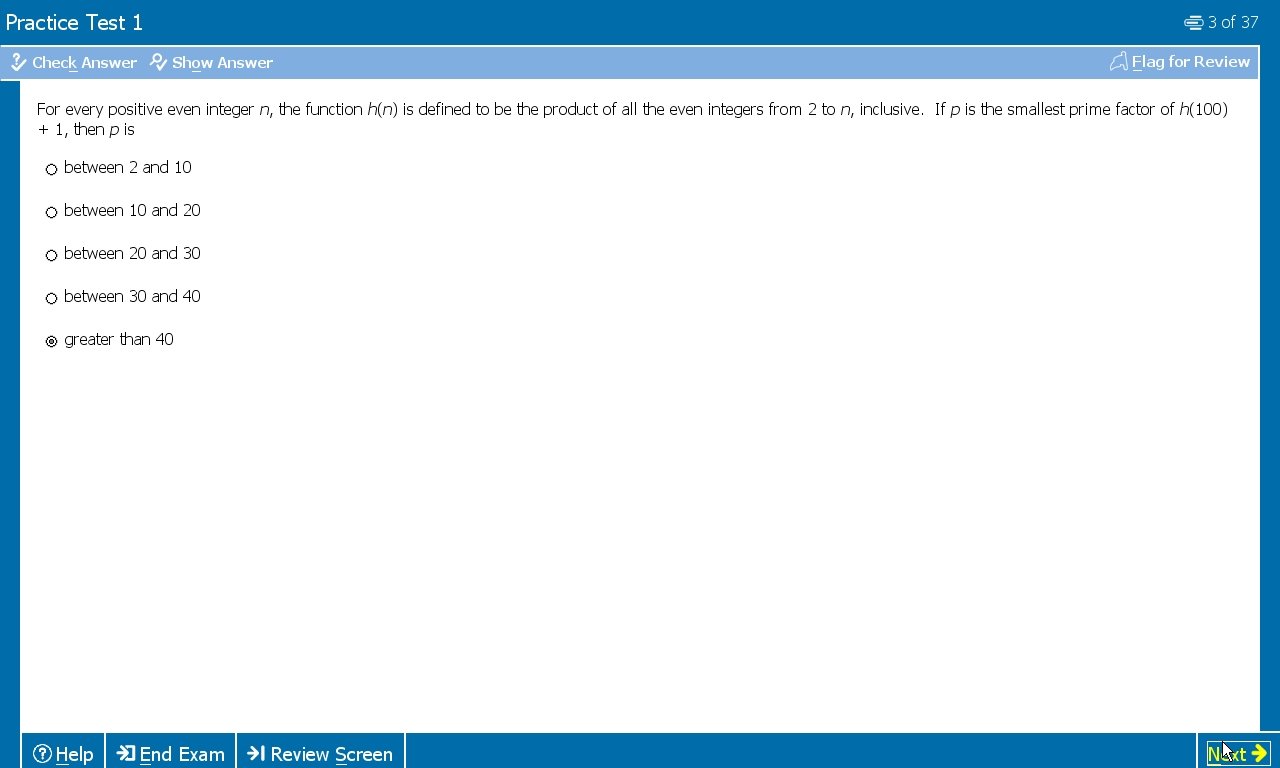
For every positive even integer n, the function h(n) is defined to be the product of all even integers from 2 to n, inclusive. If p is the smallest prime factior of h (100) + 1, the p is:
* between 2 and 10 * between 10 & 20 * between 20 & 30 * between 30 & 40 * greater than 40
If n is a positive integer and the product of all integers from 1 to n inclusive is a multiple of 990, what is the least possible value of n?
*10 *11 *12 *13 *14
|
|
|
|
|
|
Senior Manager
Joined: 25 Jun 2009
Posts: 318
Followers: 2
Kudos [?]:
56
[0], given: 6
|
Re: Questions from GMAT Prep practice exam (PLEASE HELP!) [#permalink]
03 May 2010, 13:05
If n is a positive integer and the product of all integers from 1 to n inclusive is a multiple of 990, what is the least possible value of n?
*10 *11 *12 *13 *14
Sol - Product of n numbers = 1*2*3.... n = n ! = 990 * K = 9* 10 *11 * K
The least possible value of n will be 11, as 11 is a prime number which is there in the product of the n numbers.
|
|
|
|
|
|
Director
Joined: 03 Sep 2006
Posts: 910
Followers: 5
Kudos [?]:
29
[0], given: 33
|
Re: Questions from GMAT Prep practice exam (PLEASE HELP!) [#permalink]
14 May 2010, 04:48
I will tell a more simple and direct solution for this question.
Remember the Wilson's Theorem
p divides (p-1)!+1 if p is prime. The converse is also true.
For instance, 7 is prime, and 7 divides (6!)+1=721
For h(100) = 100!
h(100)+1 = (100!+1)
Which (keeping the Wilson's theorem in mind) can be rewritten as
h(101-1)+1 = [ (101-1)! + 1 ]
101 is the prime which shall divide h(100)+1
and 101 is greater than 40, and choose this answer choice.
Magic lies in the Wilson's theorem, but if you remember the above mentioned method, it will help you in solving any similar or related question without any problem at all.
|
|
|
|
|
|
Intern
Joined: 09 Mar 2010
Posts: 1
Followers: 0
Kudos [?]:
0
[0], given: 0
|
Re: GMAT Prep Question on Integers [#permalink]
15 May 2010, 21:53
Great Explanation!
|
|
|
|
|
|
|
Re: GMAT Prep Question on Integers
[#permalink]
15 May 2010, 21:53
|
|
|
|
|
|
|
|
|
Similar topics |
Author |
Replies |
Last post |
|
Similar Topics:
|
|
|
|
For every positive even integer n, the function h(n) is
|
jodeci |
1 |
01 Apr 2006, 22:31 |
|
|
|
For every positive even integer n, the function h(n) is
|
jlui4477 |
7 |
17 Apr 2006, 01:48 |
|
|
|
For every positive even integer n, the function hn) is
|
john2005 |
5 |
07 May 2006, 14:17 |
|
|
|
For every positive even integer, n, the function h(n) is
|
ffgmat |
1 |
22 May 2006, 04:56 |
|
|
|
1) For every positive even integer n, function h(n) is
|
g1m2a3t406 |
6 |
24 Nov 2006, 14:25 |
|
|
|
|
|
|