Find all School-related info fast with the new School-Specific MBA Forum

It is currently 21 May 2013, 12:28
Customize  |  Hide

GMAT Diagnostic Test Question 35

  Question banks Downloads My Bookmarks Reviews  
Author Message
3 KUDOS received
Founder
Founder
User avatar
Status: On Vacation :-)
Affiliations: UA-1K, SPG-G, HH-D
Joined: 04 Dec 2002
Posts: 10396
Location: United States (WA)
GMAT 1: 750 Q49 V42
GPA: 3.5
WE: Information Technology (Hospitality and Tourism)
Followers: 1363

Kudos [?]: 4186 [3] , given: 3117

GMAT ToolKit User GMAT Tests User
GMAT Diagnostic Test Question 35 [#permalink] New post 06 Jun 2009, 23:20
3
This post received
KUDOS
GMAT Diagnostic Test Question 35
Field: geometry
Difficulty: 700
Rating:


If vertices of a triangle are A (5, 0), B (x, y) and C (25, 0), what is its area?

(1) |x| = y = 10
(2) x = |y| = 10

A. Statement (1) ALONE is sufficient, but Statement (2) ALONE is not sufficient
B. Statement (2) ALONE is sufficient, but Statement (1) ALONE is not sufficient
C. BOTH statements TOGETHER are sufficient, but NEITHER statement ALONE is sufficient
D. EACH statement ALONE is sufficient
E. Statements (1) and (2) TOGETHER are NOT sufficient
_________________

Founder of GMAT Club

Just starting out with GMAT? Start here... | Want to know your GMAT Score? Try GMAT Score Estimator
Need GMAT Book Recommendations? Best GMAT Books

Co-author of the GMAT Club tests

Find out what's new at GMAT Club - latest features and updates

Kaplan Promo CodeKnewton GMAT Discount CodesManhattan GMAT Discount Codes
1 KUDOS received
CEO
CEO
User avatar
Joined: 29 Aug 2007
Posts: 2530
Followers: 41

Kudos [?]: 358 [1] , given: 19

GMAT Tests User
Re: GMAT Diagnostic Test Question 35 [#permalink] New post 10 Jun 2009, 20:08
1
This post received
KUDOS
Explanation
Rating:

Official Answer: D

Statement 1: If |x| = y = 10, y is 10 but x could be -10 or 10. The area is same for x = 10 and x = -10. This is sufficient to answer the question.
Statement 2: If x = |y| = 10, x = 10 but y could be 10 or -10 but different value of y does not affect the area of the triangle. This statement is also sufficient to answer the question.

Therefore the OA is D.
_________________

Verbal: new-to-the-verbal-forum-please-read-this-first-77546.html
Math: new-to-the-math-forum-please-read-this-first-77764.html
Gmat: everything-you-need-to-prepare-for-the-gmat-revised-77983.html


GT

1 KUDOS received
Intern
Intern
Joined: 31 May 2009
Posts: 5
Followers: 0

Kudos [?]: 2 [1] , given: 0

Re: GMAT Diagnostic Test Question 35 [#permalink] New post 18 Jul 2009, 10:21
1
This post received
KUDOS
GMAT TIGER wrote:
Explanation
Rating:

Official Answer: B

Statement 1: If |x| = y = 10, y is 10 but x could be -10 or 10. Area is not same for x = 10 and x = -10. This is not sufficient to answer the question.
Statement 2: If x = |y| = 10, x = 10 but y could be 10 or -10 but different value of y does not affect the area of the triangle. This statement is sufficient to answer the question.

Therefore the OA is B.


How can a difference in x co-ordinate will change the area. Coz the y co-ordinate will decide the height of the triangle and it is constant. IMHO the answer should be D.
Intern
Intern
Joined: 24 Jun 2009
Posts: 13
Location: New York
Followers: 0

Kudos [?]: 1 [0], given: 0

GMAT Tests User
Re: GMAT Diagnostic Test Question 35 [#permalink] New post 20 Jul 2009, 15:42
kyabe wrote:
GMAT TIGER wrote:
Explanation
Rating:

Official Answer: B

Statement 1: If |x| = y = 10, y is 10 but x could be -10 or 10. Area is not same for x = 10 and x = -10. This is not sufficient to answer the question.
Statement 2: If x = |y| = 10, x = 10 but y could be 10 or -10 but different value of y does not affect the area of the triangle. This statement is sufficient to answer the question.

Therefore the OA is B.


How can a difference in x co-ordinate will change the area. Coz the y co-ordinate will decide the height of the triangle and it is constant. IMHO the answer should be D.


Agree with kyabe. Even when x = -10, you still can calculate the area of the rectangle (area of 350) and subtract the areas of two other triangles (250 total). That leaves you with 100 for the area of the triangle.


The answer is D.
1 KUDOS received
Manager
Manager
User avatar
Joined: 14 Aug 2009
Posts: 134
Followers: 2

Kudos [?]: 81 [1] , given: 13

Re: GMAT Diagnostic Test Question 35 [#permalink] New post 21 Aug 2009, 22:58
1
This post received
KUDOS
Answer should be C.

1) B can be two points B1(10, 10) or B2(-10,10)
therefore Sabc is not certain

2) B can be B1(10, 10) or B2(10, -10)
although AC is certain, but the height from B1 to AC and B2 to AC are not the same.
therefore Sabc is not certain

put 1) and 2) together,
B can only be (10, 10)
Sabc can be calculated.
_________________

Kudos me if my reply helps!

Manager
Manager
Joined: 22 Aug 2009
Posts: 54
Followers: 0

Kudos [?]: 3 [0], given: 1

Re: GMAT Diagnostic Test Question 35 [#permalink] New post 22 Aug 2009, 19:33
flyingbunny wrote:
Answer should be C.

1) B can be two points B1(10, 10) or B2(-10,10)
therefore Sabc is not certain

2) B can be B1(10, 10) or B2(10, -10)
although AC is certain, but the height from B1 to AC and B2 to AC are not the same.
therefore Sabc is not certain

put 1) and 2) together,
B can only be (10, 10)
Sabc can be calculated.


The question does not require that you know exactly where the triangle is or what its shape is... only the area is being discussed here... the area is the same for any of the possible locations for B that were mentioned, so the correct answer is D.
1 KUDOS received
Manager
Manager
Joined: 22 Aug 2009
Posts: 54
Followers: 0

Kudos [?]: 3 [1] , given: 1

Re: GMAT Diagnostic Test Question 35 [#permalink] New post 22 Aug 2009, 23:53
1
This post received
KUDOS
flyingbunny wrote:
Architect wrote:
flyingbunny wrote:
Answer should be C.

1) B can be two points B1(10, 10) or B2(-10,10)
therefore Sabc is not certain

2) B can be B1(10, 10) or B2(10, -10)
although AC is certain, but the height from B1 to AC and B2 to AC are not the same.
therefore Sabc is not certain

put 1) and 2) together,
B can only be (10, 10)
Sabc can be calculated.


The question does not require that you know exactly where the triangle is or what its shape is... only the area is being discussed here... the area is the same for any of the possible locations for B that were mentioned, so the correct answer is D.


when B is at different points, the areas are different.


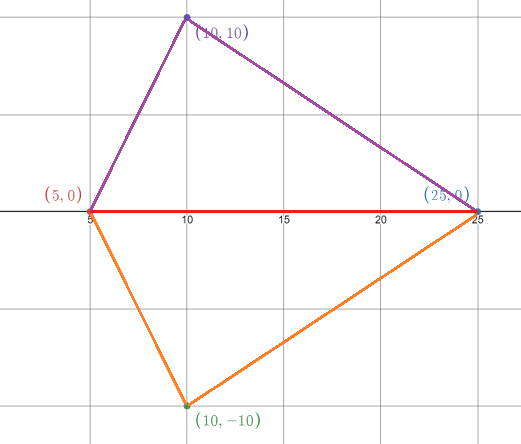
If B is (-10,10), Area=100. If B is (10,10), Area=100. If B is (10,-10), Area=100. 100=100=100. Make sense? If not, I can sketch up a diagram and scan it to prove it.
Manager
Manager
User avatar
Joined: 14 Aug 2009
Posts: 134
Followers: 2

Kudos [?]: 81 [0], given: 13

Re: GMAT Diagnostic Test Question 35 [#permalink] New post 23 Aug 2009, 00:14
damn, I didn't read the question clearly. I thought C is (0, 25)

when C is (25,0), it is easy.

Answer is D.
_________________

Kudos me if my reply helps!

Manager
Manager
User avatar
Joined: 13 Aug 2009
Posts: 208
Schools: Sloan '14 (S)
Followers: 3

Kudos [?]: 60 [0], given: 16

GMAT Tests User
Re: GMAT Diagnostic Test Question 35 [#permalink] New post 03 Sep 2009, 08:49
I agree that the answer is D as well. I spent a lot of time trying to figure this one out.

In short if you assume that two points at (5,0) and (25,0) are the base (which equals 20), you still get the same area regardless of whether the third point is at:

(10,10)
(-10,10)
(10,-10)
(-10,-10)

All that matters is that the height is still 10, because the area of a triange is 1/2*base*height: 1/2*10*20 = 100
1 KUDOS received
Senior Manager
Senior Manager
Joined: 08 Dec 2009
Posts: 421
Followers: 4

Kudos [?]: 73 [1] , given: 26

GMAT Tests User
Re: GMAT Diagnostic Test Question 35 [#permalink] New post 10 Feb 2010, 18:57
1
This post received
KUDOS
i was so sure it was D until i saw the answer sheet... made me doubt myself there...

then i had to google: area of triangle, and stumbled upon this:
http://www.mathopenref.com/trianglearea.html

doesn't matter what the x coordinate is... as long as your base is fixed, and your height is fixed, area should be the same... but i still have to see it (and drag the coordinates around -- see link above) myself to believe it!!
_________________

kudos if you like me (or my post) :P

2 KUDOS received
Manager
Manager
Joined: 27 Jul 2010
Posts: 199
Location: Prague
Schools: University of Economics Prague
Followers: 1

Kudos [?]: 10 [2] , given: 15

GMAT ToolKit User GMAT Tests User
Re: GMAT Diagnostic Test Question 35 [#permalink] New post 09 Oct 2010, 08:42
2
This post received
KUDOS
The answer is D, both pairs of triangles have the same base and height.
Attachments

triangles.gif
triangles.gif [ 12.22 KiB | Viewed 5185 times ]


_________________

You want somethin', go get it. Period!

Intern
Intern
Joined: 06 Jul 2011
Posts: 27
Followers: 1

Kudos [?]: 3 [0], given: 8

Re: GMAT Diagnostic Test Question 35 [#permalink] New post 18 Jan 2012, 09:04
Wha? Alright, either I'm totally confused right now or there's something wrong.

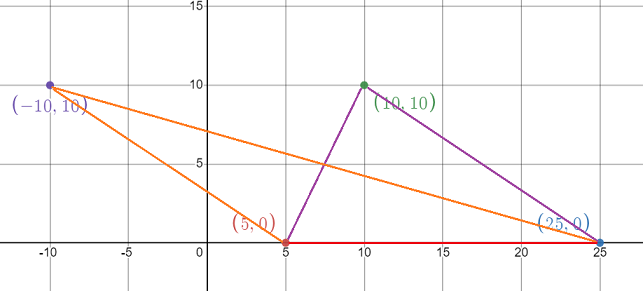
I made a drawing of the whole thing, these are the 2 triangles that could result from the points stated in A), so (10|10) or (10|-10). I've attached my drawing to this post.

Unless I made a mistake, this should be drawn to scale. Each division of the grid on the paper corresponds to 5 units. It is very obvious the area of the orange trinangle (the one resulting from point (-10|10)) is a lot larger than that of the blue triangle (resulting from point (10|10)).
Also, if assuming the line connecting (5|0) and (25|0) is the base, it is clearly obvious that the heights of these two triangles are different, after all as far as i know the height should be a line from the point opposite to the base in an angle that is orthogonal to the base. Since the base is not a straight vertical line but rather askew, the point (-10|10) cant be simply mirrored to generate a triangle with an equal area.

Does that make sense? Did I make a mistake or is there a flaw in the question?
Attachments

GMAT.jpg
GMAT.jpg [ 44.77 KiB | Viewed 970 times ]

1 KUDOS received
Senior Manager
Senior Manager
User avatar
Joined: 19 Apr 2011
Posts: 283
Schools: Booth,NUS,St.Gallon
Followers: 3

Kudos [?]: 27 [1] , given: 45

GMAT Tests User CAT Tests
Re: GMAT Diagnostic Test Question 35 [#permalink] New post 06 Feb 2012, 23:37
1
This post received
KUDOS
I just want to add some new info .The area of two traingles with the same base and between 2 parallel lines will always be the same.
_________________

+1 if you like my explanation .Thanks :)

Intern
Intern
Joined: 10 Sep 2012
Posts: 5
Followers: 0

Kudos [?]: 0 [0], given: 2

Re: GMAT Diagnostic Test Question 35 [#permalink] New post 20 Dec 2012, 17:12
ummm, the question is rather tricky.

Before wasting time trying to solve either statements, remember that:
if two statements provide identical information then the correct answer will be either D or E.
It's plain to see that both statements are identical; hence, a question with identical statements can not be A, B, or C.
(1) |x| = y = 10
(2) x = |y| = 10

Answer = D, since each statement is sufficient.
Re: GMAT Diagnostic Test Question 35   [#permalink] 20 Dec 2012, 17:12
    Similar topics Author Replies Last post
Similar
Topics:
Popular new posts 17 EXPERTS_POSTS_IN_THIS_TOPIC GMAT Diagnostic Test Question 1 bb 27 05 Jun 2009, 22:30
Popular new posts 3 EXPERTS_POSTS_IN_THIS_TOPIC GMAT Diagnostic Test Question 2 bb 25 06 Jun 2009, 19:03
Popular new posts 10 EXPERTS_POSTS_IN_THIS_TOPIC GMAT Diagnostic Test Question 3 bb 29 06 Jun 2009, 19:33
Popular new posts 10 EXPERTS_POSTS_IN_THIS_TOPIC GMAT Diagnostic Test Question 5 bb 27 06 Jun 2009, 21:07
Popular new posts 6 EXPERTS_POSTS_IN_THIS_TOPIC GMAT Diagnostic Test Question 6 bb 30 06 Jun 2009, 21:39
Display posts from previous: Sort by

GMAT Diagnostic Test Question 35

  Question banks Downloads My Bookmarks Reviews  

Moderator: Bunuel


GMAT Club MBA Forum Home| About| Privacy Policy| Terms and Conditions| GMAT Club Rules| Contact| Sitemap

Powered by phpBB © phpBB Group and phpBB SEO

Kindly note that the GMAT® test is a registered trademark of the Graduate Management Admission Council®, and this site has neither been reviewed nor endorsed by GMAC®.