|
Author |
Message |
|
TAGS:
|
|
|
Manager
Joined: 29 Jul 2009
Posts: 180
Followers: 2
Kudos [?]:
38
[0], given: 2
|
Question Stats:
100% (05:30) correct
0% (00:00) wrong based on 0 sessions
Hi for the 2nd question, I know that there should be no addition because the first 16 doesn't have a radical..so how was it solved?
Attachments

Untitled1.jpg [ 51.46 KiB | Viewed 825 times ]

Untitled.jpg [ 22.99 KiB | Viewed 827 times ]
|
|
|
|
|
|
|
Manager
Joined: 29 Jul 2009
Posts: 180
Followers: 2
Kudos [?]:
38
[0], given: 2
|
for Q10, 10 M = 16 H 8 M = ? 8*16= 96/10 = 9.6
Attachments

Untitled3.jpg [ 31.78 KiB | Viewed 817 times ]

Untitled2.jpg [ 35.92 KiB | Viewed 818 times ]
|
|
|
|
|
|
Manager
Joined: 29 Jul 2009
Posts: 180
Followers: 2
Kudos [?]:
38
[0], given: 2
|
and here's the last question... thanks for your help guys
Attachments

Untitled4.jpg [ 50.75 KiB | Viewed 823 times ]
|
|
|
|
|
|
Manager
Joined: 08 Jul 2009
Posts: 178
Followers: 3
Kudos [?]:
12
[1] , given: 13
|
1
This post received KUDOS
MontrealLady wrote: Hi
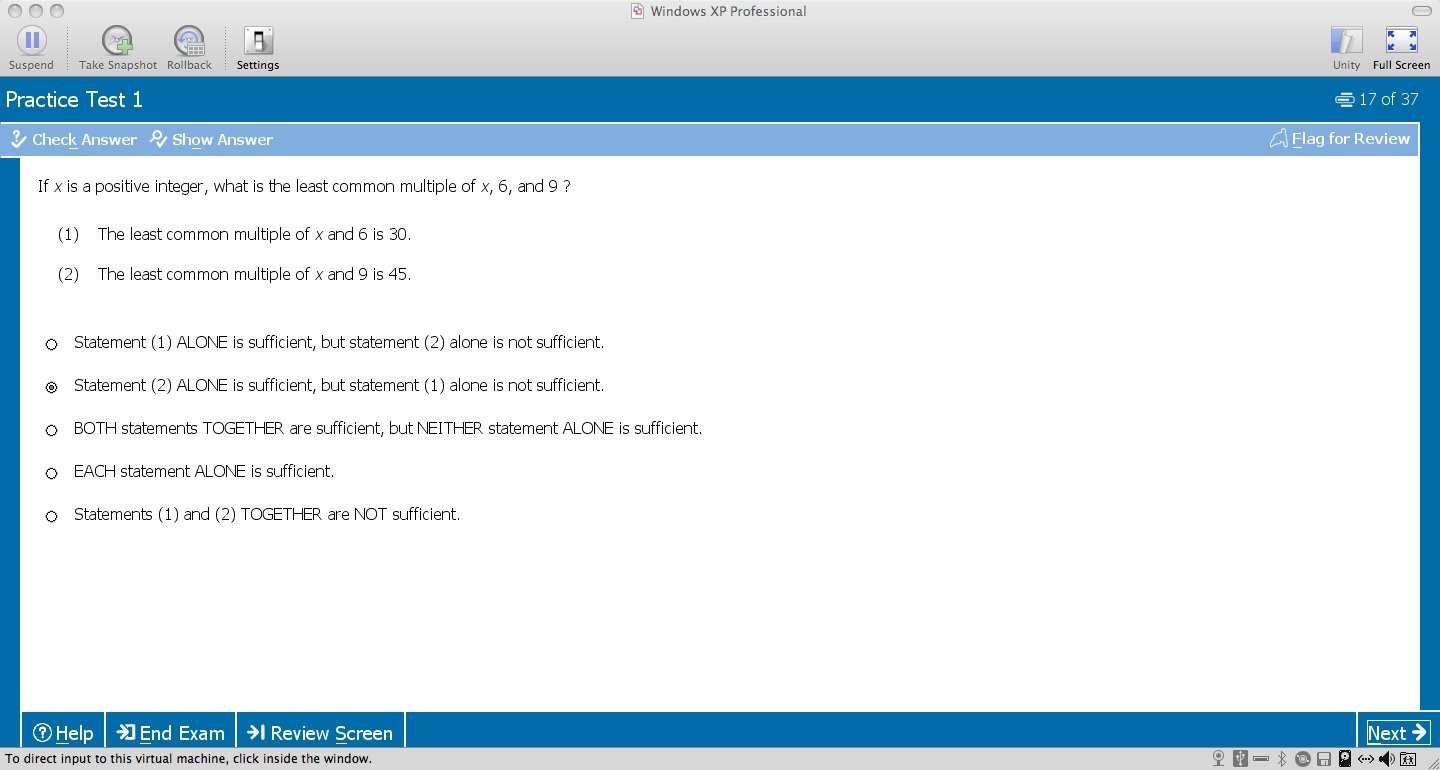
for the 2nd question, I know that there should be no addition because the first 16 doesn't have a radical..so how was it solved? Answer to the first should be D St 1 If LCM of x and 6 is 30, then x is either 5 or 30. Either way the LCM of x,6,9 would be 90 If LCM of x and 9 is 45, the x is either 5 or 45. Either way the LCM of x,6,9 would be 90
|
|
|
|
|
|
Manager
Joined: 08 Jul 2009
Posts: 178
Followers: 3
Kudos [?]:
12
[0], given: 13
|
MontrealLady wrote: Hi
for the 2nd question, I know that there should be no addition because the first 16 doesn't have a radical..so how was it solved? The only sides that would work for the triangle are 8sqrt2 + 8Sqrt2 and 16 = 16sqrt2 + 16 This question can be solved by logically thinking about the isoscles right triangle. Its sides are x,x,xsqrt2.
|
|
|
|
|
|
Manager
Joined: 10 Aug 2009
Posts: 139
Followers: 3
Kudos [?]:
46
[1] , given: 10
|
1
This post received KUDOS
For the first question about LCM, each statement alone is sufficient. 6=3X2 9=3^2 To calculate LCM we take the highest count (power of a certain prime) of each prime factor found across all integers. LCM(6,9) = 3^2\times 2
Statement 1: LCM (6,x)=30=3\times 2\times 5 x must have only one "5" in its prime factorization. x must have either no "3" or only one "3" x must have either no "2" or only one "2" It can be 5, 10,15 or 30. We do not need to know the exact value of x but the maximum powers of it's primes. It is sufficient. Across three numbers (6,9,x), the highest power of prime "3" is 2, the highest power of prime "2" is 1 and the highest power of prime "5" is 1. Therefore, LCM (x,6,9)=3^2\time 2^1\times 5^1=90
Statement 2 LCM(x,9)=45=5\times 3\times 3 x has only one "5" x has no or one or two "3". x can be 5,15 or 45. Again, it is sufficent. Across three numbers (6,9,x), the highest power of prime "3" is 2, the highest power of prime "2" is 1 and the highest power of prime "5" is 1. LCM (x,6,9)=3^2\time 2^1\times 5^1=90 Answer D.
|
|
|
|
|
|
Manager
Joined: 10 Aug 2009
Posts: 139
Followers: 3
Kudos [?]:
46
[0], given: 10
|
For your second questions,
I define hypotenuse as B and other side as A.
1) 2A+B=16+16\times \sqrt{2} 2) 2A^2=B^2
A=\frac{B}{\sqrt{2}} \frac{2B}{\sqrt{2}}+B=16+16\times \sqrt{2} B\times (1+\sqrt{2})=16\times (1+\sqrt{2}) B=16
|
|
|
|
|
|
Manager
Joined: 28 Jul 2009
Posts: 129
Location: India
Schools: NUS, NTU, SMU, AGSM, Melbourne School of Business
Followers: 6
Kudos [?]:
40
[1] , given: 12
|
1
This post received KUDOS
Q1 & Q2 Already posted by sher676 and LenaA. For Q3) A certain company employs 6 senior.... Ans : 80 Soln : 6C3 * 4C1 = 20 * 4 = 80. I see that you have added 20 and 4. However, the question mentions " and" . Hence, we need to multiply. For Q4) 10 machines... Ans : 20 Soln : I am getting 20 as well. 10 machines = 1/16th of job in each hour. Each machine working alone will do 1/160th of the job in one hour. Therefore, for 8 machines, we would multiply 8, to the equation. 1/160 * 8 = 1 / 20 ie 20 hours. If I am wrong here somewhere, please point it out. It will help. What is the OA? For Q5) What is the average of eleven consecutive... Ans : D. Lets take the first integer as n. Then, the question asks for [n+(n+1)+(n+2)...(n+10)]/11. Therefore, if the stmt helps in finding the value of n, the stmt is sufficient.Stmt 1 : Average of first 9 integers is 7. That is (9n+36)/9 = 7. Therefore, n = 3. Suff. Stmt 2 : Average of last 9 integers is 9. That is (9n+54)/9 = 9. Therefore, n = 3. Suff. Hope this helps.
_________________
GMAT offended me. Now, its my turn! Will do anything for Kudos! Please feel free to give one.
|
|
|
|
|
|
Manager
Joined: 13 Jan 2009
Posts: 180
Schools: Harvard Business School, Stanford
Followers: 3
Kudos [?]:
14
[0], given: 9
|
bhanushalinikhil wrote: For Q4) 10 machines... Ans : 20 Soln : I am getting 20 as well. 10 machines = 1/16th of job in each hour. Each machine working alone will do 1/160th of the job in one hour. Therefore, for 8 machines, we would multiply 8, to the equation. 1/160 * 8 = 1 / 20 ie 20 hours. If I am wrong here somewhere, please point it out. It will help. What is the OA?
Another good approach without using equations. 10 machines can complete the job in 16 hours then, 1 machine can complete the job in 160 hours hence, 8 machines can complete the job 160/8=20hours.
|
|
|
|
|
|
Manager
Joined: 30 Jun 2009
Posts: 52
Followers: 1
Kudos [?]:
3
[0], given: 2
|
LenaA wrote: For the first question about LCM, each statement alone is sufficient. 6=3X2 9=3^2 To calculate LCM we take the highest count (power of a certain prime) of each prime factor found across all integers. LCM(6,9) = 3^2\times 2
Statement 1: LCM (6,x)=30=3\times 2\times 5 x must have only one "5" in its prime factorization. x must have either no "3" or only one "3" x must have either no "2" or only one "2" It can be 5, 10,15 or 30. We do not need to know the exact value of x but the maximum powers of it's primes. It is sufficient. Across three numbers (6,9,x), the highest power of prime "3" is 2, the highest power of prime "2" is 1 and the highest power of prime "5" is 1. Therefore, LCM (x,6,9)=3^2\time 2^1\times 5^1=90
Statement 2 LCM(x,9)=45=5\times 3\times 3 x has only one "5" x has no or one or two "3". x can be 5,15 or 45. Again, it is sufficent. Across three numbers (6,9,x), the highest power of prime "3" is 2, the highest power of prime "2" is 1 and the highest power of prime "5" is 1. LCM (x,6,9)=3^2\time 2^1\times 5^1=90 Answer D. HI LenaA, I did not get your approach. How do you deduct the primes and the powers of prime? It may sound a stupid question... Thx
|
|
|
|
|
|
Manager
Joined: 10 Aug 2009
Posts: 139
Followers: 3
Kudos [?]:
46
[0], given: 10
|
defoue wrote: LenaA wrote: For the first question about LCM, each statement alone is sufficient. 6=3X2 9=3^2 To calculate LCM we take the highest count (power of a certain prime) of each prime factor found across all integers. LCM(6,9) = 3^2\times 2
Statement 1: LCM (6,x)=30=3\times 2\times 5 x must have only one "5" in its prime factorization. x must have either no "3" or only one "3" x must have either no "2" or only one "2" It can be 5, 10,15 or 30. We do not need to know the exact value of x but the maximum powers of it's primes. It is sufficient. Across three numbers (6,9,x), the highest power of prime "3" is 2, the highest power of prime "2" is 1 and the highest power of prime "5" is 1. Therefore, LCM (x,6,9)=3^2\time 2^1\times 5^1=90
Statement 2 LCM(x,9)=45=5\times 3\times 3 x has only one "5" x has no or one or two "3". x can be 5,15 or 45. Again, it is sufficent. Across three numbers (6,9,x), the highest power of prime "3" is 2, the highest power of prime "2" is 1 and the highest power of prime "5" is 1. LCM (x,6,9)=3^2\time 2^1\times 5^1=90 Answer D. HI LenaA, I did not get your approach. How do you deduct the primes and the powers of prime? It may sound a stupid question... Thx Ok, I will try to explain by example. If you have 3 numbers, ex. 6,9, and 15. What would be their LCM? First, I write them as a product of primes: 6=3X2 9=3X3 15=5X3 Now look at each prime and count its occurance in each number: Prime 3 - it happens two times in 9 and only one time in 6 and 15. Therefore, its highest count/power across the numbers is 2. 3^2 will be included in LCM. Prime 2 - it happens once in number 6 and it does not exist in 9 and 15. Hence its highest count/power is 1. 2^1 will be included in LCM. Prime 5 - it happens once in 15 and it does not exist in 9 or 6. So its highest count/power is 1. 5^1 will be included in LCM Based on the analysis above, LCM(6,9,15)= 3^2\times 2\times 5. Again, when finding LCM take only the highest powers of primes (when you find GCF you take the lowest powers, in this example in would be 3 ^1\times 2^0\times 5^0)...When you think of the meaning of LCM and GCF, this is very logical. With application to the specific question, it was enough to prove that x does not have the power of prime 3 greater than 2, x does not have the power of prime 2 greater than 1 and x has only one 5...You can get this info from each statement separately. Hence the answer D. Hope it helps.
|
|
|
|
|
|
Manager
Joined: 29 Jul 2009
Posts: 180
Followers: 2
Kudos [?]:
38
[0], given: 2
|
LenaA wrote: For the first question about LCM, each statement alone is sufficient. 6=3X2 9=3^2 To calculate LCM we take the highest count (power of a certain prime) of each prime factor found across all integers. LCM(6,9) = 3^2\times 2
Statement 1: LCM (6,x)=30=3\times 2\times 5 x must have only one "5" in its prime factorization. x must have either no "3" or only one "3" x must have either no "2" or only one "2" It can be 5, 10,15 or 30. We do not need to know the exact value of x but the maximum powers of it's primes. It is sufficient. Across three numbers (6,9,x), the highest power of prime "3" is 2, the highest power of prime "2" is 1 and the highest power of prime "5" is 1. Therefore, LCM (x,6,9)=3^2\time 2^1\times 5^1=90
Statement 2 LCM(x,9)=45=5\times 3\times 3 x has only one "5" x has no or one or two "3". x can be 5,15 or 45. Again, it is sufficent. Across three numbers (6,9,x), the highest power of prime "3" is 2, the highest power of prime "2" is 1 and the highest power of prime "5" is 1. LCM (x,6,9)=3^2\time 2^1\times 5^1=90 Answer D. thank you....
Last edited by MontrealLady on 29 Aug 2009, 07:47, edited 1 time in total.
|
|
|
|
|
|
Manager
Joined: 29 Jul 2009
Posts: 180
Followers: 2
Kudos [?]:
38
[0], given: 2
|
bhanushalinikhil wrote: Q1 & Q2 Already posted by sher676 nd LenaA.
For Q3) A certain company employs 6 senior.... Ans : 80 Soln : 6C3 * 4C1 = 20 * 4 = 80.
can you please provide more explanation? why did you multiply 6*3 and then the total you multiplied by 20*4? I see that you have added 20 and 4. However, the question mentions "and" . Hence, we need to multiply.
For Q4) 10 machines... Ans : 20 Soln : I am getting 20 as well. 10 machines = 1/16th of job in each hour. Each machine working alone will do 1/160th of the job in one hour. Therefore, for 8 machines, we would multiply 8, to the equation. 1/160 * 8 = 1 / 20 ie 20 hours. If I am wrong here somewhere, please point it out. It will help. What is the OA?
the correct answer is 20 thank you
For Q5) What is the average of eleven consecutive... Ans : D. Lets take the first integer as n. Then, the question asks for [n+(n+1)+(n+2)...(n+10)]/11. Therefore, if the stmt helps in finding the value of n, the stmt is sufficient. Stmt 1 : Average of first 9 integers is 7. That is (9n+36)/9 = 7. Therefore, n = 3. Suff. Stmt 2 : Average of last 9 integers is 9. That is (9n+54)/9 = 9. Therefore, n = 3. Suff.
Hope this helps. OMG...that's easy!!!
|
|
|
|
|
|
Manager
Joined: 10 Aug 2009
Posts: 139
Followers: 3
Kudos [?]:
46
[0], given: 10
|
MontrealLady wrote: LenaA wrote: For your second questions,
I define hypotenuse as B and other side as A.
1) 2A+B=16+16\times \sqrt{2} 2) 2A^2=B^2
A=\frac{B}{\sqrt{2}} \frac{2B}{\sqrt{2}}+B=16+16\times \sqrt{2} B\times (1+\sqrt{2})=16\times (1+\sqrt{2})
you took B as a common factor, so you should be left by 2/sqrt{2}+1
B=16 Hi, what I did is correct for the reason that \frac{2}{\sqrt{2}}=\sqrt{2}
|
|
|
|
|
|
Manager
Joined: 10 Aug 2009
Posts: 139
Followers: 3
Kudos [?]:
46
[0], given: 10
|
As for your probability question,
6C3\neq6 \times 3 6C3=\frac{6!}{(6-3)!\times 3!}=\frac{6!}{3!\times 3!}=20
The committee consists of 1 junior memeber and you have 4 junior memembers => so you have 4 options to choose a junior member or 4C1 options
The committee consists of 3 senior members and you have 6 senior member => you have to choose DIFFERENT sets of three people (ex. ABC and CBA will be considered the same set for this problem) since order does not important in this committee. So you have 6C3 options In total you have 4C1\times 6C3 options or 80 options in total.
Note if the senior officers would be arranged with some hierarchy (order does matter) then your options would be6\times 5\times 4 for choosing seniors and 4 options for choosing junior and in total 6\times 5\times4\times 4
|
|
|
|
|
|
Manager
Joined: 29 Jul 2009
Posts: 180
Followers: 2
Kudos [?]:
38
[0], given: 2
|
LenaA wrote: MontrealLady wrote: LenaA wrote: For your second questions,
I define hypotenuse as B and other side as A.
1) 2A+B=16+16\times \sqrt{2} 2) 2A^2=B^2
A=\frac{B}{\sqrt{2}} \frac{2B}{\sqrt{2}}+B=16+16\times \sqrt{2} B\times (1+\sqrt{2})=16\times (1+\sqrt{2})
you took B as a common factor, so you should be left by 2/sqrt{2}+1
B=16 Hi, what I did is correct for the reason that \frac{2}{\sqrt{2}}=\sqrt{2}Lena, this is something new for me...can you please explain more? what if it's 20/sqrt{5}....does it equal to 4? I know that for example 2sqrt{2}*5sqrt{3} = 10sqrt{6} 3sqrt{2}+8sqrt{5}= impossible because the square roots are not the same sqrt{10}/sqrt{5} = sqrt{2} is what I said correct? thanks,
|
|
|
|
|
|
Manager
Joined: 29 Jul 2009
Posts: 180
Followers: 2
Kudos [?]:
38
[0], given: 2
|
LenaA wrote: As for your probability question,
6C3\neq6 \times 3 6C3=\frac{6!}{(6-3)!\times 3!}=\frac{6!}{3!\times 3!}=20
The committee consists of 1 junior memeber and you have 4 junior memembers => so you have 4 options to choose a junior member or 4C1 options
The committee consists of 3 senior members and you have 6 senior member => you have to choose DIFFERENT sets of three people (ex. ABC and CBA will be considered the same set for this problem) since order does not important in this committee. So you have 6C3 options In total you have 4C1\times 6C3 options or 80 options in total.
Note if the senior officers would be arranged with some hierarchy (order does matter) then your options would be6\times 5\times 4 for choosing seniors and 4 options for choosing junior and in total 6\times 5\times4\times 4 is that similar to the following for example, we have 4 meals and three meals together make a course meal. how many different course meals can we have? 4!/(4-3)!3! = 24/1!*3! = 4 different course meals or do I simply do 4*3 = 12 course meals which way is correct? thanks for your help!!
|
|
|
|
|
|
Manager
Joined: 10 Aug 2009
Posts: 139
Followers: 3
Kudos [?]:
46
[0], given: 10
|
Think of 2 as \sqrt{2}\times \sqrt{2} then you have \frac{\sqrt{2}\times \sqrt{2}}{\sqrt{2}}
or another way of thinking 2^1\div 2^{\frac{1}{2}}=2^{1-\frac{1}{2}}
or just multiply numerator and denominator by \sqrt{2}:
\frac{2}{\sqrt{2}}\times \frac{\sqrt{2}}{sqrt{2}}
|
|
|
|
|
|
Manager
Joined: 10 Aug 2009
Posts: 139
Followers: 3
Kudos [?]:
46
[0], given: 10
|
I did not get your example with meals. But I will give you mine...also food related...
You are going to have a dessert and you have a selction of 4 chocolate cakes and 3 cheese cakes. You are going to eat 2 types of cake...how many desserts options can you have? 1) you are going to have one chocolate and one cheese cake then you have 4\times 3=12 dessert options 2) there is no limitation you can have 2 chocolate or 2 cheese or one chocolate and one cheese... then you have 7 types of cake and you can have 7C2=\frac{7!}{5!2!}dessert options...
Last edited by LenaA on 03 Sep 2009, 04:36, edited 1 time in total.
|
|
|
|
|
|
CEO
Joined: 29 Aug 2007
Posts: 2530
Followers: 41
Kudos [?]:
358
[0], given: 19
|
For LCM Question: 1: If x and 6 has LCM of 30, then take only LCM between 30 and 9. Thats 90. Suff.. No need to ahve the value of x, however x could be 5, 15 or 30. 2: If x and 9 has LCM of 45, then take LCM only between 30 and 6. Thats 90. Suff.. No need to have the value of x, however x could be 5, 15 or 45.
Attachments

Q-LCM.jpg [ 15.66 KiB | Viewed 303 times ]
_________________
Verbal: new-to-the-verbal-forum-please-read-this-first-77546.html Math: new-to-the-math-forum-please-read-this-first-77764.html Gmat: everything-you-need-to-prepare-for-the-gmat-revised-77983.html
GT
|
|
|
|
|
|
|
|
|
|
|
|
|
|
|
|
|
|