Events & Promotions
|
|

GMAT Club Daily Prep
Thank you for using the timer - this advanced tool can estimate your performance and suggest more practice questions. We have subscribed you to Daily Prep Questions via email.
Customized
for You
Track
Your Progress
Practice
Pays
Not interested in getting valuable practice questions and articles delivered to your email? No problem, unsubscribe here.
 Jun 11
01:30 AM EDT
-02:30 AM EDT
At one point, she believed GMAT wasn’t for her. After scoring 595, self-doubt crept in and she questioned her potential. But instead of quitting, she made the right strategic changes. The result? A remarkable comeback to 695. Check out how Saakshi did it. Jun 11
11:00 AM EDT
-01:00 PM EDT
TTP GMAT OnDemand gives serious students 400+ hours of expert video instruction, the full TTP course, AI support, weekly office hours, and a 715+ score guarantee—all built for elite GMAT score improvement. Jun 10
12:30 AM EDT
-01:30 AM EDT
Thought your job leaves no time for GMAT prep? After multiple GMAT attempts and a demanding consulting job, Kshitij improved to 695 in under 2 months. Learn the mindset shifts, study strategy, and execution changes that made the breakthrough possible. Jun 10
06:00 AM PDT
-06:15 PM PDT
Register for the GMAT Club Virtual MBA Spotlight Fair – the world’s premier event for serious MBA candidates. This is your chance to hear directly from Admissions Directors at nearly every Top 30 MBA program..- Jun 10
10:00 AM PDT
-11:00 AM PDT
Scoring 715 on the GMAT Focus Edition requires more than just learning formulas, memorizing concepts, or solving hundreds of questions. In this episode, Nishant shares how he improved his GMAT preparation by focusing on application of concepts, and more.  Jun 16
03:00 PM PDT
-04:00 PM PDT
Free- full-length test + 15 concept videos + 150+ short videos + study plan! Jun 22
07:30 PM EDT
-09:30 PM EDT
Master the GMAT with expert live instruction, a personalized study plan, and real-time support. Includes 40 hours of online classes plus 6 months of access to the TTP GMAT OnDemand video course. Class date: Mon/Wed June 22, 2026 →August 26, 2026


C
Be sure to select an answer first to save it in the Error Log before revealing the correct answer (OA)!
Difficulty:
 75%
(hard)
75%
(hard)
Question Stats:
50% (02:00) correct 50%
(02:13)
wrong
based on 298
sessions
50%
(02:13)
wrong
based on 298
sessions
History
Date
Time
Result
Not Attempted Yet
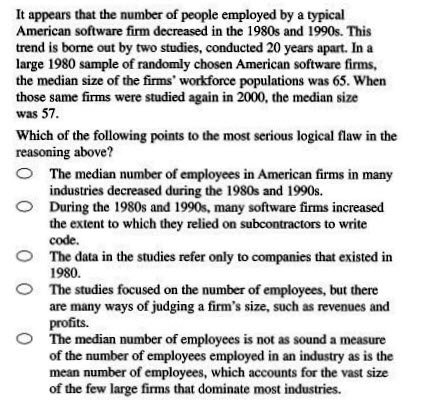
It appears that the number of people employed by a typical American software firm decreased in the 1980s and 1990s. This trend is borne out by two studies, conducted 20 years apart. In a large 1980 sample of randomly chosen American software firms, the median size of the firms* workforce populations was 65. When those same firms were studied again in 2000. the median size was 57.
Which of the following points to the most serious logical flaw in the reasoning above?
A. The median number of employees in American firms in many industries decreased during the 1980s and 1990s.
B. During the 1980s and 1990s. many software firms increased the extent to which they relied on subcontractors to write code.
C. The data in the studies refer only to companies that existed in 1980.
D. Tile studies focused on the number of employees, but there are many ways of judging a firm’s size. such as revenues and profits.
E. The median number of employees is not as sound a measure of the number of employees employed in an industry as is the mean number of employees, which accounts for the vast size of the few large firms that dominate most industries.
Untitled.jpg [ 80.51 KiB | Viewed 9299 times ]
Hey everyone.
Please let me know how you separate between C and E.
i understand why C is right, but still dont understand why E is wrong.
Lets say i had in 1980 three companies - that all had 50 workers.
and in 2000 - we have one company with 2 workers, one company with 5 workers and one company with 1,000,000 workers. the median will be lower but the total number of workers will be higher in 2000 than in 1980.
Am i missing something?
thanks.
Which of the following points to the most serious logical flaw in the reasoning above?
A. The median number of employees in American firms in many industries decreased during the 1980s and 1990s.
B. During the 1980s and 1990s. many software firms increased the extent to which they relied on subcontractors to write code.
C. The data in the studies refer only to companies that existed in 1980.
D. Tile studies focused on the number of employees, but there are many ways of judging a firm’s size. such as revenues and profits.
E. The median number of employees is not as sound a measure of the number of employees employed in an industry as is the mean number of employees, which accounts for the vast size of the few large firms that dominate most industries.
Attachment:
Untitled.jpg [ 80.51 KiB | Viewed 9299 times ]
Hey everyone.
Please let me know how you separate between C and E.
i understand why C is right, but still dont understand why E is wrong.
Lets say i had in 1980 three companies - that all had 50 workers.
and in 2000 - we have one company with 2 workers, one company with 5 workers and one company with 1,000,000 workers. the median will be lower but the total number of workers will be higher in 2000 than in 1980.
Am i missing something?
thanks.


 02 Jul 2011, 05:13
Kudos
Bookmarks
The argument says the 'typical' software firm employs fewer people now than in 1980. That conclusion is based on a study which compares the number of employees in 1980 and now at the *same* firms. The study thus ignores any firms that came into existence after 1980. Those newer firms might be today's 'typical' software firms, so you can't just ignore them, which is why C is correct.
E is not correct; if you want to work out what is 'typical', you normally want to look at the median and not the average. The average takes into account wildly extreme values (that is, values which are *not* 'typical'), and the median does not. For example, if some entrepreneur making $10 billion per year were to buy a house in an otherwise low-income neighbourhood, the average annual income in that neighbourhood would be enormous, because that $10 billion would make a significant contribution to the sum of the incomes in the neighbourhood. The average would not represent the 'typical' income level for that neighbourhood. The median would, however, represent in some way the typical income, since (being a bit imprecise) half of people will earn more than the median, and half will earn less. The presence of one extreme income in the neighbourhood barely affects the median at all. So for the argument in question, you genuinely do want to look at the median and not the average precisely because you do not want some extreme values to distort your statistics.
E is not correct; if you want to work out what is 'typical', you normally want to look at the median and not the average. The average takes into account wildly extreme values (that is, values which are *not* 'typical'), and the median does not. For example, if some entrepreneur making $10 billion per year were to buy a house in an otherwise low-income neighbourhood, the average annual income in that neighbourhood would be enormous, because that $10 billion would make a significant contribution to the sum of the incomes in the neighbourhood. The average would not represent the 'typical' income level for that neighbourhood. The median would, however, represent in some way the typical income, since (being a bit imprecise) half of people will earn more than the median, and half will earn less. The presence of one extreme income in the neighbourhood barely affects the median at all. So for the argument in question, you genuinely do want to look at the median and not the average precisely because you do not want some extreme values to distort your statistics.
General Discussion