Events & Promotions
|
|

GMAT Club Daily Prep
Thank you for using the timer - this advanced tool can estimate your performance and suggest more practice questions. We have subscribed you to Daily Prep Questions via email.
Customized
for You
Track
Your Progress
Practice
Pays
Not interested in getting valuable practice questions and articles delivered to your email? No problem, unsubscribe here.
 Jun 10
12:30 AM EDT
-01:30 AM EDT
Thought your job leaves no time for GMAT prep? After multiple GMAT attempts and a demanding consulting job, Kshitij improved to 695 in under 2 months. Learn the mindset shifts, study strategy, and execution changes that made the breakthrough possible. Jun 10
06:00 AM PDT
-06:15 PM PDT
Register for the GMAT Club Virtual MBA Spotlight Fair – the world’s premier event for serious MBA candidates. This is your chance to hear directly from Admissions Directors at nearly every Top 30 MBA program..- Jun 10
10:00 AM PDT
-11:00 AM PDT
Scoring 715 on the GMAT Focus Edition requires more than just learning formulas, memorizing concepts, or solving hundreds of questions. In this episode, Nishant shares how he improved his GMAT preparation by focusing on application of concepts, and more.  Jun 11
01:30 AM EDT
-02:30 AM EDT
At one point, she believed GMAT wasn’t for her. After scoring 595, self-doubt crept in and she questioned her potential. But instead of quitting, she made the right strategic changes. The result? A remarkable comeback to 695. Check out how Saakshi did it. Jun 11
11:00 AM EDT
-01:00 PM EDT
TTP GMAT OnDemand gives serious students 400+ hours of expert video instruction, the full TTP course, AI support, weekly office hours, and a 715+ score guarantee—all built for elite GMAT score improvement. Jun 16
03:00 PM PDT
-04:00 PM PDT
Free- full-length test + 15 concept videos + 150+ short videos + study plan! Jun 22
07:30 PM EDT
-09:30 PM EDT
Master the GMAT with expert live instruction, a personalized study plan, and real-time support. Includes 40 hours of online classes plus 6 months of access to the TTP GMAT OnDemand video course. Class date: Mon/Wed June 22, 2026 →August 26, 2026


Dropdown 1: 25%
Dropdown 2: Cambrian period
Be sure to select an answer first to save it in the Error Log before revealing the correct answer (OA)!
Difficulty:
 95%
(hard)
95%
(hard)
Question Stats:
39% (03:11) correct 61%
(03:35)
wrong
based on 1807
sessions
61%
(03:35)
wrong
based on 1807
sessions
History
Date
Time
Result
Not Attempted Yet
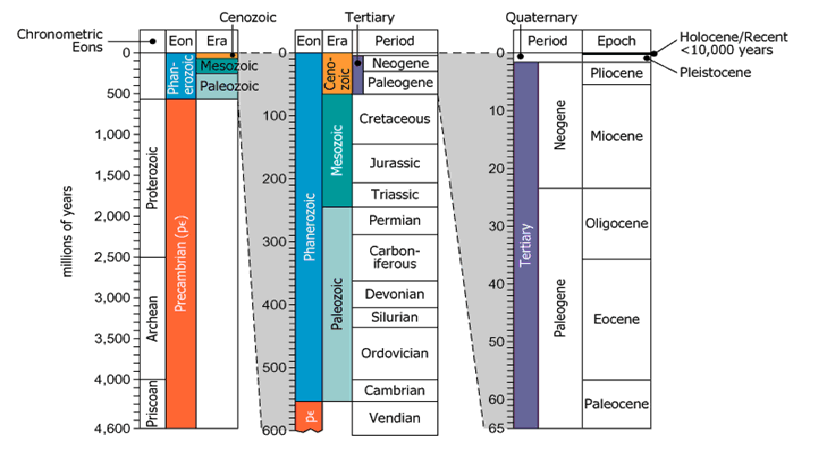
The diagram shows, in three column groupings, various divisions of Earth's geological history since its formation approximately 4,600 million years ago. In the leftmost column grouping, the Precambrian eon is subdivided into chronometric eons shown on the far left; but otherwise, in the rest of the graphic, each subsequent column to the right shows the subdivisions of the timeframes to its left. Each of the rightmost two column groupings is a magnification—with additional information—of a portion of the grouping directly to its left.
Fill each blank using the drop-down menu to create the most accurate statement on the basis of the information provided.
1. The Miocene epoch spans closest to of the era of which it is a part.
2. According to the diagram the beginning of the marks the onset of a new eon, era, and period in geological history.
-
ShowHide Answer
Official Answer
Dropdown 1: 25%
Dropdown 2: Cambrian period
Solving this question helps.
Taking a timed set of similar questions in
GMAT Club Forum Quiz →
is even better.

 18 Dec 2012, 00:55
Kudos
Bookmarks
yatesri
Hi Yatesri,
I now understand your doubt.
Let's pay attention to the question stem:
"The diagram shows, in three column groupings, various divisions of Earth's geological history since its formation approximately 4,600 million years ago."
The diagram gives information from the time since 4600 years ago. Now, if I ask you, what is the information given for the year "4600 million", would you tell me the information for the current year or the beginning year (i.e. the year which happened 4600 million years ago)?
It should be the beginning year because the language is phrased that way. You move from 4600 million years ago to present i.e. 0 years ago.
Besides, there is also a cue inside the diagram: the eon directly below "Cambrian period" is pre-cambrian eon. It means that this period occured before Cambrian period.
So, basically, you need to read the diagram downside-up if you want to read it chronologically. So, at the bottom, a time period (eon, era or period) starts and it ends at its top in the diagram.
Hope this helps

Thanks,
Chiranjeev

DhruvBadaya
Joined: 27 Feb 2024
Last visit: 08 Jun 2026
Posts: 50
Given Kudos: 39
Location: India
Schools: IIMA '25 (II)
29 Feb 2024, 12:07
Kudos
Bookmarks
The graph is meant to be read from bottom people. 0 years ago is the most recent, 10 years ago is less recent and so on. Keep that in mind.




