Find all School-related info fast with the new School-Specific MBA Forum

It is currently 20 May 2013, 20:19
Customize  |  Hide

For every positive even integer n, the function h(n) is

  Question banks Downloads My Bookmarks Reviews  
Author Message
TAGS:
Senior Manager
Senior Manager
Joined: 04 Jun 2008
Posts: 308
Followers: 5

Kudos [?]: 73 [0], given: 15

GMAT Tests User
Re: Tough GMAT question. Please help...! THANKS! [#permalink] New post 22 Jul 2009, 07:41
maliyeci and madeinafrica, very good approach.

I too had seen the approach that maliyeci took, but had not thought about madeinafrica's approach. excellent. Thanks for sharing.

+1 for both of u :-D
Manager
Manager
User avatar
Joined: 27 Jun 2008
Posts: 163
Followers: 1

Kudos [?]: 14 [0], given: 11

GMAT Tests User
Re: Tough GMAT question. Please help...! THANKS! [#permalink] New post 22 Jul 2009, 09:06
Let me dig into the concepts of relative primes, looks interesting.
Intern
Intern
Joined: 29 Aug 2009
Posts: 11
Followers: 0

Kudos [?]: 0 [0], given: 1

function h(n) [#permalink] New post 13 Sep 2009, 16:59
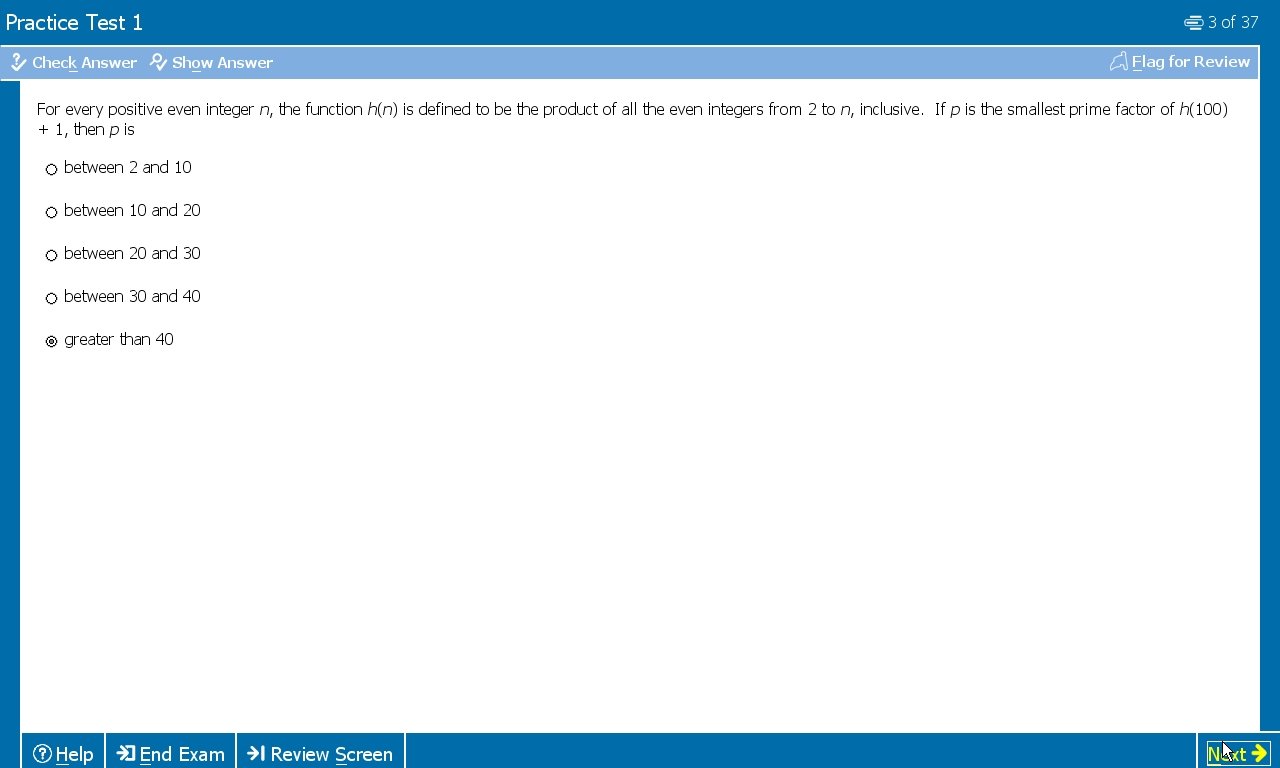
For every positive even integer n, the function h(n) is defined to be product of all the even integers from 2 to n, inclusive. If p is the smallest prime factor of h(100)+1, then p is
1) between 2 and 10
2) between 10 and 20
3) between 20 and 30
4) between 30 and 40
5) greater than 40
GMAT Club team member
Joined: 16 Mar 2009
Posts: 115
Location: Bologna, Italy
Followers: 30

Kudos [?]: 308 [0], given: 19

Re: function h(n) [#permalink] New post 13 Sep 2009, 17:23
OMG this question is like a ghost that keeps on appearing here every other week... It has been discussed many many times... just google (or search our forum for "smallest prime factor" :wink: Just one of the discussions is here... smallest-prime-factor-76565.html :wink:
_________________

My Recent Posts:
All GMAT CAT Practice Tests - links, prices, reviews
Master thread - GMAT Prep classes links to reviews and ratings
Review: GMATPrep (GMAT Prep) & PowerPrep (Power Prep) Tests

Have trouble finding answers on this site? Ask me!

Manager
Manager
Joined: 11 Jul 2009
Posts: 57
Followers: 1

Kudos [?]: 9 [0], given: 19

Re: GMAT Prep Question on Integers [#permalink] New post 14 Nov 2009, 08:18
TheGMATDoctor wrote:
This question is testing the concept of coprimes.
2 positive integers are coprime when their greatest common factor (their only common factor) is 1.
Now note that two different prime numbers are always coprime.
For example, 3 and 7 are coprime. So are 13 and 19.
But the two integers need not be prime numbers in order to be coprime.
For example, 4 and 9 are coprime (1 is their only common factor).
Also, Important!
Two consecutive integers are always coprime. The question is testing you on this concept.
Let's solve it now:
h(n) = 2*4*6*....................*n. ----n is even.
h(100) = 2*4*6*........ 94*96*98*100.
h(100) = (2^50)*(1*2*3*.......47*48*49*50). Note:I have pooled together all the 2s from all the even integers from 2 to 100; that's how I got 2^50. Now, the largest prime number involved in the above factorization is 47. All the prime from 2 to 47 are also involved in the above factorization. Actually, 47 is the greatest prime factor of h(100).
Since h(100) and h(100) + 1 are consecutive integers, they are necessarily coprime (see above). h(100) and h(100) + 1 have no common factor except 1, so they have no common prime factor either. The smallest prime factor of h(100) +1 must then be greater than 47.
Clearly, this prime factor is greater than 40.

That's all folks!
Asan Azu, The GMAT Doctor.


Excellent explaination. Thanks :)
Senior Manager
Senior Manager
User avatar
Affiliations: PMP
Joined: 13 Oct 2009
Posts: 319
Followers: 2

Kudos [?]: 76 [0], given: 37

GMAT Tests User
Re: GMAT Prep Question on Integers [#permalink] New post 14 Nov 2009, 18:22
Spot on GMAT Doctor +1 Kudos ; I had no idea whatsoever... I was prolly gonna guess E anyways..
but knowing the approach, phew.... great relief knowing what u r doing :))
_________________

Thanks, Sri
-------------------------------
keep uppp...ing the tempo...

Press +1 Kudos, if you think my post gave u a tiny tip

Intern
Intern
Joined: 25 Sep 2009
Posts: 2
Followers: 0

Kudos [?]: 0 [0], given: 1

Pl. provide the solution for the problem? [#permalink] New post 16 Nov 2009, 13:30
For every +ve even integer n, the function h(n) is defined as the product of all even integer from 2 to n, inclusive. If p is the smallest prime factor of h(100) +1 , then p is
a) between 2 and 10
b) b/w 10 & 20
c) b/w 20 & 30
d) b/w 30 & 40
e) greater than 40

Pl. provide the solution...thanx in advance
Correct answer is e
Intern
Intern
Joined: 25 Sep 2009
Posts: 2
Followers: 0

Kudos [?]: 0 [0], given: 1

Re: GMAT Prep Question on Integers [#permalink] New post 22 Nov 2009, 17:11
thnx alot ..doctor...lernt co-prime concept
Manager
Manager
Joined: 19 Nov 2007
Posts: 229
Followers: 1

Kudos [?]: 55 [0], given: 1

GMAT Tests User
Re: GMAT Prep Question on Integers [#permalink] New post 22 Nov 2009, 21:19
This is how Euclid has proved that there are infinite prime numbers in the number system.

Nice logic +1 to theGMATdoctor
Intern
Intern
Joined: 05 Aug 2009
Posts: 7
Followers: 0

Kudos [?]: 1 [0], given: 0

Hard question: Function and factors [#permalink] New post 24 Jan 2010, 02:14
Question is - For every positive even integer n, the function h(n) is defined to be the product of all the even integers from 2 to n, inclusive. If p is the smallest factor of h(100) + 1, then p is

A. between 2 and 10
B. between 20 and 10
C. between 20 and 30
D. between 30 and 40
E. greater than 40

OA is (e) , but I am not able to figure out why it is (e)

Please help
10 KUDOS received
GMAT Club team member
User avatar
Joined: 02 Sep 2009
Posts: 11522
Followers: 1795

Kudos [?]: 9548 [10] , given: 826

Re: Question on Functions [#permalink] New post 24 Jan 2010, 03:24
10
This post received
KUDOS
mohit005 wrote:
Question is - For every positive even integer n, the function h(n) is defined to be the product of all the even integers from 2 to n, inclusive. If p is the smallest factor of h(100) + 1, then p is

a) between 2 and 10
b) between 20 and 10
c) between 20 and 30
d) between 30 and 40
e) greater than 40

OA is (e) , but I am not able to figure out why it is (e)

Please help


Welcome to the club Mohit.

h(100)+1=2*4*6*...*100+1=2^{50}*(1*2*3*..*50)+1=2^{50}*50!+1

Now, two numbers h(100)=2^{50}*50! and h(100)+1=2^{50}*50!+1 are consecutive integers. Two consecutive integers are co-prime, which means that they don't share ANY common factor but 1. For example 20 and 21 are consecutive integers, thus only common factor they share is 1.

As h(100)=2^{50}*50! has all numbers from 1 to 50 as its factors, according to above h(100)+1=2^{50}*50!+1 won't have ANY factor from 1 to 50. Hence p (>1), the smallest factor of h(100)+1 will be more than 50.

Answer: E.
_________________

PLEASE READ AND FOLLOW: 11 Rules for Posting!!!

RESOURCES: [GMAT MATH BOOK]; 1. Triangles; 2. Polygons; 3. Coordinate Geometry; 4. Factorials; 5. Circles; 6. Number Theory

COLLECTION OF QUESTIONS:
PS: 1. Tough and Tricky questions; 2. Hard questions; 3. Hard questions part 2; 4. Standard deviation; 5. Tough Problem Solving Questions With Solutions; 6. Probability and Combinations Questions With Solutions; 7 Tough and tricky exponents and roots questions; 8 12 Easy Pieces (or not?); 9 Bakers' Dozen; 10 Algebra set. NEW!!!

DS: 1. DS tough questions; 2. DS tough questions part 2; 3. DS tough questions part 3; 4. DS Standard deviation; 5. Inequalities; 6. 700+ GMAT Data Sufficiency Questions With Explanations; 7 Tough and tricky exponents and roots questions; 8 The Discreet Charm of the DS ; 9 Devil's Dozen!!!; 10 Number Properties set. NEW!!!


What are GMAT Club Tests?
25 extra-hard Quant Tests

Find out what's new at GMAT Club - latest features and updates

1 KUDOS received
Intern
Intern
User avatar
Joined: 17 Nov 2009
Posts: 38
Schools: University of Toronto, Mcgill, Queens
Followers: 0

Kudos [?]: 13 [1] , given: 9

Re: GMAT Prep Question on Integers [#permalink] New post 11 Feb 2010, 03:28
1
This post received
KUDOS
brokerbevo wrote:
Wow, lot of info. I understood everything except for this part: h(100) = (2^50)*(1*2*3*.......47*48*49*50)
Could you explain this part a little more clearly? Thanks.


h(100) = 2.4.6.8........100
h(100) = (2*1)(2*2)(2*3)(2*4)........(2*50)

therefore you can factor all 2's = 2^50(1*2*3*....50)
_________________

--Action is the foundational key to all success.

Intern
Intern
Joined: 24 Feb 2010
Posts: 4
Followers: 0

Kudos [?]: 0 [0], given: 0

Math Question [#permalink] New post 24 Feb 2010, 17:54
For every positive even integer n, the function h(n) is defnied to be the product of all the even integers from 2 to n, inclusive. If p is the smallest prime factor of h(100)+1, then p is

Any help on how to get the correct answer? Thanks!


Answer: greater than 40
Intern
Intern
Joined: 24 Feb 2010
Posts: 4
Followers: 0

Kudos [?]: 0 [0], given: 0

Re: Math Question [#permalink] New post 24 Feb 2010, 18:29
Another math question. Thanks folks!

What is the value of the hypotenuse of an isosceles triangle with a perimeter equal to 16 + 16√2?


Answer: 16
Senior Manager
Senior Manager
User avatar
Joined: 01 Feb 2007
Posts: 464
Location: Silicon Valley via Russia, China, Canada and Wharton/Lauder
Schools: Wharton/Lauder (Mandarin Chinese)
Followers: 9

Kudos [?]: 50 [0], given: 8

GMAT Tests User
Re: Math Question [#permalink] New post 24 Feb 2010, 21:57
msv3763 wrote:
Another math question. Thanks folks!

What is the value of the hypotenuse of an isosceles triangle with a perimeter equal to 16 + 16√2?


Answer: 16

Since there is a hypotenuse, we are talking of a right isosceles triangle. Let a, b and c be sides of the triangle, where a=b and c is the hypotenuse.
from the prompt, a+b+c=16 + 16√2, and since a=b, it is a+a+c=16 + 16√2
from the pythagorean theorem, a^2+b^2=c^2, but since it is a isosceles and a=b, we re-write this as
a^2+a^2=c^2

Now solve the system:
a+a+c=16 + 16√2
a^2+a^2=c^2

c=16 + 16√2 - 2a
c=a√2

therefore

a√2=16 +16√2 -2a
2a+a√2=16 +16√2
a(2+√2)=16 +16√2
a=(16 +16√2)/(2+√2)

now recall from above that
c=16 + 16√2 - 2a

plug in (16 +16√2)/(2+√2) in place of a to get:
c=16 + 16√2 - 2(16 +16√2)/(2+√2)
c=16 + 16√2 -(32+32√2)/(2+√2)

simplify it further and you will get
c=(32+16√2)/(2+√2)
c=16(2+√2)/(2+√2)
c=16
_________________

Wharton/Lauder blog
http://www.onefootprint.com/lauderwharton/

Find out what's new at GMAT Club - latest features and updates

CEO
CEO
User avatar
Joined: 17 Nov 2007
Posts: 3594
Concentration: Entrepreneurship, Other
Schools: Chicago (Booth) - Class of 2011
GMAT 1: 750 Q50 V40
Followers: 230

Kudos [?]: 1299 [0], given: 346

GMAT ToolKit User GMAT Tests User
Re: Math Question [#permalink] New post 24 Feb 2010, 22:17
another way:

we have a right isosceles triangle. Let's say hypotenuse is a then perimeter is

P = a/root(2)+a/root(2) + a = 16 + root(2)16

a = 16 * (1+root(2))/(1+root(2)) = 16

Image Posted from GMAT ToolKit
_________________

iOS/Android: GMAT ToolKit - The bestselling GMAT prep app | GMAT Club (free) | PrepGame | GRE ToolKit | LSAT ToolKit
PROMO: Are you an exiting GMAT ToolKit (iOS) user? Get GMAT ToolKit 2 (iOS) for free* (read more)
Math: GMAT Math Book ||| General: GMATTimer ||| Chicago Booth: Slide Presentation
The People Who Are Crazy Enough to Think They Can Change the World, Are the Ones Who Do.

Senior Manager
Senior Manager
Joined: 01 Feb 2010
Posts: 275
Followers: 1

Kudos [?]: 30 [0], given: 2

GMAT Tests User
Re: Math Question [#permalink] New post 24 Feb 2010, 22:44
msv3763 wrote:
Another math question. Thanks folks!

What is the value of the hypotenuse of an isosceles triangle with a perimeter equal to 16 + 16√2?

Answer: 16


hypotenuse - h
side - s

2s+d = 16+16√2

also in isoceles triangle h^2 = 2s^2 so h=√2s
hence simplyfying main equation we get √2h + h = 16√2 + 16
hence h = 16.
Intern
Intern
Joined: 24 Feb 2010
Posts: 4
Followers: 0

Kudos [?]: 0 [0], given: 0

Re: Math Question [#permalink] New post 24 Feb 2010, 23:10
Thanks everybody, I really appreciate it. Any luck with the first question? (For every positive even integer n, the function h(n) is defnied to be the product of all the even integers from 2 to n, inclusive. If p is the smallest prime factor of h(100)+1, then p is...)
Intern
Intern
Joined: 18 Sep 2009
Posts: 3
Location: Belarus
Followers: 0

Kudos [?]: 0 [0], given: 1

Re: Math Question [#permalink] New post 25 Feb 2010, 03:57
msv3763 wrote:
Thanks everybody, I really appreciate it. Any luck with the first question? (For every positive even integer n, the function h(n) is defnied to be the product of all the even integers from 2 to n, inclusive. If p is the smallest prime factor of h(100)+1, then p is...)

the answer is 79, i did it on PC
1 KUDOS received
GMAT Club team member
User avatar
Joined: 02 Sep 2009
Posts: 11522
Followers: 1795

Kudos [?]: 9548 [1] , given: 826

Re: Math Question [#permalink] New post 25 Feb 2010, 08:17
1
This post received
KUDOS
msv3763 wrote:
For every positive even integer n, the function h(n) is defnied to be the product of all the even integers from 2 to n, inclusive. If p is the smallest prime factor of h(100)+1, then p is

Any help on how to get the correct answer? Thanks!


Answer: greater than 40


Welcome to the Gmat Club. Below is the solution for your question:

h(100)+1=2*4*6*...*100+1=2^{50}*(1*2*3*..*50)+1=2^{50}*50!+1

Now, two numbers h(100)=2^{50}*50! and h(100)+1=2^{50}*50!+1 are consecutive integers. Two consecutive integers are co-prime, which means that they don't share ANY common factor but 1. For example 20 and 21 are consecutive integers, thus only common factor they share is 1.

As h(100)=2^{50}*50! has all numbers from 1 to 50 as its factors, according to above h(100)+1=2^{50}*50!+1 won't have ANY factor from 1 to 50. Hence p (>1), the smallest factor of h(100)+1 will be more than 50.

Answer: More than 50.

Hope it helps.

P.S. Can you please: post one question per topic, tag the questions you post, and also post the whole questions with answer choices.
_________________

PLEASE READ AND FOLLOW: 11 Rules for Posting!!!

RESOURCES: [GMAT MATH BOOK]; 1. Triangles; 2. Polygons; 3. Coordinate Geometry; 4. Factorials; 5. Circles; 6. Number Theory

COLLECTION OF QUESTIONS:
PS: 1. Tough and Tricky questions; 2. Hard questions; 3. Hard questions part 2; 4. Standard deviation; 5. Tough Problem Solving Questions With Solutions; 6. Probability and Combinations Questions With Solutions; 7 Tough and tricky exponents and roots questions; 8 12 Easy Pieces (or not?); 9 Bakers' Dozen; 10 Algebra set. NEW!!!

DS: 1. DS tough questions; 2. DS tough questions part 2; 3. DS tough questions part 3; 4. DS Standard deviation; 5. Inequalities; 6. 700+ GMAT Data Sufficiency Questions With Explanations; 7 Tough and tricky exponents and roots questions; 8 The Discreet Charm of the DS ; 9 Devil's Dozen!!!; 10 Number Properties set. NEW!!!


What are GMAT Club Tests?
25 extra-hard Quant Tests

Find out what's new at GMAT Club - latest features and updates

Re: Math Question   [#permalink] 25 Feb 2010, 08:17
    Similar topics Author Replies Last post
Similar
Topics:
New posts For every positive even integer n, the function h(n) is jodeci 1 01 Apr 2006, 22:31
New posts For every positive even integer n, the function hn) is john2005 5 07 May 2006, 14:17
New posts For every positive even integer, n, the function h(n) is ffgmat 1 22 May 2006, 04:56
New posts For every positive even integer n, the function h(n) is kbulse 1 06 Jan 2008, 05:21
New posts For every positive even integer n , the function h(n) is Snayt 8 21 Mar 2008, 03:36
Display posts from previous: Sort by

For every positive even integer n, the function h(n) is

  Question banks Downloads My Bookmarks Reviews  

Go to page   Previous    1  ...  3   4   5   6   7   8   9   10   11   12   13   14    Next  [ 273 posts ] 


GMAT Club MBA Forum Home| About| Privacy Policy| Terms and Conditions| GMAT Club Rules| Contact| Sitemap

Powered by phpBB © phpBB Group and phpBB SEO

Kindly note that the GMAT® test is a registered trademark of the Graduate Management Admission Council®, and this site has neither been reviewed nor endorsed by GMAC®.