|
Author |
Message |
|
TAGS:
|
|
|
Manager
Joined: 28 Mar 2009
Posts: 84
Followers: 2
Kudos [?]:
6
[0], given: 0
|
Sunspots, vortices of gas associated with strong [#permalink]
05 Jun 2009, 02:34
Question Stats:
68% (01:50) correct
31% (00:44) wrong based on 8 sessions
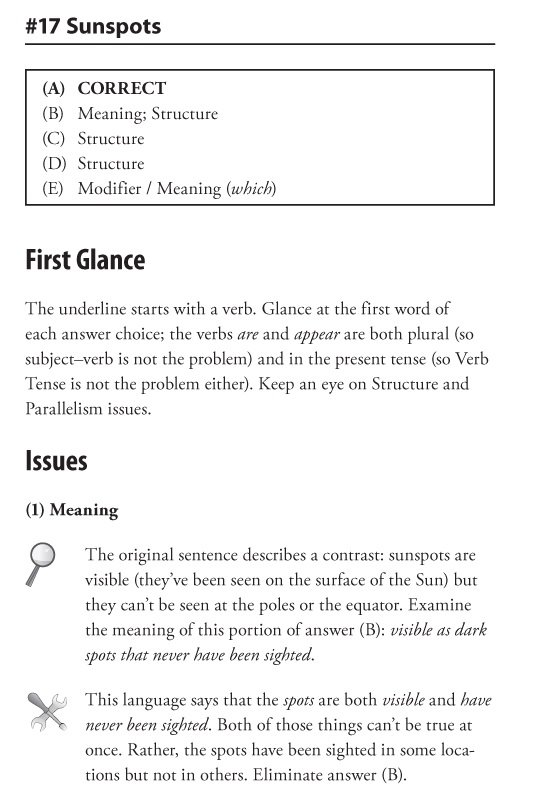
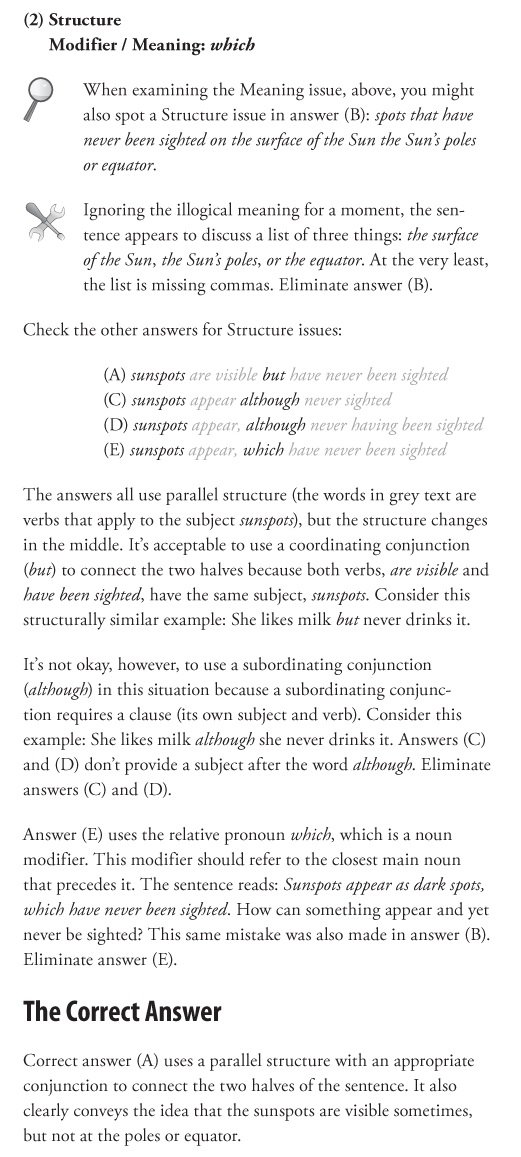
Sunspots, vortices of gas associated with strong electromagnetic activity, are visible as dark spots on the surface of the Sun but have never been sighted on the Sun’s poles or equater. (A) are visible as dark spots on the surface of the Sun but have never been sighted on (B) are visible as dark spots that never have been sighted on the surface of the Sun (C) appear on the surface of the Sun as dark spots although never sighted at (D) appear as dark spots on the surface of the Sun, although never having been sighted at (E) appear as dark spots on the Sun's surface, which have never been sighted on This is Q14 of the OG 12th ed. (Q9 of the OG 11th ed) However: 1. I don't understand the OE of option (C), in that " sighted is not a complete verb". 2. I don't understand the OE of the top paragraph which states " The adjective visible is a complement and is parallel to the past particle sighted" Would appreciate any form of explanation. Thanks
|
|
|
|
|
|
|
SVP
Joined: 21 Jul 2006
Posts: 1553
Followers: 6
Kudos [?]:
104
[0], given: 1
|
skim wrote: Sunspots, vortices of gas associated with strong electromagnetic activity, are visible as dark spots on the surface of the Sun but have never been sighted on the Sun’s poles or equater. (A) are visible as dark spots on the surface of the Sun but have never been sighted on (B) are visible as dark spots that never have been sighted on the surface of the Sun (C) appear on the surface of the Sun as dark spots although never sighted at (D) appear as dark spots on the surface of the Sun, although never having been sighted at (E) appear as dark spots on the Sun's surface, which have never been sighted on This is Q14 of the OG 12th ed. (Q9 of the OG 11th ed) However: 1. I don't understand the OE of option (C), in that " sighted is not a complete verb". 2. I don't understand the OE of the top paragraph which states " The adjective visible is a complement and is parallel to the past particle sighted" Would appreciate any form of explanation. Thanks I choose A as my answer. What you need to know is that "visible" is an adjective. You should also know that past participle is also treated as an adjective. Here's an example of a past participle, which is always used as an adjective: 1) The man carried a broken window. ---> the "broken" is a past participle describing the "window", which is a noun. As for the question regarding "sighted', it means that its a verb that doesn't need to be followed by an object. For example: 2) Tom runs ---> you don't have to say where did Tom run. The verb "runs" can stand by itself without the need to add an object. However, some of the verbs will NEED to be followed by an object to complete the thought of the sentence. For example: 3) Tom completes his homework ----> can you imagine how odd it will be if the sentence were written without "his homework"? So this shows an example of some verbs that MUST be followed by an object.
|
|
|
|
|
|
Director
Joined: 03 Jun 2009
Posts: 806
Location: New Delhi
WE 1: 5.5 yrs in IT
Followers: 46
Kudos [?]:
277
[0], given: 56
|
I'll vote for C. (A) are visible as dark spots on the surface of the Sun but have never been sighted on - "are visible" and "have never been" are not parallel.(B) are visible as dark spots that never have been sighted on the surface of the Sun - "dark spots that never have been sighted" sounds awkward and changes the meaning.(C) appear on the surface of the Sun as dark spots although never sighted at - "sunspots .. appear..." and "sunspots.. sighted.." are parallel construction(D) appear as dark spots on the surface of the Sun, although never having been sighted at - "although never having been" sounds awkward and wordy. Also not parallel to "appear as" (E) appear as dark spots on the Sun's surface, which have never been sighted on - same error as D
_________________
ISB 2011-12 thread | Ask ISB Alumni @ ThinkISB All information related to Indian candidates and B-schools | Indian B-schools accepting GMAT scores Self evaluation for Why MBA?
|
|
|
|
|
|
SVP
Joined: 21 Jul 2006
Posts: 1553
Followers: 6
Kudos [?]:
104
[1] , given: 1
|
1
This post received KUDOS
bigoyal wrote: I'll vote for C.
(A) are visible as dark spots on the surface of the Sun but have never been sighted on - "are visible" and "have never been" are not parallel. (B) are visible as dark spots that never have been sighted on the surface of the Sun - "dark spots that never have been sighted" sounds awkward and changes the meaning. (C) appear on the surface of the Sun as dark spots although never sighted at - "sunspots .. appear..." and "sunspots.. sighted.." are parallel construction (D) appear as dark spots on the surface of the Sun, although never having been sighted at - "although never having been" sounds awkward and wordy. Also not parallel to "appear as" (E) appear as dark spots on the Sun's surface, which have never been sighted on - same error as D I will have to disagree with you because I feel that "sighted at" suggests the location of the sighting. For example: A huge fight was sighted at the construction site ----> it means that those who saw the fight were also there at the construction site. So when you look at option C, it suggests that someone wasn't able to see the sunspots when he or she was at the sun's poles or equator. Unless that person is Chris Angels, I don't think that such a stunt can be possible....lol
|
|
|
|
|
|
Senior Manager
Joined: 15 Jan 2008
Posts: 295
Followers: 2
Kudos [?]:
20
[0], given: 3
|
i will go with A...
Whats the OA ?
|
|
|
|
|
|
Manager
Joined: 28 Mar 2009
Posts: 84
Followers: 2
Kudos [?]:
6
[0], given: 0
|
OA is A
|
|
|
|
|
|
Manager
Joined: 28 Mar 2009
Posts: 84
Followers: 2
Kudos [?]:
6
[0], given: 0
|
Thanks for your explanation, tarek 99. My queries below in red:- tarek99 wrote: skim wrote: Sunspots, vortices of gas associated with strong electromagnetic activity, are visible as dark spots on the surface of the Sun but have never been sighted on the Sun’s poles or equater. (A) are visible as dark spots on the surface of the Sun but have never been sighted on (B) are visible as dark spots that never have been sighted on the surface of the Sun (C) appear on the surface of the Sun as dark spots although never sighted at (D) appear as dark spots on the surface of the Sun, although never having been sighted at (E) appear as dark spots on the Sun's surface, which have never been sighted on This is Q14 of the OG 12th ed. (Q9 of the OG 11th ed) However: 1. I don't understand the OE of option (C), in that " sighted is not a complete verb". 2. I don't understand the OE of the top paragraph which states " The adjective visible is a complement and is parallel to the past particle sighted" Would appreciate any form of explanation. Thanks I choose A as my answer. What you need to know is that "visible" is an adjective. You should also know that past participle is also treated as an adjective. Here's an example of a past participle, which is always used as an adjective: 1) The man carried a broken window. ---> the "broken" is a past participle describing the "window", which is a noun. As for the question regarding "sighted', it means that its a verb that doesn't need to be followed by an object. So does this mean that "sighted" is a verb that doesn't need to be followed by an object, hence it should be a "complete verb"? For example: 2) Tom runs ---> you don't have to say where did Tom run. The verb "runs" can stand by itself without the need to add an object. However, some of the verbs will NEED to be followed by an object to complete the thought of the sentence. For example: 3) Tom completes his homework ----> can you imagine how odd it will be if the sentence were written without "his homework"? So this shows an example of some verbs that MUST be followed by an object.
|
|
|
|
|
|
SVP
Joined: 21 Jul 2006
Posts: 1553
Followers: 6
Kudos [?]:
104
[0], given: 1
|
skim wrote: Thanks for your explanation, tarek 99. My queries below in red:- tarek99 wrote: skim wrote: Sunspots, vortices of gas associated with strong electromagnetic activity, are visible as dark spots on the surface of the Sun but have never been sighted on the Sun’s poles or equater. (A) are visible as dark spots on the surface of the Sun but have never been sighted on (B) are visible as dark spots that never have been sighted on the surface of the Sun (C) appear on the surface of the Sun as dark spots although never sighted at (D) appear as dark spots on the surface of the Sun, although never having been sighted at (E) appear as dark spots on the Sun's surface, which have never been sighted on This is Q14 of the OG 12th ed. (Q9 of the OG 11th ed) However: 1. I don't understand the OE of option (C), in that " sighted is not a complete verb". 2. I don't understand the OE of the top paragraph which states " The adjective visible is a complement and is parallel to the past particle sighted" Would appreciate any form of explanation. Thanks I choose A as my answer. What you need to know is that "visible" is an adjective. You should also know that past participle is also treated as an adjective. Here's an example of a past participle, which is always used as an adjective: 1) The man carried a broken window. ---> the "broken" is a past participle describing the "window", which is a noun. As for the question regarding "sighted', it means that its a verb that doesn't need to be followed by an object. So does this mean that "sighted" is a verb that doesn't need to be followed by an object, hence it should be a "complete verb"? For example: 2) Tom runs ---> you don't have to say where did Tom run. The verb "runs" can stand by itself without the need to add an object. However, some of the verbs will NEED to be followed by an object to complete the thought of the sentence. For example: 3) Tom completes his homework ----> can you imagine how odd it will be if the sentence were written without "his homework"? So this shows an example of some verbs that MUST be followed by an object. yes, you're right with the way you've explained it. I'm just not sure of the exact definition of complete verb. I'm not sure whether "complete verb" means that the verb is essentially complete the way it is without the need to have an object, or whether "complete verb" means a verb + an object. In general, you will have to assess a verb to see whether it can stand on its own or not. That's essentially what it's all about. makes sense?
|
|
|
|
|
|
Manager
Joined: 20 Jan 2010
Posts: 63
Followers: 1
Kudos [?]:
1
[0], given: 4
|
A very tough one...confusion between a lot of options OA is A....
|
|
|
|
|
|
Senior Manager
Joined: 21 Dec 2009
Posts: 268
Location: India
Followers: 5
Kudos [?]:
41
[0], given: 25
|
bigoyal wrote: I'll vote for C.
(A) are visible as dark spots on the surface of the Sun but have never been sighted on - "are visible" and "have never been" are not parallel. (B) are visible as dark spots that never have been sighted on the surface of the Sun - "dark spots that never have been sighted" sounds awkward and changes the meaning. (C) appear on the surface of the Sun as dark spots although never sighted at - "sunspots .. appear..." and "sunspots.. sighted.." are parallel construction (D) appear as dark spots on the surface of the Sun, although never having been sighted at - "although never having been" sounds awkward and wordy. Also not parallel to "appear as" (E) appear as dark spots on the Sun's surface, which have never been sighted on - same error as D In C -- it should be have never been sighted. On the other hand I feel that there should be a comma before although.
_________________
Cheers, SD
|
|
|
|
|
|
Manager
Joined: 30 Mar 2010
Posts: 79
Followers: 0
Kudos [?]:
5
[0], given: 3
|
skim wrote: Sunspots, vortices of gas associated with strong electromagnetic activity, are visible as dark spots on the surface of the Sun but have never been sighted on the Sun’s poles or equater. (A) are visible as dark spots on the surface of the Sun but have never been sighted on (B) are visible as dark spots that never have been sighted on the surface of the Sun (C) appear on the surface of the Sun as dark spots although never sighted at (D) appear as dark spots on the surface of the Sun, although never having been sighted at (E) appear as dark spots on the Sun's surface, which have never been sighted on This is Q14 of the OG 12th ed. (Q9 of the OG 11th ed) However: 1. I don't understand the OE of option (C), in that " sighted is not a complete verb". 2. I don't understand the OE of the top paragraph which states " The adjective visible is a complement and is parallel to the past particle sighted" Would appreciate any form of explanation. Thanks Hi (A) are visible as dark spots on the surface of the Sun but have never been sighted onCorrect (B) are visible as dark spots that never have been sighted on the surface of the Sun darkspots That modifies dark spots which changes the intended meaning (C) appear on the surface of the Sun as dark spots although never sighted at although begins a subordinate clause without a subject, thus making it a fragment (D) appear as dark spots on the surface of the Sun, although never having been sighted at although begins a subordinate clause without a subject, thus making it a fragment (E) appear as dark spots on the Sun's surface, which have never been sighted onwhich modifies surface and that makes no sense 1. I don't understand the OE of option (C), in that " sighted is not a complete verb". The terms you and Tarek99 are looking for are Transitive and Intransitive verbs. Transitive Verbs require a direct object, whereas Intransitive verbs do not take a direct object (Instransitive verbs cannot be put in the passive voice). So to answer your question directly, "to sight" is a transitive verb and requires a direct object; however if it is used as a noun modifier, then it does not require a a direct object since its not acting as a verb. 2. I don't understand the OE of the top paragraph which states "The adjective visible is a complement and is parallel to the past particle sighted" Verbs in the past participle form can be used a noun modifiers. In general adjectives, Past Participles, and Present Participles (acting as a noun modifier) are all be parallel. Take Care
|
|
|
|
|
|
Manager
Joined: 30 Mar 2010
Posts: 79
Followers: 0
Kudos [?]:
5
[0], given: 3
|
SudiptoGmat wrote: bigoyal wrote: I'll vote for C.
(A) are visible as dark spots on the surface of the Sun but have never been sighted on - "are visible" and "have never been" are not parallel. (B) are visible as dark spots that never have been sighted on the surface of the Sun - "dark spots that never have been sighted" sounds awkward and changes the meaning. (C) appear on the surface of the Sun as dark spots although never sighted at - "sunspots .. appear..." and "sunspots.. sighted.." are parallel construction (D) appear as dark spots on the surface of the Sun, although never having been sighted at - "although never having been" sounds awkward and wordy. Also not parallel to "appear as" (E) appear as dark spots on the Sun's surface, which have never been sighted on - same error as D In C -- it should be have never been sighted. On the other hand I feel that there should be a comma before although. From what I know -- you have a choice whether to use a comma or not when joining a main clause to a suboirdinate clause. However when you join two main clauses using a co-ordinating conjuction, you have to use a comma. Take Care
|
|
|
|
|
|
Director
Status: Impossible is not a fact. It's an opinion. It's a dare. Impossible is nothing.
Joined: 26 Nov 2009
Posts: 995
Followers: 12
Kudos [?]:
270
[0], given: 36
|
Sunspots is the subject of the sentence; are is the verb of the first part of the contrast, and have been sighted is the verb of the second. OA : A
_________________
Please press kudos if you like my post.
|
|
|
|
|
|
Director
Status: Impossible is not a fact. It's an opinion. It's a dare. Impossible is nothing.
Joined: 26 Nov 2009
Posts: 995
Followers: 12
Kudos [?]:
270
[0], given: 36
|
Thanks. This explanation is awesome. tarek99 wrote: bigoyal wrote: I'll vote for C.
(A) are visible as dark spots on the surface of the Sun but have never been sighted on - "are visible" and "have never been" are not parallel. (B) are visible as dark spots that never have been sighted on the surface of the Sun - "dark spots that never have been sighted" sounds awkward and changes the meaning. (C) appear on the surface of the Sun as dark spots although never sighted at - "sunspots .. appear..." and "sunspots.. sighted.." are parallel construction (D) appear as dark spots on the surface of the Sun, although never having been sighted at - "although never having been" sounds awkward and wordy. Also not parallel to "appear as" (E) appear as dark spots on the Sun's surface, which have never been sighted on - same error as D I will have to disagree with you because I feel that "sighted at" suggests the location of the sighting. For example: A huge fight was sighted at the construction site ----> it means that those who saw the fight were also there at the construction site. So when you look at option C, it suggests that someone wasn't able to see the sunspots when he or she was at the sun's poles or equator. Unless that person is Chris Angels, I don't think that such a stunt can be possible....lol
_________________
Please press kudos if you like my post.
|
|
|
|
|
|
Director
Joined: 21 Dec 2009
Posts: 592
Concentration: Entrepreneurship, Finance
Followers: 13
Kudos [?]:
130
[0], given: 20
|
Please, for the sake of understanding, how does the option below fits into the original sentence? "appear as dark spots on the surface of the Sun but have never been sighted on..."
_________________
KUDOS me if you feel my contribution has helped you.
|
|
|
|
|
|
Manager
Joined: 16 Jun 2010
Posts: 188
Followers: 2
Kudos [?]:
21
[1] , given: 5
|
1
This post received KUDOS
IMO-A, Usual rule of thumb is: 'Although' fits only when it can be replaced by 'In spite of the fact' ... which can happen only for cause-effect sentences. Option-C,D: are out since the sentence is not a cause-effect sentence i.e Reason for sunspots being visible on the surface of the sun, is not because they are never sighted on the Poles or equator. Option B: modifies dark spots which changes the intended meaning Option E: modifies surface and that makes no sense Option A: Correct. Now why Option A is correct, well: Sunspots, vortices of gas associated with strong electromagnetic activity, are visible as dark spots on the surface of the Sun but have never been sighted on the Sun’s poles or equater. The above sentence can be read as: Sunspots are visible as dark spots on the surface of the Sun but have never been sighted on the Sun’s poles or equater. Correct - Subject verb agreement [Sunspots(Plural) ... are] Correct - Use of Present Perfect tense. ... This a Perfect Sentence
_________________
Please give me kudos, if you like the above post. Thanks.
|
|
|
|
|
|
Director
Joined: 21 Dec 2009
Posts: 592
Concentration: Entrepreneurship, Finance
Followers: 13
Kudos [?]:
130
[0], given: 20
|
My question has to do with whether option A would be correct if "visible" where changed to "appear as" in the context of the original meaning.
_________________
KUDOS me if you feel my contribution has helped you.
|
|
|
|
|
|
Manager
Joined: 16 Jun 2010
Posts: 188
Followers: 2
Kudos [?]:
21
[0], given: 5
|
@gmatbull: Option A would not be correct if 'visible' was 'changed to 'appear as' ... primarily because 'appear as' is unidiomatic. It should be 'appear to' to be Idiomatic. Replacing 'appear as' with 'appear to' definitely changes meaning and is wrong. So you cannot replace 'visible'
_________________
Please give me kudos, if you like the above post. Thanks.
|
|
|
|
|
|
SVP
Joined: 16 Jul 2009
Posts: 1635
Schools: CBS
WE 1: 4 years (Consulting)
Followers: 25
Kudos [?]:
119
[0], given: 2
|
That makes total sense to me. However, according to my source, OA is C. Thoughts? devashish wrote: IMO-A, Usual rule of thumb is: 'Although' fits only when it can be replaced by 'In spite of the fact' ... which can happen only for cause-effect sentences. Option-C,D: are out since the sentence is not a cause-effect sentence i.e Reason for sunspots being visible on the surface of the sun, is not because they are never sighted on the Poles or equator. Option B: modifies dark spots which changes the intended meaning Option E: modifies surface and that makes no sense Option A: Correct. Now why Option A is correct, well: Sunspots, vortices of gas associated with strong electromagnetic activity, are visible as dark spots on the surface of the Sun but have never been sighted on the Sun’s poles or equater. The above sentence can be read as: Sunspots are visible as dark spots on the surface of the Sun but have never been sighted on the Sun’s poles or equater. Correct - Subject verb agreement [Sunspots(Plural) ... are] Correct - Use of Present Perfect tense. ... This a Perfect Sentence 
_________________
The sky is the limit 800 is the limit
Find out what's new at GMAT Club - latest features and updates
|
|
|
|
|
|
Manager
Status: Mesmerized
Joined: 24 Jan 2010
Posts: 183
Location: UAE, Dubai
Followers: 2
Kudos [?]:
17
[0], given: 12
|
C can't be correct. C:you have two clauses that should be parallel. the first clause: Sunspots appear on the surface of the Sun as dark spots. Subject: sunspots, Verb: appear. The second Clause: ..... although never sighted at ...... Subject: MISSING. These subordinators typically must have a subject and a verb. Verb: sighted, SIGHTED is not a verb. It's a participle. Hence, the two clauses are not parallel. Whenever you have contrast construction, always look for parallelism between the clauses. This OG 12ed question and the OA is A
_________________
Nanquam Fractum
|
|
|
|
|
|
|
|
|
|
|
|
|
|
|
|
Similar topics |
Author |
Replies |
Last post |
|
Similar Topics:
|
|
|
|
Sunspots, vortices of gas associated with strong
|
sm176811 |
22 |
27 Apr 2006, 16:17 |
|
|
|
Sunspots, vortices of gas associated with strong
|
YHP |
3 |
14 Aug 2007, 18:54 |
|
4
|
|
Sunspots, vortices of gas associated with strong
|
bsd_lover |
15 |
08 May 2008, 01:29 |
|
1
|
|
Sunspots, vortices of gas associated with strong
|
noboru |
9 |
24 Oct 2009, 11:21 |
|
|
|
Sunspots, vortices of gas associated with strong
|
tt11234 |
7 |
05 Dec 2010, 15:29 |
|
|
|
|
|
Moderators:
metallicafan, rajeevrks27, souvik101990, PTK, MacFauz, noboru, kissthegmat, carcass, willigetmylifeback, mikemcgarry, doe007, Vercules, Legendaddy, tuanquang269, Marcab, Narenn, GetThisDone
|