|
Author |
Message |
|
TAGS:
|
|
|
Manager
Joined: 19 Feb 2009
Posts: 59
Schools: INSEAD,Nanyang Business school, CBS,
Followers: 2
Kudos [?]:
9
[0], given: 8
|
What is the volume of a certain rectangular solid? [#permalink]
24 Feb 2010, 06:45
Question Stats:
47% (02:03) correct
52% (00:49) wrong based on 7 sessions
What is the volume of a certain rectangular solid? (1) Two adjacent faces of the solid have areas 15 and 24, respectively. (2) Each of two opposite faces of the solid has area 40.
_________________
Working without expecting fruit helps in mastering the art of doing fault-free action !
Last edited by Bunuel on 14 Dec 2012, 05:52, edited 1 time in total.
Renamed the topic and edited the question.
|
|
|
|
|
|
|
GMAT Club team member
Joined: 02 Sep 2009
Posts: 11506
Followers: 1791
Kudos [?]:
9518
[3] , given: 826
|
Re: OG-12 DS # 122 [#permalink]
31 Aug 2010, 06:26
3
This post received KUDOS
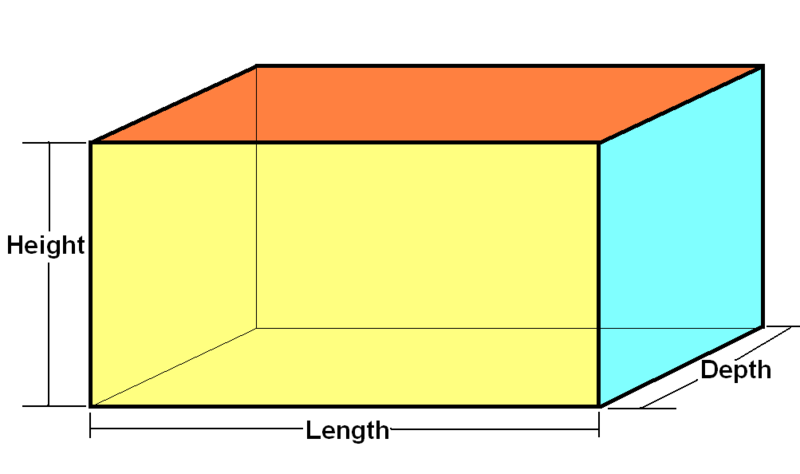
This question is from Official Guide and Official Answer is C. About rectangular solid: Attachment:
800px-Cuboid.png [ 22.06 KiB | Viewed 3849 times ]
In a rectangular solid, all angles are right angles, and opposite faces are equal, so rectangular solid can have maximum 3 different areas of its faces, on the diagram: yellow, green and red faces can have different areas. I say at max, as for example rectangular solid can be a cube and in this case it'll have all faces equal, also it's possible to have only 2 different areas of the faces, for example when the base is square and the height does not equals to the side of this square. Volume of rectangular solid is Volume=Length*Height*Depth. BACK TO THE ORIGINAL QUESTION: What is the volume of a certain rectangular solid?(1) Two adjacent faces of the solid have areas 15 and 24, respectively --> let the two adjacent faces be blue and yellow faces on the diagram --> blue=d*h=15 and yellow=l*h=24 --> we have 2 equations with 3 unknowns, not sufficient to calculate the value of each or the product of the unknowns ( V=l*h*d). To elaborate more: If blue=d*h=15*1=15 and yellow=l*h=24*1=24 then V=l*h*d=24*1*15=360; If blue=d*h=5*3=15 and yellow=l*h=8*3=24 then V=l*h*d=8*3*5=90. Two different answer, hence not sufficient. (2) Each of two opposite faces of the solid has area 40 --> just gives the are of two opposite faces, so clearly insufficient. (1)+(2) From (1): blue=d*h=15, yellow=l*h=24 and from (2) each of two opposite faces of the solid has area 40, so it must be the red one: red=d*l=40 --> here we have 3 distinct linear equations with 3 unknowns hence we can find the values of each and thus can calculate V=l*h*d. Sufficient. To show how it can be done: multiply these 3 equations --> l^2*h^2*d^2=(l*h*d)^2=15*24*40=24^2*5^2 --> V=l*h*d=24*5=120. Answer: C. Hope it helps.
_________________
PLEASE READ AND FOLLOW: 11 Rules for Posting!!!
RESOURCES: [GMAT MATH BOOK]; 1. Triangles; 2. Polygons; 3. Coordinate Geometry; 4. Factorials; 5. Circles; 6. Number Theory
COLLECTION OF QUESTIONS: PS: 1. Tough and Tricky questions; 2. Hard questions; 3. Hard questions part 2; 4. Standard deviation; 5. Tough Problem Solving Questions With Solutions; 6. Probability and Combinations Questions With Solutions; 7 Tough and tricky exponents and roots questions; 8 12 Easy Pieces (or not?); 9 Bakers' Dozen; 10 Algebra set. NEW!!!
DS: 1. DS tough questions; 2. DS tough questions part 2; 3. DS tough questions part 3; 4. DS Standard deviation; 5. Inequalities; 6. 700+ GMAT Data Sufficiency Questions With Explanations; 7 Tough and tricky exponents and roots questions; 8 The Discreet Charm of the DS ; 9 Devil's Dozen!!!; 10 Number Properties set. NEW!!!
 What are GMAT Club Tests? 25 extra-hard Quant Tests
Find out what's new at GMAT Club - latest features and updates
|
|
|
|
|
|
Senior Manager
Joined: 18 Jun 2010
Posts: 305
Schools: Chicago Booth Class of 2013
Followers: 19
Kudos [?]:
115
[2] , given: 194
|
Re: OG-12 DS # 122 [#permalink]
01 Sep 2010, 14:47
2
This post received KUDOS
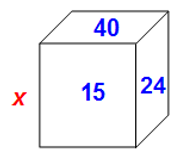
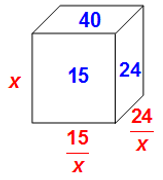
Colleagues, I hope this helps those of us who doubt that the OA is (C). The picture is made by a Person whom I believe 101%.
|
|
|
|
|
|
Retired Moderator
Joined: 02 Sep 2010
Posts: 815
Location: London
Followers: 56
Kudos [?]:
296
[1] , given: 25
|
Re: Certain rectangular solid [#permalink]
04 Oct 2010, 23:15
1
This post received KUDOS
metallicafan wrote: What is the volume of a certain rectangular solid? (1) Two adjacent faces of the solid have areas 15 and 24, respectively. (2) Each of two opposite faces of the solid has area 40.
Do you understand very well the second statement? I understand that if you pick ANY two faces of the solid, each of them has area 40. Let the sides be a,b,c (1) ab=15 & bc=24. Not enough to calculate abc which is the volume. Insufficient (2) Do you understand very well the second statement? Yes, its clear, it means that if you pick any of the two, it will have area=40. Not enough to calculate volume, just one area provided (1+2) Now we know all three areas, ab, bc, ca as 15,24,40 If you multiply all three, a^2b^2c^2 = 15x24x40. Just take the square root to get the volume (abc). Sufficient !! Answer is (c)
_________________
Math write-ups 1) Algebra-101 2) Sequences 3) Set combinatorics 4) 3-D geometry
My GMAT story
Find out what's new at GMAT Club - latest features and updates
|
|
|
|
|
|
Manager
Joined: 15 Apr 2010
Posts: 174
Followers: 4
Kudos [?]:
19
[1] , given: 3
|
Re: OG-12 DS # 122 [#permalink]
06 Oct 2010, 07:35
1
This post received KUDOS
Yes, the second statement is confusing but the catch is in the question itself. The question states a rectangular solid. All the faces cannot have an area of 40 if the solid is rectangular.
|
|
|
|
|
|
Manager
Joined: 10 Feb 2010
Posts: 198
Followers: 2
Kudos [?]:
23
[0], given: 6
|
Re: OG-12 DS # 122 [#permalink]
24 Feb 2010, 08:27
1) Two adjacent faces of the slid have areas 15 & 24, respectively.
2) Each of the opposite faces of the solid has area 40.
Let the length of the sides be a,b,c. Areas of each of the sides will be ab,bc,ca and the volume is abc
1. ab=15 ac=24 From these we cannot get individual values of a,b,c or the volume. So INSUFFICIENT
2. bc=40. From this we cannot get the volume. -- INSUFFICIENT
Combining we have:
ab=15 ac=24 bc=40
multiplying the LHS and RHS, you get:
(ab)(ac)(bc)=15*24*40 (a^2)(b^2)(c^2)=14400 or abc=120=Volume
So, C is the answer
|
|
|
|
|
|
Intern
Joined: 27 Jan 2010
Posts: 41
Followers: 0
Kudos [?]:
1
[0], given: 1
|
Re: OG-12 DS # 122 [#permalink]
24 Feb 2010, 09:17
I was able to come to a conclusion that both options are Insufficient by themselves But then I got stuck when I tried to find the area of the solid rectangle here: a * b * c =15/b * b * 40/b =600/b It was so simple, but it did not stike that I can use (a * b * c)^2 so get the answer  Thank you testprep2010...I guess lots of practice and techniques are required to get to the answer quickly...
|
|
|
|
|
|
Manager
Joined: 19 Feb 2009
Posts: 59
Schools: INSEAD,Nanyang Business school, CBS,
Followers: 2
Kudos [?]:
9
[0], given: 8
|
Re: OG-12 DS # 122 [#permalink]
25 Feb 2010, 03:10
testprep2010 wrote: 1) Two adjacent faces of the slid have areas 15 & 24, respectively.
2) Each of the opposite faces of the solid has area 40.
Let the length of the sides be a,b,c. Areas of each of the sides will be ab,bc,ca and the volume is abc
1. ab=15 ac=24 From these we cannot get individual values of a,b,c or the volume. So INSUFFICIENT
2. bc=40. From this we cannot get the volume. -- INSUFFICIENT
Combining we have:
ab=15 ac=24 bc=40
multiplying the LHS and RHS, you get:
(ab)(ac)(bc)=15*24*40 (a^2)(b^2)(c^2)=14400 or abc=120=Volume
So, C is the answer How does 2nd statement imply that only bc=40, the statement says that EACH of the opposite faces of the solid has area 40, so by this , even ac=ab=40, right?
_________________
Working without expecting fruit helps in mastering the art of doing fault-free action !
|
|
|
|
|
|
Intern
Joined: 25 Feb 2010
Posts: 1
Followers: 0
Kudos [?]:
0
[0], given: 0
|
Re: OG-12 DS # 122 [#permalink]
26 Feb 2010, 13:35
amod243 wrote: testprep2010 wrote: 1) Two adjacent faces of the slid have areas 15 & 24, respectively.
2) Each of the opposite faces of the solid has area 40.
Let the length of the sides be a,b,c. Areas of each of the sides will be ab,bc,ca and the volume is abc
1. ab=15 ac=24 From these we cannot get individual values of a,b,c or the volume. So INSUFFICIENT
2. bc=40. From this we cannot get the volume. -- INSUFFICIENT
Combining we have:
ab=15 ac=24 bc=40
multiplying the LHS and RHS, you get:
(ab)(ac)(bc)=15*24*40 (a^2)(b^2)(c^2)=14400 or abc=120=Volume
So, C is the answer How does 2nd statement imply that only bc=40, the statement says that EACH of the opposite faces of the solid has area 40, so by this , even ac=ab=40, right? Since we have the area of two adj sides is it not possible to find the length of the side that these two sides have in common and from there find the volume. Ie 15: 15, 5, 3, 1 and 24: 24, 12, 8, 6, 4, 3, 2, 1. The number three is the only one in common so this would be either the common base or height and we can go from there...please advise. Thanks!
|
|
|
|
|
|
Senior Manager
Joined: 18 Jun 2010
Posts: 305
Schools: Chicago Booth Class of 2013
Followers: 19
Kudos [?]:
115
[0], given: 194
|
Re: OG-12 DS # 122 [#permalink]
28 Aug 2010, 23:02
Guys,
I think that two statements contradict each other, because: Statement 2 states that each face has area 40, but st. 1 says that some faces are 15 and 24 each... (I assume that face=side)
Isn't it weird?
|
|
|
|
|
|
Intern
Joined: 29 Aug 2010
Posts: 3
Followers: 1
Kudos [?]:
0
[0], given: 0
|
Re: OG-12 DS # 122 [#permalink]
29 Aug 2010, 07:03
Information in (2) is redundant as from (1) we can know all required info. (1) Two adjacent faces of the solid have areas 15 and 24, respectively. So, one common side has to be 3. i.e. 5*3 and 8*3. From this info we can say area of the face is 8*5= 40. Hence only (1) is sufficient. Answer should be A and not C.
DeepakB
|
|
|
|
|
|
Director
Status: Apply - Last Chance
Affiliations: IIT, Purdue, PhD, TauBetaPi
Joined: 18 Jul 2010
Posts: 694
Schools: Wharton, Sloan, Chicago, Haas
WE 1: 8 years in Oil&Gas
Followers: 13
Kudos [?]:
50
[0], given: 15
|
Re: OG-12 DS # 122 [#permalink]
29 Aug 2010, 07:47
Bunuel, Can you clarify if 1 and 2 conflict in this case?
_________________
Consider kudos, they are good for health
|
|
|
|
|
|
Manager
Joined: 16 Feb 2010
Posts: 236
Followers: 2
Kudos [?]:
22
[0], given: 16
|
Re: OG-12 DS # 122 [#permalink]
29 Aug 2010, 18:16
deepbidwai wrote: Information in (2) is redundant as from (1) we can know all required info. (1) Two adjacent faces of the solid have areas 15 and 24, respectively. So, one common side has to be 3. i.e. 5*3 and 8*3. From this info we can say area of the face is 8*5= 40. Hence only (1) is sufficient. Answer should be A and not C.
DeepakB from (1) ab =15 and bc = 24 OR ab = 15 and ac = 24 therefore you have no idea how to find the third side if you think about it logicaly, you have three unknowns, therefore you will need three equations  hope it helps
|
|
|
|
|
|
CEO
Status: Nothing comes easy: neither do I want.
Joined: 12 Oct 2009
Posts: 2758
Location: Malaysia
Concentration: Marketing, Entrepreneurship
GMAT 1: 670 Q49 V31 GMAT 2: 710 Q50 V35
Followers: 122
Kudos [?]:
633
[0], given: 221
|
Re: OG-12 DS # 122 [#permalink]
29 Aug 2010, 18:57
mainhoon wrote: Bunuel, Can you clarify if 1 and 2 conflict in this case? There is no contradiction. It is clearly mentioned each of the two opposite faces. That means the question is referring 2 opposite faces only. READ CAREFULLYIf the area is 40 then 5*8 = 40 along with the 3*5 and 3*8 of the 1st statement is helpful in uniquely identifying the volume 3*5*8 as asked by the question. Else area 15 and 24 could be because of the sides 1,15,24. The second statement removes this alternate solution.
_________________
Fight for your dreams :For all those who fear from Verbal- lets give it a fight
Money Saved is the Money Earned 
Jo Bole So Nihaal , Sat Shri Akaal
Support GMAT Club by putting a GMAT Club badge on your blog/Facebook 
Find out what's new at GMAT Club - latest features and updates
Gmat test review : 670-to-710-a-long-journey-without-destination-still-happy-141642.html
|
|
|
|
|
|
Director
Status: Apply - Last Chance
Affiliations: IIT, Purdue, PhD, TauBetaPi
Joined: 18 Jul 2010
Posts: 694
Schools: Wharton, Sloan, Chicago, Haas
WE 1: 8 years in Oil&Gas
Followers: 13
Kudos [?]:
50
[0], given: 15
|
Re: OG-12 DS # 122 [#permalink]
29 Aug 2010, 19:21
Hi gurpreetsingh Thanks for the input. Well I see your point, however here is my dilemma even with sides of 5,3,8. stm1 - adjacent areas are 15, 24 ok. stm2 - each of the opposite faces has area 40. now each of the opposite face can also be one of the faces referred to in stmt1 and that does not have area of 40. in fact i could look at the area40 face and consider it to be one of the adjacent areas referred to in stm1 and then it is no longer 15 or 24 in area. I assume that all faces are treated equally in the solid, so how do I differentiate what is opposite and what is adjacent?
_________________
Consider kudos, they are good for health
|
|
|
|
|
|
Manager
Joined: 16 Feb 2010
Posts: 236
Followers: 2
Kudos [?]:
22
[0], given: 16
|
Re: OG-12 DS # 122 [#permalink]
31 Aug 2010, 14:40
@ Bunuel - ha! amazing! : )
|
|
|
|
|
|
Director
Status: Apply - Last Chance
Affiliations: IIT, Purdue, PhD, TauBetaPi
Joined: 18 Jul 2010
Posts: 694
Schools: Wharton, Sloan, Chicago, Haas
WE 1: 8 years in Oil&Gas
Followers: 13
Kudos [?]:
50
[0], given: 15
|
Re: OG-12 DS # 122 [#permalink]
01 Sep 2010, 00:59
Bunuel wrote: This question is from Official Guide and Official Answer is C.About rectangular solid: Attachment: 800px-Cuboid.png In a rectangular solid, all angles are right angles, and opposite faces are equal, so rectangular solid can have maximum 3 different areas of its faces, on the diagram: yellow, green and red faces can have different areas. I say at max, as for example rectangular solid can be a cube and in this case it'll have all faces equal, also it's possible to have only 2 different areas of the faces, for example when the base is square and the height does not equals to the side of this square. Volume of rectangular solid is Volume=Length*Height*Depth. BACK TO THE ORIGINAL QUESTION: What is the volume of a certain rectangular solid?(1) Two adjacent faces of the solid have areas 15 and 24, respectively --> let the two adjacent faces be blue and yellow faces on the diagram --> blue=d*h=15 and yellow=l*h=24 --> we have 2 equations with 3 unknowns, not sufficient to calculate the value of each or the product of the unknowns ( V=l*h*d). To elaborate more: If blue=d*h=15*1=15 and yellow=l*h=24*1=24 then V=l*h*d=24*1*15=360; If blue=d*h=5*3=15 and yellow=l*h=8*3=24 then V=l*h*d=8*3*5=90. Two different answer, hence not sufficient. (2) Each of two opposite faces of the solid has area 40 --> just gives the are of two opposite faces, so clearly insufficient. (1)+(2) From (1): blue=d*h=15, yellow=l*h=24 and from (2) each of two opposite faces of the solid has area 40, so it must be the red one: red=d*l=40 --> here we have 3 distinct linear equations with 3 unknowns hence we can find the values of each and thus can calculate V=l*h*d. Sufficient. To show how it can be done: multiply these 3 equations --> l^2*h^2*d^2=(l*h*d)^2=15*24*40=24^2*5^2 --> V=l*h*d=24*5=120. Answer: C. Hope it helps. But Bunuel, what I don't follow is this. As you had said statements cannot contradict each other. statement 2: Each of the opposite faces is area 40. This means if I pick a side of the solid you have drawn above then that and the side opposite to it will each have area 40. Clearly that is not the case, it is only true for one pair of the sides. Same argument with statement 1: adjacent faces are 15 and 24, if I picked one of the adjacent areas to be 40 then that is not true either. So while I understand the solution, I would like to know where am I wrong. Thanks
_________________
Consider kudos, they are good for health
|
|
|
|
|
|
Manager
Joined: 17 Mar 2010
Posts: 197
Followers: 2
Kudos [?]:
22
[0], given: 9
|
Re: OG-12 DS # 122 [#permalink]
01 Sep 2010, 01:13
simply amazing bunuel.... i often get slipped in DS
|
|
|
|
|
|
GMAT Club team member
Joined: 02 Sep 2009
Posts: 11506
Followers: 1791
Kudos [?]:
9518
[0], given: 826
|
Re: OG-12 DS # 122 [#permalink]
01 Sep 2010, 07:17
mainhoon wrote: But Bunuel, what I don't follow is this. As you had said statements cannot contradict each other. statement 2: Each of the opposite faces is area 40. This means if I pick a side of the solid you have drawn above then that and the side opposite to it will each have area 40. Clearly that is not the case, it is only true for one pair of the sides. Same argument with statement 1: adjacent faces are 15 and 24, if I picked one of the adjacent areas to be 40 then that is not true either. So while I understand the solution, I would like to know where am I wrong. Thanks Not sure I understand your question. "(1) Two adjacent faces of the solid have areas 15 and 24, respectively" means two faces have areas 15 and 24. We could say it ourselves that there will be two faces with these areas which are adjacent. How else? "(2) Each of two opposite faces of the solid has area 40" means that one pair of opposite faces has an area 40. Now, when combining: there will be 3 faces of the solid with given areas which are adjacent. How else?
_________________
PLEASE READ AND FOLLOW: 11 Rules for Posting!!!
RESOURCES: [GMAT MATH BOOK]; 1. Triangles; 2. Polygons; 3. Coordinate Geometry; 4. Factorials; 5. Circles; 6. Number Theory
COLLECTION OF QUESTIONS: PS: 1. Tough and Tricky questions; 2. Hard questions; 3. Hard questions part 2; 4. Standard deviation; 5. Tough Problem Solving Questions With Solutions; 6. Probability and Combinations Questions With Solutions; 7 Tough and tricky exponents and roots questions; 8 12 Easy Pieces (or not?); 9 Bakers' Dozen; 10 Algebra set. NEW!!!
DS: 1. DS tough questions; 2. DS tough questions part 2; 3. DS tough questions part 3; 4. DS Standard deviation; 5. Inequalities; 6. 700+ GMAT Data Sufficiency Questions With Explanations; 7 Tough and tricky exponents and roots questions; 8 The Discreet Charm of the DS ; 9 Devil's Dozen!!!; 10 Number Properties set. NEW!!!
 What are GMAT Club Tests? 25 extra-hard Quant Tests
Find out what's new at GMAT Club - latest features and updates
|
|
|
|
|
|
Director
Status: Apply - Last Chance
Affiliations: IIT, Purdue, PhD, TauBetaPi
Joined: 18 Jul 2010
Posts: 694
Schools: Wharton, Sloan, Chicago, Haas
WE 1: 8 years in Oil&Gas
Followers: 13
Kudos [?]:
50
[0], given: 15
|
Re: OG-12 DS # 122 [#permalink]
01 Sep 2010, 07:45
If I refer to your drawing above. Blue face=15 Yellow face=24 and Red face=40. Bunuel, may be its just the wording that I don't understand: "(1) Two adjacent faces of the solid have areas 15 and 24, respectively" means two faces have areas 15 and 24. We could say it ourselves that there will be two faces with these areas which are adjacent. How else? >> I took this statement to mean this: Two adjacent faces could refer to: Red+Blue, Red+Yellow, Blue+Yellow. The assumption is that all faces are treated equal. Clearly, not all adjacent faces have area 15,24. "(2) Each of two opposite faces of the solid has area 40" means that one pair of opposite faces has an area 40. >> Each of two opposite faces = 40 to me means any opposite faces =40. I can understand if it said one pair, but I am not sure if "each of two" means "one pair". Clearly not all opposite faces have area = 40. Thanks for your time and help.
_________________
Consider kudos, they are good for health
|
|
|
|
|
|
|
Re: OG-12 DS # 122
[#permalink]
01 Sep 2010, 07:45
|
|
|
|
|
|
|
|
|
|
|