Find all School-related info fast with the new School-Specific MBA Forum

It is currently 23 May 2013, 14:31
Customize  |  Hide

interesting question in Geometry

  Question banks Downloads My Bookmarks Reviews  
Author Message
TAGS:
1 KUDOS received
Intern
Intern
Joined: 19 Dec 2009
Posts: 41
Followers: 1

Kudos [?]: 27 [1] , given: 52

GMAT Tests User Reviews Badge
interesting question in Geometry [#permalink] New post 16 Feb 2010, 11:43
1
This post received
KUDOS
00:00

Question Stats:

11% (03:38) correct 88% (00:49) wrong based on 1 sessions
If 10, 12 and 'x' are sides of an acute angled triangle, how many integer values of 'x' are possible?
(A) 7
(B) 12
(C) 9
(D) 13
(E) 11

Please answer with details in logic order. Thanks to all.
Senior Manager
Senior Manager
Joined: 01 Feb 2010
Posts: 275
Followers: 1

Kudos [?]: 30 [0], given: 2

GMAT Tests User
Re: interesting question in Geometry [#permalink] New post 16 Feb 2010, 12:06
amirdubai1982 wrote:
If 10, 12 and 'x' are sides of an acute angled triangle, how many integer values of 'x' are possible?
(A) 7
(B) 12
(C) 9
(D) 13
(E) 11

Please answer with details in logic order. Thanks to all.


Any side of triangle is less than the sum of other two sides so in this case x < 22.
Also any side of triangle is larger than positive difference of other two sides so x > 2.
2 < x < 22
Total of 19 possible values.
As this is acute angled triangle x must be largest hence x > 12 and x < 22 so total of 9 possible values hence C.
Manager
Manager
Joined: 26 May 2005
Posts: 217
Followers: 1

Kudos [?]: 41 [0], given: 1

GMAT Tests User
Re: interesting question in Geometry [#permalink] New post 16 Feb 2010, 12:06
acute angle traingle - all angles in the traingle has to be less than 90.
Two possibilities lets take a or almost a right traingle(89 as one angle -> and the maximum value of the traingle will be somewhat closer to the hypotenue of the traingle.

let x be the other side .. if x is hypotenue it value is less than (12 ^ 2 + 10 ^ 2)^1/2 < 16 .. so max value is 15
let x be the other side .. if 12 is hypotenue, then value of x is greater than (12 ^ 2 - 10 ^ 2)^1/2 > 6 .. so min value is 7

idea behind this ... draw a traingle with 10 as base and 12 as the height and angle formed between these 2 is right traingle. other side is hypotenue and the max value will be 15.
then slide the side 12 towards right slowly and at some point side 12 will become hypotense .. and if you move that afterwards towards rights, then angle between 10 and x will be >90

so possibilities = 9

C
Manager
Manager
Joined: 26 May 2005
Posts: 217
Followers: 1

Kudos [?]: 41 [0], given: 1

GMAT Tests User
Re: interesting question in Geometry [#permalink] New post 16 Feb 2010, 12:10
bangalorian2000 wrote:
amirdubai1982 wrote:
If 10, 12 and 'x' are sides of an acute angled triangle, how many integer values of 'x' are possible?
(A) 7
(B) 12
(C) 9
(D) 13
(E) 11

Please answer with details in logic order. Thanks to all.


Any side of triangle is less than the sum of other two sides so in this case x < 22.
Also any side of triangle is larger than positive difference of other two sides so x > 2.
2 < x < 22
Total of 19 possible values.
As this is acute angled triangle x must be largest hence x > 12 and x < 22 so total of 9 possible values hence C.


x need not have to the largest side - take an example where x=21 .. this would be an obtuse angled traingle.
3 KUDOS received
Senior Manager
Senior Manager
User avatar
Joined: 22 Dec 2009
Posts: 368
Followers: 9

Kudos [?]: 136 [3] , given: 47

GMAT ToolKit User GMAT Tests User
Re: interesting question in Geometry [#permalink] New post 16 Feb 2010, 12:20
3
This post received
KUDOS
amirdubai1982 wrote:
If 10, 12 and 'x' are sides of an acute angled triangle, how many integer values of 'x' are possible?
(A) 7
(B) 12
(C) 9
(D) 13
(E) 11

Please answer with details in logic order. Thanks to all.


IMO C...

The catch in the acute angled triangle.

Consider the figures attached...

Case 1:
x < sqrt{12^2 + 10^2} i.e. x < 16

Case 2:
x > sqrt{12^2 - 10^2} i.e. x > 6

Therefore x ranges from 7 to 15 = 9 Values...
Attachments

1.png
1.png [ 21.93 KiB | Viewed 2589 times ]


_________________

Cheers!
JT...........
If u like my post..... payback in Kudos!! :beer

|Do not post questions with OA|Please underline your SC questions while posting|Try posting the explanation along with your answer choice|
|For CR refer Powerscore CR Bible|For SC refer Manhattan SC Guide|


~~Better Burn Out... Than Fade Away~~

1 KUDOS received
CEO
CEO
User avatar
Status: Nothing comes easy: neither do I want.
Joined: 12 Oct 2009
Posts: 2759
Location: Malaysia
Concentration: Marketing, Entrepreneurship
GMAT 1: 670 Q49 V31
GMAT 2: 710 Q50 V35
Followers: 124

Kudos [?]: 634 [1] , given: 221

GMAT Tests User Reviews Badge
Re: interesting question in Geometry [#permalink] New post 16 Feb 2010, 12:44
1
This post received
KUDOS
Ans C -9

first of using some of two sides greater than third side gives 2<x<22

now using Cos A = \frac{(b^2 + c^2 - a^2)}{2bc}

for cos A to be +ve sum of squares of 2 sides should be > square of third side
( equality will come when right angled, if its right angled then its not acute angled )

this gives 6 < x < 16
_________________

Fight for your dreams :For all those who fear from Verbal- lets give it a fight

Money Saved is the Money Earned :)

Jo Bole So Nihaal , Sat Shri Akaal

:thanks Support GMAT Club by putting a GMAT Club badge on your blog/Facebook :thanks

Find out what's new at GMAT Club - latest features and updates

Gmat test review :
670-to-710-a-long-journey-without-destination-still-happy-141642.html

Senior Manager
Senior Manager
User avatar
Joined: 20 Jan 2010
Posts: 282
Schools: HBS, Stanford, Haas, Ross, Cornell, LBS, INSEAD, Oxford, IESE/IE
Followers: 10

Kudos [?]: 99 [0], given: 117

GMAT Tests User
Acute angled triangle [#permalink] New post 19 Feb 2010, 07:57
If 10, 12 and 'x' are sides of an acute angled triangle, how many integer values of 'x' are possible?
(A) 7
(B) 12
(C) 9
(D) 13
(E) 11

What 's the answer? Any thoughts?
_________________

"Don't be afraid of the space between your dreams and reality. If you can dream it, you can make it so."
Target=780
http://challengemba.blogspot.com
Kudos??

Senior Manager
Senior Manager
User avatar
Joined: 20 Jan 2010
Posts: 282
Schools: HBS, Stanford, Haas, Ross, Cornell, LBS, INSEAD, Oxford, IESE/IE
Followers: 10

Kudos [?]: 99 [0], given: 117

GMAT Tests User
Re: Acute angled triangle [#permalink] New post 19 Feb 2010, 10:01
Bunuel wrote:
AtifS wrote:
If 10, 12 and 'x' are sides of an acute angled triangle, how many integer values of 'x' are possible?
(A) 7
(B) 12
(C) 9
(D) 13
(E) 11

What 's the answer? Any thoughts?


Merging the posts. Please refer to the solutions above.


Thank you for merging it. nice methods of soultion provided :)
_________________

"Don't be afraid of the space between your dreams and reality. If you can dream it, you can make it so."
Target=780
http://challengemba.blogspot.com
Kudos??

Director
Director
Joined: 23 Apr 2010
Posts: 595
Followers: 2

Kudos [?]: 14 [0], given: 7

Re: interesting question in Geometry [#permalink] New post 11 Nov 2010, 03:13
There are like 3 different solutions that all give the same answer but different values for x. Could someone please look at it once again?
1 KUDOS received
Veritas Prep GMAT Instructor
User avatar
Joined: 16 Oct 2010
Posts: 3111
Location: Pune, India
Followers: 572

Kudos [?]: 2012 [1] , given: 92

Re: interesting question in Geometry [#permalink] New post 11 Nov 2010, 05:36
1
This post received
KUDOS
Actually, chix475ntu, jeetesh and gurpreet have all given the correct answer either using diagrams or formulas.. 6 < x < 16 is the same as values from 7 to 15 because only integral values are allowed.

Anyway, I am putting down the explanation.
The question asks you for an acute triangle i.e. a triangle with all angles less than 90. An obtuse angled triangle has one angle more than 90. So the logic is that before one of the angles reaches 90, find out all the values that x can take.
Starting from the first diagram where x is minimum and the angle is very close to 90, to the 2nd diagram where all angles are much less than 90 to the third diagram where the other angle is going towards 90.
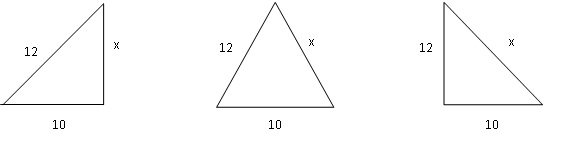
Attachment:
Ques1.jpg
Ques1.jpg [ 9.53 KiB | Viewed 1644 times ]


Note: The remaining angle cannot be 90 because that will make 10 the hypotenuse but hypotenuse is always the greatest side.

In the leftmost diagram x = \sqrt{(12^2 - 10^2)}
x = root 44 which is 6.something
x should be greater than 6.something because the angle cannot be 90.

In the rightmost diagram, x = \sqrt{(12^2 + 10^2)}
x = root 244 which is 15.something
x should be less than 15.something so that the angle is not 90.

Values that x can take range from 7 to 15 which is 15 - 7 = 8 + 1 = 9 values.
(If the +1 above is not clear, check out the explanation on my blog
http://gmatquant.blogspot.com/2010/11/four-prongs.html)
_________________

Karishma
Veritas Prep | GMAT Instructor
My Blog

Save 10% on Veritas Prep GMAT Courses And Admissions Consulting
Enroll now. Pay later. Take advantage of Veritas Prep's flexible payment plan options.

Veritas Prep Reviews

Intern
Intern
Status: Winning is not everything, but wanting to win is
Joined: 10 Nov 2010
Posts: 34
WE 1: IT Consultant (6Yr)
Followers: 0

Kudos [?]: 9 [0], given: 4

GMAT Tests User
Re: interesting question in Geometry [#permalink] New post 16 Nov 2010, 23:43
Hi,

Doubt Clrd :) but just a point in case, if it traingle would have been an obtused triangle

The points would have been b/w 2<x<6 and 15<x<22

Regards
J
Director
Director
Joined: 23 Apr 2010
Posts: 595
Followers: 2

Kudos [?]: 14 [0], given: 7

Re: interesting question in Geometry [#permalink] New post 18 Nov 2010, 05:27
Karishma, thanks a lot for your explanation. It was very helpful. I got it now.

And also thanks for the link to your blog. Great article on math operations.
Manager
Manager
Joined: 16 Jul 2010
Posts: 163
Followers: 3

Kudos [?]: 9 [0], given: 0

GMAT Tests User
Re: interesting question in Geometry [#permalink] New post 18 Nov 2010, 07:18
thanks for a solid explanation, Karishma!
Intern
Intern
User avatar
Joined: 27 Aug 2010
Posts: 31
Followers: 0

Kudos [?]: 2 [0], given: 4

Re: interesting question in Geometry [#permalink] New post 20 Nov 2010, 15:12
chix475ntu wrote:
bangalorian2000 wrote:
amirdubai1982 wrote:
If 10, 12 and 'x' are sides of an acute angled triangle, how many integer values of 'x' are possible?
(A) 7
(B) 12
(C) 9
(D) 13
(E) 11

Please answer with details in logic order. Thanks to all.


Any side of triangle is less than the sum of other two sides so in this case x < 22.
Also any side of triangle is larger than positive difference of other two sides so x > 2.
2 < x < 22
Total of 19 possible values.
As this is acute angled triangle x must be largest hence x > 12 and x < 22 so total of 9 possible values hence C.


x need not have to the largest side - take an example where x=21 .. this would be an obtuse angled traingle.


Your explanations is easy to assimilate , but i'm having a doubt (may be a silly one) - how do we deicide that x HAS to be the largest side ?
Please enlighten.
_________________

This time , its my time .

Veritas Prep GMAT Instructor
User avatar
Joined: 16 Oct 2010
Posts: 3111
Location: Pune, India
Followers: 572

Kudos [?]: 2012 [0], given: 92

Re: interesting question in Geometry [#permalink] New post 20 Nov 2010, 18:37
girisshhh84 wrote:
how do we deicide that x HAS to be the largest side ?
Please enlighten.


I am not sure I understand your question very well... But let me try.

In an obtuse angled triangle, only one angle can be more than 90 (because the sum of all angles has to be 180). The side opposite that angle is largest. The side opposite the smallest angle is the smallest side.
Similarly, in a right angled triangle, the side opposite 90 degree angle is greatest (the hypotenuse).
In our question, we have to consider only acute triangles. Therefore, we are working with right triangles. The values of x we obtain from them will be very close to the smallest/greatest that are acceptable.

In the first figure, we are trying to calculate the smallest value of x. In that case, 12 will be the hypotenuse of the triangle. x will be less than 12. The angle opposite x is the smallest possible (if you look at the second figure, the angle opposite x is getting greater)

In the third figure, angle opposite to x has become the greatest possible i.e. 90 degrees (actually it should be slightly less than 90). Here x will be the hypotenuse and hence the greatest side of the triangle. x can't be any greater because then the triangle will become obtuse.
_________________

Karishma
Veritas Prep | GMAT Instructor
My Blog

Save 10% on Veritas Prep GMAT Courses And Admissions Consulting
Enroll now. Pay later. Take advantage of Veritas Prep's flexible payment plan options.

Veritas Prep Reviews

Intern
Intern
User avatar
Joined: 27 Aug 2010
Posts: 31
Followers: 0

Kudos [?]: 2 [0], given: 4

Re: interesting question in Geometry [#permalink] New post 20 Nov 2010, 23:23
VeritasPrepKarishma wrote:
girisshhh84 wrote:
how do we deicide that x HAS to be the largest side ?
Please enlighten.


I am not sure I understand your question very well... But let me try.

In an obtuse angled triangle, only one angle can be more than 90 (because the sum of all angles has to be 180). The side opposite that angle is largest. The side opposite the smallest angle is the smallest side.
Similarly, in a right angled triangle, the side opposite 90 degree angle is greatest (the hypotenuse).
In our question, we have to consider only acute triangles. Therefore, we are working with right triangles. The values of x we obtain from them will be very close to the smallest/greatest that are acceptable.

In the first figure, we are trying to calculate the smallest value of x. In that case, 12 will be the hypotenuse of the triangle. x will be less than 12. The angle opposite x is the smallest possible (if you look at the second figure, the angle opposite x is getting greater)

In the third figure, angle opposite to x has become the greatest possible i.e. 90 degrees (actually it should be slightly less than 90). Here x will be the hypotenuse and hence the greatest side of the triangle. x can't be any greater because then the triangle will become obtuse.


HI Karishma ,
Thank you , i could understand the explanation as you told me .
But Still have a doubt with 'bangalorian2000's statement "As this is acute angled triangle x must be largest hence x > 12 and x < 22 so total of 9 possible values hence C."
To help me understand , pls tell me when we have
2 < x < 22 i.e. Total of 19 possible values.
How many possible values of x when obtuse triangle ?
How many values of x when right triangle.
_________________

This time , its my time .

Veritas Prep GMAT Instructor
User avatar
Joined: 16 Oct 2010
Posts: 3111
Location: Pune, India
Followers: 572

Kudos [?]: 2012 [0], given: 92

Re: interesting question in Geometry [#permalink] New post 21 Nov 2010, 08:37
girisshhh84 wrote:

HI Karishma ,
Thank you , i could understand the explanation as you told me .
But Still have a doubt with 'bangalorian2000's statement "As this is acute angled triangle x must be largest hence x > 12 and x < 22 so total of 9 possible values hence C."
To help me understand , pls tell me when we have
2 < x < 22 i.e. Total of 19 possible values.
How many possible values of x when obtuse triangle ?
How many values of x when right triangle.


Ok. A side of a triangle is less than the sum of other two sides.
Also a side of a triangle is greater than the difference of other two sides. Since the other two sides are 10 and 12, x should be less than 22 and more than 2.

Now we only have to consider acute angled triangles. Look at the figures below.

Attachment:
Ques.jpg
Ques.jpg [ 17.39 KiB | Viewed 1308 times ]

In the first figure when x is very small, till the angle goes to 90, the triangle is obtuse, which is not allowed.
When x becomes \sqrt{(12^2 - 10^2)} = root 44 = 6.something, the angle is right angled. Now x greater than this value is allowed since we will get acute triangles.
Values of 3, 4, 5 and 6 give obtuse angled triangles.
Values of 7, 8, 9 ... give acute triangles so allowed.

Now look at the second figure. Finally x is \sqrt{(12^2 + 10^2)} = root 244 = 15.something
So values of x till 15.something make acute triangles. Therefore 7, 8, 9, 10, 11, 12, 13, 14 and 15 (9 values) are allowed.
When x is even bigger (16, 17, 18, 19, 20, 21), it will again make an obtuse angled triangle.
And, as we saw, there are two values of x (6.something and 15.something) when we get a right angled triangle.

As for bangalorian2000's statement, he was probably mistaken.
_________________

Karishma
Veritas Prep | GMAT Instructor
My Blog

Save 10% on Veritas Prep GMAT Courses And Admissions Consulting
Enroll now. Pay later. Take advantage of Veritas Prep's flexible payment plan options.

Veritas Prep Reviews

Intern
Intern
User avatar
Joined: 27 Aug 2010
Posts: 31
Followers: 0

Kudos [?]: 2 [0], given: 4

Re: interesting question in Geometry [#permalink] New post 21 Nov 2010, 09:37
VeritasPrepKarishma wrote:
girisshhh84 wrote:

HI Karishma ,
Thank you , i could understand the explanation as you told me .
But Still have a doubt with 'bangalorian2000's statement "As this is acute angled triangle x must be largest hence x > 12 and x < 22 so total of 9 possible values hence C."
To help me understand , pls tell me when we have
2 < x < 22 i.e. Total of 19 possible values.
How many possible values of x when obtuse triangle ?
How many values of x when right triangle.


Ok. A side of a triangle is less than the sum of other two sides.
Also a side of a triangle is greater than the difference of other two sides. Since the other two sides are 10 and 12, x should be less than 22 and more than 2.

Now we only have to consider acute angled triangles. Look at the figures below.

Attachment:
Ques.jpg

In the first figure when x is very small, till the angle goes to 90, the triangle is obtuse, which is not allowed.
When x becomes \sqrt{(12^2 - 10^2)} = root 44 = 6.something, the angle is right angled. Now x greater than this value is allowed since we will get acute triangles.
Values of 3, 4, 5 and 6 give obtuse angled triangles.
Values of 7, 8, 9 ... give acute triangles so allowed.

Now look at the second figure. Finally x is \sqrt{(12^2 + 10^2)} = root 244 = 15.something
So values of x till 15.something make acute triangles. Therefore 7, 8, 9, 10, 11, 12, 13, 14 and 15 (9 values) are allowed.
When x is even bigger (16, 17, 18, 19, 20, 21), it will again make an obtuse angled triangle.
And, as we saw, there are two values of x (6.something and 15.something) when we get a right angled triangle.

As for bangalorian2000's statement, he was probably mistaken.

Woah .. Now i understand it, in and out. thanks Karishma for the splendid explaination .
_________________

This time , its my time .

Re: interesting question in Geometry   [#permalink] 21 Nov 2010, 09:37
    Similar topics Author Replies Last post
Similar
Topics:
Popular new posts Interesting Question ywilfred 13 27 Jul 2004, 17:56
New posts Geometry question kaitibruck 3 07 Oct 2006, 13:17
Popular new posts Geometry Questions..... usman7 21 25 Oct 2006, 00:32
New posts Geometry question coldweather999 4 12 Oct 2007, 19:10
New posts 2 GEOMETRY QUESTION Poots 5 14 Oct 2008, 10:37
Display posts from previous: Sort by

interesting question in Geometry

  Question banks Downloads My Bookmarks Reviews  


GMAT Club MBA Forum Home| About| Privacy Policy| Terms and Conditions| GMAT Club Rules| Contact| Sitemap

Powered by phpBB © phpBB Group and phpBB SEO

Kindly note that the GMAT® test is a registered trademark of the Graduate Management Admission Council®, and this site has neither been reviewed nor endorsed by GMAC®.