Events & Promotions
|
|

GMAT Club Daily Prep
Thank you for using the timer - this advanced tool can estimate your performance and suggest more practice questions. We have subscribed you to Daily Prep Questions via email.
Customized
for You
Track
Your Progress
Practice
Pays
Not interested in getting valuable practice questions and articles delivered to your email? No problem, unsubscribe here.
 Nov 20
07:30 AM PST
-08:30 AM PST
Learn what truly sets the UC Riverside MBA apart and how it helps in your professional growth Nov 20
01:30 PM EST
-02:30 PM IST
Learn how Kamakshi achieved a GMAT 675 with an impressive 96th %ile in Data Insights. Discover the unique methods and exam strategies that helped her excel in DI along with other sections for a balanced and high score. Nov 19
12:30 PM EST
-01:30 PM EST
Learn how Keshav, a Chartered Accountant, scored an impressive 705 on GMAT in just 30 days with GMATWhiz's expert guidance. In this video, he shares preparation tips and strategies that worked for him, including the mock, time management, and more Nov 22
11:00 AM IST
-01:00 PM IST
Do RC/MSR passages scare you? e-GMAT is conducting a masterclass to help you learn – Learn effective reading strategies Tackle difficult RC & MSR with confidence Excel in timed test environment- Nov 23
11:00 AM IST
-01:00 PM IST
Attend this free GMAT Algebra Webinar and learn how to master the most challenging Inequalities and Absolute Value problems with ease.  Nov 24
07:00 PM PST
-08:00 PM PST
Full-length FE mock with insightful analytics, weakness diagnosis, and video explanations! Nov 25
10:00 AM EST
-11:00 AM EST
Prefer video-based learning? The Target Test Prep OnDemand course is a one-of-a-kind video masterclass featuring 400 hours of lecture-style teaching by Scott Woodbury-Stewart, founder of Target Test Prep and one of the most accomplished GMAT instructors.

 04 Nov 2010, 19:49
Kudos
Bookmarks


A
Be sure to select an answer first to save it in the Error Log before revealing the correct answer (OA)!
Difficulty:
 5%
(low)
5%
(low)
Question Stats:
81% (00:51) correct 19%
(01:01)
wrong
based on 1731
sessions
19%
(01:01)
wrong
based on 1731
sessions
History
Date
Time
Result
Not Attempted Yet
Is x between 0 and 1 ?
(1) x^2 is less than x
(2) x^3 is positive
DS17181
(1) x^2 is less than x
(2) x^3 is positive
I am curious how to rephrase Statement 1 using inequalities. I rewrote it as \(x^2 - x < 0\) , which then gives me \(x(x-1) < 0\). If x < 0 and x < 1 then \(0>x<1\). Wouldnt this statement be insufficient? or am i writing that dual inequality incorrectly?
DS17181


 06 Feb 2014, 01:16
Kudos
Bookmarks
SOLUTION
Is x between 0 and 1?
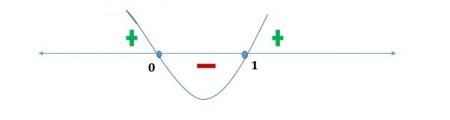
(1) x^2 is less than x --> \(x^2<x\) --> \(x(x-1)<0\):
Multiples must have opposite signs:
\(x<0\) and \(x-1>0\), or \(x>1\) --> no solution (\(x\) cannot be simultaneously less than zero and more than 1);
\(x>0\) and \(x-1<0\), or \(x<1\) --> \(0<x<1\);
So \(x(x-1)<0\) holds true when \(0<x<1\). Sufficient.
For alternate approach check "How to solve quadratic inequalities": https://gmatclub.com/forum/x2-4x-94661.html#p731476
(2) x^3 is positive --> \(x^3>0\) just tells us that x is positive. Not sufficient.
Answer: A.
Is x between 0 and 1?
(1) x^2 is less than x --> \(x^2<x\) --> \(x(x-1)<0\):
Multiples must have opposite signs:
\(x<0\) and \(x-1>0\), or \(x>1\) --> no solution (\(x\) cannot be simultaneously less than zero and more than 1);
\(x>0\) and \(x-1<0\), or \(x<1\) --> \(0<x<1\);
So \(x(x-1)<0\) holds true when \(0<x<1\). Sufficient.
For alternate approach check "How to solve quadratic inequalities": https://gmatclub.com/forum/x2-4x-94661.html#p731476
(2) x^3 is positive --> \(x^3>0\) just tells us that x is positive. Not sufficient.
Answer: A.

jscott319
x(x - 1) < 0 is not the same as x <0 and (x - 1)< 0
When I multiply two terms, the result is negative if and only if one of them is negative and the other is positive. When I multiply x with (x - 1), the result x(x - 1) will be negative (less than 0) in two cases:
Case I: x < 0 (x is negative) but (x - 1) > 0 (x - 1 is positive)
(x - 1) > 0 implies x > 1
But this is not possible. x cannot be less than 0 and greater than 1 at the same time.
Case II: x > 0 (x is positive) but (x - 1) < 0 (x - 1 is negative)
(x - 1) < 0 implies x < 1
This will happen when x lies between 0 and 1. i.e. when 0 < x < 1.
The link gives you the shortcut of solving inequalities of this type.