Events & Promotions
| Last visit was: 06 Sep 2026, 04:04 |
It is currently 06 Sep 2026, 04:04 |
|
|

GMAT Club Daily Prep
Thank you for using the timer - this advanced tool can estimate your performance and suggest more practice questions. We have subscribed you to Daily Prep Questions via email.
Customized
for You
Track
Your Progress
Practice
Pays
Not interested in getting valuable practice questions and articles delivered to your email? No problem, unsubscribe here.
 Sep 06
09:30 AM EDT
-12:30 PM EST
Top scores are possible when you enroll in a powerful EA course, taught live online + 6 months access to TTP OnDemand video courses included! Perfect class schedule and easy course access for working professionals. Class starts Sundays Sept. 6, 2026. Sep 07
12:01 AM PDT
-11:59 PM PDT
On the 7th, GMAT Club Tests will be Free! Including all the Quizzes, Questions, and Tests. 12 AM - 11:59 PM PDT Sep 07
12:30 AM EDT
-01:30 AM EDT
Tejas studied hard but kept repeating the same mistakes. After 3 attempts at 645, a focused 4-week strategy helped him identify and fix what was holding him back—leading to a 695 with just 12–15 hours of study per week. Sep 02
01:00 PM EDT
-11:59 PM EDT
Take 30% off all study plans with code COURSEWORK - Expires on Monday 9/7 Sep 04
01:30 AM EDT
-02:30 AM EDT
This Labor Day, turn your hard work into real score gains. From 615→715 in 15 days to 705 in 30 days, our students prove what's possible with personalized, expert guidance. Save up to 25% on 1-on-1 tutoring. Sep 04
10:00 AM EDT
-11:59 PM EDT
We’ve worked incredibly hard to build TTP into the best test prep experience possible, and it would mean a lot to us to win Newsweek’s 2026 Readers’ Choice Award for Best Test Prep. If TTP has helped you, we’d be incredibly grateful for your vote.- Sep 07
10:00 AM PDT
-11:00 AM PDT
A complete walkthrough of GMAT Club’s free 12-week GMAT study plan: what you study each week, how progress and goals are tracked, how the error log works, and how your practice unlocks paid tools at no cost. - Sep 09
07:00 AM PDT
-10:00 AM PDT
Meet AdComs and explore top Master’s programs - MiM, MiF, MSc, MSBA and more. - Application Fee Waivers - Free 1-Week of GMAT Club Tests: - Master's Application Toolkit - Grand Prize Giveaway - Sep 09
10:00 AM PDT
-11:00 AM PDT
Three MBA applications. Three rejections. No interview invites. A year later, Aman was admitted to Cambridge Judge, SMU, and IMD. In this episode of MBA Admit Stories, Aman shares how he rebuilt his MBA application...  Sep 10
08:00 PM PDT
-09:00 PM PDT
Free- full-length test + 15 concept videos + 150+ short videos + study plan! Sep 15
07:00 PM EDT
-09:00 PM EST
Elite scores are possible when you enroll in a powerful GMAT course, taught live online + 6 months access to TTP OnDemand video courses included! Class starts Tues/Thurs Sept. 15, 2026 - Nov. 15, 2027, 7:00pm-9:00pm EST Sep 21
08:00 PM EDT
-10:00 PM EDT
Boost your GMAT score in less than one month in a live online class + 6 months access to TTP OnDemand video courses included! Class starts Mon, Tues, Wed, Thur, Fri Sept. 21, 2026 - Oct. 9, 2027, 7:00pm-10:00pm EST


B
Be sure to select an answer first to save it in the Error Log before revealing the correct answer (OA)!
Difficulty:
 25%
(medium)
25%
(medium)
Question Stats:
73% (01:32) correct 27%
(01:40)
wrong
based on 9959
sessions
27%
(01:40)
wrong
based on 9959
sessions
History
Date
Time
Result
Not Attempted Yet
The stars, some of them at tremendous speeds, are in motion just as the planets are, yet being so far away from the Earth that their apparent positions in the sky do not change enough for their movement to be observed during a single human lifetime.
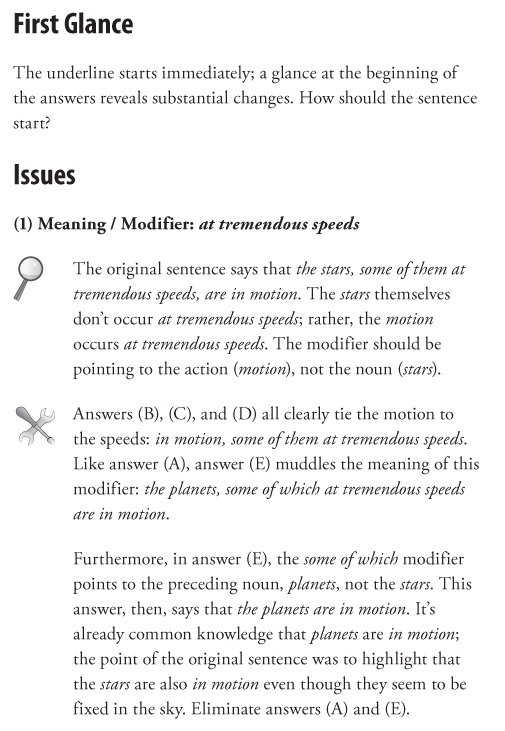
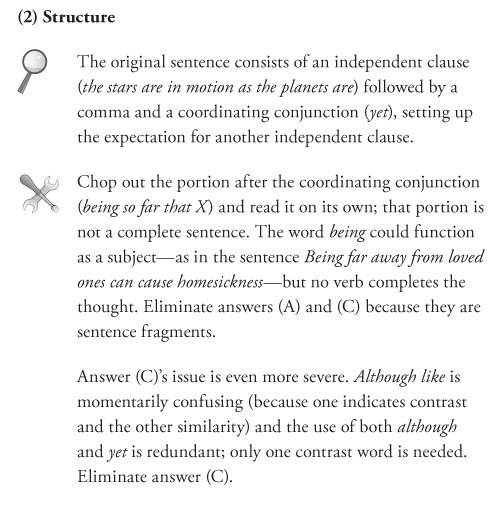
(A) The stars, some of them at tremendous speeds, are in motion just as the planets are, yet being
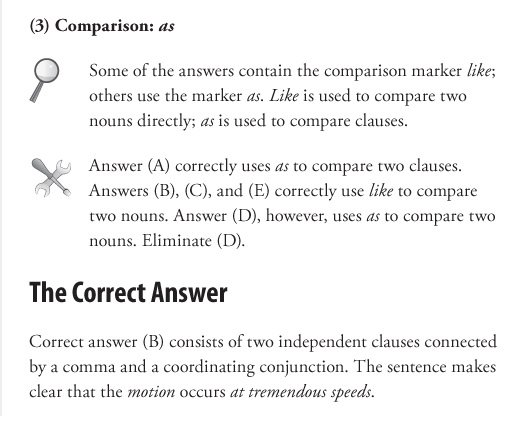
(B) Like the planets, the stars are in motion, some of them at tremendous speeds, but they are
(C) Although like the planets the stars are in motion, some of them at tremendous speeds, yet
(D) As the planets, the stars are in motion, some of them at tremendous speeds, but they are
(E) The stars are in motion like the planets, some of which at tremendous speeds are in motion but
(A) The stars, some of them at tremendous speeds, are in motion just as the planets are, yet being
(B) Like the planets, the stars are in motion, some of them at tremendous speeds, but they are
(C) Although like the planets the stars are in motion, some of them at tremendous speeds, yet
(D) As the planets, the stars are in motion, some of them at tremendous speeds, but they are
(E) The stars are in motion like the planets, some of which at tremendous speeds are in motion but
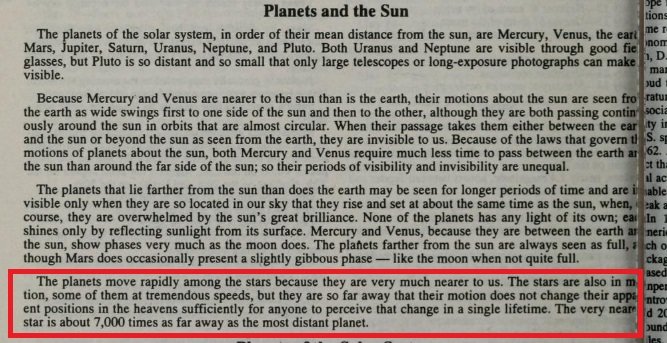
The World Almanac and Book of Facts
The stars are also in motion, some of them at tremendous speeds, but they are so far away that their motion does not change their apparent positions in the heavens sufficiently for anyone to perceive that change in a single lifetime.
04.jpg [ 132.77 KiB | Viewed 55204 times ]
01.jpg [ 110.52 KiB | Viewed 55251 times ]
02.jpg [ 82.94 KiB | Viewed 55257 times ]
03.jpg [ 62.31 KiB | Viewed 55149 times ]
The stars are also in motion, some of them at tremendous speeds, but they are so far away that their motion does not change their apparent positions in the heavens sufficiently for anyone to perceive that change in a single lifetime.
Attachment:
04.jpg [ 132.77 KiB | Viewed 55204 times ]
Attachment:
01.jpg [ 110.52 KiB | Viewed 55251 times ]
Attachment:
02.jpg [ 82.94 KiB | Viewed 55257 times ]
Attachment:
03.jpg [ 62.31 KiB | Viewed 55149 times ]
Solving this question helps.
Taking a timed set of similar questions in
GMAT Club Forum Quiz →
is even better.

 05 Apr 2013, 21:16
Kudos
Bookmarks
1.) Notice that the end of some of the answers include a subject/verb, so check sentence structure. ABCD each uses ", but" or ", yet" and each of these requires an independent clause on each side (S/V ", but" S/V). There is no verb after the underlined part, so we need a subject/verb in the answer after the ", but" or ", yet". This knocks out A and C. E doesn't need to be eliminated, because we don't have a comma before "but"
2.) We see "like" and "as" in the beginning, so comparisons are being tested. "like" needs to be followed by a noun. "as" can be followed by a noun or a subject/verb, but it is NOT a comparison if it is followed by a noun - it is describing function. Because we are comparing how the stars are in motion to how the planets are in motion, "as" needs to be followed by a subject/verb if it is used.
3.) The order of "stars" and "planets" changes, which usually indicates a modifier-related meaning issue. Here the sentence is intending to tell us that the "stars" are "so far away from the Earth", not the "planets".
The stars, some of them at tremendous speeds, are in motion just as the planets are, yet being so far away from the Earth that their apparent positions in the sky do not change enough for their movement to be observed during a single human lifetime.
A) The stars, some of them at tremendous speeds, are in motion just as the planets are, yet being - "being" doesn't make this wrong. In fact, the GMAT sometimes starts a clause using being if it is trying to use the state of being something as the subject. What makes this answer wrong is the lack of a subject/verb after the ", yet"
B) Like the planets, the stars are in motion, some of them at tremendous speeds, but they are - There is a subject/verb after ", but" and there is proper use of "like". Also, the modifier "some of them" is properly modifying "stars". Don't worry that "them" might be a little ambiguous ("stars" or "planets") because ambiguity is a lower priority than improper sentence structure, improper like/as usage, and improper meaning from improper modifier placement.
C) Although like the planets the stars are in motion, some of them at tremendous speeds, yet - Again, no verb after ", yet"
D) As the planets, the stars are in motion, some of them at tremendous speeds, but they are - "as" is followed by a noun, so it describes the function that the stars are performing, which is not the intended meaning of the sentence
E) The stars are in motion like the planets, some of which at tremendous speeds are in motion but - The modifier "some of which" is describing planets as being far away from the Earth. This is not the intended meaning of the sentence.
2.) We see "like" and "as" in the beginning, so comparisons are being tested. "like" needs to be followed by a noun. "as" can be followed by a noun or a subject/verb, but it is NOT a comparison if it is followed by a noun - it is describing function. Because we are comparing how the stars are in motion to how the planets are in motion, "as" needs to be followed by a subject/verb if it is used.
3.) The order of "stars" and "planets" changes, which usually indicates a modifier-related meaning issue. Here the sentence is intending to tell us that the "stars" are "so far away from the Earth", not the "planets".
The stars, some of them at tremendous speeds, are in motion just as the planets are, yet being so far away from the Earth that their apparent positions in the sky do not change enough for their movement to be observed during a single human lifetime.
A) The stars, some of them at tremendous speeds, are in motion just as the planets are, yet being - "being" doesn't make this wrong. In fact, the GMAT sometimes starts a clause using being if it is trying to use the state of being something as the subject. What makes this answer wrong is the lack of a subject/verb after the ", yet"
B) Like the planets, the stars are in motion, some of them at tremendous speeds, but they are - There is a subject/verb after ", but" and there is proper use of "like". Also, the modifier "some of them" is properly modifying "stars". Don't worry that "them" might be a little ambiguous ("stars" or "planets") because ambiguity is a lower priority than improper sentence structure, improper like/as usage, and improper meaning from improper modifier placement.
C) Although like the planets the stars are in motion, some of them at tremendous speeds, yet - Again, no verb after ", yet"
D) As the planets, the stars are in motion, some of them at tremendous speeds, but they are - "as" is followed by a noun, so it describes the function that the stars are performing, which is not the intended meaning of the sentence
E) The stars are in motion like the planets, some of which at tremendous speeds are in motion but - The modifier "some of which" is describing planets as being far away from the Earth. This is not the intended meaning of the sentence.

 05 Apr 2013, 05:16
Kudos
Bookmarks
A) The stars, some of them at tremendous speeds, are in motion just as the planets are, yet being -using of being is not preffered for this sentence ,makes it verbose
B) Like the planets, the stars are in motion, some of them at tremendous speeds, but they are-bingo. Like is used to compare nouns and it is used to compare stars and planets here. The rest of the sentence is gramatically correct.
C) Although like the planets the stars are in motion, some of them at tremendous speeds, yet -Use of although and yet simultaneously makes the sentence less clear .
D) As the planets, the stars are in motion, some of them at tremendous speeds, but they are-Use of as is wrong in the sentence .As is used to compare clause ,Like is prefered
E) The stars are in motion like the planets, some of which at tremendous speeds are in motion but -Incorrect comparison.
B) Like the planets, the stars are in motion, some of them at tremendous speeds, but they are-bingo.
Like is used to compare nouns and it is used to compare stars and planets here. The rest of the sentence is gramatically correct.C) Although like the planets the stars are in motion, some of them at tremendous speeds, yet -Use of although and yet simultaneously makes the sentence less clear .
D) As the planets, the stars are in motion, some of them at tremendous speeds, but they are-Use of as is wrong in the sentence .As is used to compare clause ,Like is prefered
E) The stars are in motion like the planets, some of which at tremendous speeds are in motion but -Incorrect comparison.
 25 Mar 2022, 02:05
Kudos
Bookmarks
Dear Friends,
Here is a detailed explanation to this question-
Meaning is crucial to solving this problem:
Understanding the intended meaning is key to solving this question; the intended core meaning of this sentence is that - like planets, the stars are in motion, but they are so far away from the Earth that their apparent positions in the sky do not change enough for their movement to be observed during a single human lifetime.
Concepts tested here: Meaning + Modifiers + Verb Forms + Grammatical Construction + Comparison + Parallelism
• “like” is used for comparing nouns, “as” is used for comparing actions/clauses, and “such as” is used for giving examples.
• A comparison must always be made between similar elements.
• If a list contains only two elements, they must be joined by a conjunction.
• Semicolons or "comma + conjunction" are used for introducing an independent clause.
• "who/whose/whom/which/where", when preceded by a comma, refer to the noun just before the comma.
• Statements of universal fact are best conveyed through the simple present tense.
A: This answer choice incorrectly uses the present participle ("verb+ing" - "being" in this sentence) to refer to a statement of universal fact; remember, statements of universal fact are best conveyed through the simple present tense. Further, Option A incorrectly uses the "comma + conjunction ("yet" in this sentence)" construction to join two elements in a list - the verb phrases "are in motion" and "being so far away from the Earth"; please remember, if a list contains only two elements, they must be joined by a conjunction.
B: Correct. This answer choice acts upon the independent noun "the stars" with the active verb phrase "are in motion" to form a complete thought, leading to a complete sentence. Moreover, Option B correctly uses the clause "but they (the stars) are so far away from the Earth...lifetime", conveying the intended meaning - that some of the stars are in motion at tremendous speeds but are so far away from the Earth that their apparent positions in the sky do not change enough for their movement to be observed during a single human lifetime. Further, Option B correctly uses the simple present tense verb "are" to refer to a statement of universal fact. Additionally, Option B correctly uses the "comma + conjunction ("but" in this case")" construction to join the independent clauses "the stars are in motion" and "that...are so far away from the Earth...lifetime"; remember, semicolons or "comma + conjunction" are used for introducing an independent clause. Besides, Option B correctly uses "Like" to compare the nouns "the planets" and "the stars".
C: This answer choice fails to form a complete sentence; since "Although like the planets the stars are in motion" is a dependent clause, and "yet so far away from the Earth...lifetime" is a modifying phrase, the sentence lacks an independent subject noun.
D: This answer choice incorrectly uses "As" to compare two nouns; please remember, “like” is used for comparing nouns, and “as” is used for comparing actions/clauses.
E: This answer choice incorrectly refers to "the planets" with the "which" phrase "some of which at tremendous speeds are in motion but...lifetime", incorrectly implying that some of the planets are in motion at tremendous speeds but are so far away from the Earth that their apparent positions in the sky do not change enough for their movement to be observed during a single human lifetime; the intended meaning is that some of the stars are in motion at tremendous speeds but are so far away from the Earth that their apparent positions in the sky do not change enough for their movement to be observed during a single human lifetime; remember, "who/whose/whom/which/where", when preceded by a comma, refer to the noun just before the comma. Further, Option E incorrectly compares the action "are in motion" to the noun "the planets"; remember, a comparison must always be made between similar elements.
Hence, B is the best answer choice.
All the best!
Experts' Global Team
Here is a detailed explanation to this question-
beckee529
Meaning is crucial to solving this problem:
Understanding the intended meaning is key to solving this question; the intended core meaning of this sentence is that - like planets, the stars are in motion, but they are so far away from the Earth that their apparent positions in the sky do not change enough for their movement to be observed during a single human lifetime.
Concepts tested here: Meaning + Modifiers + Verb Forms + Grammatical Construction + Comparison + Parallelism
• “like” is used for comparing nouns, “as” is used for comparing actions/clauses, and “such as” is used for giving examples.
• A comparison must always be made between similar elements.
• If a list contains only two elements, they must be joined by a conjunction.
• Semicolons or "comma + conjunction" are used for introducing an independent clause.
• "who/whose/whom/which/where", when preceded by a comma, refer to the noun just before the comma.
• Statements of universal fact are best conveyed through the simple present tense.
A: This answer choice incorrectly uses the present participle ("verb+ing" - "being" in this sentence) to refer to a statement of universal fact; remember, statements of universal fact are best conveyed through the simple present tense. Further, Option A incorrectly uses the "comma + conjunction ("yet" in this sentence)" construction to join two elements in a list - the verb phrases "are in motion" and "being so far away from the Earth"; please remember, if a list contains only two elements, they must be joined by a conjunction.
B: Correct. This answer choice acts upon the independent noun "the stars" with the active verb phrase "are in motion" to form a complete thought, leading to a complete sentence. Moreover, Option B correctly uses the clause "but they (the stars) are so far away from the Earth...lifetime", conveying the intended meaning - that some of the stars are in motion at tremendous speeds but are so far away from the Earth that their apparent positions in the sky do not change enough for their movement to be observed during a single human lifetime. Further, Option B correctly uses the simple present tense verb "are" to refer to a statement of universal fact. Additionally, Option B correctly uses the "comma + conjunction ("but" in this case")" construction to join the independent clauses "the stars are in motion" and "that...are so far away from the Earth...lifetime"; remember, semicolons or "comma + conjunction" are used for introducing an independent clause. Besides, Option B correctly uses "Like" to compare the nouns "the planets" and "the stars".
C: This answer choice fails to form a complete sentence; since "Although like the planets the stars are in motion" is a dependent clause, and "yet so far away from the Earth...lifetime" is a modifying phrase, the sentence lacks an independent subject noun.
D: This answer choice incorrectly uses "As" to compare two nouns; please remember, “like” is used for comparing nouns, and “as” is used for comparing actions/clauses.
E: This answer choice incorrectly refers to "the planets" with the "which" phrase "some of which at tremendous speeds are in motion but...lifetime", incorrectly implying that some of the planets are in motion at tremendous speeds but are so far away from the Earth that their apparent positions in the sky do not change enough for their movement to be observed during a single human lifetime; the intended meaning is that some of the stars are in motion at tremendous speeds but are so far away from the Earth that their apparent positions in the sky do not change enough for their movement to be observed during a single human lifetime; remember, "who/whose/whom/which/where", when preceded by a comma, refer to the noun just before the comma. Further, Option E incorrectly compares the action "are in motion" to the noun "the planets"; remember, a comparison must always be made between similar elements.
Hence, B is the best answer choice.
All the best!
Experts' Global Team





 I see your point and do agree with you. It is better to place the subgroup modifier after






