|
Author |
Message |
|
Senior Manager
Joined: 18 Aug 2009
Posts: 441
Schools: UT at Austin, Indiana State University, UC at Berkeley
WE 1: 5.5
WE 2: 5.5
WE 3: 6.0
Followers: 4
Kudos [?]:
37
[0], given: 16
|
Question Stats:
57% (01:31) correct
42% (00:45) wrong based on 1 sessions
If in triangle ABC angle ABC is the largest and point D lies on segment AC, is the area of triangle ABD larger than that of triangle DBC? 1. AD \lt DC 2. AB \lt BC Source: GMAT Club Tests - hardest GMAT questions Could not understand GMAT club explanation, please elaborate.
_________________
Never give up,,,
|
|
|
|
|
|
|
|
|
CIO
Joined: 02 Oct 2007
Posts: 1261
Followers: 75
Kudos [?]:
506
[3] , given: 334
|
3
This post received KUDOS
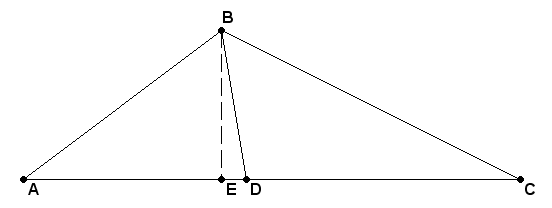
It becomes easier if you draw a sketch for problems like this one. I'm attaching a sketch that I draw. So, we have two triangles ABD and CBD. BE is the height of both these smaller triangles as well as of the bigger triangle ABC. We know that a formula for finding the area of a triangle is \frac{1}{2}*base*height. In our case the height is the same for both triangles (BE on the image below). So we need to know which of the bases is longer in order to tell which triangle has the greater area. S1 explicitly states that AD<DC. This is sufficient to know that the area of triangle ABD is smaller than that of triangle CBD. Since the height is the same, the longer base gives us the greater area. S2 is not sufficient because the lengths of AB and BC don't influence the area in this case. Imagine point D sliding to the right closer to the point C - this will increase the area of triangle ABD and decrease the area of triangle CBD. Notice that if we shift point D this way, the lengths of AB and BC don't change. Therefore, we don't really care about these values (AB and BC). I hope it helped  .
Attachments

m18-04.PNG [ 4.77 KiB | Viewed 4142 times ]
_________________
Welcome to GMAT Club! 
   Want to solve GMAT questions on the go? GMAT Club iPhone app will help. Please read this before posting in GMAT Club Tests forum Result correlation between real GMAT and GMAT Club Tests Are GMAT Club Test sets ordered in any way?
Take 15 free tests with questions from GMAT Club, Knewton, Manhattan GMAT, and Veritas.
Find out what's new at GMAT Club - latest features and updates
|
|
|
|
|
|
Senior Manager
Joined: 21 Jul 2009
Posts: 371
Schools: LBS, INSEAD, IMD, ISB - Anything with just 1 yr program.
Followers: 11
Kudos [?]:
74
[0], given: 22
|
dzyubam wrote: It becomes easier if you draw a sketch for problems like this one.
consider, BC is base and angle ABC is obtuse. Because, we can't be sure exactly how the figure looks like, we should take all possibilities in to consideration and I am guessing, both statements can help assert the required condition.\ My answer to the question is D.
_________________
I am AWESOME and it's gonna be LEGENDARY!!!
|
|
|
|
|
|
Senior Manager
Joined: 18 Aug 2009
Posts: 441
Schools: UT at Austin, Indiana State University, UC at Berkeley
WE 1: 5.5
WE 2: 5.5
WE 3: 6.0
Followers: 4
Kudos [?]:
37
[0], given: 16
|
Great explanation, thank you
_________________
Never give up,,,
|
|
|
|
|
|
CIO
Joined: 02 Oct 2007
Posts: 1261
Followers: 75
Kudos [?]:
506
[0], given: 334
|
Angle ABC is obtuse in the image I attached above. S2 can't be sufficient, see explanation: Quote: S2 is not sufficient because the lengths of AB and BC don't influence the area in this case. Imagine point D sliding to the right closer to the point C - this will increase the area of triangle ABD and decrease the area of triangle CBD. Notice that if we shift point D this way, the lengths of AB and BC don't change. Therefore, we don't really care about these values (AB and BC). BC can't be the base as it's clearly stated in the question stem that point D lies on AC and we are dealing with triangles ABD and DBC. Can you draw a sketch to demonstrate how BC would be the base under the conditions given in the stem? I hope I'm not missing anything big here  . BarneyStinson wrote: dzyubam wrote: It becomes easier if you draw a sketch for problems like this one.
consider, BC is base and angle ABC is obtuse. Because, we can't be sure exactly how the figure looks like, we should take all possibilities in to consideration and I am guessing, both statements can help assert the required condition.\ My answer to the question is D.
_________________
Welcome to GMAT Club! 
   Want to solve GMAT questions on the go? GMAT Club iPhone app will help. Please read this before posting in GMAT Club Tests forum Result correlation between real GMAT and GMAT Club Tests Are GMAT Club Test sets ordered in any way?
Take 15 free tests with questions from GMAT Club, Knewton, Manhattan GMAT, and Veritas.
Find out what's new at GMAT Club - latest features and updates
|
|
|
|
|
|
Intern
Joined: 20 Nov 2009
Posts: 6
Followers: 0
Kudos [?]:
0
[0], given: 2
|
I sketched the diagram of the triangle and was able to arrive at a solution using the first statement, but the second statement alone is insufficient to arrive at an answer no matter how you draw it. I'm guessing the answer is A.
|
|
|
|
|
|
Intern
Joined: 28 Jan 2010
Posts: 3
Followers: 0
Kudos [?]:
0
[0], given: 0
|
Stmt1: If the AD = DC then both the triangle are equal and as shown in the picture both share the ame altitude and area is determined by which base is larger among the two. - Sufficient.
Stmt2: if AB < BC : the deciding factor still will be the proximity of D to A. If it is farther away from A, triangle ABD is greater.. Since no information about D is given - not Sufficient
Answer is A
|
|
|
|
|
|
Manager
Joined: 18 Oct 2009
Posts: 53
Location: Alberta, Canada
Schools: Queen's E-MBA
Followers: 0
Kudos [?]:
10
[0], given: 7
|
BarneyStinson wrote: dzyubam wrote: It becomes easier if you draw a sketch for problems like this one.
consider, BC is base and angle ABC is obtuse. Because, we can't be sure exactly how the figure looks like, we should take all possibilities in to consideration and I am guessing, both statements can help assert the required condition.\ My answer to the question is D. You have a good point but even with angle ABC obtuse, the area of triangles ABD and BDC cannot be compared if we do not get any info on D's location. S1 clarifies the location and compares the length of the bases of these triangles, so only answer is A!
|
|
|
|
|
|
Intern
Joined: 16 Jan 2011
Posts: 6
Schools: Arizona State University
Followers: 0
Kudos [?]:
0
[0], given: 0
|
We need to figure out if Triangle ABD > Triangle DBC??
Based on s1 we know that base of Triangle DBC (i.e. DC) > base of Triangle ABD (i.e. AD). Now Area of triangle DBC is 1/2*BD*DC----(1) and Area of triangle ABD is 1/2*BD*AD-----(2) As in both equations DC and AD are the only variables and based on s1 DC > AD therefore triangle ABD is NOT GREATER than triangle DBC. Hence S1 is SUFFICIENT.
Based on s2 AB < BC. This makes no difference in the formula of the area of both the triangles (i.e. triangle ABD and triangle DBC). Therefore S2 is NOT SUFFICIENT
|
|
|
|
|
|
Manager
Affiliations: The Earth organization, India
Joined: 25 Dec 2010
Posts: 196
WE 1: SAP consultant-IT 2 years
WE 2: Entrepreneur-family business 2 years
Followers: 4
Kudos [?]:
8
[0], given: 12
|
I solved by median approach- if d was mid point of side ac then the position of D decides whether smaller triangles are equal in area or unequal. There is an official guide 12- DS-109 is based on similar lines. I had a small question if anyone can answer- regarding the OA here - for any triangle abc, which has d as the point on BC, will the height of all 3 triangles be equal ?? {2 smaller and 1 larger triangle}
_________________
Cheers !!
Quant 47-Striving for 50 Verbal 34-Striving for 40
|
|
|
|
|
|
Manager
Status: MBA Aspirant
Joined: 12 Jun 2010
Posts: 190
Location: India
Concentration: Finance, International Business
WE: Information Technology (Investment Banking)
Followers: 3
Kudos [?]:
14
[0], given: 1
|
My answer is D Statement 1: DC>AD since area of a triangle is 1/2*base*ht. Since both the traingles have the same height. So the triangle which has the larger base will have the largest area. Statement 2: A continuation of what is stated in the stimulus. Does provide any info for the area of triangle.
|
|
|
|
|
|
GMAT Club team member
Joined: 02 Sep 2009
Posts: 11534
Followers: 1795
Kudos [?]:
9566
[0], given: 826
|
If in triangle ABC angle ABC is the largest and point D lies on segment AC, is the area of triangle ABD larger than that of triangle DBC?(1) AD<DC(2) AB<BCConsider the diagram below: Attachment:
m18-04.PNG [ 4.77 KiB | Viewed 1129 times ]
Notice that BE is the height of the triangle ABC. Now, the area of triangle ABD is \frac{1}{2}*height*base=\frac{1}{2}*BE*AD and the area of triangle DBC is \frac{1}{2}*height*base=\frac{1}{2}*BE*DC. So, we can see that the area of triangle ABD will be greater than the area of triangle DBC if AD is greater than DC. (1) AD<DC. Sufficient. (2) AB<BC. Not sufficient. Answer: A.
_________________
PLEASE READ AND FOLLOW: 11 Rules for Posting!!!
RESOURCES: [GMAT MATH BOOK]; 1. Triangles; 2. Polygons; 3. Coordinate Geometry; 4. Factorials; 5. Circles; 6. Number Theory
COLLECTION OF QUESTIONS: PS: 1. Tough and Tricky questions; 2. Hard questions; 3. Hard questions part 2; 4. Standard deviation; 5. Tough Problem Solving Questions With Solutions; 6. Probability and Combinations Questions With Solutions; 7 Tough and tricky exponents and roots questions; 8 12 Easy Pieces (or not?); 9 Bakers' Dozen; 10 Algebra set. NEW!!!
DS: 1. DS tough questions; 2. DS tough questions part 2; 3. DS tough questions part 3; 4. DS Standard deviation; 5. Inequalities; 6. 700+ GMAT Data Sufficiency Questions With Explanations; 7 Tough and tricky exponents and roots questions; 8 The Discreet Charm of the DS ; 9 Devil's Dozen!!!; 10 Number Properties set. NEW!!!
 What are GMAT Club Tests? 25 extra-hard Quant Tests
Find out what's new at GMAT Club - latest features and updates
|
|
|
|
|
|
|
|
|
|
|
|
|
|
|
|
|
|