Events & Promotions
|
|

GMAT Club Daily Prep
Thank you for using the timer - this advanced tool can estimate your performance and suggest more practice questions. We have subscribed you to Daily Prep Questions via email.
Customized
for You
Track
Your Progress
Practice
Pays
Not interested in getting valuable practice questions and articles delivered to your email? No problem, unsubscribe here.
 Jun 11
11:00 AM EDT
-01:00 PM EDT
TTP GMAT OnDemand gives serious students 400+ hours of expert video instruction, the full TTP course, AI support, weekly office hours, and a 715+ score guarantee—all built for elite GMAT score improvement. Jun 10
06:00 AM PDT
-06:15 PM PDT
Register for the GMAT Club Virtual MBA Spotlight Fair – the world’s premier event for serious MBA candidates. This is your chance to hear directly from Admissions Directors at nearly every Top 30 MBA program.. Jun 22
07:30 PM EDT
-09:30 PM EDT
Master the GMAT with expert live instruction, a personalized study plan, and real-time support. Includes 40 hours of online classes plus 6 months of access to the TTP GMAT OnDemand video course. Class date: Mon/Wed June 22, 2026 →August 26, 2026


A
Be sure to select an answer first to save it in the Error Log before revealing the correct answer (OA)!
Difficulty:
 75%
(hard)
75%
(hard)
Question Stats:
57% (02:26) correct 43%
(02:18)
wrong
based on 1144
sessions
43%
(02:18)
wrong
based on 1144
sessions
History
Date
Time
Result
Not Attempted Yet
Set T consists of all points (x, y) such that x^2 + y^2 = 1. If point (a, b) is selected from set T at random, what is the probability that b > a + 1 ?
(A) \(\frac{1}{4}\)
(B) \(\frac{1}{3}\)
(C) \(\frac{1}{2}\)
(D) \(\frac{3}{5}\)
(E) \(\frac{2}{3}\)

(A) \(\frac{1}{4}\)
(B) \(\frac{1}{3}\)
(C) \(\frac{1}{2}\)
(D) \(\frac{3}{5}\)
(E) \(\frac{2}{3}\)
Attachment:
0012.jpg
Experience GMAT Club Test Questions
Yes, you've landed on a GMAT Club Tests question
Craving more? Unlock our full suite of GMAT Club Tests here
Want to experience more? Get a taste of our tests with our free trial today
Rise to the challenge with GMAT Club Tests. Happy practicing!


 21 Feb 2012, 00:36
Kudos
Bookmarks
Set T consists of all points (x, y) such that x^2 + y^2 = 1. If point (a, b) is selected from set T at random, what is the probability that b > a + 1 ?
(A) \(\frac{1}{4}\)
(B) \(\frac{1}{3}\)
(C) \(\frac{1}{2}\)
(D) \(\frac{3}{5}\)
(E) \(\frac{2}{3}\)
Look at the diagram below.
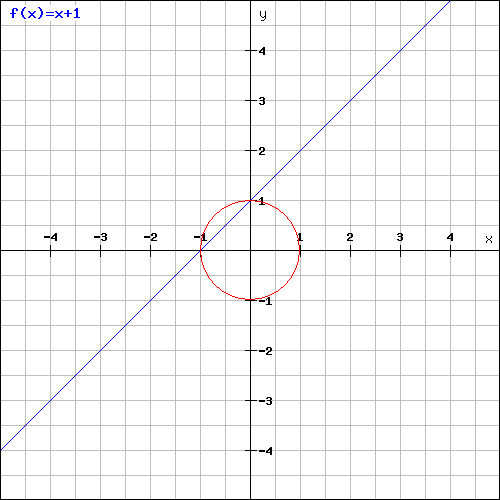
The circle represented by the equation \(x^2+y^2 = 1\) is centered at the origin and has the radius of \(r=\sqrt{1}=1\) (for more on this check Coordinate Geometry chapter of math book: https://gmatclub.com/forum/math-coordina ... 87652.html ).
So, set T is the circle itself (red curve).
Question is: if point (a,b) is selected from set T at random, what is the probability that b>a+1? All points (a,b) which satisfy this condition (belong to T and have y-coordinate > x-coordinate + 1) lie above the line y=x+1 (blue line). You can see that portion of the circle which is above the line is 1/4 of the whole circumference, hence P=1/4.
Answer: A.
If it were: set T consists of all points (x,y) such that \(x^2+y^2<1\) (so set T consists of all points inside the circle). If point (a,b) is selected from set T at random, what is the probability that b>a+1?
Then as the area of the segment of the circle which is above the line is \(\frac{\pi{r^2}}{4}-\frac{r^2}{2}=\frac{\pi-2}{4}\) so \(P=\frac{area_{segment}}{area_{circle}}=\frac{\frac{\pi-2}{4}}{\pi{r^2}}=\frac{\pi-2}{4\pi}\).
Hope it's clear.
graph.php.png [ 15.81 KiB | Viewed 33113 times ]
(A) \(\frac{1}{4}\)
(B) \(\frac{1}{3}\)
(C) \(\frac{1}{2}\)
(D) \(\frac{3}{5}\)
(E) \(\frac{2}{3}\)
Look at the diagram below.
The circle represented by the equation \(x^2+y^2 = 1\) is centered at the origin and has the radius of \(r=\sqrt{1}=1\) (for more on this check Coordinate Geometry chapter of math book: https://gmatclub.com/forum/math-coordina ... 87652.html ).
So, set T is the circle itself (red curve).
Question is: if point (a,b) is selected from set T at random, what is the probability that b>a+1? All points (a,b) which satisfy this condition (belong to T and have y-coordinate > x-coordinate + 1) lie above the line y=x+1 (blue line). You can see that portion of the circle which is above the line is 1/4 of the whole circumference, hence P=1/4.
Answer: A.
If it were: set T consists of all points (x,y) such that \(x^2+y^2<1\) (so set T consists of all points inside the circle). If point (a,b) is selected from set T at random, what is the probability that b>a+1?
Then as the area of the segment of the circle which is above the line is \(\frac{\pi{r^2}}{4}-\frac{r^2}{2}=\frac{\pi-2}{4}\) so \(P=\frac{area_{segment}}{area_{circle}}=\frac{\frac{\pi-2}{4}}{\pi{r^2}}=\frac{\pi-2}{4\pi}\).
Hope it's clear.
Attachment:
graph.php.png [ 15.81 KiB | Viewed 33113 times ]
09 Jun 2014, 01:50
Kudos
Bookmarks
ammuseeru
I searched our questions banks and was able to find the following questions.
PROBABILITY AND GEOMETRY:
in-the-xy-plane-a-triangle-has-vertexes-0-0-4-0-and-88395.html
in-the-coordinate-plane-rectangular-region-r-has-vertices-a-104869.html
a-5-meter-long-wire-is-cut-into-two-pieces-if-the-longer-106448.html
a-triangle-with-three-equal-sides-is-inscribed-inside-a-160874.html
a-game-at-the-state-fair-has-a-circular-target-with-a-radius-171756.html
a-cylindrical-tank-has-a-base-with-a-circumference-of-105453.html
an-x-y-coordinate-pair-is-to-be-chosen-at-random-from-the-146005.html
a-cylinder-has-a-base-with-a-circumference-of-20pi-meters-132132.html
a-circular-racetrack-is-3-miles-in-length-and-has-signs-post-106203.html
in-the-coordinate-plane-rectangular-region-r-has-vertices-a-104869.html
in-the-xy-plane-the-vertex-of-a-square-are-88246.html
a-searchlight-on-top-of-the-watch-tower-makes-3-revolutions-76069.html
point-p-a-b-is-randomly-selected-in-the-region-enclosed-by-160615.html
Hope this helps.