Events & Promotions
|
|

GMAT Club Daily Prep
Thank you for using the timer - this advanced tool can estimate your performance and suggest more practice questions. We have subscribed you to Daily Prep Questions via email.
Customized
for You
Track
Your Progress
Practice
Pays
Not interested in getting valuable practice questions and articles delivered to your email? No problem, unsubscribe here.
 Jun 10
06:00 AM PDT
-06:15 PM PDT
Register for the GMAT Club Virtual MBA Spotlight Fair – the world’s premier event for serious MBA candidates. This is your chance to hear directly from Admissions Directors at nearly every Top 30 MBA program..- Jun 10
10:00 AM PDT
-11:00 AM PDT
Scoring 715 on the GMAT Focus Edition requires more than just learning formulas, memorizing concepts, or solving hundreds of questions. In this episode, Nishant shares how he improved his GMAT preparation by focusing on application of concepts, and more.  Jun 11
11:00 AM EDT
-01:00 PM EDT
TTP GMAT OnDemand gives serious students 400+ hours of expert video instruction, the full TTP course, AI support, weekly office hours, and a 715+ score guarantee—all built for elite GMAT score improvement. Jun 22
07:30 PM EDT
-09:30 PM EDT
Master the GMAT with expert live instruction, a personalized study plan, and real-time support. Includes 40 hours of online classes plus 6 months of access to the TTP GMAT OnDemand video course. Class date: Mon/Wed June 22, 2026 →August 26, 2026


N
Be sure to select an answer first to save it in the Error Log before revealing the correct answer (OA)!
Difficulty:
(N/A)
Question Stats:
0% (00:00) correct 100%
(00:00)
wrong
based on 4
sessions
100%
(00:00)
wrong
based on 4
sessions
History
Date
Time
Result
Not Attempted Yet
COMBINATORICS
created by: walker
edited by: bb, Bunuel
Definition
Combinatorics is the branch of mathematics studying the enumeration, combination, and permutation of sets of elements and the mathematical relations that characterize their properties.
Enumeration
Enumeration is a method of counting all possible ways to arrange elements. Although it is the simplest method, it is often the fastest method to solve hard GMAT problems and is a pivotal principle for any other combinatorial method. In fact, combination and permutation is shortcuts for enumeration. The main idea of enumeration is writing down all possible ways and then count them. Let's consider a few examples:
Example #1
Q:. There are three marbles: 1 blue, 1 gray and 1 green. In how many ways is it possible to arrange marbles in a row?
Solution: Let's write out all possible ways:
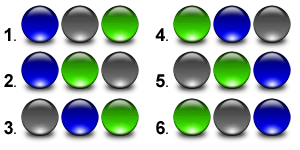
Answer is 6.
In general, the number of ways to arrange n different objects in a row
Example #2
Q:. There are three marbles: 1 blue, 1 gray and 1 green. In how many ways is it possible to arrange marbles in a row if blue and green marbles have to be next to each other?
Solution: Let's write out all possible ways to arrange marbles in a row and then find only arrangements that satisfy question's condition:
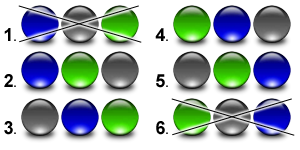
Answer is 4.
Example #3
Q:. There are three marbles: 1 blue, 1 gray and 1 green. In how many ways is it possible to arrange marbles in a row if gray marble have to be left to blue marble?
Solution: Let's write out all possible ways to arrange marbles in a row and then find only arrangements that satisfy question's condition:
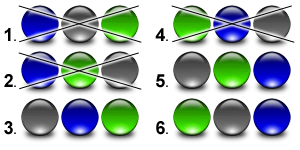
Answer is 3.
Arrangements of n different objects
Enumeration is a great way to count a small number of arrangements. But when the total number of arrangements is large, enumeration can't be very useful, especially taking into account GMAT time restriction. Fortunately, there are some methods that can speed up counting of all arrangements.
The number of arrangements of n different objects in a row is a typical problem that can be solve this way:
1. How many objects we can put at 1st place? n.
2. How many objects we can put at 2nd place? n - 1. We can't put the object that already placed at 1st place.
.....
n. How nany objects we can put at n-th place? 1. Only one object remains.
Therefore, the total number of arrangements of n different objects in a row is
\(N = n*(n-1)*(n-2)....2*1 = n!\)
Combination
A combination is an unordered collection of k objects taken from a set of n distinct objects. The number of ways how we can choose k objects out of n distinct objects is denoted as:
\(C^n_k\)
knowing how to find the number of arrangements of n distinct objects we can easily find formula for combination:
1. The total number of arrangements of n distinct objects is n!
2. Now we have to exclude all arrangements of k objects (k!) and remaining (n-k) objects ((n-k)!) as the order of chosen k objects and remained (n-k) objects doesn't matter.
\(C^n_k = \frac{n!}{k!(n-k)!}\)
Permutation
A permutation is an ordered collection of k objects taken from a set of n distinct objects. The number of ways how we can choose k objects out of n distinct objects is denoted as:
\(P^n_k\)
knowing how to find the number of arrangements of n distinct objects we can easily find formula for combination:
1. The total number of arrangements of n distinct objects is n!
2. Now we have to exclude all arrangements of remaining (n-k) objects ((n-k)!) as the order of remained (n-k) objects doesn't matter.
\(P^n_k = \frac{n!}{(n-k)!}\)
If we exclude order of chosen objects from permutation formula, we will get combination formula:
\(\frac{P^n_k}{k!} = C^n_k\)
Circular arrangements
Let's say we have 6 distinct objects, how many relatively different arrangements do we have if those objects should be placed in a circle.
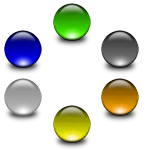
The difference between placement in a row and that in a circle is following: if we shift all object by one position, we will get different arrangement in a row but the same relative arrangement in a circle. So, for the number of circular arrangements of n objects we have:
\(R = \frac{n!}{n} = (n-1)!\)
Tips and Tricks
Any problem in Combinatorics is a counting problem. Therefore, a key to solution is a way how to count the number of arrangements. It sounds obvious but a lot of people begin approaching to a problem with thoughts like "Should I apply C- or P- formula here?". Don't fall in this trap: define how you are going to count arrangements first, realize that your way is right and you don't miss something important, and only then use C- or P- formula if you need them.
Resources
Walker's post with Combinatorics/probability problems: Combinatorics/probability Problems
Practice Questions
Easy:
1. https://gmatclub.com/forum/there-are-8- ... 34582.html
2. https://gmatclub.com/forum/there-are-5- ... 88100.html
3. https://gmatclub.com/forum/a-certain-un ... 68638.html
4. https://gmatclub.com/forum/the-diagram- ... 44271.html
5. https://gmatclub.com/forum/in-a-tournam ... 55939.html
6. https://gmatclub.com/forum/how-many-way ... 47677.html
7. https://gmatclub.com/forum/in-how-many- ... 05506.html
8. https://gmatclub.com/forum/a-certain-ba ... 98055.html
9. https://gmatclub.com/forum/how-many-dif ... 54633.html
10. https://gmatclub.com/forum/if-a-person- ... 24843.html
Medium:
1. https://gmatclub.com/forum/the-letters- ... 20320.html
2. https://gmatclub.com/forum/team-a-and-t ... 41461.html
3. https://gmatclub.com/forum/the-subsets- ... 08256.html
4. https://gmatclub.com/forum/each-in-the- ... 95162.html
5. https://gmatclub.com/forum/a-company-th ... 68427.html
6. https://gmatclub.com/forum/clarissa-wil ... 42452.html
7. https://gmatclub.com/forum/in-the-table ... 66572.html
8. https://gmatclub.com/forum/if-a-code-wo ... 26652.html
9. https://gmatclub.com/forum/how-many-two ... 28130.html
10. https://gmatclub.com/forum/john-has-12- ... 07307.html
Hard:
1. https://gmatclub.com/forum/pat-will-wal ... 68374.html
2. https://gmatclub.com/forum/five-integer ... 05923.html
3. https://gmatclub.com/forum/in-how-many- ... 85707.html
4. https://gmatclub.com/forum/how-many-fiv ... 91597.html
5. https://gmatclub.com/forum/nine-family- ... 75071.html
6. https://gmatclub.com/forum/how-many-pos ... 55804.html
7. https://gmatclub.com/forum/how-many-odd ... 94655.html
8. https://gmatclub.com/forum/how-many-dif ... 71774.html
9. https://gmatclub.com/forum/a-committee- ... 04966.html
10. https://gmatclub.com/forum/in-how-many- ... 56400.html
created by: walker
edited by: bb, Bunuel
Definition
Combinatorics is the branch of mathematics studying the enumeration, combination, and permutation of sets of elements and the mathematical relations that characterize their properties.
Enumeration
Enumeration is a method of counting all possible ways to arrange elements. Although it is the simplest method, it is often the fastest method to solve hard GMAT problems and is a pivotal principle for any other combinatorial method. In fact, combination and permutation is shortcuts for enumeration. The main idea of enumeration is writing down all possible ways and then count them. Let's consider a few examples:
Example #1
Q:. There are three marbles: 1 blue, 1 gray and 1 green. In how many ways is it possible to arrange marbles in a row?
Solution: Let's write out all possible ways:
Answer is 6.
In general, the number of ways to arrange n different objects in a row
Example #2
Q:. There are three marbles: 1 blue, 1 gray and 1 green. In how many ways is it possible to arrange marbles in a row if blue and green marbles have to be next to each other?
Solution: Let's write out all possible ways to arrange marbles in a row and then find only arrangements that satisfy question's condition:
Answer is 4.
Example #3
Q:. There are three marbles: 1 blue, 1 gray and 1 green. In how many ways is it possible to arrange marbles in a row if gray marble have to be left to blue marble?
Solution: Let's write out all possible ways to arrange marbles in a row and then find only arrangements that satisfy question's condition:
Answer is 3.
Arrangements of n different objects
Enumeration is a great way to count a small number of arrangements. But when the total number of arrangements is large, enumeration can't be very useful, especially taking into account GMAT time restriction. Fortunately, there are some methods that can speed up counting of all arrangements.
The number of arrangements of n different objects in a row is a typical problem that can be solve this way:
1. How many objects we can put at 1st place? n.
2. How many objects we can put at 2nd place? n - 1. We can't put the object that already placed at 1st place.
.....
n. How nany objects we can put at n-th place? 1. Only one object remains.
Therefore, the total number of arrangements of n different objects in a row is
\(N = n*(n-1)*(n-2)....2*1 = n!\)
Combination
A combination is an unordered collection of k objects taken from a set of n distinct objects. The number of ways how we can choose k objects out of n distinct objects is denoted as:
\(C^n_k\)
knowing how to find the number of arrangements of n distinct objects we can easily find formula for combination:
1. The total number of arrangements of n distinct objects is n!
2. Now we have to exclude all arrangements of k objects (k!) and remaining (n-k) objects ((n-k)!) as the order of chosen k objects and remained (n-k) objects doesn't matter.
\(C^n_k = \frac{n!}{k!(n-k)!}\)
Permutation
A permutation is an ordered collection of k objects taken from a set of n distinct objects. The number of ways how we can choose k objects out of n distinct objects is denoted as:
\(P^n_k\)
knowing how to find the number of arrangements of n distinct objects we can easily find formula for combination:
1. The total number of arrangements of n distinct objects is n!
2. Now we have to exclude all arrangements of remaining (n-k) objects ((n-k)!) as the order of remained (n-k) objects doesn't matter.
\(P^n_k = \frac{n!}{(n-k)!}\)
If we exclude order of chosen objects from permutation formula, we will get combination formula:
\(\frac{P^n_k}{k!} = C^n_k\)
Circular arrangements
Let's say we have 6 distinct objects, how many relatively different arrangements do we have if those objects should be placed in a circle.
The difference between placement in a row and that in a circle is following: if we shift all object by one position, we will get different arrangement in a row but the same relative arrangement in a circle. So, for the number of circular arrangements of n objects we have:
\(R = \frac{n!}{n} = (n-1)!\)
Tips and Tricks
Any problem in Combinatorics is a counting problem. Therefore, a key to solution is a way how to count the number of arrangements. It sounds obvious but a lot of people begin approaching to a problem with thoughts like "Should I apply C- or P- formula here?". Don't fall in this trap: define how you are going to count arrangements first, realize that your way is right and you don't miss something important, and only then use C- or P- formula if you need them.
Resources
Walker's post with Combinatorics/probability problems: Combinatorics/probability Problems
Practice Questions
Easy:
1. https://gmatclub.com/forum/there-are-8- ... 34582.html
2. https://gmatclub.com/forum/there-are-5- ... 88100.html
3. https://gmatclub.com/forum/a-certain-un ... 68638.html
4. https://gmatclub.com/forum/the-diagram- ... 44271.html
5. https://gmatclub.com/forum/in-a-tournam ... 55939.html
6. https://gmatclub.com/forum/how-many-way ... 47677.html
7. https://gmatclub.com/forum/in-how-many- ... 05506.html
8. https://gmatclub.com/forum/a-certain-ba ... 98055.html
9. https://gmatclub.com/forum/how-many-dif ... 54633.html
10. https://gmatclub.com/forum/if-a-person- ... 24843.html
1. https://gmatclub.com/forum/the-letters- ... 20320.html
2. https://gmatclub.com/forum/team-a-and-t ... 41461.html
3. https://gmatclub.com/forum/the-subsets- ... 08256.html
4. https://gmatclub.com/forum/each-in-the- ... 95162.html
5. https://gmatclub.com/forum/a-company-th ... 68427.html
6. https://gmatclub.com/forum/clarissa-wil ... 42452.html
7. https://gmatclub.com/forum/in-the-table ... 66572.html
8. https://gmatclub.com/forum/if-a-code-wo ... 26652.html
9. https://gmatclub.com/forum/how-many-two ... 28130.html
10. https://gmatclub.com/forum/john-has-12- ... 07307.html
1. https://gmatclub.com/forum/pat-will-wal ... 68374.html
2. https://gmatclub.com/forum/five-integer ... 05923.html
3. https://gmatclub.com/forum/in-how-many- ... 85707.html
4. https://gmatclub.com/forum/how-many-fiv ... 91597.html
5. https://gmatclub.com/forum/nine-family- ... 75071.html
6. https://gmatclub.com/forum/how-many-pos ... 55804.html
7. https://gmatclub.com/forum/how-many-odd ... 94655.html
8. https://gmatclub.com/forum/how-many-dif ... 71774.html
9. https://gmatclub.com/forum/a-committee- ... 04966.html
10. https://gmatclub.com/forum/in-how-many- ... 56400.html
Show SpoilerImages
Attachment: Math_Combinatorics_6balls.png [ 28.14 KiB | Viewed 312607 times ] | Attachment: Math_Combinatorics_6balls_b.png [ 41.17 KiB | Viewed 312559 times ] | Attachment: Math_Combinatorics_6balls_l.png [ 43.99 KiB | Viewed 312432 times ] |
Attachment: Math_Comb_Round_t.png [ 17.02 KiB | Viewed 310130 times ] |


 20 Sep 2010, 11:22
Kudos
Bookmarks
walker
Here are some notes on choosing subsets, which might serve as a good addition. Hope you find this useful.
Choosing subsets & their applications
Combinatorial questions almost always deal with counting certain kinds of subsets of a given set in question. For instance, the popular C(n,r) formula is used to count the number of ways to pick up r objects from a set of n objects. This is basically the same as asking the question : "If a set A contains n objects, how many subsets of A contain exactly r objects ?". Notice that we cannot use P(n,r) to count these subsets since that involves counting the ordering as well, which is irrelevant when it comes to sets ({1,2,3} is same as {3,2,1}).
An interesting and useful extension of this way of thinking about counting presents itself when we encounter a group of problems where we need to count all the possible subsets of a set. Consider the following question :
There is a basket with 5 different fruits inside. A child is given the basket and he may pick out none, one or more of the fruits. In how many ways can this choice be made ?
In this question if we an count all the possible subsets of the basket of fruits, then each subset represents one way of choosing, and hence the answer to the question.
Solution 1
Think of each fruit as a yes/no question that the child is answering. "Will this fruit be picked ?". There are 2 ways to answer that question. There are 5 fruits in all and hence, 5 yes/no questions. Each set of answers [y n y n n], [y y n n n], etc represents a way of picking. In all the number of ways would be 2x2x2x2x2=2^5
Solution 2
An alternate method is to consider the cases, that the child picks 0 fruit, picks 1 fruit, ... picks 5 fruits. And sum the possibility
This method will yield the answer to be C(5,0)+C(5,1)+C(5,2)+C(5,3)+C(5,4)+C(5,5). If you calculate this sum, it is exactly equal to 2^5
Lets now look at a special case where, the objects we are picking from are identical to each other. Consider the following question :
There is a basket with 5 identical balls. A child is given the basket and he may pick out none, one or more of the balls. In how many ways can this choice be made ?
Notice the subtlety in this question, the objects to be picked out are identical to each other. So unlike the previous case where choosing just fruit#1 is a different choice to choosing just fruit#2, here choosing one ball or the other ball constitutes the same choice as long as only 1 ball is picked because the balls are indistinguishable
Solution
Since the balls are identical, the number of ways to pick them is defined merely by the number of balls you pick. So the different ways are "pick 0 balls", "pick 1 ball", ... "pick 5 balls". The answer therefore is 5+1 (The plus 1 giving the case where you pick 0 balls)
Finally we should consider the special case where we need to pick objects out of a set such that a few of the objects are identical to each other.
There is a basket with 4 blue balls, 3 red balls and 2 yellow balls. The balls of the same color are identical. How many ways can a child pick balls out of this basket ?
Solution
We combine techniques from the 2 cases above. Consider the blue balls as one entity and instead of asking the yes/no question, ask the question how many ways to choose the balls ? This is answered using the second case, and the answer is (4+1). Combining this with the ways to choose red and yellow balls, the overall ways to choose balls would be (4+1)*(3+1)*(2+1).
Formula Summary
Number of ways to pick 0 or more objects from n non-identical objects = \(2^n\)
Number of ways to pick 1 or more objects from n non-identical objects = \(2^n - 1\)
Number of ways to pick 0 or more objects from n identical objects = \(n+1\)
Number of ways to pick 1 or more objects from n identical objects = \(n\)
Number of ways to pick 0 or more objects from n objects of which n1 are identical, n2 are identical, ... ,nk are identical, such that n is n1+..+nk = \((n1+1)*(n2+1)*...*(nk+1)\)
Number of ways to pick 1 or more objects from n objects of which n1 are identical, n2 are identical, ... ,nk are identical, such that n is n1+..+nk = \((n1+1)*(n2+1)*...*(nk+1) - 1\)
Typical Applications
Here are just a couple of questions of this type :
How many factors does a number n have ?
Consider the prime factorization of n. Let this be :
\(n=p_1^{a1} p_2^{a2} ... p_n^{an}\)
Any factor of n will be of the form
\(m=p_1^{b1} p_2^{b2} ... p_n^{bn}\) where \(0<=b_i<=a_i\) & \(1<=i<=n\)
To count the number of factors, we need to count all the products of p1,...,pn such that the exponent is less than or equal to ai. This is just case 3. We just count per factor, how many ways to select p1, p2, ....
Answer is (a1+1)*(a2+1)* .... *(an+1)
In a class of 10 students, in how many ways can you form a academic committee, if the committee must contain a minimum of 2 students ?
Total number of ways to form committees (case 1) = 2^10
Number of ways to form of size 0 = 1
Number of ways to form of size 1 = 10 (each student picked one at a time)
So no of ways = 1024 -1 -10 = 1013
General Discussion
 17 Aug 2010, 06:30
Kudos
Bookmarks
Walker,
How come no updates on this chapter? If you're too busy to complete it, could you let me know what additional concepts to add? I could send a draft to you...?!
How come no updates on this chapter? If you're too busy to complete it, could you let me know what additional concepts to add? I could send a draft to you...?!