Events & Promotions
|
|

GMAT Club Daily Prep
Thank you for using the timer - this advanced tool can estimate your performance and suggest more practice questions. We have subscribed you to Daily Prep Questions via email.
Customized
for You
Track
Your Progress
Practice
Pays
Not interested in getting valuable practice questions and articles delivered to your email? No problem, unsubscribe here.
 Sep 28
07:00 PM EDT
-10:00 PM EDT
Boost your GMAT score in less than one month in a live online class + 6 months access to TTP OnDemand video courses included! Class starts Mon, Tues, Wed, Thur, Fri Sept. 28, 2026 - Oct. 16, 2027, 7:00pm-10:00pm EST Sep 29
11:00 AM EDT
-01:00 PM EDT
" Description: Top scores are possible when you enroll in a powerful GMAT course, taught live online + 6 months access to TTP OnDemand video courses included! Class starts Tues/Thur Sept. 29, 2026 - Dec. 3, 2026, 11:00am-1:00pm EST Oct 01
07:00 AM BST
-08:00 AM GMT
Welcome to the GMAT Club's Free Interview Prep Event for Top MBA Programs! Buy tickets - Virtual series that’s all set to equip you to -excel in your MBA interviews. Oct 03
01:00 PM EDT
-04:00 PM EDT
Top scores are possible when you enroll in a powerful GMAT course, taught live online + 6 months access to TTP OnDemand video courses included! Class starts Saturdays Oct. 3, 2026 - Dec. 26, 2026, 1:00pm-4:00pm EST

 06 Jul 2021, 10:18
Kudos
Bookmarks
What is a GMAT Data Sufficiency Question?
Of the quant question types on the GMAT, Data Sufficiency (DS) questions very well may be the most feared by new GMAT students. Even though you don’t need to calculate a “numerical” answer for a DS question, successfully solving these questions takes a combination of quantitative knowledge, critical thinking, and analytical skills. The good news is that after reading this article, you will see that DS questions do not actually need to be feared.
Now, you may be wondering, what exactly is a Data Sufficiency question?
What Are GMAT Data Sufficiency Questions?
Data Sufficiency questions constitute about one-third of the quant questions on the GMAT. So, of the 31 questions on the GMAT quantitative section, you can expect to see 10-12 DS questions. Thus, when preparing for the GMAT, spending a fair amount of time mastering this question type will be an investment that pays big dividends.
At the most basic level, a Data Sufficiency question begins with a question stem that contains a question and some optional information followed by two statements (Statement One and Statement Two). Your job is to determine whether you have enough information to answer the question in the stem.
DS questions are one way that the GMAT tests your ability to use logic and decision-making skills in a mathematical setting. A DS question is a blend of math and information processing, a tough combination, especially when you’re taking an intense exam and you’re in a time crunch.
If you’re a bit nervous so far, rest assured: With the right approach and a healthy dose of practice, GMAT Data Sufficiency questions can become not only something you excel at but also a question type that you are happy to see on test day.
Before we explore the various types of Data Sufficiency questions, let’s start by taking a look at the 5 standard answer choices that are given for every DS question.
The Data Sufficiency Answer Choices
Data Sufficiency questions have 5 possible answer choices: A, B, C, D, and E. These answer choices are the same for every DS question, so memorizing them will save you valuable time on the GMAT. The answer choices are as follows:
- Answer A: Statement (1) ALONE is sufficient, but statement (2) alone is not sufficient to answer the question asked.
- Answer B: Statement (2) ALONE is sufficient, but statement (1) alone is not sufficient to answer the question asked.
- Answer C: BOTH statements (1) and (2) TOGETHER are sufficient to answer the question asked, but NEITHER statement ALONE is sufficient to answer the question asked.
- Answer D: EACH statement ALONE is sufficient to answer the question asked.
- Answer E: Statements (1) and (2) TOGETHER are NOT sufficient to answer the question asked, and additional data specific to the problem are needed.
Now we’re ready to practice an example of a Data Sufficiency question.
How to Analyze GMAT Data Sufficiency Questions
To see how we can analyze GMAT Data Sufficiency Questions, let’s take a look at an example.
The following DS question provides a question stem in the form of a brief question. The two statements that follow the question provide information that may or may not be enough for you to be able to definitively answer that question. Let’s get started.
Example 1
What is Howard’s current age?
(1) Howard is twice as old as Olivia.
(2) Olivia is 5 years old.
Solution:
Note that the question stem is asking Howard’s age. This stem is followed by two statements labeled (1) and (2), respectively. Your first job is to decide whether statement (1) alone gives sufficient information to answer the question about Howard’s age. Then, you will need to decide whether statement (2) alone gives sufficient information to answer the question. Let’s consider each of the statements in isolation.
Statement One Alone:
Howard is twice as old as Olivia.
We are told that Howard is twice as old as Olivia. But, since we don’t know Olivia’s age, we can’t calculate Howard’s age. Thus, we say that statement (1) by itself is NOT SUFFICIENT to answer the question.
Statement Two Alone:
Olivia is 5 years old.
Knowing only that Olivia is 5 years old doesn’t give us enough information to determine Howard’s age. Thus, we say that statement (2) by itself is NOT SUFFICIENT to answer the question.
Since neither statement by itself allows us to determine Howard’s age, we next will evaluate both statements together to see whether we can answer the question.
Both Statements Together:
From statement (1), we see that Howard is twice as old as Olivia, and from statement (2), we see that Olivia is 5 years old. If we combine the information from both statements, we can deduce that Howard is 10 years old. Thus, both statements together are SUFFICIENT to answer the question.
The answer is C: BOTH statements (1) and (2) TOGETHER are sufficient to answer the question asked, but NEITHER statement ALONE is sufficient to answer the question asked.
That question was simpler than the examples you will generally see on the GMAT. But it was an important example to show you the logic of answering a DS question. Let’s now discuss how to eliminate answer choices as we work through the statements in a DS question, so that we can more efficiently answer DS questions.
Eliminating Data Sufficiency Answer Choices
Because of the nature of GMAT Data Sufficiency questions, there is an efficient way to eliminate answer choices as you move through the statements in any given problem. To see how we can eliminate choices systematically, let’s refer to the diagram below.
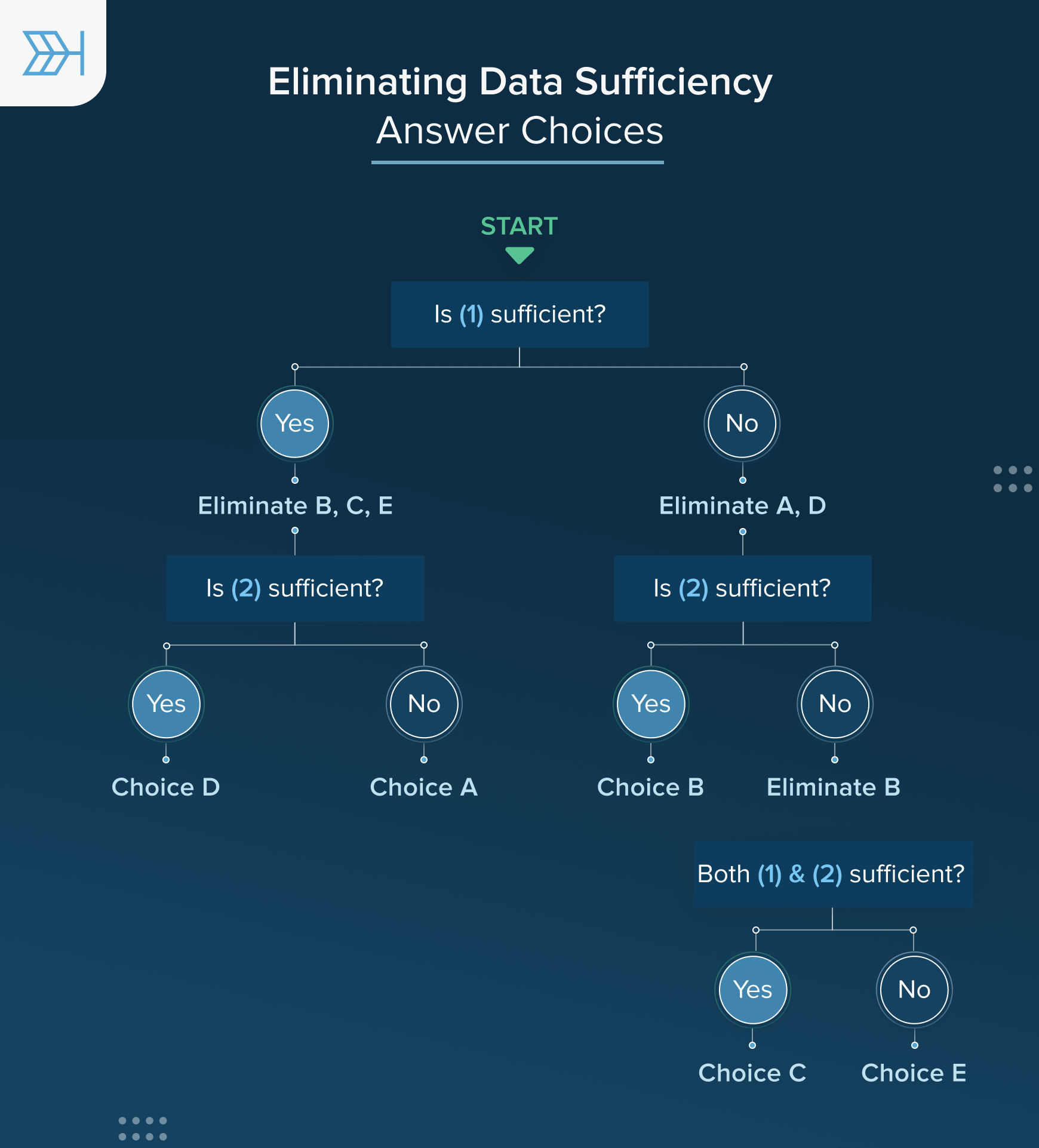
There are various scenarios in which you will be able to eliminate certain answer choices. Let’s walk through those scenarios now.
Scenario 1:
- If statement one alone is sufficient, you can eliminate answers B, C, and E, because each of these answer choices requires statement one to not be sufficient alone. Then, you move to statement two.
- If statement two is sufficient, the answer is D.
- If statement two is not sufficient, the answer is A.
Scenario 2:
- If statement one alone is not sufficient, you can eliminate answers A and D, because both of these answer choices require statement one to be sufficient alone. Then, you move to statement two.
- If statement two is sufficient, the answer is B.
- If statement two is not sufficient, then the statements must be analyzed together. If when analyzing them together the two statements are sufficient, the answer is C. If when analyzing them together the two statements are still not sufficient, the answer is E.
To read the complete article, please click here.
Get Started Now! 5-Day Trial For Just $1

Archived Topic
Hi there,
This topic has been closed and archived due to inactivity or violation of community quality standards. No more replies are possible here.
Where to now? Join ongoing discussions on thousands of quality questions in our Quantitative Questions Forum
Still interested in this question? Check out the "Best Topics" block below for a better discussion on this exact question, as well as several more related questions.
Thank you for understanding, and happy exploring!

 16 Jul 2021, 23:03
Kudos
Bookmarks
The quant master speaks! Looks like a great article for anyone seeking to get the basics of DS down.
 30 Oct 2023, 06:18
Kudos
Bookmarks
Automated notice from GMAT Club BumpBot:
A member just gave Kudos to this thread, showing it’s still useful. I’ve bumped it to the top so more people can benefit. Feel free to add your own questions or solutions.
This post was generated automatically.
A member just gave Kudos to this thread, showing it’s still useful. I’ve bumped it to the top so more people can benefit. Feel free to add your own questions or solutions.
This post was generated automatically.
Archived Topic
Hi there,
This topic has been closed and archived due to inactivity or violation of community quality standards. No more replies are possible here.
Where to now? Join ongoing discussions on thousands of quality questions in our Quantitative Questions Forum
Still interested in this question? Check out the "Best Topics" block above for a better discussion on this exact question, as well as several more related questions.
Thank you for understanding, and happy exploring!




