Events & Promotions
|
|

GMAT Club Daily Prep
Thank you for using the timer - this advanced tool can estimate your performance and suggest more practice questions. We have subscribed you to Daily Prep Questions via email.
Customized
for You
Track
Your Progress
Practice
Pays
Not interested in getting valuable practice questions and articles delivered to your email? No problem, unsubscribe here.
 Sep 26
01:00 PM EDT
-04:00 PM EDT
Top scores are possible when you enroll in a powerful GMAT course, taught live online + 6 months access to TTP OnDemand video courses included. Class starts Saturdays Sept. 26, 2026 - Dec. 19, 2026, 1:00pm-4:00pm ES Sep 28
07:00 PM EDT
-10:00 PM EDT
Boost your GMAT score in less than one month in a live online class + 6 months access to TTP OnDemand video courses included! Class starts Mon, Tues, Wed, Thur, Fri Sept. 28, 2026 - Oct. 16, 2027, 7:00pm-10:00pm EST Sep 29
11:00 AM EDT
-01:00 PM EDT
" Description: Top scores are possible when you enroll in a powerful GMAT course, taught live online + 6 months access to TTP OnDemand video courses included! Class starts Tues/Thur Sept. 29, 2026 - Dec. 3, 2026, 11:00am-1:00pm EST Oct 01
07:00 AM BST
-08:00 AM GMT
Welcome to the GMAT Club's Free Interview Prep Event for Top MBA Programs! Buy tickets - Virtual series that’s all set to equip you to -excel in your MBA interviews.


 18 Jul 2023, 08:00
Kudos
Bookmarks


A
Be sure to select an answer first to save it in the Error Log before revealing the correct answer (OA)!
Difficulty:
 95%
(hard)
95%
(hard)
Question Stats:
34% (02:16) correct 66%
(02:18)
wrong
based on 325
sessions
66%
(02:18)
wrong
based on 325
sessions
History
Date
Time
Result
Not Attempted Yet
At a dinner party, 4 married couples are to be seated around a circular table. Two seating arrangements are considered different only when the positions of the people are different relative to each other. What is the total number of different possible seating arrangements for the group, if no two men should occupy adjacent seats and no husband and wife should occupy adjacent seats ?
A. 12
B. 14
C. 16
D. 24
E. 132

A. 12
B. 14
C. 16
D. 24
E. 132
|


Experience GMAT Club Test Questions
Yes, you've landed on a GMAT Club Tests question
Craving more? Unlock our full suite of GMAT Club Tests here
Want to experience more? Get a taste of our tests with our free trial today
Rise to the challenge with GMAT Club Tests. Happy practicing!


 18 Jul 2023, 09:04
Kudos
Bookmarks
Given: At a dinner party, 4 married couples are to be seated around a circular table. Two seating arrangements are considered different only when the positions of the people are different relative to each other.
Asked: What is the total number of different possible seating arrangements for the group, if no two men should occupy adjacent seats and no husband and wife should occupy adjacent seats ?
Since there are 4 married couples and total 2*4 = 8 persons seated around a circular table, and no two men should occupy adjacent seats
Number of ways to place 4 men around circular table = 3! = 6
The number of ways to place 4 wives around 4 husbands so that no husband and wife should occupy adjacent seats
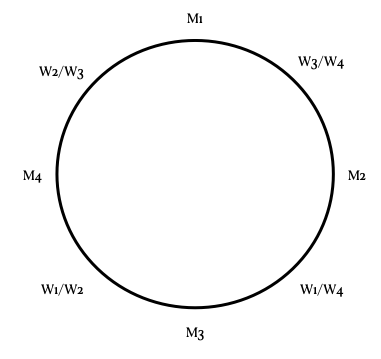
Screenshot 2023-07-18 at 9.28.35 PM.png [ 24.4 KiB | Viewed 7474 times ]
There are only 2 ways to place 4 wives around 4 husbands so that no husband and wife should occupy adjacent seats
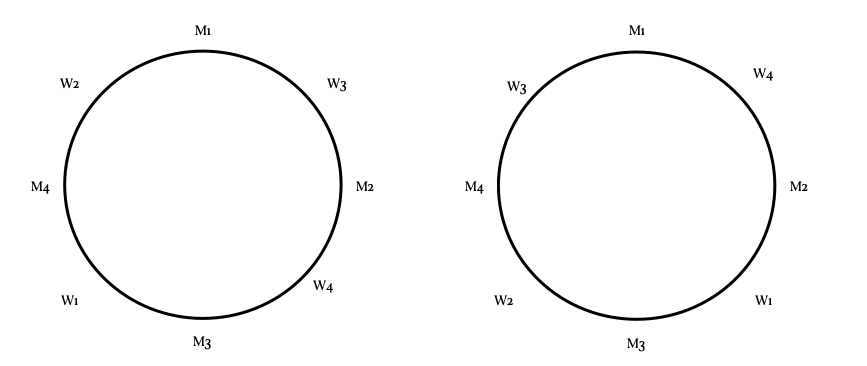
Screenshot 2023-07-18 at 9.29.58 PM.png [ 38.19 KiB | Viewed 7446 times ]
The total number of different possible seating arrangements for the group, so that no two men should occupy adjacent seats and no husband and wife should occupy adjacent seats = 3! * 2 = 6*2 = 12
IMO A
Asked: What is the total number of different possible seating arrangements for the group, if no two men should occupy adjacent seats and no husband and wife should occupy adjacent seats ?
Since there are 4 married couples and total 2*4 = 8 persons seated around a circular table, and no two men should occupy adjacent seats
Number of ways to place 4 men around circular table = 3! = 6
The number of ways to place 4 wives around 4 husbands so that no husband and wife should occupy adjacent seats
Attachment:
Screenshot 2023-07-18 at 9.28.35 PM.png [ 24.4 KiB | Viewed 7474 times ]
There are only 2 ways to place 4 wives around 4 husbands so that no husband and wife should occupy adjacent seats
Attachment:
Screenshot 2023-07-18 at 9.29.58 PM.png [ 38.19 KiB | Viewed 7446 times ]
The total number of different possible seating arrangements for the group, so that no two men should occupy adjacent seats and no husband and wife should occupy adjacent seats = 3! * 2 = 6*2 = 12
IMO A
General Discussion
 18 Jul 2023, 09:06
Kudos
Bookmarks
Bunuel
Refer to the diagram, the arrangement of no two men together can be done in this way
Let's place men first
Men can be placed in (4-1)! = 3! ways
Now when we are placing women
The first lady has the option of occupying 2 positions that are opposite to her husband
The rest of the ladies can only occupy one position each
You can try with various combinations
So total possible arrangements = 3! * 2 = 12
Ans A
Posted from my mobile device






