Events & Promotions
|
|

GMAT Club Daily Prep
Thank you for using the timer - this advanced tool can estimate your performance and suggest more practice questions. We have subscribed you to Daily Prep Questions via email.
Customized
for You
Track
Your Progress
Practice
Pays
Not interested in getting valuable practice questions and articles delivered to your email? No problem, unsubscribe here.
 Sep 24
01:30 AM EDT
-01:30 AM EDT
Tejas studied hard but kept repeating the same mistakes. After 3 attempts at 645, a focused 4-week strategy helped him identify and fix what was holding him back—leading to a 695 with just 12–15 hours of study per week. Sep 24
08:00 AM EDT
-08:30 AM EDT
Meet Tuck at an informal student or staff-hosted coffee chat in a city near you! Sep 23
12:30 AM EDT
-01:30 AM EDT
Learn how Keshav, a Chartered Accountant, scored an impressive 705 on GMAT in just 30 days with GMATWhiz's expert guidance. In this video, he shares preparation tips and strategies that worked for him, including the mock, time management, and more Sep 26
01:00 PM EDT
-04:00 PM EDT
Top scores are possible when you enroll in a powerful GMAT course, taught live online + 6 months access to TTP OnDemand video courses included. Class starts Saturdays Sept. 26, 2026 - Dec. 19, 2026, 1:00pm-4:00pm ES Sep 26
06:00 PM PDT
-07:00 PM PDT
Free- full-length test + 15 concept videos + 150+ short videos + study plan! Sep 29
11:00 AM EDT
-01:00 PM EDT
" Description: Top scores are possible when you enroll in a powerful GMAT course, taught live online + 6 months access to TTP OnDemand video courses included! Class starts Tues/Thur Sept. 29, 2026 - Dec. 3, 2026, 11:00am-1:00pm EST Oct 01
07:00 AM BST
-08:00 AM GMT
Welcome to the GMAT Club's Free Interview Prep Event for Top MBA Programs! Buy tickets - Virtual series that’s all set to equip you to -excel in your MBA interviews.


 02 Nov 2022, 07:08
Kudos
Bookmarks


N
Be sure to select an answer first to save it in the Error Log before revealing the correct answer (OA)!
Difficulty:
(N/A)
Question Stats:
0% (00:00) correct 0%
(00:00)
wrong
based on 0
sessions
0%
(00:00)
wrong
based on 0
sessions
History
Date
Time
Result
Not Attempted Yet
Alligation Made Easy
Alligation is a very strong tool/method that can be used to reduce a lot of calculations while solving questions in GMAT. However, many students have this common doubt that where can they use it and where they cannot. Let us understand this through this article.
Let us start this discussion with a question that is very common in GMAT mixture problems.
Question 1:
10 % acidic solution (by volume) is mixed with the 15 % acidic solution by volume to form a 13% acidic solution (by volume). What is the ratio of the quantity of the 13% solution to the 15% solution in the final solution?
Solution:
alligationGC.png [ 8.41 KiB | Viewed 5617 times ]
Always Alligation?
It brings us to the question of that can we use this method in every scenario.
Let us take another mixture problem:
Question 2:
Two types of rice costing $60 per kg and $40 per kg are mixed in a ratio 2: 3. What will be the cost per kg of mixed rice?
Solution:
alligationGC2.png [ 7.74 KiB | Viewed 5524 times ]
Alligation in other topics?
Alligation is generally associated with mixtures of questions
Question 3:
Mike invested a total of $25,000 in two accounts at simple interests of 8% and 12% respectively. The total interest he earned after a year is $2,600. What fraction of the total money was invested at the higher rate?
Solution:
alligationGC3.png [ 9.33 KiB | Viewed 5438 times ]
Having said that, one must have good clarity on the method and apply this method to different types of questions before trying them in the exam.
Alligation is a very strong tool/method that can be used to reduce a lot of calculations while solving questions in GMAT. However, many students have this common doubt that where can they use it and where they cannot. Let us understand this through this article.
Let us start this discussion with a question that is very common in GMAT mixture problems.
Question 1:
10 % acidic solution (by volume) is mixed with the 15 % acidic solution by volume to form a 13% acidic solution (by volume). What is the ratio of the quantity of the 13% solution to the 15% solution in the final solution?
Solution:
- There are two ways to go about this problem
- First is the orthodox way of taking variables:
- Let us assume the volume of 1st acid be \(x\) ml
- The volume of acid in this = 10% of \(x = \frac{10}{100}\times x=\frac{x}{10}\)
- And the volume of the 2nd acid be \(y\) ml
- The volume of acid in this = 15% of \(y = \frac{15}{100}\times y=\frac{3y}{20}\)
- Total acid mixed \(=\frac{x}{10}+\frac{3y}{20}=\frac{2x+3y}{20}\)
- This \(\frac{2x+3y}{20}\) ml acid happens to be 13% of the total solution which is \((x+y)\) ml
- Thus, we can write \(\frac{\frac{2x+3y}{20}}{x+y}=13\%\)
\(⇒\frac{2x+3y}{20(x+y)}=\frac{13}{100}\)
\(⇒\frac{2x+3y}{x+y}=\frac{13}{5}\)
\(⇒\frac{10x+15y}{x+y}=13\) - Does this look familiar? Yes, this is exactly what we do in the weighted average method
\(⇒10x+15y=13x+13y\)\(\)
\(⇒2y=3x\)\(\)
\(⇒\frac{x}{y}=\frac{2}{3}\) - So, the required answer is 2:3
- Let us assume the volume of 1st acid be \(x\) ml
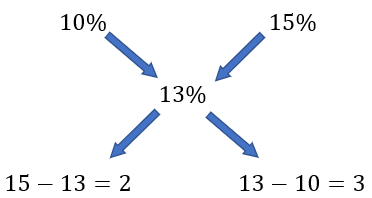
- The second way is the Alligation Method
- The concentration of the two solutions is 10% and 15%
- Whereas the concentration of the resulting mixture is 13%
- So, we can use the alligation method and say:
Attachment:
alligationGC.png [ 8.41 KiB | Viewed 5617 times ]
- The ratio of the quantity of 10% acetic solution to the 15% acetic acid = 2∶3
- So, you see how the alligation method made the solution to the problem so easy and quick
Always Alligation?
It brings us to the question of that can we use this method in every scenario.
Let us take another mixture problem:
Question 2:
Two types of rice costing $60 per kg and $40 per kg are mixed in a ratio 2: 3. What will be the cost per kg of mixed rice?
Solution:
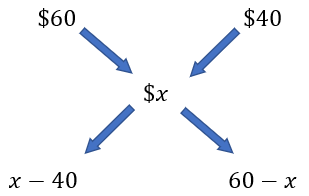
- Can we apply alligation to this question?
- Can we assume the price of the mixed rice to be $x per kg and make this diagram?
Attachment:
alligationGC2.png [ 7.74 KiB | Viewed 5524 times ]
- Now does this mean \(x-40=2\) and \(60-x=3?\)
- We can see that we are getting 2 different values of x above
- Thus, we cannot use alligation in this way here
- Well, we can still use these numbers by using proportions here as follows,
- \(\frac{x-40}{60-x}=\frac{2}{3}\)
\(⇒3x-120=120-2x\)
\(⇒5x=240\)
\(⇒x=48\)
- \(\frac{x-40}{60-x}=\frac{2}{3}\)
- So, the final concentration or the price of the mix will be $48 per kg
- The point to be noted here is that all mixture questions need not be tackled with the alligation method
Alligation in other topics?
Alligation is generally associated with mixtures of questions
- Now is this method only limited to topics such as mixtures?
- Let us look at a question based on ‘interests’ and see how the method of alligation can be applied there:
Question 3:
Mike invested a total of $25,000 in two accounts at simple interests of 8% and 12% respectively. The total interest he earned after a year is $2,600. What fraction of the total money was invested at the higher rate?
Solution:
- Now, we can get assume the money invested at 8% is x and money invested at 12% is 25000 – x and form an equation and solve it to get our answer
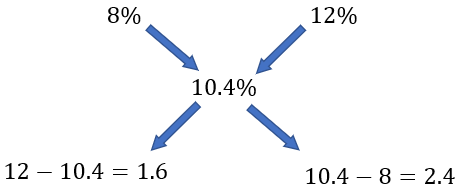
- However, there is a quicker way using alligation. Let us see
- The total interest earned is \($2,600\) which is \(\frac{2600}{25000}=10.4\)% of the total investment
Attachment:
alligationGC3.png [ 9.33 KiB | Viewed 5438 times ]
- Fraction of total money that was invested at a higher rate i.e., 12% \(=\frac{2.4}{2.4+1.6}=\frac{2.4}{4}=\frac{3}{5}\)
- Hence the right answer is \(\frac{3}{3+5}=\frac{3}{8}\)
- From this, we can understand that the alligation method does not only need to be associated with mixture problems but can also be used to solve a lot of other questions where the proportionality works in a straightforward way
Having said that, one must have good clarity on the method and apply this method to different types of questions before trying them in the exam.