Events & Promotions
|
|

GMAT Club Daily Prep
Thank you for using the timer - this advanced tool can estimate your performance and suggest more practice questions. We have subscribed you to Daily Prep Questions via email.
Customized
for You
Track
Your Progress
Practice
Pays
Not interested in getting valuable practice questions and articles delivered to your email? No problem, unsubscribe here.
 Sep 02
01:00 PM EDT
-11:59 PM EDT
Take 30% off all study plans with code COURSEWORK - Expires on Monday 9/7 Sep 04
10:00 AM PDT
-11:00 AM PDT
What does test anxiety really look like on the GMAT? For many test takers, it does not look like a panic attack. Instead, it shows up as brain fog, rereading, negative comparisons, mental noise.... Sep 06
09:30 AM EDT
-12:30 PM EST
Top scores are possible when you enroll in a powerful EA course, taught live online + 6 months access to TTP OnDemand video courses included! Perfect class schedule and easy course access for working professionals. Class starts Sundays Sept. 6, 2026.- Sep 07
12:01 AM PDT
-11:59 PM PDT
On the 7th, GMAT Club Tests will be Free! Including all the Quizzes, Questions, and Tests. 12 AM - 11:59 PM PDT - Sep 09
07:00 AM PDT
-10:00 AM PDT
Meet AdComs and explore top Master’s programs - MiM, MiF, MSc, MSBA and more. - Application Fee Waivers - Free 1-Week of GMAT Club Tests: - Master's Application Toolkit - Grand Prize Giveaway  Sep 15
07:00 PM EDT
-09:00 PM EST
Elite scores are possible when you enroll in a powerful GMAT course, taught live online + 6 months access to TTP OnDemand video courses included! Class starts Tues/Thurs Sept. 15, 2026 - Nov. 15, 2027, 7:00pm-9:00pm EST Sep 21
08:00 PM EDT
-10:00 PM EDT
Boost your GMAT score in less than one month in a live online class + 6 months access to TTP OnDemand video courses included! Class starts Mon, Tues, Wed, Thur, Fri Sept. 21, 2026 - Oct. 9, 2027, 7:00pm-10:00pm EST


 Updated on: 12 Mar 2026, 07:01
Originally posted by RonPurewal on 23 Feb 2026, 22:12.
Last edited by Bunuel on 12 Mar 2026, 07:01, edited 1 time in total.
Last edited by Bunuel on 12 Mar 2026, 07:01, edited 1 time in total.
Kudos
Bookmarks


Dropdown 1: 5
Dropdown 2: 1 empty lipstick
Be sure to select an answer first to save it in the Error Log before revealing the correct answer (OA)!
Difficulty:
 95%
(hard)
95%
(hard)
Question Stats:
42% (02:43) correct 58%
(02:25)
wrong
based on 400
sessions
58%
(02:25)
wrong
based on 400
sessions
History
Date
Time
Result
Not Attempted Yet
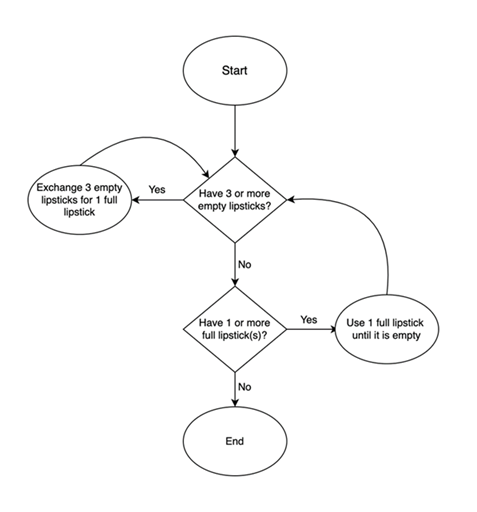
A drugstore chain can return empty lipsticks that it originally sold to the supplier for recycling. To encourage customers to return their empty lipsticks to its stores rather than throw them in the trash, the drugstore chain has instituted a new policy allowing customers to bring empty lipsticks to a store and exchange them for a new, full lipstick, as shown in the diagram.
Select from each drop-down menu the option that creates the most accurate statement based on the information provided.
Dara has 11 empty lipsticks originally purchased from this drugstore chain. If Dara exchanges these for new lipsticks under the store policy, wears the new lipsticks until they run out, and then repeats these actions (with the lipsticks that are now empty) to the fullest extent possible—without acquiring any additional lipsticks outside of the exchange program—then Dara will be able to acquire and wear new lipsticks, and will have upon reaching “End”.
ShowHide Answer
Official Answer
Dropdown 1: 5
Dropdown 2: 1 empty lipstick
I32-07
GMAT-Club-Forum-c1ne8vxk.png [ 42.35 KiB | Viewed 1269 times ]
Attachment:
GMAT-Club-Forum-c1ne8vxk.png [ 42.35 KiB | Viewed 1269 times ]
28 Feb 2026, 10:15
Kudos
Bookmarks
RonPurewal
Official Explanation:
The store’s program allows Dara to trade 3 empty lipsticks for 1 new full one, as shown by the “Yes” path at the first question. With 11 empty lipsticks to begin with, Dara will be able to make this exchange three times (following the “Yes” arrow and then looping back, three times each). In so doing, Dara will trade 9 empty lipsticks for 3 full ones—and thus will have 3 full and 2 empty lipsticks.
At this point, Dara will not be able to make another exchange. So Dara wears one of the new lipsticks until it runs out, at which point Dara will have 2 full and 3 empty lipsticks, and will have worn 1.
Dara can now trade those 3 empty lipsticks for an additional full one—ending up with 3 full lipsticks (and no empties).
At this point, Dara will wear all three of these lipsticks one by one. After wearing all three, Dara will have just the 3 empty lipsticks, and will now have worn 4 lipsticks total.
Dara can then trade those 3 empties for one last full lipstick, and then wear that lipstick—the fifth and final one that Dara can wear. Dara will then reach “End” with the empty container of this one last lipstick. So, Dara acquires and wears 5 lipsticks total, and reaches “End” wih 1 empty lipstick.
General Discussion
 24 Feb 2026, 01:40
Kudos
Bookmarks
RonPurewal
With 11 empty lipsticks,
Decision box : Have 3 or more empty lipsticks ? Yes
For 3 empty , you get a new one.
9 empty , you get 3 new ones.
So, now we are left with 2 Empty and 3 New.
So, now the Decision box : Have 3 or more empty lipsticks ? NO.
We use a new lipstick, so 3 empty and 2 new.
now the Decision box : Have 3 or more empty lipsticks ? yes.
So, the quantity becomes 0 empty and 3 new. ( added a new lipstick)
After using all the three, we get 3 empty, 0 new.
now the Decision box : Have 3 or more empty lipsticks ? yes.
0 empty and 1 new is what we add at final. After using , we have 1 empty.
Number of new sticks bought is :
3 (initially) + 1 in the middle and 1 at last = 3+1+1 = 5
Answer:
5 new lipsticks
1 Empty lipstick.








