Last visit was: 23 Apr 2026, 06:59 It is currently 23 Apr 2026, 06:59
Close
GMAT Club Daily Prep
Thank you for using the timer - this advanced tool can estimate your performance and suggest more practice questions. We have subscribed you to Daily Prep Questions via email.

Customized
for You

we will pick new questions that match your level based on your Timer History

Track
Your Progress

every week, we’ll send you an estimated GMAT score based on your performance

Practice
Pays

we will pick new questions that match your level based on your Timer History
Not interested in getting valuable practice questions and articles delivered to your email? No problem, unsubscribe here.
Close
Request Expert Reply
Confirm Cancel
User avatar
KarishmaB
Joined: 16 Oct 2010
Last visit: 23 Apr 2026
Posts: 16,441
Own Kudos:
79,393
 [81]
Given Kudos: 484
Location: Pune, India
Expert
Expert reply
Active GMAT Club Expert! Tag them with @ followed by their username for a faster response.
Posts: 16,441
Kudos: 79,393
 [81]
8
Kudos
Add Kudos
73
Bookmarks
Bookmark this Post
Most Helpful Reply
User avatar
KarishmaB
Joined: 16 Oct 2010
Last visit: 23 Apr 2026
Posts: 16,441
Own Kudos:
79,393
 [45]
Given Kudos: 484
Location: Pune, India
Expert
Expert reply
Active GMAT Club Expert! Tag them with @ followed by their username for a faster response.
Posts: 16,441
Kudos: 79,393
 [45]
14
Kudos
Add Kudos
30
Bookmarks
Bookmark this Post
User avatar
diebeatsthegmat
Joined: 18 Oct 2010
Last visit: 08 Jan 2012
Posts: 44
Own Kudos:
26
 [5]
Posts: 44
Kudos: 26
 [5]
5
Kudos
Add Kudos
Bookmarks
Bookmark this Post
General Discussion
User avatar
craky
Joined: 27 Jul 2010
Last visit: 29 Jan 2013
Posts: 101
Own Kudos:
323
 [1]
Given Kudos: 15
Location: Prague
Concentration: Finance
Schools:University of Economics Prague
GMAT 1: 700 Q48 V38
Posts: 101
Kudos: 323
 [1]
1
Kudos
Add Kudos
Bookmarks
Bookmark this Post
It would be good to specify whether they the salary they make is already taxed or not.

But anyway, is there any way to solve

(0.3*56000+0.4*72000)/(72000+56000)=0.35625

in hand?
avatar
santosh18
Joined: 16 Mar 2010
Last visit: 02 Apr 2012
Posts: 6
Own Kudos:
6
 [3]
Given Kudos: 3
Posts: 6
Kudos: 6
 [3]
3
Kudos
Add Kudos
Bookmarks
Bookmark this Post
Code:
Income            TAX
J - 56,000        16,800
I - 72,000        28,800
-----------------------
T- 128,000       45,600


Part              X
-----     =    ------
Whole           100

45,600             X
--------   =    -----
128,000          100

       45,600 * 100
X =  --------------
          128,000


       4560
X =  ------  = 35.6
        128

short cut

       4560               4560        456 
X =  ------  =(approx)  ------- =     ---- = 35.07
        128                130         13

As denominator has been increased answer choice should be greater than 35.07

So the Ans is 35.6%

avatar
mehtakaustubh
Joined: 11 Jul 2009
Last visit: 21 Jun 2022
Posts: 63
Own Kudos:
155
 [1]
Given Kudos: 83
WE:Design (Computer Software)
Posts: 63
Kudos: 155
 [1]
1
Kudos
Add Kudos
Bookmarks
Bookmark this Post
i go with
D
(0.3*56000+0.4*72000)/(72000+56000)=0.35625
User avatar
dkj1984
Joined: 28 Mar 2011
Last visit: 31 Jul 2011
Posts: 19
Own Kudos:
21
 [3]
Posts: 19
Kudos: 21
 [3]
3
Kudos
Add Kudos
Bookmarks
Bookmark this Post
Hi Karishma,

I really love the weighted averages shortcut method you use every time,but I get confused in using it.

In the problem above,please advise,why you have used 9:7 instead of 7:9?


Thanks!

regards,
User avatar
KarishmaB
Joined: 16 Oct 2010
Last visit: 23 Apr 2026
Posts: 16,441
Own Kudos:
79,393
 [4]
Given Kudos: 484
Location: Pune, India
Expert
Expert reply
Active GMAT Club Expert! Tag them with @ followed by their username for a faster response.
Posts: 16,441
Kudos: 79,393
 [4]
3
Kudos
Add Kudos
1
Bookmarks
Bookmark this Post
dkj1984
Hi Karishma,

I really love the weighted averages shortcut method you use every time,but I get confused in using it.

In the problem above,please advise,why you have used 9:7 instead of 7:9?


Thanks!

regards,

When we use the formula of weighted averages, we say that one quantity is A1 and its weight is w1. Another is A2 and its weight is w2. We have to find the average Aavg.
The formula is w1/w2 = (A2 - Aavg)/(Aavg - A1)

Notice that you have w1 in numerator on LHS and A2 in numerator on RHS.
avatar
dcastan2
Joined: 28 Apr 2012
Last visit: 25 Feb 2013
Posts: 13
Own Kudos:
Given Kudos: 51
Posts: 13
Kudos: 76
Kudos
Add Kudos
Bookmarks
Bookmark this Post
VeritasPrepKarishma
John and Ingrid pay 30% and 40% tax annually, respectively. If John makes $56000 and Ingrid makes $72000, what is their combined tax rate?

a. 32%
b. 34.4%
c. 35%
d. 35.6%
e. 36.4%

Great solution everyone! Yes, the answer is (D) 35.6.

Now let me explain why I like this question. The big numbers - 56000 and 72000 have limited utility. I could have as well given 86380 and 111060 as their salaries; I would have still obtained the same answer!
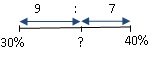
We need to find the weighted average of their tax rate. The important thing is their individual tax rates and the ratio of their salaries 7:9 (56000:72000), not the actual salaries
Attachment:
Ques1.jpg

The length between 30% and 40% i.e. 10% is split in the ratio 9:7.
So the average will be at (9/16)*10 + 30 = 35.6%.

So you don't have to do any long calculations. If there is a doubt in this method, check out this link:
https://gmatclub.com/forum/tough-ds-105651.html#p828579

When we want to find the average of lets say age of 2 groups - one group has average age of 30 yrs and there are 10 people in it and the other group has average age of 40 yrs and there are 40 people in it, all we need is the relative weights (relative number of people) in the two groups i.e. 1:4. It doesn't matter whether there are 10 and 40 people or 100 and 400 people... It's exactly the same concept here.

Let me know if there is a doubt in this concept.

and when we say, "A makes $100,000," we mean gross by default. Taxes are a part of your salary just like your other expenses.

I am lost at (9/16)*10 + 30 = 35.6%. where YOU add 30. I want to learn how to use this method completely so I can have it in my back pocket ready to use. I feel that we already found the ratio and then flipped it so it would be the distance and could put it in the chart. We divided 9/16 to find the middle number that was missing and multiplied by 10 because that was the weight? Is the only reason because 10+30 = the original 40?
User avatar
KarishmaB
Joined: 16 Oct 2010
Last visit: 23 Apr 2026
Posts: 16,441
Own Kudos:
Given Kudos: 484
Location: Pune, India
Expert
Expert reply
Active GMAT Club Expert! Tag them with @ followed by their username for a faster response.
Posts: 16,441
Kudos: 79,393
Kudos
Add Kudos
Bookmarks
Bookmark this Post
dcastan2

I am lost at (9/16)*10 + 30 = 35.6%. where YOU add 30. I want to learn how to use this method completely so I can have it in my back pocket ready to use. I feel that we already found the ratio and then flipped it so it would be the distance and could put it in the chart. We divided 9/16 to find the middle number that was missing and multiplied by 10 because that was the weight? Is the only reason because 10+30 = the original 40?

The distance between 30 and 40 i.e. 10 has to be split in the ratio 9:7. The average is 9 (of these 16 units) to the right of 30. So you find 9/16th of 10 which is 90/16 and add it to 30.

Before you work on this question, check out the links mentioned in the post above. I have discussed simpler numbers in them. They will give you a feel for the method. Thereafter, you can solve any question using this method.
User avatar
mbaiseasy
Joined: 13 Aug 2012
Last visit: 29 Dec 2013
Posts: 316
Own Kudos:
2,095
 [2]
Given Kudos: 11
Concentration: Marketing, Finance
GPA: 3.23
Posts: 316
Kudos: 2,095
 [2]
2
Kudos
Add Kudos
Bookmarks
Bookmark this Post
Using weighted averages...

(1) When 30 and 40 has equal weight or weight = 1/2, the answer would be 35.
(2) When 40 has larger weight than 30, the answer would be in between 35 and 40. Unfortunately, we have 2 answer choices D and E that fit that condition so we need to narrow down our range.
(3) Get 72000/128000 = 72/128 = 9/16. 9/16 is a little above 8/16 = 1/2. Thus, our answer is just a little above 35.

Answer: D

For details on Weighted Averages: Weighted Averages
User avatar
Narenn
User avatar
Major Poster
Joined: 22 Feb 2012
Last visit: 23 Apr 2026
Posts: 9,291
Own Kudos:
11,303
 [23]
Given Kudos: 4,711
Affiliations: GMAT Club
Test: Test
Posts: 9,291
Kudos: 11,303
 [23]
11
Kudos
Add Kudos
12
Bookmarks
Bookmark this Post
Here is another approach
Attachments

Untitled.png
Untitled.png [ 51.62 KiB | Viewed 21596 times ]

avatar
Asifpirlo
Joined: 10 Jul 2013
Last visit: 26 Jan 2014
Posts: 220
Own Kudos:
Given Kudos: 102
Posts: 220
Kudos: 1,195
Kudos
Add Kudos
Bookmarks
Bookmark this Post
VeritasPrepKarishma
John and Ingrid pay 30% and 40% tax annually, respectively. If John makes $56000 and Ingrid makes $72000, what is their combined tax rate?

A. 32%
B. 34.4%
C. 35%
D. 35.6%
E. 36.4%

It is one of my favorite problems from the Veritas Arithmetic book.. I like to use Weighted Averages here...

(0.3 * 56000 + 0.4 * 72000) / (72000 + 56000) = 0.356 = 35.6% = D (Answer)
User avatar
jlgdr
Joined: 06 Sep 2013
Last visit: 24 Jul 2015
Posts: 1,302
Own Kudos:
Given Kudos: 355
Concentration: Finance
Posts: 1,302
Kudos: 2,976
Kudos
Add Kudos
Bookmarks
Bookmark this Post
VeritasPrepKarishma
John and Ingrid pay 30% and 40% tax annually, respectively. If John makes $56000 and Ingrid makes $72000, what is their combined tax rate?

A. 32%
B. 34.4%
C. 35%
D. 35.6%
E. 36.4%

It is one of my favorite problems from the Veritas Arithmetic book.. I like to use Weighted Averages here...

Ratio is 56/72 = 8/9

Weighted average is therefore ((30)(8) + (40)(9))/17 = 600/17=35.6%

Hence answer is D

Hope it helps
Cheers!
J :)
User avatar
Raihanuddin
Joined: 11 Sep 2013
Last visit: 29 Aug 2021
Posts: 87
Own Kudos:
Given Kudos: 381
Concentration: Finance, Finance
Posts: 87
Kudos: 705
Kudos
Add Kudos
Bookmarks
Bookmark this Post
ratio of their salaries 7:9 (56000:72000)
30 40
X
40-x x-30
(40-x):(x-30) = 7: 9
X= 35.6%
User avatar
mvictor
User avatar
Board of Directors
Joined: 17 Jul 2014
Last visit: 14 Jul 2021
Posts: 2,118
Own Kudos:
Given Kudos: 236
Location: United States (IL)
Concentration: Finance, Economics
GMAT 1: 650 Q49 V30
GPA: 3.92
WE:General Management (Transportation)
Products:
GMAT 1: 650 Q49 V30
Posts: 2,118
Kudos: 1,276
Kudos
Add Kudos
Bookmarks
Bookmark this Post
VeritasPrepKarishma
John and Ingrid pay 30% and 40% tax annually, respectively. If John makes $56000 and Ingrid makes $72000, what is their combined tax rate?

a. 32%
b. 34.4%
c. 35%
d. 35.6%
e. 36.4%

Great solution everyone! Yes, the answer is (D) 35.6.

Now let me explain why I like this question. The big numbers - 56000 and 72000 have limited utility. I could have as well given 86380 and 111060 as their salaries; I would have still obtained the same answer!
We need to find the weighted average of their tax rate. The important thing is their individual tax rates and the ratio of their salaries 7:9 (56000:72000), not the actual salaries

Attachment:
Ques1.jpg

The length between 30% and 40% i.e. 10% is split in the ratio 9:7.
So the average will be at (9/16)*10 + 30 = 35.6%.

So you don't have to do any long calculations. If there is a doubt in this method, check out this link:
https://gmatclub.com/forum/tough-ds-105651.html#p828579

When we want to find the average of lets say age of 2 groups - one group has average age of 30 yrs and there are 10 people in it and the other group has average age of 40 yrs and there are 40 people in it, all we need is the relative weights (relative number of people) in the two groups i.e. 1:4. It doesn't matter whether there are 10 and 40 people or 100 and 400 people... It's exactly the same concept here.

Let me know if there is a doubt in this concept.

and when we say, "A makes $100,000," we mean gross by default. Taxes are a part of your salary just like your other expenses.

I always get messed up when trying to use this method...ended up the direct one...
56,000 = 100%
5,600=10%
11,200 = 20%
28,000 = 50%
16800 = 30%


72,000 = 100%
36,000 = 50%
7,200 = 10%
28,800 = 40%

now..
28,800+16,800=45600
total amount: 128,000

45,600/128,000 = 456/1280 = 228/640 = 114/320 = 57/160. clearly it is more than 33% since 60/180 is 1/3 or 33%. A is out right away...
now...long division....
57/160 = 0.35625

so 35.625%

closest one: D
User avatar
Kritisood
Joined: 21 Feb 2017
Last visit: 19 Jul 2023
Posts: 488
Own Kudos:
1,315
 [2]
Given Kudos: 1,090
Location: India
GMAT 1: 700 Q47 V39
Products:
GMAT 1: 700 Q47 V39
Posts: 488
Kudos: 1,315
 [2]
1
Kudos
Add Kudos
1
Bookmarks
Bookmark this Post
VeritasKarishma
John and Ingrid pay 30% and 40% tax annually, respectively. If John makes $56000 and Ingrid makes $72000, what is their combined tax rate?

A. 32%
B. 34.4%
C. 35%
D. 35.6%
E. 36.4%

It is one of my favorite problems from the Veritas Arithmetic book.. I like to use Weighted Averages here...

Diagrammatic approach
Attachments

IMG_1263.jpeg
IMG_1263.jpeg [ 64.25 KiB | Viewed 13683 times ]

User avatar
Basshead
Joined: 09 Jan 2020
Last visit: 07 Feb 2024
Posts: 907
Own Kudos:
Given Kudos: 431
Location: United States
Posts: 907
Kudos: 323
Kudos
Add Kudos
Bookmarks
Bookmark this Post
56,000 : 72,000
7: 9

72,000 is weighted more heavily so we can eliminate A, B, and C right off the bat.

9/16 * 10 = 5.625

30 + 5.625 = 35.625

Answer is D.
User avatar
rajatjoshi
Joined: 01 Dec 2024
Last visit: 02 Nov 2025
Posts: 1
Given Kudos: 15
Posts: 1
Kudos: 0
Kudos
Add Kudos
Bookmarks
Bookmark this Post
craky
It would be good to specify whether they the salary they make is already taxed or not.

But anyway, is there any way to solve

(0.3*56000+0.4*72000)/(72000+56000)=0.35625

in hand?
A better approach could be to first take the ratio of salaries which is 7:9 then find the weighted average of tax rate that is [30(7) + 40(9)]/(7 + 9) = 35.6%.

Hope this helps
User avatar
BKD5050
Joined: 26 Aug 2023
Last visit: 08 Feb 2026
Posts: 123
Own Kudos:
Given Kudos: 49
Posts: 123
Kudos: 25
Kudos
Add Kudos
Bookmarks
Bookmark this Post
Hi Karishma,

When to use alligation method and when to use scaling method or is it that both works on all such q types? Also how to quickly sense that we can use scaling method in the given question?
 1   2   
Moderators:
Math Expert
109778 posts
Tuck School Moderator
853 posts