Events & Promotions
|
|

GMAT Club Daily Prep
Thank you for using the timer - this advanced tool can estimate your performance and suggest more practice questions. We have subscribed you to Daily Prep Questions via email.
Customized
for You
Track
Your Progress
Practice
Pays
Not interested in getting valuable practice questions and articles delivered to your email? No problem, unsubscribe here.
 Sep 21
07:00 PM EDT
-10:00 PM EDT
Boost your GMAT score in less than one month in a live online class + 6 months access to TTP OnDemand video courses included! Sep 18
10:00 AM IST
-11:00 PM IST
Start your journey with a fully customized action plan and work with a dedicated mentor to achieve a 735+ score. Sep 26
01:00 PM EDT
-04:00 PM EDT
Top scores are possible when you enroll in a powerful GMAT course, taught live online + 6 months access to TTP OnDemand video courses included. Class starts Saturdays Sept. 26, 2026 - Dec. 19, 2026, 1:00pm-4:00pm ES


 25 Sep 2025, 05:47
Kudos
Bookmarks
Dropdown 1: Lab D
Dropdown 2: the same as
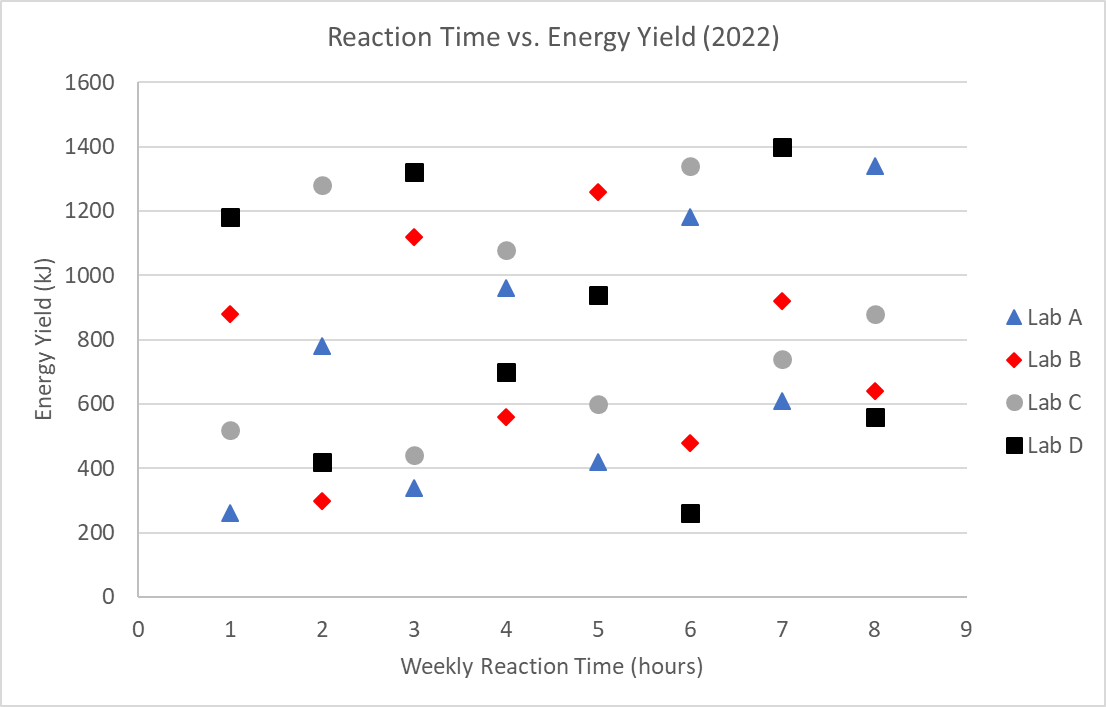
The graph provides data on weekly reaction times and resulting energy yields from 32 trials carried out by four research labs in the Andean Valley in 2022. Each lab conducted eight trials, and for every trial both the reaction time (in hours) and the resulting energy yield (in kilojoules) were recorded.
Select from each drop-down menu the option that creates the most accurate statement based on the information provided.
The range of the recorded energy yields was greatest for Lab .
The median reported reaction time for all trials across the four labs was the median reported reaction time for all trials across the three labs excluding Lab D.
ShowHide Answer
Official Answer
Dropdown 1: Lab D
Dropdown 2: the same as
25 Sep 2025, 05:47
Kudos
Bookmarks
Official Solution:
Drop-down 1:
The range of a data set is the maximum value minus the minimum value.
From the graph, the lowest yield is 260 and the highest yield is 1400, both from Lab D. Since both extremes belong to Lab D, Lab D has the greatest range.
Correct answer: Lab D
Drop-down 2:
The median is the middle value of a data set in ascending order, or the average of the two middle values if the total number is even.
Across all 32 trials, the median is the average of the 16th and 17th values: (4 + 5)/2 = 4.5.
Across the 24 trials excluding Lab D, the median is the average of the 12th and 13th values: (4 + 5)/2 = 4.5.
Thus, the two medians are the same.
Correct answer: the same as
Correct answer:
Dropdown 1: "Lab D"
Dropdown 2: "the same as"
Bunuel
Drop-down 1:
The range of a data set is the maximum value minus the minimum value.
From the graph, the lowest yield is 260 and the highest yield is 1400, both from Lab D. Since both extremes belong to Lab D, Lab D has the greatest range.
Correct answer: Lab D
Drop-down 2:
The median is the middle value of a data set in ascending order, or the average of the two middle values if the total number is even.
Across all 32 trials, the median is the average of the 16th and 17th values: (4 + 5)/2 = 4.5.
Across the 24 trials excluding Lab D, the median is the average of the 12th and 13th values: (4 + 5)/2 = 4.5.
Thus, the two medians are the same.
Correct answer: the same as
Correct answer:
Dropdown 1: "Lab D"
Dropdown 2: "the same as"