Last visit was: 20 May 2026, 16:04 It is currently 20 May 2026, 16:04
Close
GMAT Club Daily Prep
Thank you for using the timer - this advanced tool can estimate your performance and suggest more practice questions. We have subscribed you to Daily Prep Questions via email.

Customized
for You

we will pick new questions that match your level based on your Timer History

Track
Your Progress

every week, we’ll send you an estimated GMAT score based on your performance

Practice
Pays

we will pick new questions that match your level based on your Timer History
Not interested in getting valuable practice questions and articles delivered to your email? No problem, unsubscribe here.
Close
Request Expert Reply
Confirm Cancel
User avatar
MathRevolution
User avatar
Math Revolution GMAT Instructor
Joined: 16 Aug 2015
Last visit: 27 Sep 2022
Posts: 10,063
Own Kudos:
Given Kudos: 4
GMAT 1: 760 Q51 V42
GPA: 3.82
Expert
Expert reply
GMAT 1: 760 Q51 V42
Posts: 10,063
Kudos: 20,107
Kudos
Add Kudos
Bookmarks
Bookmark this Post
User avatar
MathRevolution
User avatar
Math Revolution GMAT Instructor
Joined: 16 Aug 2015
Last visit: 27 Sep 2022
Posts: 10,063
Own Kudos:
Given Kudos: 4
GMAT 1: 760 Q51 V42
GPA: 3.82
Expert
Expert reply
GMAT 1: 760 Q51 V42
Posts: 10,063
Kudos: 20,107
Kudos
Add Kudos
Bookmarks
Bookmark this Post
User avatar
MathRevolution
User avatar
Math Revolution GMAT Instructor
Joined: 16 Aug 2015
Last visit: 27 Sep 2022
Posts: 10,063
Own Kudos:
Given Kudos: 4
GMAT 1: 760 Q51 V42
GPA: 3.82
Expert
Expert reply
GMAT 1: 760 Q51 V42
Posts: 10,063
Kudos: 20,107
Kudos
Add Kudos
Bookmarks
Bookmark this Post
User avatar
MathRevolution
User avatar
Math Revolution GMAT Instructor
Joined: 16 Aug 2015
Last visit: 27 Sep 2022
Posts: 10,063
Own Kudos:
Given Kudos: 4
GMAT 1: 760 Q51 V42
GPA: 3.82
Expert
Expert reply
GMAT 1: 760 Q51 V42
Posts: 10,063
Kudos: 20,107
Kudos
Add Kudos
Bookmarks
Bookmark this Post
MathRevolution
[GMAT math practice question]

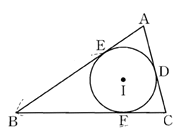
(Geometry) What is the length of \(CD\) in the figure?

1) Point \(I\) is the incenter of triangle \(ABC\), and \(D, E\), and \(F\) are the tangential points.

2) The length of \(BC\) is \(11\), and \(BE\) is \(8. \)
Attachment:
The attachment 1.29ds.png is no longer available

=>

Forget conventional ways of solving math questions. For DS problems, the VA (Variable Approach) method is the quickest and easiest way to find the answer without actually solving the problem. Remember that equal numbers of variables and independent equations ensure a solution.
Visit https://www.mathrevolution.com/gmat/lesson for details.

Since we have a triangle, we have \(3\) variables and \(0\) equations, E is most likely the answer. So, we should consider conditions 1) & 2) together first. After comparing the number of variables and the number of equations, we can save time by considering conditions 1) & 2) together first.

Conditions 1) & 2)
Since point \(I\) is the incenter of the triangle \(ABC, AD, AE, BE, BF, CD\), and \(CE\) are tangent to the same circle, and we have \(AD = AE, BE = BF\) and \(CD = CF.\)

Then we have \(CD = FC = BC – BF = BC – BE = 11 – 8 = 3.\)

Since both conditions together yield a unique solution, they are sufficient.

Attachment:
1.29DS(A).png
1.29DS(A).png [ 10.73 KiB | Viewed 1594 times ]

Therefore, C is the answer.
Answer: C

In cases where 3 or more additional equations are required, such as for original conditions with “3 variables”, or “4 variables and 1 equation”, or “5 variables and 2 equations”, conditions 1) and 2) usually supply only one additional equation. Therefore, there is an 80% chance that E is the answer, a 15% chance that C is the answer, and a 5% chance that the answer is A, B, or D. Since E (i.e. conditions 1) & 2) are NOT sufficient, when taken together) is most likely to be the answer, it is generally most efficient to begin by checking the sufficiency of conditions 1) and 2) when taken together. Obviously, there may be occasions in which the answer is A, B, C, or D.
User avatar
MathRevolution
User avatar
Math Revolution GMAT Instructor
Joined: 16 Aug 2015
Last visit: 27 Sep 2022
Posts: 10,063
Own Kudos:
Given Kudos: 4
GMAT 1: 760 Q51 V42
GPA: 3.82
Expert
Expert reply
GMAT 1: 760 Q51 V42
Posts: 10,063
Kudos: 20,107
Kudos
Add Kudos
Bookmarks
Bookmark this Post
[GMAT math practice question]

(Number Properties) What is the value of \(\frac{[x]}{x - [x]} - \frac{x}{[-x + 1] + x}\)? (\([x]\) means the greatest integer less than or equal to \(x\))

1) \(2 ≤ x < 3.\)

2) \(x\) is not integer.
User avatar
InaKi20
Joined: 19 Jan 2020
Last visit: 06 Mar 2021
Posts: 16
Own Kudos:
Given Kudos: 38
Posts: 16
Kudos: 7
Kudos
Add Kudos
Bookmarks
Bookmark this Post
Hello MathRevolution

Can you explain the VA and the LLGG, or show me where I can find resources to study that? :)
User avatar
MathRevolution
User avatar
Math Revolution GMAT Instructor
Joined: 16 Aug 2015
Last visit: 27 Sep 2022
Posts: 10,063
Own Kudos:
Given Kudos: 4
GMAT 1: 760 Q51 V42
GPA: 3.82
Expert
Expert reply
GMAT 1: 760 Q51 V42
Posts: 10,063
Kudos: 20,107
Kudos
Add Kudos
Bookmarks
Bookmark this Post
MathRevolution
[GMAT math practice question]

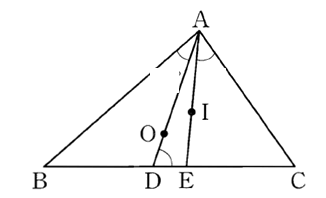
(Geometry) The figure shows that \(∠BAD\) is \(30^o\), and \(∠CAE\) is \(40^o.\) What is the measure of \(∠ADE\)?
Attachment:
1.30DS.png

1) Point \(O\) is the circumcenter of triangle \(ABC\).

2) Point \(I\) is the incenter of triangle \(ABC\).

=>

Forget conventional ways of solving math questions. For DS problems, the VA (Variable Approach) method is the quickest and easiest way to find the answer without actually solving the problem. Remember that equal numbers of variables and independent equations ensure a solution.
Visit https://www.mathrevolution.com/gmat/lesson for details.

Since we have \(6\) variables (\(∠ABC, ∠BCA, ∠CAB, ∠ADE, ∠DAE,\) and \(∠DEA\)) and \(2\) equations (\(∠ABC + ∠BCA + ∠CAB = 180°, ∠ADE + ∠DAE + ∠DEA = 180°\)), C is most likely the answer. So, we should consider conditions 1) & 2) together first. After comparing the number of variables and the number of equations, we can save time by considering conditions 1) & 2) together first.

Conditions 1) & 2)
Since point \(I\) is the incenter of triangle \(ABC\), we have \(∠IAB = ∠IAC = 40°\) and \(∠DAE = ∠IAB - ∠BAD, ∠DAE = 40° - 30°, ∠DAE = 10°.\)

Since point \(\)O is the circumcenter of triangle \(ABC\), we have \(∠BAO = ∠ABO = 30°\) and \(∠OBC = ∠OCB = (\frac{1}{2})(180° – (2*30° + 2*50°)) = 10°.\)

Then \(∠ABC = ∠ABO + ∠OBC = 30° + 10° = 40°.\)

Since \(∠ADE\) is an exterior angle of triangle \(ABD,\) we have \(∠ADE = ∠DAB + ∠ABD = 30° + 40° = 70°.\)

Since both conditions together yield a unique solution, they are sufficient.

Therefore, C is the answer.
Answer: C

In cases where 3 or more additional equations are required, such as for original conditions with “3 variables”, or “4 variables and 1 equation”, or “5 variables and 2 equations”, conditions 1) and 2) usually supply only one additional equation. Therefore, there is an 80% chance that E is the answer, a 15% chance that C is the answer, and a 5% chance that the answer is A, B, or D. Since E (i.e. conditions 1) & 2) are NOT sufficient, when taken together) is most likely to be the answer, it is generally most efficient to begin by checking the sufficiency of conditions 1) and 2) when taken together. Obviously, there may be occasions in which the answer is A, B, C, or D.
User avatar
MathRevolution
User avatar
Math Revolution GMAT Instructor
Joined: 16 Aug 2015
Last visit: 27 Sep 2022
Posts: 10,063
Own Kudos:
Given Kudos: 4
GMAT 1: 760 Q51 V42
GPA: 3.82
Expert
Expert reply
GMAT 1: 760 Q51 V42
Posts: 10,063
Kudos: 20,107
Kudos
Add Kudos
Bookmarks
Bookmark this Post
MathRevolution
[GMAT math practice question]

(Number Properties) What is the value of \(\frac{[x]}{x - [x]} - \frac{x}{[-x + 1] + x}\)? (\([x]\) means the greatest integer less than or equal to \(x\))

1) \(2 ≤ x < 3.\)

2) \(x\) is not integer.

=>

Forget conventional ways of solving math questions. For DS problems, the VA (Variable Approach) method is the quickest and easiest way to find the answer without actually solving the problem. Remember that equal numbers of variables and independent equations ensure a solution.
Visit https://www.mathrevolution.com/gmat/lesson for details.

Since we have \(1\) variable (\(x\)) and \(0\) equations, D is most likely the answer. So, we should consider each condition on its own first.

Condition 1)
Since \(2 ≤ x < 3\), we have \(\frac{[x]}{x - [x]} - \frac{x}{[-x + 1] + x} = \frac{2}{x - 2} - \frac{x}{-2+ x} = \frac{2 - x}{x - 2} = \frac{-1(x - 2)}{x - 2} = -1.\)

Since condition 1) yields a unique solution, it is sufficient.

Condition 2) If \(x = n + h\) where n is the integer part of \(x\) and \(h\) is the positive decimal part of \(x\), then we have:

\(\frac{[x]}{x - [x]} - \frac{x}{[-x + 1] + x} = \frac{n}{h} - \frac{n + h}{-n + n + h} = \frac{n}{h} - \frac{n + h}{h} = \frac{-h}{h} = -1.\)

Since condition 2) yields a unique solution, it is sufficient.

Therefore, D is the answer.
Answer: D

This question is a CMT 4(B) question: condition 1) is easy to work with, and condition 2) is difficult to work with. For CMT 4(B) questions, D is most likely the answer.

If the original condition includes “1 variable”, or “2 variables and 1 equation”, or “3 variables and 2 equations”, etc., one more equation is required to answer the question. If each of conditions 1) and 2) provide an additional equation, there is a 59% chance that D is the answer, a 38% chance that A or B is the answer, and a 3% chance that the answer is C or E. Thus, answer D (conditions 1) and 2), when applied separately, are sufficient to answer the question) is most likely, but there may be cases where the answer is A, B, C, or E.
User avatar
MathRevolution
User avatar
Math Revolution GMAT Instructor
Joined: 16 Aug 2015
Last visit: 27 Sep 2022
Posts: 10,063
Own Kudos:
Given Kudos: 4
GMAT 1: 760 Q51 V42
GPA: 3.82
Expert
Expert reply
GMAT 1: 760 Q51 V42
Posts: 10,063
Kudos: 20,107
Kudos
Add Kudos
Bookmarks
Bookmark this Post
InaKi20
Hello MathRevolution

Can you explain the VA and the LLGG, or show me where I can find resources to study that? :)

You can visit the following page to review VA method.
https://www.mathrevolution.com/gmat/lesson

Regarding LLGG, when we have (x-a)(x-b) > 0 where a < b, the solution set of the inequality is "x < a or x > b".
"x < a or x > b" means that x is Less than Less number or x is Greater than Greater number.
Here the Less number is a and the Greater number is b.

On the other hand, when we have (x-a)(x-b) < 0 where a < b, the solution set of the inequality is "a < x < b".
It means the solution set is the set of numbers between a and b.

Happy Studying !!!
User avatar
MathRevolution
User avatar
Math Revolution GMAT Instructor
Joined: 16 Aug 2015
Last visit: 27 Sep 2022
Posts: 10,063
Own Kudos:
20,107
 [1]
Given Kudos: 4
GMAT 1: 760 Q51 V42
GPA: 3.82
Expert
Expert reply
GMAT 1: 760 Q51 V42
Posts: 10,063
Kudos: 20,107
 [1]
1
Kudos
Add Kudos
Bookmarks
Bookmark this Post
[GMAT math practice question]

(Geometry) The figure below shows the dimensions of the right triangle \(ABC\) with \(AB = 13, BC = 12, CA = 5\) and \(I\) is a point inside triangle \(ABC.\) Angle \(C\) is \(90^o.\) What is the minimum distance from the point \(I\) to sides \(AB, BC\) and \(CA\)?

Attachment:
2.3ds.png
2.3ds.png [ 12.43 KiB | Viewed 1577 times ]

1) Point \(I\) is the incenter of \(△ABC.\)

2) Line \(AI\) bisects angle \(A\), and line \(BI\) bisects angle \(B\).
User avatar
InaKi20
Joined: 19 Jan 2020
Last visit: 06 Mar 2021
Posts: 16
Own Kudos:
Given Kudos: 38
Posts: 16
Kudos: 7
Kudos
Add Kudos
Bookmarks
Bookmark this Post
MathRevolution
InaKi20
Hello MathRevolution

Can you explain the VA and the LLGG, or show me where I can find resources to study that? :)

You can visit the following page to review VA method.
https://www.mathrevolution.com/gmat/lesson

Regarding LLGG, when we have (x-a)(x-b) > 0 where a < b, the solution set of the inequality is "x < a or x > b".
"x < a or x > b" means that x is Less than Less number or x is Greater than Greater number.
Here the Less number is a and the Greater number is b.

On the other hand, when we have (x-a)(x-b) < 0 where a < b, the solution set of the inequality is "a < x < b".
It means the solution set is the set of numbers between a and b.

Happy Studying !!!

Thanks so much MathRevolution,
this really helps a lot!
User avatar
MathRevolution
User avatar
Math Revolution GMAT Instructor
Joined: 16 Aug 2015
Last visit: 27 Sep 2022
Posts: 10,063
Own Kudos:
Given Kudos: 4
GMAT 1: 760 Q51 V42
GPA: 3.82
Expert
Expert reply
GMAT 1: 760 Q51 V42
Posts: 10,063
Kudos: 20,107
Kudos
Add Kudos
Bookmarks
Bookmark this Post
[GMAT math practice question]

(Geometry) The figure below shows the dimensions of triangle \(ABC\). What is \(∠BIC\)?

Attachment:
2.4DS.png
2.4DS.png [ 8.92 KiB | Viewed 1528 times ]

1) Point \(I\) is the incenter of \(△ABC.\)

2) Line \(DE\) is parallel to line \(BC.\)
User avatar
MathRevolution
User avatar
Math Revolution GMAT Instructor
Joined: 16 Aug 2015
Last visit: 27 Sep 2022
Posts: 10,063
Own Kudos:
Given Kudos: 4
GMAT 1: 760 Q51 V42
GPA: 3.82
Expert
Expert reply
GMAT 1: 760 Q51 V42
Posts: 10,063
Kudos: 20,107
Kudos
Add Kudos
Bookmarks
Bookmark this Post
MathRevolution
[GMAT math practice question]

(Geometry) The figure below shows the dimensions of the right triangle \(ABC\) with \(AB = 13, BC = 12, CA = 5\) and \(I\) is a point inside triangle \(ABC.\) Angle \(C\) is \(90^o.\) What is the minimum distance from the point \(I\) to sides \(AB, BC\) and \(CA\)?

Attachment:
The attachment 2.3ds.png is no longer available

1) Point \(I\) is the incenter of \(△ABC.\)

2) Line \(AI\) bisects angle \(A\), and line \(BI\) bisects angle \(B\).

=>

Forget conventional ways of solving math questions. For DS problems, the VA (Variable Approach) method is the quickest and easiest way to find the answer without actually solving the problem. Remember that equal numbers of variables and independent equations ensure a solution.
Visit https://www.mathrevolution.com/gmat/lesson for details.

The first step of the VA (Variable Approach) method is to modify the original condition and the question. We then recheck the question. We should simplify conditions if necessary.

Condition 1)

Attachment:
2.3DS.A1.png
2.3DS.A1.png [ 9.44 KiB | Viewed 1513 times ]

Since I is the incenter of the triangle, the distances to all sides from point I are equal. Assume the distances are \(x\).

Attachment:
2.3DS(A2).png
2.3DS(A2).png [ 11.47 KiB | Viewed 1514 times ]

The area of triangles \(IAB, IBC\) and \(ICA\) are \((\frac{1}{2})*13*x + (\frac{1}{2})*12*x + (\frac{1}{2})*5*x = (\frac{13}{2})x + 6x + (\frac{5}{2})x = (\frac{18}{2})x + 6x = 9x + 6x = 15x.\)

The area of triangle \(ABC = (\frac{1}{2})*5*12 = 30.\)

Since the sum of the areas of triangles \(IAB, IBC\) and \(ICA\) is equal to the area of triangle \(ABC\), we have \(15x = 30\) or \(x = 2.\)

Since condition 1) yields a unique solution, it is sufficient.

Condition 2)

Since we can find an incenter of a triangle by the intersection of lines bisecting interior angles, \(I\) is the incenter of the triangle from condition 2).

Thus, condition 2) is sufficient with the previous reasoning in condition 1).

Therefore, D is the answer.
Answer: D

Note: Tip 1) of the VA method states that D is most likely to be the answer if condition 1) gives the same information as condition 2).
User avatar
MathRevolution
User avatar
Math Revolution GMAT Instructor
Joined: 16 Aug 2015
Last visit: 27 Sep 2022
Posts: 10,063
Own Kudos:
Given Kudos: 4
GMAT 1: 760 Q51 V42
GPA: 3.82
Expert
Expert reply
GMAT 1: 760 Q51 V42
Posts: 10,063
Kudos: 20,107
Kudos
Add Kudos
Bookmarks
Bookmark this Post
[GMAT math practice question]

(Algebra) What is the value of \([x] + [-x]\)? (\([x]\) means the greatest integer less than or equal to \(x\).)

1) \(0 ≤ x\)

2) \(x\) is not an integer.
User avatar
MathRevolution
User avatar
Math Revolution GMAT Instructor
Joined: 16 Aug 2015
Last visit: 27 Sep 2022
Posts: 10,063
Own Kudos:
Given Kudos: 4
GMAT 1: 760 Q51 V42
GPA: 3.82
Expert
Expert reply
GMAT 1: 760 Q51 V42
Posts: 10,063
Kudos: 20,107
Kudos
Add Kudos
Bookmarks
Bookmark this Post
MathRevolution
[GMAT math practice question]

(Geometry) The figure below shows the dimensions of triangle \(ABC\). What is \(∠BIC\)?

Attachment:
The attachment 2.4DS.png is no longer available

1) Point \(I\) is the incenter of \(△ABC.\)

2) Line \(DE\) is parallel to line \(BC.\)

=>

Forget conventional ways of solving math questions. For DS problems, the VA (Variable Approach) method is the quickest and easiest way to find the answer without actually solving the problem. Remember that equal numbers of variables and independent equations ensure a solution.
Visit https://www.mathrevolution.com/gmat/lesson for details.

The first step of the VA (Variable Approach) method is to modify the original condition and the question. We then recheck the question. We should simplify conditions if necessary.

Condition 1)

Since we can find an incenter of a triangle by the intersection of lines bisecting interior angles, \(∠DBI\) is equal to \(∠IBC\), and \(∠ECI\) is equal to \(∠ICB.\)

Attachment:
2.4DS(A).png
2.4DS(A).png [ 10.96 KiB | Viewed 1493 times ]

Then we have \(∠IBC = 22°\) and \(∠ICB = 30°\).

Thus, we have \(∠BIC = 180° - ∠IBC - ∠ICB = 180° – 22° – 30° = 128°.\)

Since condition 1) yields a unique solution, it is sufficient.

Condition 2)

Since we don’t know the position of \(I\) on segment \(DE\), condition 2) does not yield a unique solution, and it is not sufficient.

Therefore, A is the answer.
Answer: A
User avatar
MathRevolution
User avatar
Math Revolution GMAT Instructor
Joined: 16 Aug 2015
Last visit: 27 Sep 2022
Posts: 10,063
Own Kudos:
Given Kudos: 4
GMAT 1: 760 Q51 V42
GPA: 3.82
Expert
Expert reply
GMAT 1: 760 Q51 V42
Posts: 10,063
Kudos: 20,107
Kudos
Add Kudos
Bookmarks
Bookmark this Post
[GMAT math practice question]

(Geometry) The figure below shows the dimensions of triangle ABC. What is \(∠OBI\)?

Attachment:
2.6DS.png
2.6DS.png [ 11.66 KiB | Viewed 1486 times ]

1) \(AB = AC\)

2) Point \(O\) is the circumcenter and point \(I\) is the incenter of triangle \(ABC.\)
User avatar
MathRevolution
User avatar
Math Revolution GMAT Instructor
Joined: 16 Aug 2015
Last visit: 27 Sep 2022
Posts: 10,063
Own Kudos:
Given Kudos: 4
GMAT 1: 760 Q51 V42
GPA: 3.82
Expert
Expert reply
GMAT 1: 760 Q51 V42
Posts: 10,063
Kudos: 20,107
Kudos
Add Kudos
Bookmarks
Bookmark this Post
MathRevolution
[GMAT math practice question]

(Algebra) What is the value of \([x] + [-x]\)? (\([x]\) means the greatest integer less than or equal to \(x\).)

1) \(0 ≤ x\)

2) \(x\) is not an integer.

=>

Forget conventional ways of solving math questions. For DS problems, the VA (Variable Approach) method is the quickest and easiest way to find the answer without actually solving the problem. Remember that equal numbers of variables and independent equations ensure a solution.
Visit https://www.mathrevolution.com/gmat/lesson for details.

The first step of the VA (Variable Approach) method is to modify the original condition and the question. We then recheck the question. We should simplify conditions if necessary.

If \(x = n + h\) where \(n\) is an integer and \(0 ≤ h < 1\), then \([x] = n\). Here \(n\) is the integer part of \(n\), and \(h\) is the decimal part of \(n\).

If \(x\) is an integer, then we have \(x = n + h\) where \(h = 0, [x] = n, [-x] = -n\) and \([x] + [-x] = n + (-n) = 0.\)

Assume \(x\) is not an integer.

Then we have \(x = n + h\) where \(0 < h < 1, [x] = n.\)

We have \(-x = -n - h, -x = -n - 1 + 1 - h, -x = -(n + 1) + (1 - h)\) where \(0 < 1 - h < 1.\)

Thus \([-x] = -n - 1\) and we have \([x] + [-x] = n + (-n - 1) = -1.\)

Condition 2) tells us that \(x\) is not an integer. Therefore \([x] + [-x] = -1\) and condition 2) yields a unique solution.

Condition 2) is sufficient.

Condition 1)
If \(x = 0\) which is an integer, then we have \([x] + [-x] = 0.\)

If \(x = 1.5\) which is not an integer, then we have \([x] + [-x] = -1.\)

Since condition 1) does not yield a unique solution, it is not sufficient.

Therefore, B is the answer.
Answer: B
User avatar
MathRevolution
User avatar
Math Revolution GMAT Instructor
Joined: 16 Aug 2015
Last visit: 27 Sep 2022
Posts: 10,063
Own Kudos:
Given Kudos: 4
GMAT 1: 760 Q51 V42
GPA: 3.82
Expert
Expert reply
GMAT 1: 760 Q51 V42
Posts: 10,063
Kudos: 20,107
Kudos
Add Kudos
Bookmarks
Bookmark this Post
[GMAT math practice question]

(Number Properties) \(<x>\) denotes \(x - 10[\frac{x}{10}]\) and \(n\) is a positive integer. What is the value of \(<9^n - 1>\)? (\([x]\) means the greatest integer less than or equal to \(x\).)

1) \(<9^n - 1>\) is not positive.

2) \(n\) is an even number.
User avatar
MathRevolution
User avatar
Math Revolution GMAT Instructor
Joined: 16 Aug 2015
Last visit: 27 Sep 2022
Posts: 10,063
Own Kudos:
Given Kudos: 4
GMAT 1: 760 Q51 V42
GPA: 3.82
Expert
Expert reply
GMAT 1: 760 Q51 V42
Posts: 10,063
Kudos: 20,107
Kudos
Add Kudos
Bookmarks
Bookmark this Post
MathRevolution
[GMAT math practice question]

(Geometry) The figure below shows the dimensions of triangle ABC. What is \(∠OBI\)?

Attachment:
2.6DS.png

1) \(AB = AC\)

2) Point \(O\) is the circumcenter and point \(I\) is the incenter of triangle \(ABC.\)

=>

Forget conventional ways of solving math questions. For DS problems, the VA (Variable Approach) method is the quickest and easiest way to find the answer without actually solving the problem. Remember that equal numbers of variables and independent equations ensure a solution.
Visit https://www.mathrevolution.com/gmat/lesson for details.

Since a triangle has \(3\) variables, E is most likely the answer. So, we should consider conditions 1) & 2) together first. After comparing the number of variables and the number of equations, we can save time by considering conditions 1) & 2) together first.

Conditions 1) & 2)
Since triangle \(ABC\) is an isosceles, we have interior angles \(∠ABC = ∠ACB = (\frac{1}{2})(180 - ∠A) = (\frac{1}{2})(180 - 36) = 72.\)

Since \(O\) is the circumcenter of triangle \(ABC\), we have \(∠OBA = ∠OCA = (\frac{1}{2}) ∠A = (\frac{1}{2})36 = 18.\)

Since \(I\) is the incenter of triangle \(ABC\), we have \(∠IBA = (\frac{1}{2}) ∠ABC = (1/2)72 = 36.\)

Thus, we have \(∠OBI = ∠IBA - ∠OBA = 36 – 18 = 18.\)

Since both conditions together yield a unique solution, they are sufficient.

Therefore, C is the answer.
Answer: C

In cases where 3 or more additional equations are required, such as for original conditions with “3 variables”, or “4 variables and 1 equation”, or “5 variables and 2 equations”, conditions 1) and 2) usually supply only one additional equation. Therefore, there is an 80% chance that E is the answer, a 15% chance that C is the answer, and a 5% chance that the answer is A, B, or D. Since E (i.e. conditions 1) & 2) are NOT sufficient when taken together) is most likely to be the answer, it is generally most efficient to begin by checking the sufficiency of conditions 1) and 2) when taken together. Obviously, there may be occasions in which the answer is A, B, C, or D.
User avatar
MathRevolution
User avatar
Math Revolution GMAT Instructor
Joined: 16 Aug 2015
Last visit: 27 Sep 2022
Posts: 10,063
Own Kudos:
Given Kudos: 4
GMAT 1: 760 Q51 V42
GPA: 3.82
Expert
Expert reply
GMAT 1: 760 Q51 V42
Posts: 10,063
Kudos: 20,107
Kudos
Add Kudos
Bookmarks
Bookmark this Post
MathRevolution
[GMAT math practice question]

(Number Properties) \(<x>\) denotes \(x - 10[\frac{x}{10}]\) and \(n\) is a positive integer. What is the value of \(<9^n - 1>\)? (\([x]\) means the greatest integer less than or equal to \(x\).)

1) \(<9^n - 1>\) is not positive.

2) \(n\) is an even number.

=>

Forget conventional ways of solving math questions. For DS problems, the VA (Variable Approach) method is the quickest and easiest way to find the answer without actually solving the problem. Remember that equal numbers of variables and independent equations ensure a solution.
Visit https://www.mathrevolution.com/gmat/lesson for details.

The first step of the VA (Variable Approach) method is to modify the original condition and the question. We then recheck the question. We should simplify conditions if necessary.

\(<x>\) means the unit digit of \(x\).

For example, if \(x = 123\), then\( x - 10[\frac{x}{10}] = 123 - 10[12.3] = 123 - 120 = 3.\)

We have \(9^1 = 9, 9^2 = 81, 9^3 = 729, 9^4 = 6561, ...\)

Then, \(9^1 - 1 = 8, 9^2 - 1 = 80, 9^3 - 1 = 728, 9^4 - 1 = 6560, ....\)

We notice that if \(n\) is an odd number, the unit digit of \(9^n - 1\) is \(8\), and if \(n\) is an even number, the unit digit of \(9^n - 1\) is \(0.\)

The question asks what the unit digit of \(9^n - 1\) is.

Condition 2) tells us that \(n\) is an even number. Therefore \(9^n - 1\) is \(0.\) Since condition 2) yields a unique solution, it is sufficient.

Condition 1)
Since the only possible values of \(<9^n - 1>\) are \(0\) and \(8, <9^n - 1>\) is \(0\) if \(<9^n - 1>\) is not positive.

Since condition 1) yields a unique solution, it is sufficient.

Therefore, D is the answer.
Answer: D
   1  ...  38   39   40   41   42  ...  64   
Moderators:
Math Expert
110739 posts
GMAT Tutor
1922 posts


