Events & Promotions
|
|

GMAT Club Daily Prep
Thank you for using the timer - this advanced tool can estimate your performance and suggest more practice questions. We have subscribed you to Daily Prep Questions via email.
Customized
for You
Track
Your Progress
Practice
Pays
Not interested in getting valuable practice questions and articles delivered to your email? No problem, unsubscribe here.
 Sep 13
12:30 AM EDT
-01:30 AM EDT
Struggling to find the right strategies to score a 99 %ile on GMAT Focus? Riya (GMAT 715) boosted her score by 100-points in just 15 days! Discover how the right mentorship, tailored strategies, and an unwavering mindset can transform your GMAT prep. Sep 13
01:30 AM EDT
-02:30 AM EDT
At one point, she believed GMAT wasn’t for her. After scoring 595, self-doubt crept in and she questioned her potential. But instead of quitting, she made the right strategic changes. The result? A remarkable comeback to 695. Check out how Saakshi did it. Sep 15
07:00 PM EDT
-09:00 PM EST
Elite scores are possible when you enroll in a powerful GMAT course, taught live online + 6 months access to TTP OnDemand video courses included! Class starts Tues/Thurs Sept. 15, 2026 - Nov. 15, 2027, 7:00pm-9:00pm EST Sep 21
07:00 PM EDT
-10:00 PM EDT
Boost your GMAT score in less than one month in a live online class + 6 months access to TTP OnDemand video courses included! Class starts Mon, Tues, Wed, Thur, Fri Sept. 21, 2026 - Oct. 9, 2027, 7:00pm-10:00pm EST

 08 Mar 2024, 04:10
Kudos
Bookmarks
Question 1


E
Be sure to select an answer first to save it in the Error Log before revealing the correct answer (OA)!
Difficulty:
 55%
(hard)
55%
(hard)
Question Stats:
59% (02:55) correct 41%
(02:47) wrong
based on 986
sessions
41%
(02:47) wrong
based on 986
sessions
History
Date
Time
Result
Not Attempted Yet
Question 2
B
Be sure to select an answer first to save it in the Error Log before revealing the correct answer (OA)!
Difficulty:
 35%
(medium)
35%
(medium)
Question Stats:
65% (01:20) correct 35%
(01:29) wrong
based on 1033
sessions
History
Date
Time
Result
Not Attempted Yet
Question 3
C
Be sure to select an answer first to save it in the Error Log before revealing the correct answer (OA)!
Difficulty:
 15%
(low)
15%
(low)
Question Stats:
76% (01:07) correct 24%
(01:15) wrong
based on 996
sessions
History
Date
Time
Result
Not Attempted Yet
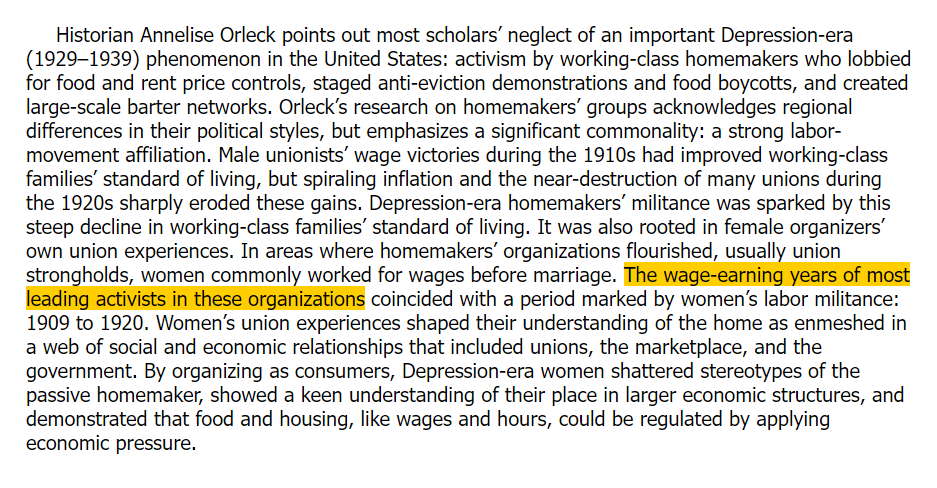
Historian Annelise Orleck points out most scholars’ neglect of an important Depression-era (1929-1939) phenomenon in the United States: activism by working-class homemakers who lobbied for food and rent price controls, staged anti-eviction demonstrations and food boycotts, and created large-scale barter networks. Orleck’s research on homemakers' groups acknowledges regional differences in their political styles, but emphasizes a significant commonality: a strong labor- movement affiliation. Male unionists’ wage victories during the 1910s had improved working-class families’ standard of living, but spiraling inflation and the near-destruction of many unions during the 1920s sharply eroded these gains. Depression-era homemakers' militance was sparked by this steep decline in working-class families’ standard of living. It was also rooted in female organizers’ own union experiences. In areas where homemakers' organizations flourished, usually union strongholds, women commonly worked for wages before marriage. The wage-earning years of most leading activists in these organizations coincided with a period marked by women’s labor militance: 1909 to 1920. Women’s union experiences shaped their understanding of the home as enmeshed in a web of social and economic relationships that included unions, the marketplace, and the government. By organizing as consumers. Depression-era women shattered stereotypes of the passive homemaker, showed a keen understanding of their place in larger economic structures, and demonstrated that food and housing, like wages and hours, could be regulated by applying economic pressure.
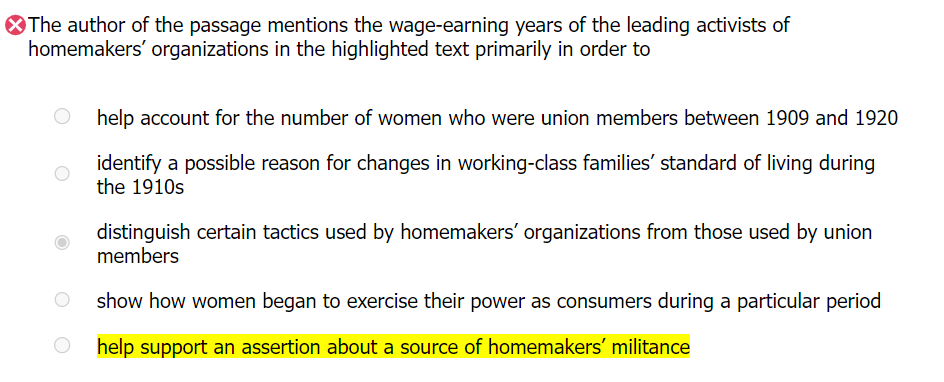
1. The author of the passage mentions the wage-earning years of the leading activists of homemakers' organizations in the highlighted text primarily in order to
A. help account for the number of women who were union members between 1909 and 1920
B. identify a possible reason for changes in working-class families’ standard of living during the 1910s
C. distinguish certain tactics used by homemakers' organizations from those used by union members
D. show how women began to exercise their power as consumers during a particular period
E. help support an assertion about a source of homemakers' militance
A. help account for the number of women who were union members between 1909 and 1920
B. identify a possible reason for changes in working-class families’ standard of living during the 1910s
C. distinguish certain tactics used by homemakers' organizations from those used by union members
D. show how women began to exercise their power as consumers during a particular period
E. help support an assertion about a source of homemakers' militance
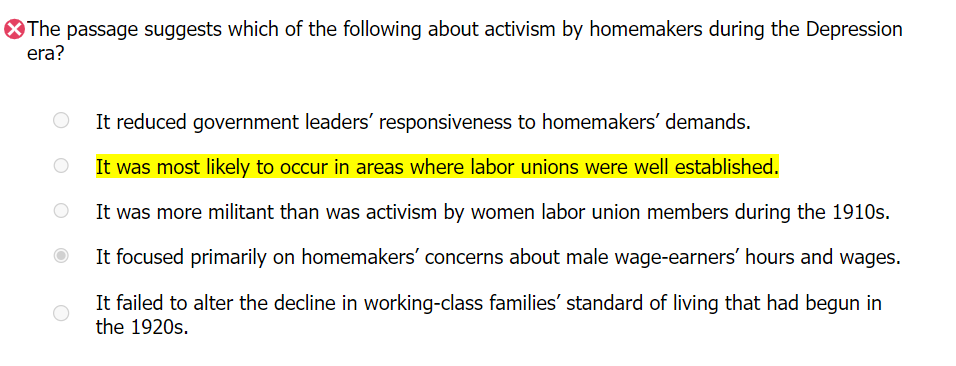
2. The passage suggests which of the following about activism by homemakers during the Depression era?
A. It reduced government leaders’ responsiveness to homemakers' demands.
B. It was most likely to occur in areas where labor unions were well established.
C. It was more militant than was activism by women labor union members during the 1910s.
D. It focused primarily on homemakers' concerns about male wage-earners' hours and wages.
E. It failed to alter the decline in working-class families’ standard of living that had begun in the 1920s.
A. It reduced government leaders’ responsiveness to homemakers' demands.
B. It was most likely to occur in areas where labor unions were well established.
C. It was more militant than was activism by women labor union members during the 1910s.
D. It focused primarily on homemakers' concerns about male wage-earners' hours and wages.
E. It failed to alter the decline in working-class families’ standard of living that had begun in the 1920s.
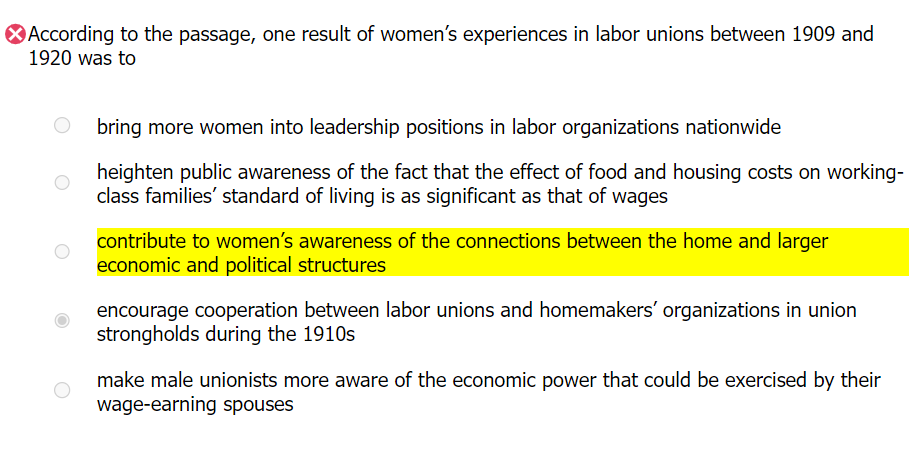
3. According to the passage, one result of women’s experiences in labor unions between 1909 and 1920 was to
A. bring more women into leadership positions in labor organizations nationwide
B. heighten public awareness of the fact that the effect of food and housing costs on working- class families’ standard of living is as significant as that of wages
C. contribute to women’s awareness of the connections between the home and larger economic and political structures
D. encourage cooperation between labor unions and homemakers' organizations in union strongholds during the 1910s
E. make male unionists more aware of the economic power that could be exercised by their wage-earning spouses
A. bring more women into leadership positions in labor organizations nationwide
B. heighten public awareness of the fact that the effect of food and housing costs on working- class families’ standard of living is as significant as that of wages
C. contribute to women’s awareness of the connections between the home and larger economic and political structures
D. encourage cooperation between labor unions and homemakers' organizations in union strongholds during the 1910s
E. make male unionists more aware of the economic power that could be exercised by their wage-earning spouses
4.png [ 138.23 KiB | Viewed 12125 times ]
5.png [ 58.07 KiB | Viewed 12125 times ]
6.png [ 52.93 KiB | Viewed 12118 times ]
7.png [ 68.79 KiB | Viewed 12122 times ]
Attachment:
4.png [ 138.23 KiB | Viewed 12125 times ]
Attachment:
5.png [ 58.07 KiB | Viewed 12125 times ]
Attachment:
6.png [ 52.93 KiB | Viewed 12118 times ]
Attachment:
7.png [ 68.79 KiB | Viewed 12122 times ]
Need more Tests to Practice?
GMAT Club Tests give expert solutions for every question in full and sectional GMAT Focus mocks.
Learn more →

1. The author of the passage mentions the wage-earning years of the leading activists of homemakers' organizations in the highlighted text primarily in order to
The wage-earning years of most leading activists in these organizations coincided with a period marked by women’s labor militance: 1909 to 1920. Women’s union experiences shaped their understanding of the home as enmeshed in a web of social and economic relationships that included unions, the marketplace, and the government.
A. help account for the number of women who were union members between 1909 and 1920 - irrelevant , focus of passage is related to involvement of women relative to men, focus is not on wheather women involvement increased decreased etc.
B. identify a possible reason for changes in working-class families’ standard of living during the 1910s - irrelevant
C. distinguish certain tactics used by homemakers' organizations from those used by union members - irrelevant
D. show how women began to exercise their power as consumers during a particular period - This does not answer how women began to exercise their power but rather what led them to participate in the activism
E. help support an assertion about a source of homemakers' militance - Correct since this statement explains what was the source or rather how women's role in these activism started what shaped their understanding
2. The passage suggests which of the following about activism by homemakers during the Depression era?
In areas where homemakers' organizations flourished, usually union strongholds, women commonly worked for wages before marriage.
A. It reduced government leaders’ responsiveness to homemakers' demands. - no mention of govt's change of attitude
B. It was most likely to occur in areas where labor unions were well established. - Correct, Clearly suggested in passage
C. It was more militant than was activism by women labor union members during the 1910s. - more militant or less is not mentioned in passage
D. It focused primarily on homemakers' concerns about male wage-earners' hours and wages. - not mentioned in passage
E. It failed to alter the decline in working-class families’ standard of living that had begun in the 1920s. - We don't know if living standards improvement failed, but we atleast know they managed to demostrate that regulating the food and housing prices was possible!
Out of all the options only B is suggested in the passage ( not directly mentioned but suggested , we can make an inference )
3. According to the passage, one result of women’s experiences in labor unions between 1909 and 1920 was to
The wage-earning years of most leading activists in these organizations coincided with a period marked by women’s labor militance: 1909 to 1920. Women’s union experiences shaped their understanding of the home as enmeshed in a web of social and economic relationships that included unions, the marketplace, and the government.
A. bring more women into leadership positions in labor organizations nationwide
B. heighten public awareness of the fact that the effect of food and housing costs on working- class families’ standard of living is as significant as that of wages - No, no mention of motive being heightening public awareness. Though they demonstrated that economic pressure could be leveraged to achieve regulations in living and food housing.
C. contribute to women’s awareness of the connections between the home and larger economic and political structures - Correct, Passage clearly mentions the result of women's militance helped them understand home as enmeshed in a web of social and economic relationships that included unions, the marketplace, and the government.
D. encourage cooperation between labor unions and homemakers' organizations in union strongholds during the 1910s
E. make male unionists more aware of the economic power that could be exercised by their wage-earning spouses
The wage-earning years of most leading activists in these organizations coincided with a period marked by women’s labor militance: 1909 to 1920. Women’s union experiences shaped their understanding of the home as enmeshed in a web of social and economic relationships that included unions, the marketplace, and the government.
A. help account for the number of women who were union members between 1909 and 1920 - irrelevant , focus of passage is related to involvement of women relative to men, focus is not on wheather women involvement increased decreased etc.
B. identify a possible reason for changes in working-class families’ standard of living during the 1910s - irrelevant
C. distinguish certain tactics used by homemakers' organizations from those used by union members - irrelevant
D. show how women began to exercise their power as consumers during a particular period - This does not answer how women began to exercise their power but rather what led them to participate in the activism
E. help support an assertion about a source of homemakers' militance - Correct since this statement explains what was the source or rather how women's role in these activism started what shaped their understanding
2. The passage suggests which of the following about activism by homemakers during the Depression era?
In areas where homemakers' organizations flourished, usually union strongholds, women commonly worked for wages before marriage.
A. It reduced government leaders’ responsiveness to homemakers' demands. - no mention of govt's change of attitude
B. It was most likely to occur in areas where labor unions were well established. - Correct, Clearly suggested in passage
C. It was more militant than was activism by women labor union members during the 1910s. - more militant or less is not mentioned in passage
D. It focused primarily on homemakers' concerns about male wage-earners' hours and wages. - not mentioned in passage
E. It failed to alter the decline in working-class families’ standard of living that had begun in the 1920s. - We don't know if living standards improvement failed, but we atleast know they managed to demostrate that regulating the food and housing prices was possible!
Out of all the options only B is suggested in the passage ( not directly mentioned but suggested , we can make an inference )
3. According to the passage, one result of women’s experiences in labor unions between 1909 and 1920 was to
The wage-earning years of most leading activists in these organizations coincided with a period marked by women’s labor militance: 1909 to 1920. Women’s union experiences shaped their understanding of the home as enmeshed in a web of social and economic relationships that included unions, the marketplace, and the government.
A. bring more women into leadership positions in labor organizations nationwide
B. heighten public awareness of the fact that the effect of food and housing costs on working- class families’ standard of living is as significant as that of wages - No, no mention of motive being heightening public awareness. Though they demonstrated that economic pressure could be leveraged to achieve regulations in living and food housing.
C. contribute to women’s awareness of the connections between the home and larger economic and political structures - Correct, Passage clearly mentions the result of women's militance helped them understand home as enmeshed in a web of social and economic relationships that included unions, the marketplace, and the government.
D. encourage cooperation between labor unions and homemakers' organizations in union strongholds during the 1910s
E. make male unionists more aware of the economic power that could be exercised by their wage-earning spouses
 30 Dec 2024, 22:42
Kudos
Bookmarks
GMATNinja KarishmaB GMATNinjaTwo, SarahPurewal
mikemcgarry
saji
Please help clarifying question 1 & 2
Q1: "help support an assertion about a source of homemakers' militance"
-> Source of homemaker's militance - what does this refer to?
How does the wage-earning years of the leading activists of homemakers' organization support this assertion?
Q2: Which line supports the claim "It was most likely to occur in areas where labor unions were well established"
mikemcgarry
saji
Please help clarifying question 1 & 2
Q1: "help support an assertion about a source of homemakers' militance"
-> Source of homemaker's militance - what does this refer to?
How does the wage-earning years of the leading activists of homemakers' organization support this assertion?
Q2: Which line supports the claim "It was most likely to occur in areas where labor unions were well established"





