Events & Promotions
|
|

GMAT Club Daily Prep
Thank you for using the timer - this advanced tool can estimate your performance and suggest more practice questions. We have subscribed you to Daily Prep Questions via email.
Customized
for You
Track
Your Progress
Practice
Pays
Not interested in getting valuable practice questions and articles delivered to your email? No problem, unsubscribe here.
 Sep 17
12:30 AM EDT
-01:30 AM EDT
Thought your job leaves no time for GMAT prep? After multiple GMAT attempts and a demanding consulting job, Kshitij improved to 695 in under 2 months. Learn the mindset shifts, study strategy, and execution changes that made the breakthrough possible. Sep 18
01:30 AM EDT
-02:30 AM EDT
Learn how Kamakshi achieved a GMAT 675 with an impressive 96th %ile in Data Insights. Discover the unique methods and exam strategies that helped her excel in DI along with other sections for a balanced and high score. Sep 18
08:00 PM PDT
-09:00 PM PDT
Video explanations + diagnosis of 10 weakest areas + 150+ short videos + study plan! Sep 21
07:00 PM EDT
-10:00 PM EDT
Boost your GMAT score in less than one month in a live online class + 6 months access to TTP OnDemand video courses included!


 18 Mar 2022, 06:45
Kudos
Bookmarks


E
Be sure to select an answer first to save it in the Error Log before revealing the correct answer (OA)!
Difficulty:
 95%
(hard)
95%
(hard)
Question Stats:
37% (02:12) correct 63%
(02:20)
wrong
based on 206
sessions
63%
(02:20)
wrong
based on 206
sessions
History
Date
Time
Result
Not Attempted Yet
The table below represents three sets of numbers with their respective medians, means and standard deviations. The third set, Set [ A+ B], denotes the set that is formed by combining Set A and Set B.
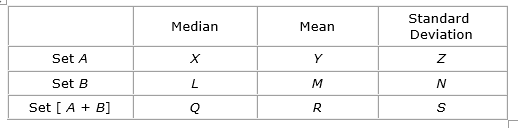
If X – Y > 0 and L – M = 0, then which of the following must be true?
I. Z > N
II. R > M
III. Q > R
(A) I only
(B) II only
(C) III only
(D) I and II only
(E) None
Are You Up For the Challenge: 700 Level Questions

1.PNG [ 1.69 KiB | Viewed 5601 times ]
If X – Y > 0 and L – M = 0, then which of the following must be true?
I. Z > N
II. R > M
III. Q > R
(A) I only
(B) II only
(C) III only
(D) I and II only
(E) None
Are You Up For the Challenge: 700 Level Questions
Attachment:
1.PNG [ 1.69 KiB | Viewed 5601 times ]
 21 Mar 2022, 18:30
Kudos
Bookmarks
Bunuel
Breaking Down the Info:
I. This means the Std of set A is greater than that of set B, which can never be concluded since these sets are independent.
II. If Y < M, then R < M. If Y > M, then R > M. Again, the two original sets are independent, so we can't conclude anything about Y vs M, and R vs M.
III. We have X > Y and L = M. The only conclusion for the new median (Q) is that it must be between X and L, inclusive. We can also say that for R, it must be between Y and M, conclusive. Thus there is no clear relation between Q and R.
Answer: E
 22 May 2026, 11:28
Kudos
Bookmarks
The key idea here is:
The three sets are independent.
Knowing something about:
* mean vs median in Set A
* mean vs median in Set B
does NOT force a relationship between:
* standard deviations
* combined median
* combined mean
Question:
Set A:
* median = X
* mean = Y
* std dev = Z
Set B:
* median = L
* mean = M
* std dev = N
Combined set:
* median = Q
* mean = R
Given:
X − Y > 0 → X > Y
L − M = 0 → L = M
Need statements that MUST be true.
---
First understand what:
X > Y
means.
Median > Mean.
That usually means left-skewed distribution.
But it tells NOTHING definite about standard deviation.
Similarly:
L = M
means symmetric/balanced in some way.
Again nothing definite about spread.
So statement I is suspicious.
---
I. Z > N
“Std dev of A greater than std dev of B”
No connection.
You can easily make:
* Set A tightly packed
* Set B wildly spread
while still keeping:
* median > mean in A
* median = mean in B
So NOT must.
Eliminate I.
---
II. R > M
R is combined mean.
M is mean of Set B.
Combined mean must lie between the two means.
But we do NOT know whether Y > M or Y < M.
Since R is weighted average of Y and M:
R=\frac{n_AY+n_BM}{n_A+n_B}
R could be:
* greater than M
* equal to M
* less than M
depending on Y.
So II not must.
---
III. Q > R
Q = combined median
R = combined mean
Again no guarantee.
Even if one set has median > mean, the other may offset it.
Combined set could have:
* Q > R
* Q = R
* Q < R
Nothing fixed.
So III also not must.
Hence:
None must be true.
Answer: (E) None
Extra's
Because mean–median difference and standard deviation measure completely different things.
* Mean vs median → tells you about skew/asymmetry
* Standard deviation → tells you about spread
A distribution can be:
* highly skewed but tightly packed
OR
* barely skewed but extremely spread out
Example 1: small SD, noticeable mean-median gap
Numbers:
1, 5, 5, 5, 5
Median = 5
Mean = 21/5 = 4.2
Gap = 0.8
But spread is not huge.
---
Example 2: enormous SD, zero mean-median gap
Numbers:
−1000, 0, 0, 0, 1000
Median = 0
Mean = 0
Gap = 0
But SD is massive.
So mean-median gap does NOT determine SD.
Even among sets where median > mean:
Set A:
1,5,5,5,5
Set B:
−1000,100,100,100,100
For Set B:
Median = 100
Mean = −600/5 = −120
Huge median-mean gap and huge SD.
But you can also make:
4,5,5,5,5
Median = 5
Mean = 4.8
Still median > mean, but tiny SD.
So:
“median > mean”
only tells direction of skew,
not how spread out numbers are.
The three sets are independent.
Knowing something about:
* mean vs median in Set A
* mean vs median in Set B
does NOT force a relationship between:
* standard deviations
* combined median
* combined mean
Question:
Set A:
* median = X
* mean = Y
* std dev = Z
Set B:
* median = L
* mean = M
* std dev = N
Combined set:
* median = Q
* mean = R
Given:
X − Y > 0 → X > Y
L − M = 0 → L = M
Need statements that MUST be true.
---
First understand what:
X > Y
means.
Median > Mean.
That usually means left-skewed distribution.
But it tells NOTHING definite about standard deviation.
Similarly:
L = M
means symmetric/balanced in some way.
Again nothing definite about spread.
So statement I is suspicious.
---
I. Z > N
“Std dev of A greater than std dev of B”
No connection.
You can easily make:
* Set A tightly packed
* Set B wildly spread
while still keeping:
* median > mean in A
* median = mean in B
So NOT must.
Eliminate I.
---
II. R > M
R is combined mean.
M is mean of Set B.
Combined mean must lie between the two means.
But we do NOT know whether Y > M or Y < M.
Since R is weighted average of Y and M:
R=\frac{n_AY+n_BM}{n_A+n_B}
R could be:
* greater than M
* equal to M
* less than M
depending on Y.
So II not must.
---
III. Q > R
Q = combined median
R = combined mean
Again no guarantee.
Even if one set has median > mean, the other may offset it.
Combined set could have:
* Q > R
* Q = R
* Q < R
Nothing fixed.
So III also not must.
Hence:
None must be true.
Answer: (E) None
Extra's
Because mean–median difference and standard deviation measure completely different things.
* Mean vs median → tells you about skew/asymmetry
* Standard deviation → tells you about spread
A distribution can be:
* highly skewed but tightly packed
OR
* barely skewed but extremely spread out
Example 1: small SD, noticeable mean-median gap
Numbers:
1, 5, 5, 5, 5
Median = 5
Mean = 21/5 = 4.2
Gap = 0.8
But spread is not huge.
---
Example 2: enormous SD, zero mean-median gap
Numbers:
−1000, 0, 0, 0, 1000
Median = 0
Mean = 0
Gap = 0
But SD is massive.
So mean-median gap does NOT determine SD.
Even among sets where median > mean:
Set A:
1,5,5,5,5
Set B:
−1000,100,100,100,100
For Set B:
Median = 100
Mean = −600/5 = −120
Huge median-mean gap and huge SD.
But you can also make:
4,5,5,5,5
Median = 5
Mean = 4.8
Still median > mean, but tiny SD.
So:
“median > mean”
only tells direction of skew,
not how spread out numbers are.



