Last visit was: 22 Apr 2026, 03:30 It is currently 22 Apr 2026, 03:30
Close
GMAT Club Daily Prep
Thank you for using the timer - this advanced tool can estimate your performance and suggest more practice questions. We have subscribed you to Daily Prep Questions via email.

Customized
for You

we will pick new questions that match your level based on your Timer History

Track
Your Progress

every week, we’ll send you an estimated GMAT score based on your performance

Practice
Pays

we will pick new questions that match your level based on your Timer History
Not interested in getting valuable practice questions and articles delivered to your email? No problem, unsubscribe here.
Close
Request Expert Reply
Confirm Cancel
avatar
guygmat
Joined: 18 Jun 2011
Last visit: 21 Jun 2011
Posts: 41
Own Kudos:
367
 [44]
Posts: 41
Kudos: 367
 [44]
13
Kudos
Add Kudos
31
Bookmarks
Bookmark this Post
Most Helpful Reply
User avatar
Bunuel
User avatar
Math Expert
Joined: 02 Sep 2009
Last visit: 22 Apr 2026
Posts: 109,740
Own Kudos:
Given Kudos: 105,816
Products:
Expert
Expert reply
Active GMAT Club Expert! Tag them with @ followed by their username for a faster response.
Posts: 109,740
Kudos: 810,533
 [30]
23
Kudos
Add Kudos
7
Bookmarks
Bookmark this Post
General Discussion
User avatar
kp1811
Joined: 30 Aug 2009
Last visit: 05 Sep 2015
Posts: 125
Own Kudos:
385
 [3]
Given Kudos: 5
Location: India
Concentration: General Management
Posts: 125
Kudos: 385
 [3]
2
Kudos
Add Kudos
1
Bookmarks
Bookmark this Post
User avatar
fluke
User avatar
Retired Moderator
Joined: 20 Dec 2010
Last visit: 24 Oct 2013
Posts: 1,095
Own Kudos:
Given Kudos: 376
Posts: 1,095
Kudos: 5,167
Kudos
Add Kudos
Bookmarks
Bookmark this Post
guygmat
A rectangle is plotted on the standard coordinate plane, with vertices at the origin and (0,6). If the coordinates of all vertices of the rectangle are non-negative integers, what are the coordinates of the other two vertices?

(1) The distance between the origin and one of the other vertices is 10 units.

(2) The distance between the origin and one of the other vertices is 8 units.

What if one of the statements were:
(1) The distance between the origin and one of the other vertices is 6 units.
User avatar
microair
Joined: 26 Oct 2010
Last visit: 01 Apr 2013
Posts: 19
Own Kudos:
Given Kudos: 3
Posts: 19
Kudos: 12
Kudos
Add Kudos
Bookmarks
Bookmark this Post
fluke

What if one of the statements were:
(1) The distance between the origin and one of the other vertices is 6 units.

Well in that case St 1 gives us no new information, since we know its a rectangle, we already know one side is of 6 units, the other side is either bigger or smaller than 6. So St 1 is insuff. We already know St 2 is insuff. But this time both together are also insuff since we don't know what 8 represents (the diagonal or one of the perpendicular sides).

Is my analysis valid?
User avatar
fluke
User avatar
Retired Moderator
Joined: 20 Dec 2010
Last visit: 24 Oct 2013
Posts: 1,095
Own Kudos:
Given Kudos: 376
Posts: 1,095
Kudos: 5,167
Kudos
Add Kudos
Bookmarks
Bookmark this Post
microair
fluke

What if one of the statements were:
(1) The distance between the origin and one of the other vertices is 6 units.

Well in that case St 1 gives us no new information, since we know its a rectangle, we already know one side is of 6 units, the other side is either bigger or smaller than 6. So St 1 is insuff. We already know St 2 is insuff. But this time both together are also insuff since we don't know what 8 represents (the diagonal or one of the perpendicular sides).

Is my analysis valid?

Actually, st1 is sufficient in this case.

A square is a specialized rectangle. And it's only 6 units away from origin, thus it is directly above it.
User avatar
IanStewart
User avatar
GMAT Tutor
Joined: 24 Jun 2008
Last visit: 17 Apr 2026
Posts: 4,143
Own Kudos:
Given Kudos: 99
Expert
Expert reply
Posts: 4,143
Kudos: 11,268
Kudos
Add Kudos
Bookmarks
Bookmark this Post
fluke
guygmat
A rectangle is plotted on the standard coordinate plane, with vertices at the origin and (0,6). If the coordinates of all vertices of the rectangle are non-negative integers, what are the coordinates of the other two vertices?

(1) The distance between the origin and one of the other vertices is 10 units.

(2) The distance between the origin and one of the other vertices is 8 units.

What if one of the statements were:
(1) The distance between the origin and one of the other vertices is 6 units.

You could interpret that statement in two different ways, so I think the question becomes ambiguous. That statement is only sufficient if by 'one of the other vertices' you mean 'one of the vertices not mentioned in the question'. In that case, we must have a square, which is of course a type of rectangle. But, if by 'one of the other vertices' you mean 'one of the other vertices of the rectangle' (which is how I'd interpret it), then it's not sufficient; we already know that (0,0) and (0,6) are six apart.
User avatar
fluke
User avatar
Retired Moderator
Joined: 20 Dec 2010
Last visit: 24 Oct 2013
Posts: 1,095
Own Kudos:
Given Kudos: 376
Posts: 1,095
Kudos: 5,167
Kudos
Add Kudos
Bookmarks
Bookmark this Post
IanStewart
fluke
guygmat
A rectangle is plotted on the standard coordinate plane, with vertices at the origin and (0,6). If the coordinates of all vertices of the rectangle are non-negative integers, what are the coordinates of the other two vertices?

(1) The distance between the origin and one of the other vertices is 10 units.

(2) The distance between the origin and one of the other vertices is 8 units.

What if one of the statements were:
(1) The distance between the origin and one of the other vertices is 6 units.

You could interpret that statement in two different ways, so I think the question becomes ambiguous. That statement is only sufficient if by 'one of the other vertices' you mean 'one of the vertices not mentioned in the question'. In that case, we must have a square, which is of course a type of rectangle. But, if by 'one of the other vertices' you mean 'one of the other vertices of the rectangle' (which is how I'd interpret it), then it's not sufficient; we already know that (0,0) and (0,6) are six apart.

Good that pointed out the ambiguity.

I was just trying to create a situation where knowing one of the vertices of the rectangle that doesn't lie on the x-axis can still suffice to answer the question.

So, I rephrase my statement.
(1) The distance between the origin and one of the rectangle's other vertices that don't lie on the x-axis is 6 units.
User avatar
IanStewart
User avatar
GMAT Tutor
Joined: 24 Jun 2008
Last visit: 17 Apr 2026
Posts: 4,143
Own Kudos:
Given Kudos: 99
Expert
Expert reply
Posts: 4,143
Kudos: 11,268
Kudos
Add Kudos
Bookmarks
Bookmark this Post
fluke
[
I was just trying to create a situation where knowing one of the vertices of the rectangle that doesn't lie on the x-axis can still suffice to answer the question.

I think it's a more interesting question that way, and a more GMAT-like one as well - if one of the statements turns out to be sufficient alone. If, in your rephrased statement, you make the distance any number less than 6, then there would be no ambiguity and the statement would be sufficient alone, since then the distance cannot possibly be the length of the diagonal.
avatar
keenys
Joined: 12 Mar 2013
Last visit: 27 May 2015
Posts: 12
Own Kudos:
Given Kudos: 14
Posts: 12
Kudos: 2
Kudos
Add Kudos
Bookmarks
Bookmark this Post
Bunuel
Answer to this question is B, not C.

A rectangle is plotted on the standard coordinate plane, with vertices at the origin and (0,6). If the coordinates of all vertices of the rectangle are non-negative integers, what are the coordinates of the other two vertices?

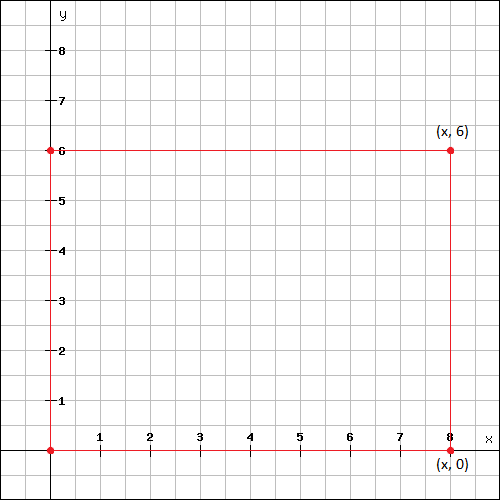
Notice that we are told that the coordinates of all vertices of the rectangle are non-negative integers. That basically means that the rectangle is plotted entirely in the first quadrant: one vertex at the origin (0, 0), another on Y-axis (0, 6), third one somewhere in the first quadrant (x, 6) and the fourth vertex on the X-axis (x, 0).

(1) The distance between the origin and one of the other vertices is 10 units. 10 units is either the length of the other side or the length of the diagonal. The vertices could be: (0, 0), (0, 6), (10, 6) and (10, 0) OR (0, 0), (0, 6), (8, 6) and (8, 0), in this case the distance of 10 units is the distance between (0, 0) and (6, 8). Not sufficient.

(2) The distance between the origin and one of the other vertices is 8 units. Now, 8 units can not be the length of the diagonal since in this case the coordinates of the other two vertices won't be integers: if the diagonal=8, then the length of the other side of the rectangle is \(\sqrt{8^2-6^2}=2\sqrt{7}\), so the coordinates of the other two vertices are: \((2\sqrt{7}, \ 6)\) and \((2\sqrt{7}, \ 0)\). So, 8 units must be the length of the side, therefore the vertices are (0, 0), (0, 6), (8, 6) and (8, 0). Sufficient.

Answer: B.

Hope it's clear.


What if you rotate the rectangle by few degrees upwards in the first quadrant but let the length of the two sides remain 6 and 8 respectively? The coordinates will remain positive but will be different from what you have listed above.

Am I right?
User avatar
Bunuel
User avatar
Math Expert
Joined: 02 Sep 2009
Last visit: 22 Apr 2026
Posts: 109,740
Own Kudos:
Given Kudos: 105,816
Products:
Expert
Expert reply
Active GMAT Club Expert! Tag them with @ followed by their username for a faster response.
Posts: 109,740
Kudos: 810,533
Kudos
Add Kudos
Bookmarks
Bookmark this Post
keenys
Bunuel
Answer to this question is B, not C.

A rectangle is plotted on the standard coordinate plane, with vertices at the origin and (0,6). If the coordinates of all vertices of the rectangle are non-negative integers, what are the coordinates of the other two vertices?

Notice that we are told that the coordinates of all vertices of the rectangle are non-negative integers. That basically means that the rectangle is plotted entirely in the first quadrant: one vertex at the origin (0, 0), another on Y-axis (0, 6), third one somewhere in the first quadrant (x, 6) and the fourth vertex on the X-axis (x, 0).

(1) The distance between the origin and one of the other vertices is 10 units. 10 units is either the length of the other side or the length of the diagonal. The vertices could be: (0, 0), (0, 6), (10, 6) and (10, 0) OR (0, 0), (0, 6), (8, 6) and (8, 0), in this case the distance of 10 units is the distance between (0, 0) and (6, 8). Not sufficient.

(2) The distance between the origin and one of the other vertices is 8 units. Now, 8 units can not be the length of the diagonal since in this case the coordinates of the other two vertices won't be integers: if the diagonal=8, then the length of the other side of the rectangle is \(\sqrt{8^2-6^2}=2\sqrt{7}\), so the coordinates of the other two vertices are: \((2\sqrt{7}, \ 6)\) and \((2\sqrt{7}, \ 0)\). So, 8 units must be the length of the side, therefore the vertices are (0, 0), (0, 6), (8, 6) and (8, 0). Sufficient.

Answer: B.

Hope it's clear.


What if you rotate the rectangle by few degrees upwards in the first quadrant but let the length of the two sides remain 6 and 8 respectively? The coordinates will remain positive but will be different from what you have listed above.

Am I right?

Will the figure still be a rectangle then?
avatar
abhisheksharma
Joined: 24 Apr 2013
Last visit: 14 Jan 2014
Posts: 3
Posts: 3
Kudos: 0
Kudos
Add Kudos
Bookmarks
Bookmark this Post
Bunuel, if the co-ordinates are 2root7 thn wht is the harm in it ??

Posted from my mobile device
User avatar
Bunuel
User avatar
Math Expert
Joined: 02 Sep 2009
Last visit: 22 Apr 2026
Posts: 109,740
Own Kudos:
Given Kudos: 105,816
Products:
Expert
Expert reply
Active GMAT Club Expert! Tag them with @ followed by their username for a faster response.
Posts: 109,740
Kudos: 810,533
Kudos
Add Kudos
Bookmarks
Bookmark this Post
abhisheksharma
Bunuel, if the co-ordinates are 2root7 thn wht is the harm in it ??

Posted from my mobile device

Stem says that the coordinates of all vertices of the rectangle are non-negative integers.
avatar
nariskat
Joined: 20 Jun 2013
Last visit: 12 Jul 2014
Posts: 1
Given Kudos: 14
Posts: 1
Kudos: 0
Kudos
Add Kudos
Bookmarks
Bookmark this Post
I think it should be c as 'non-negative integers' means it can be either negative non integer or positive integers. Please correct me if I'm wrong. Thanks!
User avatar
Bunuel
User avatar
Math Expert
Joined: 02 Sep 2009
Last visit: 22 Apr 2026
Posts: 109,740
Own Kudos:
Given Kudos: 105,816
Products:
Expert
Expert reply
Active GMAT Club Expert! Tag them with @ followed by their username for a faster response.
Posts: 109,740
Kudos: 810,533
Kudos
Add Kudos
Bookmarks
Bookmark this Post
nariskat
I think it should be c as 'non-negative integers' means it can be either negative non integer or positive integers. Please correct me if I'm wrong. Thanks!

Non-negative integers mean integers more than or equal to zero: 0, 1, 2, ...

Hope it's clear.
User avatar
vad3tha
Joined: 22 Feb 2009
Last visit: 15 Dec 2023
Posts: 106
Own Kudos:
Given Kudos: 148
Posts: 106
Kudos: 584
Kudos
Add Kudos
Bookmarks
Bookmark this Post
B is sufficient. The distance from (0,0) to other vertices is 8. So can be point (0,8) or the distance can be the the diagonal length of 8. Then the other length of the rectangle will be \sqrt{( 8^2 -6^2)} = 2\sqrt{7}. And 2\sqrt{7} is not an integer, there is left with one choice. (0,8)
avatar
abullet
Joined: 14 Dec 2014
Last visit: 06 Jan 2015
Posts: 1
Concentration: Strategy, Finance
GMAT 1: 590 Q36 V35
GMAT 1: 590 Q36 V35
Posts: 1
Kudos: 0
Kudos
Add Kudos
Bookmarks
Bookmark this Post
I think in either statement you have a distance that can be the x coordinate you need or the diagonal. With 10 you can have (10, 0) or a diagonal 10 in which case with the Pythagorean theorem the coordinates would be (8,0). This is possible so you don't now the solution.
If the distance is 8 you can have (8,0) or a diagonal that gives coordinates (square root of 28, 0) which is not an integer. So in this case the only possibility is for (8,0). Therefore Stat 2 is suf.
avatar
bankerboy30
Joined: 27 May 2014
Last visit: 14 Feb 2018
Posts: 71
Own Kudos:
Given Kudos: 21
Posts: 71
Kudos: 46
Kudos
Add Kudos
Bookmarks
Bookmark this Post
Bunuel can you explain why the rectangle can't be rotated a few degrees?
User avatar
Bunuel
User avatar
Math Expert
Joined: 02 Sep 2009
Last visit: 22 Apr 2026
Posts: 109,740
Own Kudos:
Given Kudos: 105,816
Products:
Expert
Expert reply
Active GMAT Club Expert! Tag them with @ followed by their username for a faster response.
Posts: 109,740
Kudos: 810,533
Kudos
Add Kudos
Bookmarks
Bookmark this Post
bankerboy30
Bunuel can you explain why the rectangle can't be rotated a few degrees?

Because we re told that the coordinates of all vertices of the rectangle are non-negative integers. If you rotate it this condition would be violated. I think the image here a-rectangle-is-plotted-on-the-standard-coordinate-plane-115697.html#p1098927 should help to visualize this.

Hope it helps.
avatar
shallow9323
Joined: 16 May 2015
Last visit: 02 Jun 2015
Posts: 13
Own Kudos:
Given Kudos: 133
Posts: 13
Kudos: 6
Kudos
Add Kudos
Bookmarks
Bookmark this Post
guygmat
A rectangle is plotted on the standard coordinate plane, with vertices at the origin and (0,6). If the coordinates of all vertices of the rectangle are non-negative integers, what are the coordinates of the other two vertices?

(1) The distance between the origin and one of the other vertices is 10 units.

(2) The distance between the origin and one of the other vertices is 8 units.

The question states that it is a rectangle, so if u look at statement 2.
8 units has to be the length along the x plain because for it to be a square a min length of 6*1.4 =8.4 is needed.
If the length is lower that 8.4, then rectangle would have lower part move into the 4th quadrant, hence 8 has to be along the x axis and not
the diagonal length.

and statement 1 is not sufficient as its is more than 8.4 and hence the rectangle can be formed if it is a the diagonal or the horizontal length.
 1   2   
Moderators:
Math Expert
109740 posts
498 posts
211 posts