Events & Promotions
|
|

GMAT Club Daily Prep
Thank you for using the timer - this advanced tool can estimate your performance and suggest more practice questions. We have subscribed you to Daily Prep Questions via email.
Customized
for You
Track
Your Progress
Practice
Pays
Not interested in getting valuable practice questions and articles delivered to your email? No problem, unsubscribe here.
 Sep 27
01:30 AM EDT
-02:30 AM EDT
At one point, she believed GMAT wasn’t for her. After scoring 595, self-doubt crept in and she questioned her potential. But instead of quitting, she made the right strategic changes. The result? A remarkable comeback to 695. Check out how Saakshi did it. Sep 28
07:00 PM EDT
-10:00 PM EDT
Boost your GMAT score in less than one month in a live online class + 6 months access to TTP OnDemand video courses included! Class starts Mon, Tues, Wed, Thur, Fri Sept. 28, 2026 - Oct. 16, 2027, 7:00pm-10:00pm EST Sep 29
11:00 AM EDT
-01:00 PM EDT
" Description: Top scores are possible when you enroll in a powerful GMAT course, taught live online + 6 months access to TTP OnDemand video courses included! Class starts Tues/Thur Sept. 29, 2026 - Dec. 3, 2026, 11:00am-1:00pm EST Oct 01
02:00 AM EDT
-03:00 AM EDT
Tejas studied hard but kept repeating the same mistakes. After 3 attempts at 645, a focused 4-week strategy helped him identify and fix what was holding him back—leading to a 695 with just 12–15 hours of study per week. Oct 01
07:00 AM BST
-08:00 AM GMT
Welcome to the GMAT Club's Free Interview Prep Event for Top MBA Programs! Buy tickets - Virtual series that’s all set to equip you to -excel in your MBA interviews. Oct 03
01:00 PM EDT
-04:00 PM EDT
Top scores are possible when you enroll in a powerful GMAT course, taught live online + 6 months access to TTP OnDemand video courses included! Class starts Saturdays Oct. 3, 2026 - Dec. 26, 2026, 1:00pm-4:00pm EST Oct 04
08:00 PM PDT
-09:00 PM PDT
15 Full-length GMAT FE mocks with insightful analytics, weakness diagnosis, and video explanations!

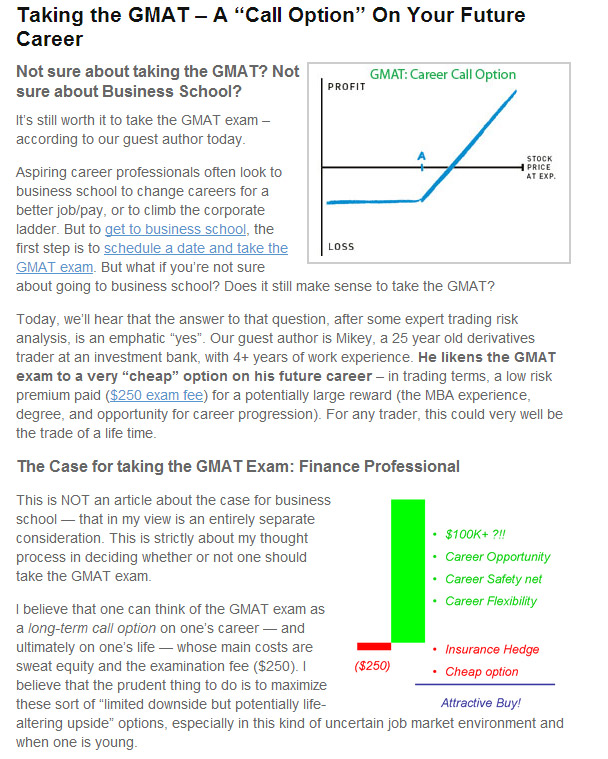
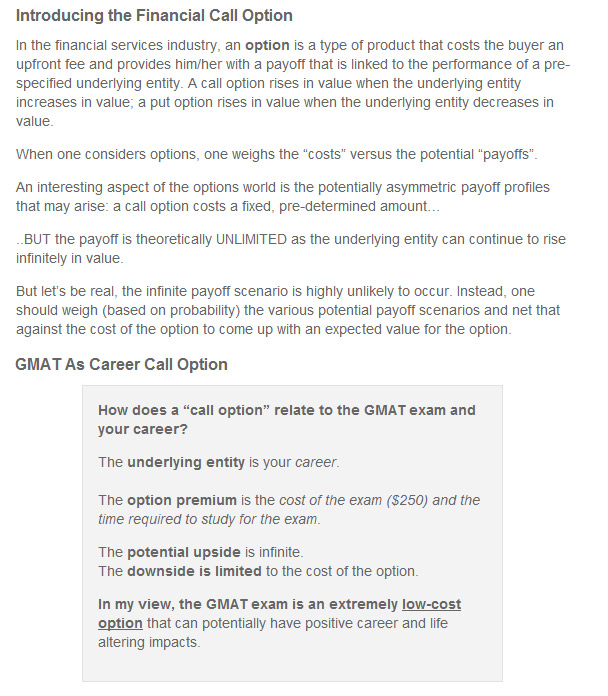
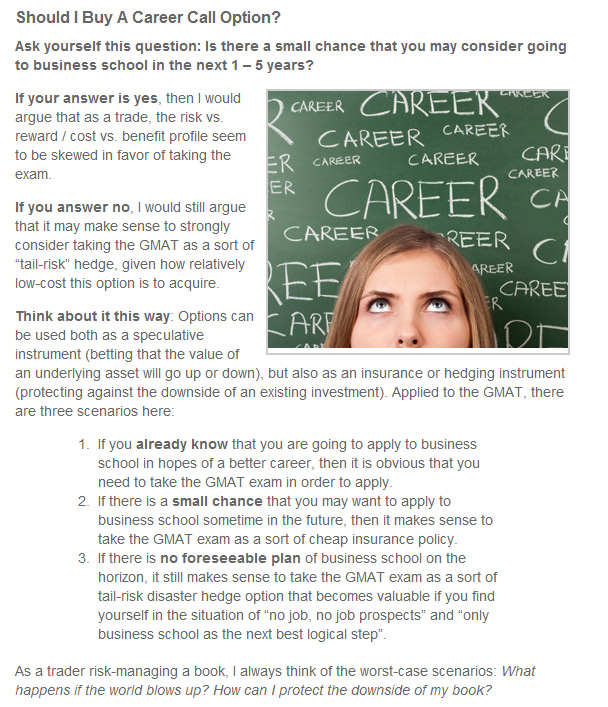
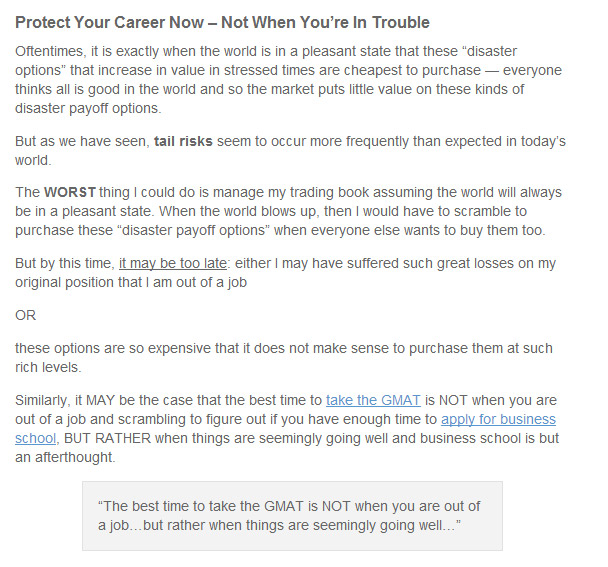
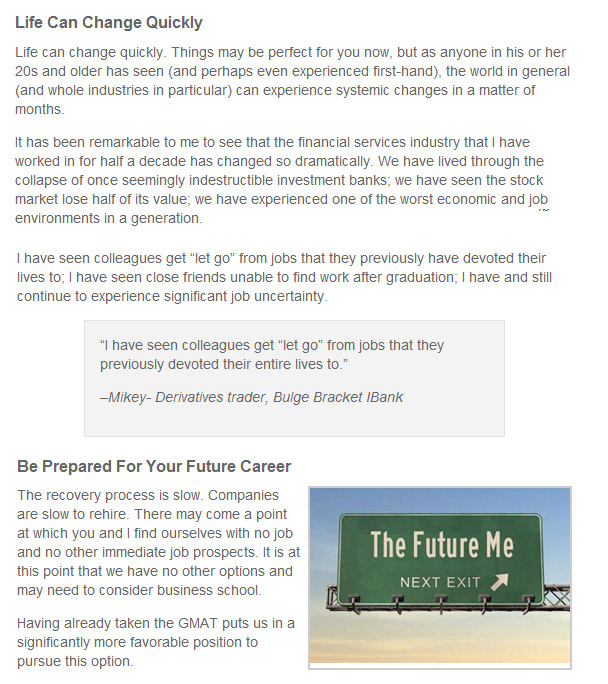
A contributing staff member would like to share his insights on what the GMAT exam means for your career. He is a credit derivatives trader and sees the GMAT exam as a "call option" on your career. Take a look:
So what do you think?
Do you see the GMAT exam as a financial "call option" on your career?
So what do you think?
Do you see the GMAT exam as a financial "call option" on your career?

jumsumtak
Joined: 23 Mar 2011
Last visit: 14 Jun 2023
Posts: 1,092
Own Kudos:
Given Kudos: 479
Concentration: Healthcare, Strategy
Schools: Duke '16 (M)
 25 Dec 2012, 10:29
Kudos
Bookmarks
One of the best posts on GC.
Great analogy and the thing in the box (on when to take the GMAT) is what I always advise people to do. Take it early enough, when you are in a good shape.
Great analogy and the thing in the box (on when to take the GMAT) is what I always advise people to do. Take it early enough, when you are in a good shape.
 25 Dec 2012, 21:21
Kudos
Bookmarks
Hmm interesting read. The only disagreement that I would have with this analogy is that taking the GMAT is not entering into a legal trading contract by taking opposite sides of a bet with a counterparty.
Ie for you to take a profit by buying a call option in the financial markets, the counterparty who sold you that option must take an equally-sized loss (discounting fees). Conversely if you take a loss by buying that put option, then the counterparty that sold you the option would take a equally-sized profit in that trade.
Of course by taking the GMAT, going to business school, and then making lots of money from your successful career, GMAC doesn't actually lose any money as a result of all of your successes, which is why the analogy is flawed.
Anyways interesting read, thanks for sharing, and kudos for the post!
Ie for you to take a profit by buying a call option in the financial markets, the counterparty who sold you that option must take an equally-sized loss (discounting fees). Conversely if you take a loss by buying that put option, then the counterparty that sold you the option would take a equally-sized profit in that trade.
Of course by taking the GMAT, going to business school, and then making lots of money from your successful career, GMAC doesn't actually lose any money as a result of all of your successes, which is why the analogy is flawed.
Anyways interesting read, thanks for sharing, and kudos for the post!







