Last visit was: 23 Apr 2026, 20:23 It is currently 23 Apr 2026, 20:23
Close
GMAT Club Daily Prep
Thank you for using the timer - this advanced tool can estimate your performance and suggest more practice questions. We have subscribed you to Daily Prep Questions via email.

Customized
for You

we will pick new questions that match your level based on your Timer History

Track
Your Progress

every week, we’ll send you an estimated GMAT score based on your performance

Practice
Pays

we will pick new questions that match your level based on your Timer History
Not interested in getting valuable practice questions and articles delivered to your email? No problem, unsubscribe here.
Close
Request Expert Reply
Confirm Cancel
avatar
PareshGmat
Joined: 27 Dec 2012
Last visit: 10 Jul 2016
Posts: 1,531
Own Kudos:
8,272
 [20]
Given Kudos: 193
Status:The Best Or Nothing
Location: India
Concentration: General Management, Technology
WE:Information Technology (Computer Software)
Posts: 1,531
Kudos: 8,272
 [20]
2
Kudos
Add Kudos
18
Bookmarks
Bookmark this Post
Most Helpful Reply
avatar
nvijayprasanna
Joined: 17 Apr 2012
Last visit: 10 May 2017
Posts: 12
Own Kudos:
46
 [7]
Given Kudos: 5
Location: United States
WE:Information Technology (Computer Software)
Posts: 12
Kudos: 46
 [7]
5
Kudos
Add Kudos
2
Bookmarks
Bookmark this Post
General Discussion
User avatar
KarishmaB
Joined: 16 Oct 2010
Last visit: 23 Apr 2026
Posts: 16,441
Own Kudos:
79,397
 [3]
Given Kudos: 484
Location: Pune, India
Expert
Expert reply
Active GMAT Club Expert! Tag them with @ followed by their username for a faster response.
Posts: 16,441
Kudos: 79,397
 [3]
2
Kudos
Add Kudos
1
Bookmarks
Bookmark this Post
User avatar
KarishmaB
Joined: 16 Oct 2010
Last visit: 23 Apr 2026
Posts: 16,441
Own Kudos:
79,397
 [4]
Given Kudos: 484
Location: Pune, India
Expert
Expert reply
Active GMAT Club Expert! Tag them with @ followed by their username for a faster response.
Posts: 16,441
Kudos: 79,397
 [4]
2
Kudos
Add Kudos
2
Bookmarks
Bookmark this Post
PareshGmat
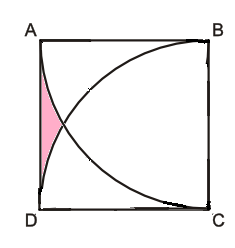
As shown in figure, Square ABCD has arc AC centred at B and arc BD centred at C. If AB = 4, area of shaded region is


A: \(\frac{16\pi}{3} - 4\sqrt{3}\)

B: \(4\sqrt{3} - \frac{4\pi}{3}\)

C: \(4 + 4\sqrt{3} + \frac{4\pi}{3}\)

D: \(16 + 2\sqrt{3} - \frac{8\pi}{3}\)

E: \(16 - 4\sqrt{3} - \frac{8\pi}{3}\)

Experts: Please jump in. This question went top of my head. Either its too hard or too easy to make me dumb :)

Anxiously awaiting for breakthrough....

Now that you know how to calculate the area of the other shaded region (the question you have put in the Quantitative forum), you should be able to solve this.
For that solution, check: area-of-the-shaded-region-181249.html#p1408136

Area of this shaded region = Area of square - Area of a quarter of a circle - (Area of Quarter of circle - Area of the other shaded region)

Area of this shaded region = Area of square\(- (1/4)*\pi*4^2 - ((1/4)*\pi*4^2 - (16/3)*\pi + 4*\sqrt{3})\) - Area obtained in that question if radius is 4

Area of this shaded region \(= 16 - 4*\pi - 4*\pi + (16/3)*\pi - 4*\sqrt{3}\)

Area of this shaded region \(= 16 - (8/3)*\pi - 4\sqrt{3}\)
avatar
PareshGmat
Joined: 27 Dec 2012
Last visit: 10 Jul 2016
Posts: 1,531
Own Kudos:
Given Kudos: 193
Status:The Best Or Nothing
Location: India
Concentration: General Management, Technology
WE:Information Technology (Computer Software)
Posts: 1,531
Kudos: 8,272
Kudos
Add Kudos
Bookmarks
Bookmark this Post
VeritasPrepKarishma
PareshGmat
As shown in figure, Square ABCD has arc AC centred at B and arc BD centred at C. If AB = 4, area of shaded region is

Attachment:
square.png

A: \(\frac{16\pi}{3} - 4\sqrt{3}\)

B: \(4\sqrt{3} - \frac{4\pi}{3}\)

C: \(4 + 4\sqrt{3} + \frac{4\pi}{3}\)

D: \(16 + 2\sqrt{3} - \frac{8\pi}{3}\)

E: \(16 - 4\sqrt{3} - \frac{8\pi}{3}\)

Experts: Please jump in. This question went top of my head. Either its too hard or too easy to make me dumb :)

Anxiously awaiting for breakthrough....

Now that you know how to calculate the area of the other shaded region (the question you have put in the Quantitative forum), you should be able to solve this.
For that solution, check: area-of-the-shaded-region-181249.html#p1408136

Area of this shaded region = Area of square - Area of a quarter of a circle - (Area of Quarter of circle - Area of the other shaded region)

Area of this shaded region = Area of square\(- (1/4)*\pi*4^2 - ((1/4)*\pi*4^2 - (16/3)*\pi + 4*\sqrt{3})\) - Area obtained in that question if radius is 4

Area of this shaded region \(= 16 - 4*\pi - 4*\pi + (16/3)*\pi - 4*\sqrt{3}\)

Area of this shaded region \(= 16 - (8/3)*\pi - 4\sqrt{3}\)

Yes Karishma, thank you so much for the calculus.

That question placed was in line for this one. Can you kindly tell as to what level this question would be...?
User avatar
KarishmaB
Joined: 16 Oct 2010
Last visit: 23 Apr 2026
Posts: 16,441
Own Kudos:
79,397
 [1]
Given Kudos: 484
Location: Pune, India
Expert
Expert reply
Active GMAT Club Expert! Tag them with @ followed by their username for a faster response.
Posts: 16,441
Kudos: 79,397
 [1]
1
Kudos
Add Kudos
Bookmarks
Bookmark this Post
PareshGmat
VeritasPrepKarishma
PareshGmat
As shown in figure, Square ABCD has arc AC centred at B and arc BD centred at C. If AB = 4, area of shaded region is

Attachment:
square.png

A: \(\frac{16\pi}{3} - 4\sqrt{3}\)

B: \(4\sqrt{3} - \frac{4\pi}{3}\)

C: \(4 + 4\sqrt{3} + \frac{4\pi}{3}\)

D: \(16 + 2\sqrt{3} - \frac{8\pi}{3}\)

E: \(16 - 4\sqrt{3} - \frac{8\pi}{3}\)

Experts: Please jump in. This question went top of my head. Either its too hard or too easy to make me dumb :)

Anxiously awaiting for breakthrough....

Now that you know how to calculate the area of the other shaded region (the question you have put in the Quantitative forum), you should be able to solve this.
For that solution, check: area-of-the-shaded-region-181249.html#p1408136

Area of this shaded region = Area of square - Area of a quarter of a circle - (Area of Quarter of circle - Area of the other shaded region)

Area of this shaded region = Area of square\(- (1/4)*\pi*4^2 - ((1/4)*\pi*4^2 - (16/3)*\pi + 4*\sqrt{3})\) - Area obtained in that question if radius is 4

Area of this shaded region \(= 16 - 4*\pi - 4*\pi + (16/3)*\pi - 4*\sqrt{3}\)

Area of this shaded region \(= 16 - (8/3)*\pi - 4\sqrt{3}\)

Yes Karishma, thank you so much for the calculus.

That question placed was in line for this one. Can you kindly tell as to what level this question would be...?

This will not be a GMAT question - too convoluted and very cumbersome calculation. The first one, perhaps, is workable since it needs only one step but even that one would be 700+.
avatar
akhilshrmaa
Joined: 12 May 2014
Last visit: 14 Jan 2016
Posts: 12
Own Kudos:
Given Kudos: 4
Location: United States
Concentration: Strategy, Operations
Schools: IIMC'17
GMAT Date: 10-22-2014
GPA: 1.9
WE:Engineering (Energy)
Schools: IIMC'17
Posts: 12
Kudos: 51
Kudos
Add Kudos
Bookmarks
Bookmark this Post
Solved with the same method as Prasanna.
I believe that most questions are solvable within time if the mind strikes in the right direction (Think that can comes with practice only)

TIP: Most geometry questions that seem unsolvable with the figure provided can be solved with some constructions. (Again comes with practice):P
avatar
Jerry1982
Joined: 19 Sep 2011
Last visit: 06 Aug 2020
Posts: 22
Own Kudos:
Given Kudos: 9
Posts: 22
Kudos: 6
Kudos
Add Kudos
Bookmarks
Bookmark this Post
hi ,
will this type of question appear on GMAT?
also i was unable to understand the solution , can you please explain this in detail.
User avatar
KarishmaB
Joined: 16 Oct 2010
Last visit: 23 Apr 2026
Posts: 16,441
Own Kudos:
Given Kudos: 484
Location: Pune, India
Expert
Expert reply
Active GMAT Club Expert! Tag them with @ followed by their username for a faster response.
Posts: 16,441
Kudos: 79,397
Kudos
Add Kudos
Bookmarks
Bookmark this Post
Jerry1982
hi ,
will this type of question appear on GMAT?
also i was unable to understand the solution , can you please explain this in detail.

Try making the diagram from the given diagram. You are given that "Square ABCD has arc AC centred at B & arc BD centred at C". So make the circle centered at B and the circle centered at C. Now, remove the lines of the square that you don't care about and focus on only the shaded area. Don't worry about the way I have named the vertices - they are not according to the given diagram. Just note that the shaded portion corresponds to the area bounded by arc AC, arc BC and line BA in my diagram. Now join the points that define the shaded region to get an equilateral triangle (they are all radii of circles with equal radii).
Then you get that the angle subtended at the center is 60 degrees which means area of the sector is 1/6th (which is 60/360) of the area of the circle. But that is not all the shaded region. There is some extra shaded region lying between arc BC and line BC (in my diagram). To get the value of this, we subtract the area of the triangle BAC from the area of the sector BAC (in my diagram)
User avatar
DropBear
Joined: 04 May 2015
Last visit: 30 Jul 2016
Posts: 64
Own Kudos:
35
 [1]
Given Kudos: 58
Concentration: Strategy, Operations
WE:Operations (Military & Defense)
Posts: 64
Kudos: 35
 [1]
Kudos
Add Kudos
1
Bookmarks
Bookmark this Post
VeritasPrepKarishma
PareshGmat
As shown in figure, Square ABCD has arc AC centred at B and arc BD centred at C. If AB = 4, area of shaded region is

Attachment:
square.png

A: \(\frac{16\pi}{3} - 4\sqrt{3}\)

B: \(4\sqrt{3} - \frac{4\pi}{3}\)

C: \(4 + 4\sqrt{3} + \frac{4\pi}{3}\)

D: \(16 + 2\sqrt{3} - \frac{8\pi}{3}\)

E: \(16 - 4\sqrt{3} - \frac{8\pi}{3}\)

Experts: Please jump in. This question went top of my head. Either its too hard or too easy to make me dumb :)

Anxiously awaiting for breakthrough....

Now that you know how to calculate the area of the other shaded region (the question you have put in the Quantitative forum), you should be able to solve this.
For that solution, check: area-of-the-shaded-region-181249.html#p1408136

Area of this shaded region = Area of square - Area of a quarter of a circle - (Area of Quarter of circle - Area of the other shaded region)

Area of this shaded region = Area of square\(- (1/4)*\pi*4^2 - ((1/4)*\pi*4^2 - (16/3)*\pi + 4*\sqrt{3})\) - Area obtained in that question if radius is 4

Area of this shaded region \(= 16 - 4*\pi - 4*\pi + (16/3)*\pi - 4*\sqrt{3}\)

Area of this shaded region \(= 16 - (8/3)*\pi - 4\sqrt{3}\)

Hi VeritasPrepKarishma

I'm very confused :(

I understand, calculating the square and then subtracting the area of a quarter of a circle with radius four, but I am lost after that as to how we calculate the leftover for the second arc? are you able to elaborate for me please?

I had a read of the other post you linked to which asks you to calculate the opposite area. Once again, I can understand how one section is calculated, just not how this works in a simultaneous sense?

Anyone else feel free to jump in too.

Moderator Note: I worked on this for a while and finally got to the bottom of it. It's about finding the difference between the arc and an equilateral triangle... My first mistake was that I did not know the formula for the area of an equilateral triangle and had to google it. Second mistake... Not being clever enough to recognize the process. Working on it though :)
User avatar
Temurkhon
Joined: 23 Jan 2013
Last visit: 06 Apr 2019
Posts: 408
Own Kudos:
Given Kudos: 43
Schools: Cambridge'16
Posts: 408
Kudos: 325
Kudos
Add Kudos
Bookmarks
Bookmark this Post
Option E is most favourable format in which we subtract unneeded area from 16. Answer in 1.5 min :twisted:

E
avatar
sharma123
Joined: 29 Oct 2014
Last visit: 03 May 2017
Posts: 31
Own Kudos:
Given Kudos: 194
Products:
Posts: 31
Kudos: 23
Kudos
Add Kudos
Bookmarks
Bookmark this Post
VeritasPrepKarishma
PareshGmat
As shown in figure, Square ABCD has arc AC centred at B and arc BD centred at C. If AB = 4, area of shaded region is

Attachment:
square.png

A: \(\frac{16\pi}{3} - 4\sqrt{3}\)

B: \(4\sqrt{3} - \frac{4\pi}{3}\)

C: \(4 + 4\sqrt{3} + \frac{4\pi}{3}\)

D: \(16 + 2\sqrt{3} - \frac{8\pi}{3}\)

E: \(16 - 4\sqrt{3} - \frac{8\pi}{3}\)

Experts: Please jump in. This question went top of my head. Either its too hard or too easy to make me dumb :)

Anxiously awaiting for breakthrough....

Now that you know how to calculate the area of the other shaded region (the question you have put in the Quantitative forum), you should be able to solve this.
For that solution, check: area-of-the-shaded-region-181249.html#p1408136

Area of this shaded region = Area of square - Area of a quarter of a circle - (Area of Quarter of circle - Area of the other shaded region)

Area of this shaded region = Area of square\(- (1/4)*\pi*4^2 - ((1/4)*\pi*4^2 - (16/3)*\pi + 4*\sqrt{3})\) - Area obtained in that question if radius is 4

Area of this shaded region \(= 16 - 4*\pi - 4*\pi + (16/3)*\pi - 4*\sqrt{3}\)

Area of this shaded region \(= 16 - (8/3)*\pi - 4\sqrt{3}\)
Nice explanationVeritasPrepKarishma
User avatar
exc4libur
Joined: 24 Nov 2016
Last visit: 22 Mar 2022
Posts: 1,680
Own Kudos:
1,469
 [2]
Given Kudos: 607
Location: United States
Posts: 1,680
Kudos: 1,469
 [2]
2
Kudos
Add Kudos
Bookmarks
Bookmark this Post
PareshGmat
As shown in figure, Square ABCD has arc AC centred at B and arc BD centred at C. If AB = 4, area of shaded region is


A: \(\frac{16\pi}{3} - 4\sqrt{3}\)
B: \(4\sqrt{3} - \frac{4\pi}{3}\)
C: \(4 + 4\sqrt{3} + \frac{4\pi}{3}\)
D: \(16 + 2\sqrt{3} - \frac{8\pi}{3}\)
E: \(16 - 4\sqrt{3} - \frac{8\pi}{3}\)

Area Shaded = Area Square ABCD - Area Equilateral BOC - 2(Area of Sector AOB or DOC)
Area Square = 16
Area Equilateral = \(x^2\sqrt{3}/4=16\sqrt{3}/4=4\sqrt{3}\)
Area Sector = Area Circle * 30/360 = \(4^2π*30/360=16π/12=4π/3\)
Area Shaded = \(16 - 4\sqrt{3} - 2(4π/3) = 16 - 4\sqrt{3} - 8π/3\)

Answer (E)
Attachments

Untitled.png
Untitled.png [ 32.98 KiB | Viewed 6591 times ]

User avatar
bumpbot
User avatar
Non-Human User
Joined: 09 Sep 2013
Last visit: 04 Jan 2021
Posts: 38,960
Own Kudos:
Posts: 38,960
Kudos: 1,117
Kudos
Add Kudos
Bookmarks
Bookmark this Post
Automated notice from GMAT Club BumpBot:

A member just gave Kudos to this thread, showing it’s still useful. I’ve bumped it to the top so more people can benefit. Feel free to add your own questions or solutions.

This post was generated automatically.
Moderators:
Math Expert
109785 posts
Tuck School Moderator
853 posts


