Events & Promotions
|
|

GMAT Club Daily Prep
Thank you for using the timer - this advanced tool can estimate your performance and suggest more practice questions. We have subscribed you to Daily Prep Questions via email.
Customized
for You
Track
Your Progress
Practice
Pays
Not interested in getting valuable practice questions and articles delivered to your email? No problem, unsubscribe here.
 Sep 02
01:00 PM EDT
-11:59 PM EDT
Take 30% off all study plans with code COURSEWORK - Expires on Monday 9/7 Sep 04
01:30 AM EDT
-02:30 AM EDT
This Labor Day, turn your hard work into real score gains. From 615→715 in 15 days to 705 in 30 days, our students prove what's possible with personalized, expert guidance. Save up to 25% on 1-on-1 tutoring. Sep 04
10:00 AM EDT
-11:59 PM EDT
We’ve worked incredibly hard to build TTP into the best test prep experience possible, and it would mean a lot to us to win Newsweek’s 2026 Readers’ Choice Award for Best Test Prep. If TTP has helped you, we’d be incredibly grateful for your vote. Sep 06
09:30 AM EDT
-12:30 PM EST
Top scores are possible when you enroll in a powerful EA course, taught live online + 6 months access to TTP OnDemand video courses included! Perfect class schedule and easy course access for working professionals. Class starts Sundays Sept. 6, 2026. Sep 07
12:01 AM PDT
-11:59 PM PDT
On the 7th, GMAT Club Tests will be Free! Including all the Quizzes, Questions, and Tests. 12 AM - 11:59 PM PDT Sep 07
12:30 AM EDT
-01:30 AM EDT
Tejas studied hard but kept repeating the same mistakes. After 3 attempts at 645, a focused 4-week strategy helped him identify and fix what was holding him back—leading to a 695 with just 12–15 hours of study per week.- Sep 07
10:00 AM PDT
-11:00 AM PDT
A complete walkthrough of GMAT Club’s free 12-week GMAT study plan: what you study each week, how progress and goals are tracked, how the error log works, and how your practice unlocks paid tools at no cost. - Sep 09
07:00 AM PDT
-10:00 AM PDT
Meet AdComs and explore top Master’s programs - MiM, MiF, MSc, MSBA and more. - Application Fee Waivers - Free 1-Week of GMAT Club Tests: - Master's Application Toolkit - Grand Prize Giveaway - Sep 09
10:00 AM PDT
-11:00 AM PDT
Three MBA applications. Three rejections. No interview invites. A year later, Aman was admitted to Cambridge Judge, SMU, and IMD. In this episode of MBA Admit Stories, Aman shares how he rebuilt his MBA application...  Sep 10
08:00 PM PDT
-09:00 PM PDT
Free- full-length test + 15 concept videos + 150+ short videos + study plan! Sep 15
07:00 PM EDT
-09:00 PM EST
Elite scores are possible when you enroll in a powerful GMAT course, taught live online + 6 months access to TTP OnDemand video courses included! Class starts Tues/Thurs Sept. 15, 2026 - Nov. 15, 2027, 7:00pm-9:00pm EST Sep 21
08:00 PM EDT
-10:00 PM EDT
Boost your GMAT score in less than one month in a live online class + 6 months access to TTP OnDemand video courses included! Class starts Mon, Tues, Wed, Thur, Fri Sept. 21, 2026 - Oct. 9, 2027, 7:00pm-10:00pm EST


D
Be sure to select an answer first to save it in the Error Log before revealing the correct answer (OA)!
Difficulty:
 65%
(hard)
65%
(hard)
Question Stats:
60% (01:55) correct 40%
(02:12)
wrong
based on 1749
sessions
40%
(02:12)
wrong
based on 1749
sessions
History
Date
Time
Result
Not Attempted Yet
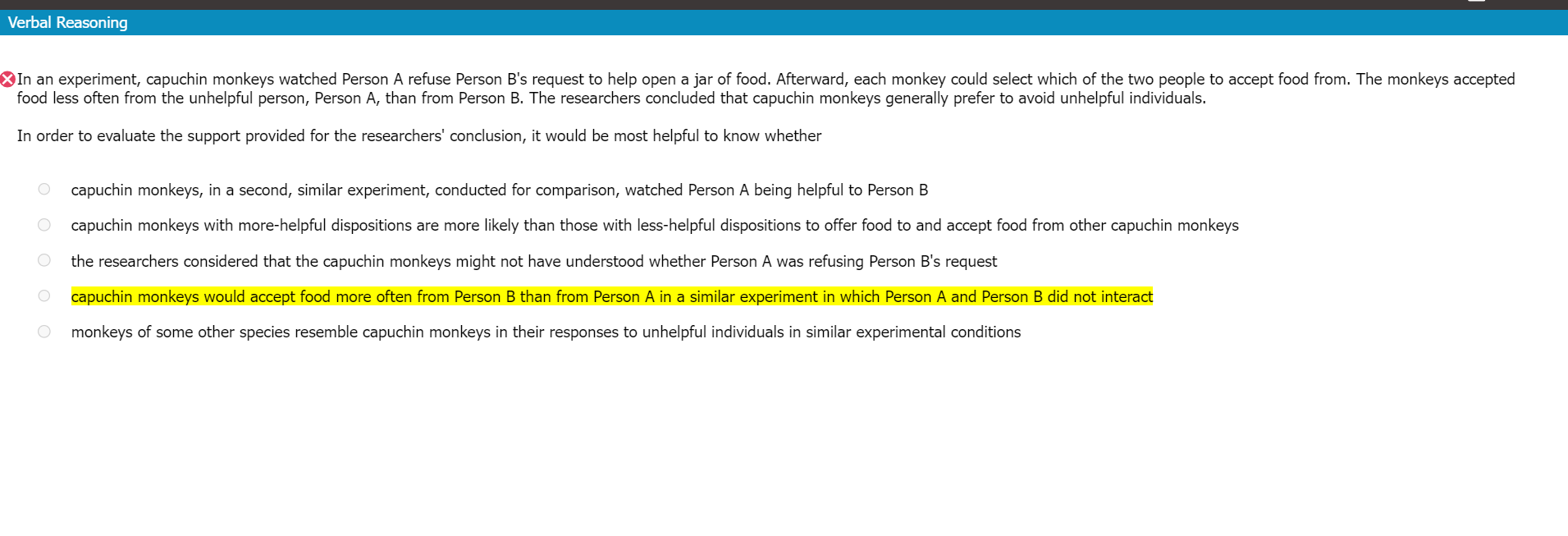
In an experiment, capuchin monkeys watched Person A refuse Person B's request to help open a jar of food. Afterward, each monkey could select which of the two people to accept food from. The monkeys accepted food less often from the unhelpful person, Person A, than from Person B. The researchers concluded that capuchin monkeys generally prefer to avoid unhelpful individuals.
In order to evaluate the support provided for the researchers' conclusion, it would be most helpful to know whether
A. capuchin monkeys, in a second, similar experiment, conducted for comparison, watched Person A being helpful to Person B
B. capuchin monkeys with more-helpful dispositions are more likely than those with less-helpful dispositions to offer food to and accept food from other capuchin monkeys
C. the researchers considered that the capuchin monkeys might not have understood whether Person A was refusing Person B's request
D. capuchin monkeys would accept food more often from Person B than from Person A in a similar experiment in which Person A and Person B did not interact
E. monkeys of some other species resemble capuchin monkeys in their responses to unhelpful individuals in similar experimental conditions
In order to evaluate the support provided for the researchers' conclusion, it would be most helpful to know whether
A. capuchin monkeys, in a second, similar experiment, conducted for comparison, watched Person A being helpful to Person B
B. capuchin monkeys with more-helpful dispositions are more likely than those with less-helpful dispositions to offer food to and accept food from other capuchin monkeys
C. the researchers considered that the capuchin monkeys might not have understood whether Person A was refusing Person B's request
D. capuchin monkeys would accept food more often from Person B than from Person A in a similar experiment in which Person A and Person B did not interact
E. monkeys of some other species resemble capuchin monkeys in their responses to unhelpful individuals in similar experimental conditions
Why doesn't A work here?
CR - 2.png [ 88.87 KiB | Viewed 14131 times ]
Attachment:
CR - 2.png [ 88.87 KiB | Viewed 14131 times ]
Using official mocks already?
Add GMAT Club Tests for harder practice, analytics, and explanations without overlapping Official Guide or official mock questions.
Try it now →
Try it now →

 17 Nov 2024, 00:24
Kudos
Bookmarks
Why A is not as strong as D:
While testing the opposite behavior (Person A being helpful) could provide additional insights, it does not directly address the core question of whether the monkeys' preference in the original experiment was specifically due to their perception of unhelpfulness. The conclusion is about avoiding unhelpful individuals, so A introduces a new variable (helpfulness) rather than isolating the original one (unhelpfulness).
A might show whether monkeys prefer helpful individuals, but it wouldn't clarify if the observed behavior in the original experiment was solely due to unhelpfulness or influenced by other factors, such as an inherent preference for Person B.
Why D is stronger:
D isolates the variable of the interaction. If the monkeys still prefer Person B in a scenario where no refusal occurred, it suggests the preference was unrelated to perceived helpfulness or unhelpfulness. This directly challenges or supports the conclusion.
While A introduces a complementary line of inquiry, it doesn’t directly evaluate the researchers’ conclusion. D is better because it tests the monkeys’ behavior under controlled conditions to confirm whether the avoidance of Person A is indeed due to perceived unhelpfulness.
While C raises a potentially valid concern about the monkeys’ comprehension of the situation, it does not directly test the validity of the researchers’ conclusion. D is more appropriate because it experimentally isolates the helpfulness/unhelpfulness variable and provides actionable evidence to confirm or refute the claim that capuchin monkeys avoid unhelpful individuals.
While testing the opposite behavior (Person A being helpful) could provide additional insights, it does not directly address the core question of whether the monkeys' preference in the original experiment was specifically due to their perception of unhelpfulness. The conclusion is about avoiding unhelpful individuals, so A introduces a new variable (helpfulness) rather than isolating the original one (unhelpfulness).
A might show whether monkeys prefer helpful individuals, but it wouldn't clarify if the observed behavior in the original experiment was solely due to unhelpfulness or influenced by other factors, such as an inherent preference for Person B.
Why D is stronger:
D isolates the variable of the interaction. If the monkeys still prefer Person B in a scenario where no refusal occurred, it suggests the preference was unrelated to perceived helpfulness or unhelpfulness. This directly challenges or supports the conclusion.
While A introduces a complementary line of inquiry, it doesn’t directly evaluate the researchers’ conclusion. D is better because it tests the monkeys’ behavior under controlled conditions to confirm whether the avoidance of Person A is indeed due to perceived unhelpfulness.
While C raises a potentially valid concern about the monkeys’ comprehension of the situation, it does not directly test the validity of the researchers’ conclusion. D is more appropriate because it experimentally isolates the helpfulness/unhelpfulness variable and provides actionable evidence to confirm or refute the claim that capuchin monkeys avoid unhelpful individuals.
 08 Jan 2024, 00:55
Kudos
Bookmarks
In an experiment, capuchin monkeys watched Person A refuse Person B's request to help open a jar of food. Afterward, each monkey could select which of the two people to accept food from. The monkeys accepted food less often from the unhelpful person, Person A, than from Person B. The researchers concluded that capuchin monkeys generally prefer to avoid unhelpful individuals.
Q1. Did the Capucin monkeys interpret A not helping B correctly ?
Q2. Do the Capucin monkeys actually prefer helpful disposition ?
Either an Yes (would strengthen) or No (would weaken) answer provided by the Options to either of the above Questions will help us evaluate this Premise.
In order to evaluate the support provided for the researchers' conclusion, it would be most helpful to know whether
A. capuchin monkeys, in a second, similar experiment, conducted for comparison, watched Person A being helpful to Person B
Let's say the monkeys did watch A being helpful to B, but is this is not enough to provide an Yes or NO answer to the Q1 (see above). If the experiment also included the monkeys taking more food from either A or B, Only then we could have come to the conclusion.
But they were only watching A being helpful to B, We don't know if they received more food from A / B, it's not provided in the option. Hence it doesn't answer our question.
B. capuchin monkeys with more-helpful dispositions are more likely than those with less-helpful dispositions to offer food to and accept food from other capuchin monkeys
Again it doesn't answer Q1 or Q2 since the interpretation is about receiving food from Monkeys ( whose actual disposition whether helpful or not isn't clear )
C. the researchers considered that the capuchin monkeys might not have understood whether Person A was refusing Person B's request
The researchers considering whether the monkeys understood the interpretation correctly or incorrectly, does not necessarily prove the fact that the Monkeys themselves interpreted it correctly ! Only through experiment or evidence we can correlate that only through simple consideration !
(maybe (Yes) the researches considered it but their consideration may be proven wrong later or maybe (No) they did not consider this and yet this interpretation would be proven true later on) Yes / NO answer to this doesn't give conclusive answers to the Q1
D. capuchin monkeys would accept food more often from Person B than from Person A in a similar experiment in which Person A and Person B did not interact
This one definitely gives an evidence to provide an answer to our Q1. This should be the proper answer.
S1: If answer to this option is an YES it means Capucin monkeys simply like B better nothing to do with helpful disposition Q1. No ( Monkeys don't interpret it, they don't understand who is helpful or not ).
S2: If the answer to this option No that means Q1 doesn't have a definite / conclusive answer.
But S1 is enough to weaken the scientist's conclusion.
E. monkeys of some other species resemble capuchin monkeys in their responses to unhelpful individuals in similar experimental conditions
This again won't give an definite Yes or No ans to either Q1 or Q2 as it simply isn't about Capucin monkeys.
Request an Expert answer for this Question.
mikemcgarry
Q1. Did the Capucin monkeys interpret A not helping B correctly ?
Q2. Do the Capucin monkeys actually prefer helpful disposition ?
Either an Yes (would strengthen) or No (would weaken) answer provided by the Options to either of the above Questions will help us evaluate this Premise.
In order to evaluate the support provided for the researchers' conclusion, it would be most helpful to know whether
A. capuchin monkeys, in a second, similar experiment, conducted for comparison, watched Person A being helpful to Person B
Let's say the monkeys did watch A being helpful to B, but is this is not enough to provide an Yes or NO answer to the Q1 (see above). If the experiment also included the monkeys taking more food from either A or B, Only then we could have come to the conclusion.
But they were only watching A being helpful to B, We don't know if they received more food from A / B, it's not provided in the option. Hence it doesn't answer our question.
B. capuchin monkeys with more-helpful dispositions are more likely than those with less-helpful dispositions to offer food to and accept food from other capuchin monkeys
Again it doesn't answer Q1 or Q2 since the interpretation is about receiving food from Monkeys ( whose actual disposition whether helpful or not isn't clear )
C. the researchers considered that the capuchin monkeys might not have understood whether Person A was refusing Person B's request
The researchers considering whether the monkeys understood the interpretation correctly or incorrectly, does not necessarily prove the fact that the Monkeys themselves interpreted it correctly ! Only through experiment or evidence we can correlate that only through simple consideration !
(maybe (Yes) the researches considered it but their consideration may be proven wrong later or maybe (No) they did not consider this and yet this interpretation would be proven true later on) Yes / NO answer to this doesn't give conclusive answers to the Q1
D. capuchin monkeys would accept food more often from Person B than from Person A in a similar experiment in which Person A and Person B did not interact
This one definitely gives an evidence to provide an answer to our Q1. This should be the proper answer.
S1: If answer to this option is an YES it means Capucin monkeys simply like B better nothing to do with helpful disposition Q1. No ( Monkeys don't interpret it, they don't understand who is helpful or not ).
S2: If the answer to this option No that means Q1 doesn't have a definite / conclusive answer.
But S1 is enough to weaken the scientist's conclusion.
E. monkeys of some other species resemble capuchin monkeys in their responses to unhelpful individuals in similar experimental conditions
This again won't give an definite Yes or No ans to either Q1 or Q2 as it simply isn't about Capucin monkeys.
Request an Expert answer for this Question.
mikemcgarry