Events & Promotions
|
|

GMAT Club Daily Prep
Thank you for using the timer - this advanced tool can estimate your performance and suggest more practice questions. We have subscribed you to Daily Prep Questions via email.
Customized
for You
Track
Your Progress
Practice
Pays
Not interested in getting valuable practice questions and articles delivered to your email? No problem, unsubscribe here.
 Sep 15
07:00 PM EDT
-09:00 PM EST
Elite scores are possible when you enroll in a powerful GMAT course, taught live online + 6 months access to TTP OnDemand video courses included! Class starts Tues/Thurs Sept. 15, 2026 - Nov. 15, 2027, 7:00pm-9:00pm EST Sep 21
07:00 PM EDT
-10:00 PM EDT
Boost your GMAT score in less than one month in a live online class + 6 months access to TTP OnDemand video courses included! Class starts Mon, Tues, Wed, Thur, Fri Sept. 21, 2026 - Oct. 9, 2027, 7:00pm-10:00pm EST

 13 Jan 2024, 21:11
Kudos
Bookmarks


B
Be sure to select an answer first to save it in the Error Log before revealing the correct answer (OA)!
Difficulty:
 45%
(medium)
45%
(medium)
Question Stats:
71% (01:57) correct 29%
(02:19)
wrong
based on 1404
sessions
29%
(02:19)
wrong
based on 1404
sessions
History
Date
Time
Result
Not Attempted Yet
Economist: The social impact of venture capital may be even larger than previously thought. A recent study calculated that a dollar of venture capital stimulates three to five times more inventions to be registered with the government each year than a dollar of corporate research and development spending. This implies that if the current surge of venture capital funding continues, it would generate as much innovation as all corporate research and development spending added together.
The economist’s argument about venture-capital funding depends on which of the following assumptions?
A) An increase in the number of inventions registered with the government is a sign of a surge in venture-capital funding.
B) Innovation is accurately reflected in the numbers of inventions registered with the government.
C) There has been a decline in the number of inventions registered with the government that resulted from corporate research- and – development spending.
D) Corporate research and development spending currently has a smaller social impact than does venture-capital spending.
E) Most corporations will remain fiscally conservative in their spending on research and development.
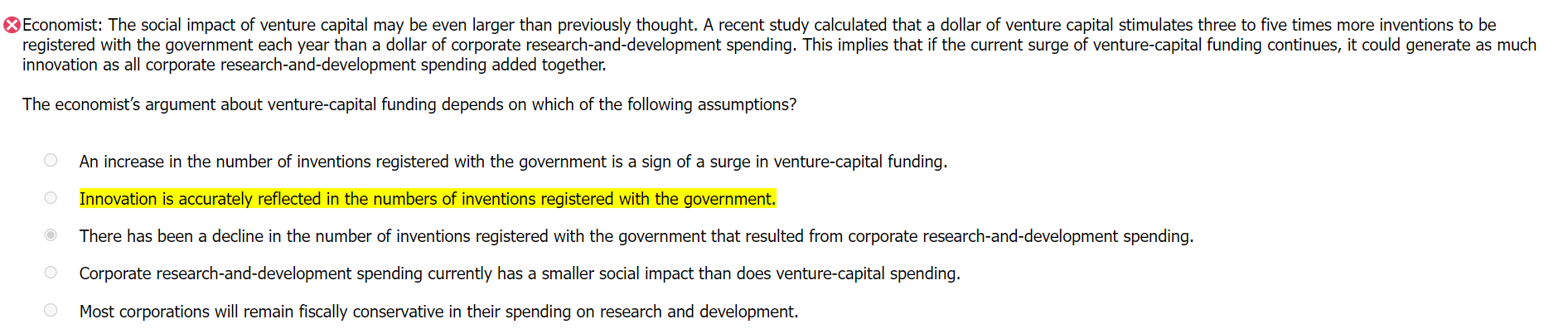
GMAT-Club-Forum-ocz4hdjx.png [ 102.79 KiB | Viewed 3794 times ]
The economist’s argument about venture-capital funding depends on which of the following assumptions?
A) An increase in the number of inventions registered with the government is a sign of a surge in venture-capital funding.
B) Innovation is accurately reflected in the numbers of inventions registered with the government.
C) There has been a decline in the number of inventions registered with the government that resulted from corporate research- and – development spending.
D) Corporate research and development spending currently has a smaller social impact than does venture-capital spending.
E) Most corporations will remain fiscally conservative in their spending on research and development.
Attachment:
GMAT-Club-Forum-ocz4hdjx.png [ 102.79 KiB | Viewed 3794 times ]
Using official mocks already?
Add GMAT Club Tests for harder practice, analytics, and explanations without overlapping Official Guide or official mock questions.
Try it now →
Try it now →

 15 Jan 2024, 11:41
Kudos
Bookmarks
Explanation
Economist: The social impact of venture capital may be even larger than previously thought. A recent study calculated that a dollar of venture capital stimulates three to five times more inventions to be registered with the government each year than a dollar of corporate research and development spending. This implies that if the current surge of venture capital funding continues, it would generate as much innovation as all corporate research and development spending added together.
We see that the reasoning of the argument is basically that, if it's true that a dollar of venture capital stimulates more inventions to be registered with the government each year than a dollar of corporate research and development spending does, then venture capital funding will generate as much innovation as corporate research and development.
In that line of reasoning, there is a clear gap, in that the evidence is about "inventions .. registered with the government" and the conclusion is about "innovation."
The economist’s argument about venture-capital funding depends on which of the following assumptions?
The correct answer will state an assumption on which the argument depends, and it's likely that that assumption will somehow connect "inventions .. registered with the government" to "innovation."
A) An increase in the number of inventions registered with the government is a sign of a surge in venture-capital funding.
The argument does not depend on this choice being true. After all, even if an increase in the number of inventions registered with the government does not always result from a surge in venture-capital funding, and sometimes results from something else, it could still be the case that venture-capital funding will generate as much innovation as corporate research and development.
In other words, the argument is not saying that corporate research and development or something else other than venture-capital funding couldn't cause an increase in the number of inventions registered. It's just saying that venture-capital funding will play a big role.
So, even if this choice isn't true, the argument could still work.
Eliminate.
B) Innovation is accurately reflected in the numbers of inventions registered with the government.
As we discussed above, the argument jumps from the evidence that "a dollar of venture capital stimulates three to five times more inventions to be registered with the government each year than a dollar of corporate research and development spending," to the conclusion that "if the current surge of venture capital funding continues, it would generate as much innovation as all corporate research and development spending added together."
So, the argument depends on the assumption that "inventions ... registered with the government" are connected to "innovation."
In other words, if it were not true that "Innovation is accurately reflected in the numbers of inventions registered with the government," then the evidence about "inventions" would not support the conclusion about "innovation" since the numbers of inventions registered with the government would not be accurate indicators of innovation.
Keep.
C) There has been a decline in the number of inventions registered with the government that resulted from corporate research- and – development spending.
The evidence presented is that "a dollar of venture capital stimulates three to five times more inventions to be registered with the government each year than a dollar of corporate research and development spending." So, we see that the argument supports the conclusion with a fact about the relative results of a dollar of venture-capital funding and of a dollar of corporate research and development spending.
That fact supports the conclusion regardless of whether there has been a decline in the number of inventions registered with the government that resulted from corporate research- and – development spending. After all, even if there has not been a a decline in the number of inventions that resulted from corporate research- and – development spending, the fact that a dollar of venture-capital funding is so much more productive than a dollar of corporate research- and – development spending could still support the conclusion.
So, the argument works regardless of whether this choice is true.
Eliminate.
D) Corporate research and development spending currently has a smaller social impact than does venture-capital spending.
The conclusion of the argument is "if the current surge of venture capital funding continues, it (venture-capital funding) would generate as much innovation as all corporate research and development spending added together.
"As much as" communicates the idea that the results of "venture-capital funding" and "corporate research and development spending" will be the same.
So, the argument does not involve the assumption that corporate research and development spending has a "smaller" impact.
Eliminate.
E) Most corporations will remain fiscally conservative in their spending on research and development.
This choice is a little tricky to eliminate because "Most corporations will remain fiscally conservative in their spending on research and development" seems to communicate "Most corporations will not increase their spending on research and development," and we could think that the author assumes that corporations will not increase their spending on research and development.
At the same time,. I think we can eliminate this choice since the argument may work even if corporations will not remain fiscally conservative in their spending on research and development. After all, the fact stated by the passage, "a dollar of venture capital stimulates three to five times more inventions to be registered with the government each year than a dollar of corporate research and development spending," may be enough to support the conclusion even if corporations will increase their spending on research and development. After all, it could be that the author knows that corporations will increase their spending and still believes that, because "a dollar of venture capital stimulates three to five times more inventions to be registered," the conclusion is correct.
In other words, we don't have a clear reason to believe that the author has assumed that the future will involve the specific situation that "Most corporations will remain fiscally conservative in their spending on research and development." The author could have many beliefs about the future and may believe that corporations will not remain fiscally conservative in their spending and that, in that case, the evidence still supports the conclusion.
So, the argument can work even if this choice isn't true.
Thus, since the argument clearly does not work unless choice (B) is true and can work if (E) is not true, we can safely choose (B) over (E).
Correct answer: (B)
Economist: The social impact of venture capital may be even larger than previously thought. A recent study calculated that a dollar of venture capital stimulates three to five times more inventions to be registered with the government each year than a dollar of corporate research and development spending. This implies that if the current surge of venture capital funding continues, it would generate as much innovation as all corporate research and development spending added together.
We see that the reasoning of the argument is basically that, if it's true that a dollar of venture capital stimulates more inventions to be registered with the government each year than a dollar of corporate research and development spending does, then venture capital funding will generate as much innovation as corporate research and development.
In that line of reasoning, there is a clear gap, in that the evidence is about "inventions .. registered with the government" and the conclusion is about "innovation."
The economist’s argument about venture-capital funding depends on which of the following assumptions?
The correct answer will state an assumption on which the argument depends, and it's likely that that assumption will somehow connect "inventions .. registered with the government" to "innovation."
A) An increase in the number of inventions registered with the government is a sign of a surge in venture-capital funding.
The argument does not depend on this choice being true. After all, even if an increase in the number of inventions registered with the government does not always result from a surge in venture-capital funding, and sometimes results from something else, it could still be the case that venture-capital funding will generate as much innovation as corporate research and development.
In other words, the argument is not saying that corporate research and development or something else other than venture-capital funding couldn't cause an increase in the number of inventions registered. It's just saying that venture-capital funding will play a big role.
So, even if this choice isn't true, the argument could still work.
Eliminate.
B) Innovation is accurately reflected in the numbers of inventions registered with the government.
As we discussed above, the argument jumps from the evidence that "a dollar of venture capital stimulates three to five times more inventions to be registered with the government each year than a dollar of corporate research and development spending," to the conclusion that "if the current surge of venture capital funding continues, it would generate as much innovation as all corporate research and development spending added together."
So, the argument depends on the assumption that "inventions ... registered with the government" are connected to "innovation."
In other words, if it were not true that "Innovation is accurately reflected in the numbers of inventions registered with the government," then the evidence about "inventions" would not support the conclusion about "innovation" since the numbers of inventions registered with the government would not be accurate indicators of innovation.
Keep.
C) There has been a decline in the number of inventions registered with the government that resulted from corporate research- and – development spending.
The evidence presented is that "a dollar of venture capital stimulates three to five times more inventions to be registered with the government each year than a dollar of corporate research and development spending." So, we see that the argument supports the conclusion with a fact about the relative results of a dollar of venture-capital funding and of a dollar of corporate research and development spending.
That fact supports the conclusion regardless of whether there has been a decline in the number of inventions registered with the government that resulted from corporate research- and – development spending. After all, even if there has not been a a decline in the number of inventions that resulted from corporate research- and – development spending, the fact that a dollar of venture-capital funding is so much more productive than a dollar of corporate research- and – development spending could still support the conclusion.
So, the argument works regardless of whether this choice is true.
Eliminate.
D) Corporate research and development spending currently has a smaller social impact than does venture-capital spending.
The conclusion of the argument is "if the current surge of venture capital funding continues, it (venture-capital funding) would generate as much innovation as all corporate research and development spending added together.
"As much as" communicates the idea that the results of "venture-capital funding" and "corporate research and development spending" will be the same.
So, the argument does not involve the assumption that corporate research and development spending has a "smaller" impact.
Eliminate.
E) Most corporations will remain fiscally conservative in their spending on research and development.
This choice is a little tricky to eliminate because "Most corporations will remain fiscally conservative in their spending on research and development" seems to communicate "Most corporations will not increase their spending on research and development," and we could think that the author assumes that corporations will not increase their spending on research and development.
At the same time,. I think we can eliminate this choice since the argument may work even if corporations will not remain fiscally conservative in their spending on research and development. After all, the fact stated by the passage, "a dollar of venture capital stimulates three to five times more inventions to be registered with the government each year than a dollar of corporate research and development spending," may be enough to support the conclusion even if corporations will increase their spending on research and development. After all, it could be that the author knows that corporations will increase their spending and still believes that, because "a dollar of venture capital stimulates three to five times more inventions to be registered," the conclusion is correct.
In other words, we don't have a clear reason to believe that the author has assumed that the future will involve the specific situation that "Most corporations will remain fiscally conservative in their spending on research and development." The author could have many beliefs about the future and may believe that corporations will not remain fiscally conservative in their spending and that, in that case, the evidence still supports the conclusion.
So, the argument can work even if this choice isn't true.
Thus, since the argument clearly does not work unless choice (B) is true and can work if (E) is not true, we can safely choose (B) over (E).
Correct answer: (B)
General Discussion
13 Jan 2024, 21:24
Kudos
Bookmarks
Hi MartyMurray Bunuel ChiranjeevSingh
,
Can you explain why E is not the corrrect answer?
My analysis:
Conclusion: VC will generate as much innovation as corporate R&D if the current surge of VC funding continues.
So for the conclusion to be true, the author assumes that there is no malicious varience for which VC will not generate as much innovation as corporate R&D even if the current surge continues.
If we negate E, it says "Most corporations will not remain fiscally conservative in their spending on R&D"
In that case it will break the argument right?
because corporates can spend as much money as they can & make more inventions.
Please let me know where am I getting it wrong. Thanks!
,
Can you explain why E is not the corrrect answer?
My analysis:
Conclusion: VC will generate as much innovation as corporate R&D if the current surge of VC funding continues.
So for the conclusion to be true, the author assumes that there is no malicious varience for which VC will not generate as much innovation as corporate R&D even if the current surge continues.
If we negate E, it says "Most corporations will not remain fiscally conservative in their spending on R&D"
In that case it will break the argument right?
because corporates can spend as much money as they can & make more inventions.
Please let me know where am I getting it wrong. Thanks!





