Events & Promotions
|
|

GMAT Club Daily Prep
Thank you for using the timer - this advanced tool can estimate your performance and suggest more practice questions. We have subscribed you to Daily Prep Questions via email.
Customized
for You
Track
Your Progress
Practice
Pays
Not interested in getting valuable practice questions and articles delivered to your email? No problem, unsubscribe here.
 Sep 21
07:00 PM EDT
-10:00 PM EDT
Boost your GMAT score in less than one month in a live online class + 6 months access to TTP OnDemand video courses included! Sep 23
12:30 AM EDT
-01:30 AM EDT
Learn how Keshav, a Chartered Accountant, scored an impressive 705 on GMAT in just 30 days with GMATWhiz's expert guidance. In this video, he shares preparation tips and strategies that worked for him, including the mock, time management, and more Sep 24
01:30 AM EDT
-01:30 AM EDT
Tejas studied hard but kept repeating the same mistakes. After 3 attempts at 645, a focused 4-week strategy helped him identify and fix what was holding him back—leading to a 695 with just 12–15 hours of study per week. Sep 26
06:00 PM PDT
-07:00 PM PDT
Free- full-length test + 15 concept videos + 150+ short videos + study plan!

 10 Jun 2024, 03:15
Kudos
Bookmarks


Dropdown 1: DK
Dropdown 2: NL
Be sure to select an answer first to save it in the Error Log before revealing the correct answer (OA)!
Difficulty:
 65%
(hard)
65%
(hard)
Question Stats:
69% (02:32) correct 31%
(02:25)
wrong
based on 3734
sessions
31%
(02:25)
wrong
based on 3734
sessions
History
Date
Time
Result
Not Attempted Yet
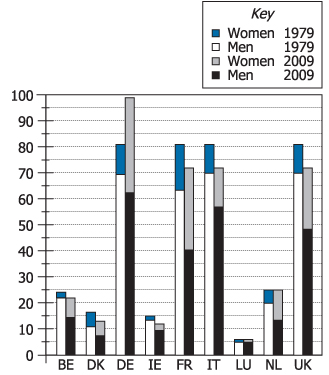
In 1979 when the European Union elected its first Parliament, the Union had 9 member states: Belgium (BE), Denmark (DK), Germany (DE), Ireland (IE), France (FR), Italy (IT), Luxembourg (LU), the Netherlands (NL), and the United Kingdom (UK).
The graph shown has 9 pairs of bars—1 pair for each of those 9 member states. The first bar in each pair represents the composition by gender of the state’s members in the Parliament elected in 1979, and the second bar represents the composition by gender of the state’s members in the Parliament elected in 2009.
In the following statements, the terms least, greatest, and most apply to only the 9 member states represented in the graph. Use the drop-down menus to create the most accurate statements based on the information provided.
If a member were chosen at random from each state’s members in the 1979 Parliament, the state most likely to have had a woman chosen is .
If the member states were arranged in order from least number of members to greatest number of members in the 1979 Parliament, would be in the middle.
In 1979 when the European Union elected its first Parliament, the Union had 9 member states: Belgium (BE), Denmark (DK), Germany (DE), Ireland (IE), France (FR), Italy (IT), Luxembourg (LU), the Netherlands (NL), and the United Kingdom (UK).
The graph shown has 9 pairs of bars—1 pair for each of those 9 member states. The first bar in each pair represents the composition by gender of the state’s members in the Parliament elected in 1979, and the second bar represents the composition by gender of the state’s members in the Parliament elected in 2009.
In the following statements, the terms least, greatest, and most apply to only the 9 member states represented in the graph. Use the drop-down menus to create the most accurate statements based on the information provided.
If a member were chosen at random from each state’s members in the 1979 Parliament, the state most likely to have had a woman chosen is .
If the member states were arranged in order from least number of members to greatest number of members in the 1979 Parliament, would be in the middle.
ID: 100380
ShowHide Answer
Official Answer
Dropdown 1: DK
Dropdown 2: NL
 10 Jun 2024, 09:59
Kudos
Bookmarks
DK, NL
For (1), We need to find probability of women in each case. we can see option has choice between DK, NL, FR, UK. FR and UK has same height bar. UK can be eliminated since blue bar is shorter. Hence we are left with DK, NL, FR. DK, NL has approximate same blue bar but total members more in NL, So NL can be eliminated. We are left with DK and FR in which FR probability will come around (1/4) and DK will come around (1/3). Hence DK will be our answer.
For (2) we need to see 5th highest bar which is NL
For (1), We need to find probability of women in each case. we can see option has choice between DK, NL, FR, UK. FR and UK has same height bar. UK can be eliminated since blue bar is shorter. Hence we are left with DK, NL, FR. DK, NL has approximate same blue bar but total members more in NL, So NL can be eliminated. We are left with DK and FR in which FR probability will come around (1/4) and DK will come around (1/3). Hence DK will be our answer.
For (2) we need to see 5th highest bar which is NL
General Discussion
 Updated on: 07 Sep 2026, 11:08
Originally posted by Sujithz001 on 26 Jun 2024, 08:57.
Last edited by Bunuel on 07 Sep 2026, 11:08, edited 1 time in total.
Last edited by Bunuel on 07 Sep 2026, 11:08, edited 1 time in total.
Kudos
Bookmarks
Drop-down 1:
So here, we shouldn't be deceived by the heights' comparison between bars. My approach would be to use the calculator & start finding the ratios of women vs men, for each of the 4 given choices. The greater the value, the greater the probability of choosing a woman in random
1. DK = 6/10 = 0.6
2. FR = 17/63 = 0.26
3. NL = 5/20 = 0.25
4. UK = 10/70 = 0.14.
Hence DK is the answer.
So here, we shouldn't be deceived by the heights' comparison between bars. My approach would be to use the calculator & start finding the ratios of women vs men, for each of the 4 given choices. The greater the value, the greater the probability of choosing a woman in random
1. DK = 6/10 = 0.6
2. FR = 17/63 = 0.26
3. NL = 5/20 = 0.25
4. UK = 10/70 = 0.14.
Hence DK is the answer.