Events & Promotions
|
|

GMAT Club Daily Prep
Thank you for using the timer - this advanced tool can estimate your performance and suggest more practice questions. We have subscribed you to Daily Prep Questions via email.
Customized
for You
Track
Your Progress
Practice
Pays
Not interested in getting valuable practice questions and articles delivered to your email? No problem, unsubscribe here.
 Sep 23
12:30 AM EDT
-01:30 AM EDT
Learn how Keshav, a Chartered Accountant, scored an impressive 705 on GMAT in just 30 days with GMATWhiz's expert guidance. In this video, he shares preparation tips and strategies that worked for him, including the mock, time management, and more Sep 24
01:30 AM EDT
-01:30 AM EDT
Tejas studied hard but kept repeating the same mistakes. After 3 attempts at 645, a focused 4-week strategy helped him identify and fix what was holding him back—leading to a 695 with just 12–15 hours of study per week. Sep 26
01:00 PM EDT
-04:00 PM EDT
Top scores are possible when you enroll in a powerful GMAT course, taught live online + 6 months access to TTP OnDemand video courses included. Class starts Saturdays Sept. 26, 2026 - Dec. 19, 2026, 1:00pm-4:00pm ES Sep 26
06:00 PM PDT
-07:00 PM PDT
Free- full-length test + 15 concept videos + 150+ short videos + study plan! Sep 29
11:00 AM EDT
-01:00 PM EDT
" Description: Top scores are possible when you enroll in a powerful GMAT course, taught live online + 6 months access to TTP OnDemand video courses included! Class starts Tues/Thur Sept. 29, 2026 - Dec. 3, 2026, 11:00am-1:00pm EST Oct 01
07:00 AM BST
-08:00 AM GMT
Welcome to the GMAT Club's Free Interview Prep Event for Top MBA Programs! Buy tickets - Virtual series that’s all set to equip you to -excel in your MBA interviews.



 29 Oct 2024, 09:08
Kudos
Bookmarks
Hello everyone!
After a year-long journey, I finally made it!! Scored a 685(Q86,V83,DI83). 😊
My prep started with the Classic GMAT, where I realized I had significant gaps to fill. While my quant was decent at 61%ile, my verbal score held me back significantly at 51%ile Knowing that I needed help I started looking out for-test prep companies and decided to go ahead with e-GMAT.
Critical Reasoning Progress: I was decent in CR, but I wanted to do better. The key change was learning to think about the possible answers before looking at the actual choices – the "pre-thinking" technique. By taking a few seconds to predict what the answer might be, I avoided getting tricked by wrong answers that sounded good.
DI was a new challenge in the GMAT Focus Edition, requiring a completely fresh approach to tackle it effectively. I found success by treating Multiple Source Reasoning questions like mini Reading Comprehension passages, applying the same strategies I'd learned in verbal - identifying key points rather than getting lost in details.
This approach helped me develop a systematic method for quickly spotting relevant data points across different sources. The sectional tests were particularly valuable for improving my timing - I initially spent too much time but regular practice with timed sections helped me develop a rhythm. This improvement in timing was crucial since DI questions can be time-consuming if not approached strategically.
My final preparation phase
Focused heavily on strategic mock testing and thorough analysis. I began with sectional tests to build my confidence and perfect my timing for each section separately. Once I felt comfortable, I transitioned to taking full-length official GMAT mocks, where I saw steady improvement with scores ranging from 675 to 685 and higher. However, what made these practice tests truly valuable wasn't just the scores - I treated each one as a detailed learning experience.
After each mock, I would conduct a thorough review, paying special attention not only to the questions I got wrong but also to those where I felt uncertain but happened to guess correctly. This comprehensive analysis helped me identify patterns in my mistakes and areas where my understanding was shaky. It also revealed situations where I got lucky with guesses, which could have gone wrong on test day. This approach of treating mocks as learning tools rather than mere score predictors helped me strengthen my weak areas and build genuine confidence for the actual exam.
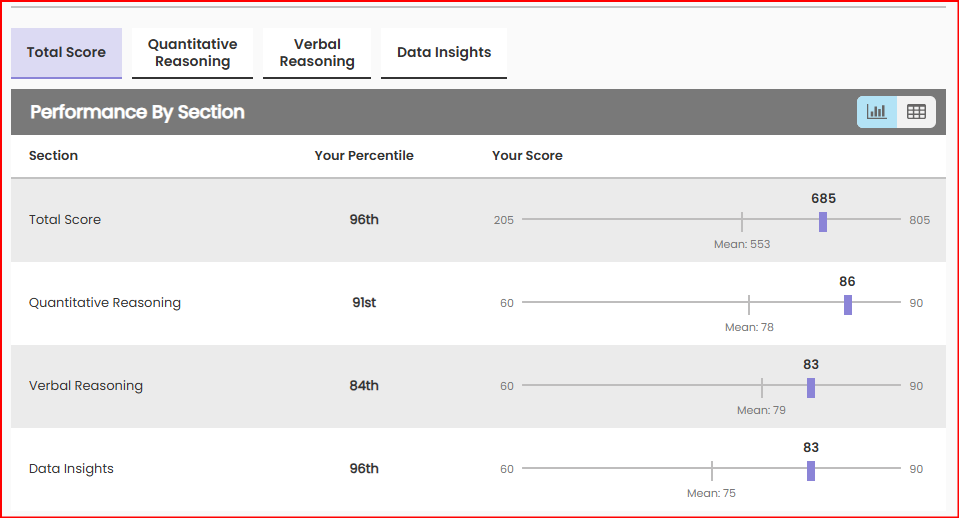
In the end, scoring a 685 was a relief 😊
Learnings
Remember, every GMAT journey is unique. What worked for me might need tweaking for you. Find your rhythm, stick to it, and don't be afraid to adjust your strategies as you go. With dedication, the right approach, and a positive attitude, you can conquer the GMAT.
All the best guys!!

GMAT-Club-Forum-umjotfm7.png [ 41.17 KiB | Viewed 451 times ]
After a year-long journey, I finally made it!! Scored a 685(Q86,V83,DI83). 😊
My prep started with the Classic GMAT, where I realized I had significant gaps to fill. While my quant was decent at 61%ile, my verbal score held me back significantly at 51%ile Knowing that I needed help I started looking out for-test prep companies and decided to go ahead with e-GMAT.
My journey with the GMAT was filled with several challenges, particularly in the verbal section, which initially seemed insurmountable. I would like to share how I navigated these hurdles with specific strategies that might resonate with many of you facing similar difficulties.
Reading Comprehension Journey: I used to read passages very slowly and carefully, trying to understand every small detail. This wasn't working well, especially with complex wordy passages. I was getting stuck in the details and wasting time. Then I learned from e-GMAT that I needed to change my approach. Instead of focusing on every detail, I started looking for the main ideas and how the passage was organized. This simple change helped me improve my RC score dramatically.Critical Reasoning Progress: I was decent in CR, but I wanted to do better. The key change was learning to think about the possible answers before looking at the actual choices – the "pre-thinking" technique. By taking a few seconds to predict what the answer might be, I avoided getting tricked by wrong answers that sounded good.
Taking Quant to Q86!!
Quant section of the GMAT was where I had a relatively strong foundation, but I was determined not to take it for granted. This is where e-GMAT's strategic resources, particularly the P.A.C.E. engine and the concept of the cementing stage, played a critical role.
The platform has a special feature called P.A.C.E. in Quant that looks at how you're doing on certain quizzes and adjusts your study plan. It's like having a smart tutor who spots where you need the most help and focuses your study time there.
The most important part of my prep was what e-GMAT calls the "cementing stage." Think of it like building muscle memory - I did lots of practice problems that were similar to what I'd see on the real GMAT. This helped me in two ways: I got better at spotting trick questions, and I became faster at solving problems. By the time I took the real test, I was making fewer mistakes and working much more quickly.DI was a new challenge in the GMAT Focus Edition, requiring a completely fresh approach to tackle it effectively. I found success by treating Multiple Source Reasoning questions like mini Reading Comprehension passages, applying the same strategies I'd learned in verbal - identifying key points rather than getting lost in details.
This approach helped me develop a systematic method for quickly spotting relevant data points across different sources. The sectional tests were particularly valuable for improving my timing - I initially spent too much time but regular practice with timed sections helped me develop a rhythm. This improvement in timing was crucial since DI questions can be time-consuming if not approached strategically.
My final preparation phase
Focused heavily on strategic mock testing and thorough analysis. I began with sectional tests to build my confidence and perfect my timing for each section separately. Once I felt comfortable, I transitioned to taking full-length official GMAT mocks, where I saw steady improvement with scores ranging from 675 to 685 and higher. However, what made these practice tests truly valuable wasn't just the scores - I treated each one as a detailed learning experience.
After each mock, I would conduct a thorough review, paying special attention not only to the questions I got wrong but also to those where I felt uncertain but happened to guess correctly. This comprehensive analysis helped me identify patterns in my mistakes and areas where my understanding was shaky. It also revealed situations where I got lucky with guesses, which could have gone wrong on test day. This approach of treating mocks as learning tools rather than mere score predictors helped me strengthen my weak areas and build genuine confidence for the actual exam.
In the end, scoring a 685 was a relief 😊
Learnings
- Time management is crucial. Develop a timing strategy for each section and stick to it.
- I strongly recommend while deciding the section order always go for a strong>weaker sequence.
- Practice on the official Mocks to get a hang of the actual test.
Remember, every GMAT journey is unique. What worked for me might need tweaking for you. Find your rhythm, stick to it, and don't be afraid to adjust your strategies as you go. With dedication, the right approach, and a positive attitude, you can conquer the GMAT.
All the best guys!!
Attachment:
GMAT-Club-Forum-umjotfm7.png [ 41.17 KiB | Viewed 451 times ]


 30 Oct 2024, 07:43
Kudos
Bookmarks
Quote:
Gratz and all the best going forward.









