Events & Promotions
|
|

GMAT Club Daily Prep
Thank you for using the timer - this advanced tool can estimate your performance and suggest more practice questions. We have subscribed you to Daily Prep Questions via email.
Customized
for You
Track
Your Progress
Practice
Pays
Not interested in getting valuable practice questions and articles delivered to your email? No problem, unsubscribe here.
 Jun 08
08:00 PM EDT
-10:00 PM EDT
Master the GMAT with expert live instruction, a personalized study plan, and real-time support. Includes 40 hours of online classes plus 6 months of access to the TTP GMAT OnDemand video course. Mon/Wed June 8, 2026 →August 12, 2026 8:00pm-10:00pm EST Jun 10
06:00 AM PDT
-06:15 PM PDT
Register for the GMAT Club Virtual MBA Spotlight Fair – the world’s premier event for serious MBA candidates. This is your chance to hear directly from Admissions Directors at nearly every Top 30 MBA program..- Jun 10
10:00 AM PDT
-11:00 AM PDT
Scoring 715 on the GMAT Focus Edition requires more than just learning formulas, memorizing concepts, or solving hundreds of questions. In this episode, Nishant shares how he improved his GMAT preparation by focusing on application of concepts, and more.  Jun 11
11:00 AM EDT
-01:00 PM EDT
TTP GMAT OnDemand gives serious students 400+ hours of expert video instruction, the full TTP course, AI support, weekly office hours, and a 715+ score guarantee—all built for elite GMAT score improvement.


 12 Nov 2024, 03:55
Kudos
Bookmarks
Dropdown 1: 25% more
Dropdown 2: Between 2005 and 2006
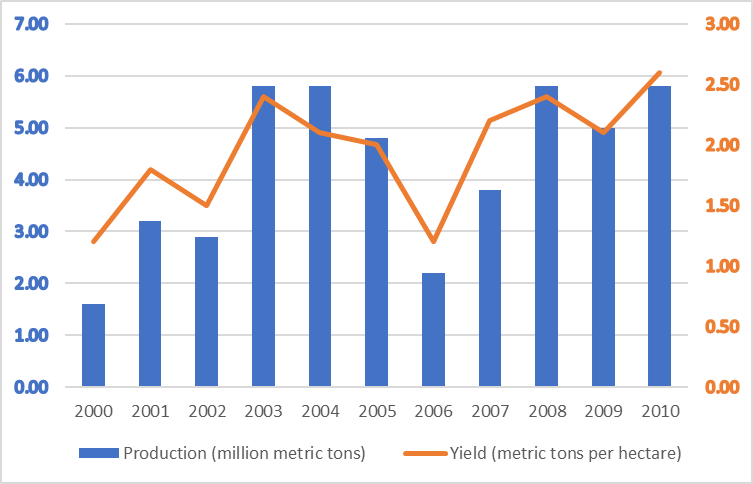
The graph above shows wheat production in million metric tons (blue bars) and yield in metric tons per hectare (orange line) for a country from 2000 through 2010.
From each drop-down menu, select the option that creates the most accurate statement based on the information provided.
The total land under wheat in 2003 was approximately than that in 2002.
The largest percentage drop in yield per hectare was .
ShowHide Answer
Official Answer
Dropdown 1: 25% more
Dropdown 2: Between 2005 and 2006
12 Nov 2024, 03:55
Kudos
Bookmarks
Official Solution:
Drop-down 1:
To calculate the land area under wheat, we divide wheat production by yield per hectare, since \(\text{land}=\frac{\text{production}}{\text{yield}}\). For 2002, this is approximately \(\frac{2.9}{1.5} \approx 1.9\), and for 2003, it is approximately \(\frac{5.8}{2.4} \approx 2.4\). The increase from 1.9 to 2.4 is about 25%, so the land under wheat in 2003 was approximately 25% more than that in 2002.
Drop-down 2:
Largest percentage drop means the largest proportional decrease from one year to the next, that is, (previous yield - new yield)/(previous yield). The biggest proportional decline occurs between 2005 and 2006, where yield falls from a little over 2 to about 1.2, which is the largest relative drop.
Correct answer:
Dropdown 1: "25% more"
Dropdown 2: "Between 2005 and 2006"
Bunuel
Drop-down 1:
To calculate the land area under wheat, we divide wheat production by yield per hectare, since \(\text{land}=\frac{\text{production}}{\text{yield}}\). For 2002, this is approximately \(\frac{2.9}{1.5} \approx 1.9\), and for 2003, it is approximately \(\frac{5.8}{2.4} \approx 2.4\). The increase from 1.9 to 2.4 is about 25%, so the land under wheat in 2003 was approximately 25% more than that in 2002.
Drop-down 2:
Largest percentage drop means the largest proportional decrease from one year to the next, that is, (previous yield - new yield)/(previous yield). The biggest proportional decline occurs between 2005 and 2006, where yield falls from a little over 2 to about 1.2, which is the largest relative drop.
Correct answer:
Dropdown 1: "25% more"
Dropdown 2: "Between 2005 and 2006"
20 Nov 2024, 07:46
Kudos
Bookmarks
I have revised the question, solution, and formatting by adding more details to enhance clarity