Events & Promotions
|
|

GMAT Club Daily Prep
Thank you for using the timer - this advanced tool can estimate your performance and suggest more practice questions. We have subscribed you to Daily Prep Questions via email.
Customized
for You
Track
Your Progress
Practice
Pays
Not interested in getting valuable practice questions and articles delivered to your email? No problem, unsubscribe here.
 Sep 24
08:00 AM EDT
-08:30 AM EDT
Meet Tuck at an informal student or staff-hosted coffee chat in a city near you! Sep 26
01:00 PM EDT
-04:00 PM EDT
Top scores are possible when you enroll in a powerful GMAT course, taught live online + 6 months access to TTP OnDemand video courses included. Class starts Saturdays Sept. 26, 2026 - Dec. 19, 2026, 1:00pm-4:00pm ES Sep 29
11:00 AM EDT
-01:00 PM EDT
" Description: Top scores are possible when you enroll in a powerful GMAT course, taught live online + 6 months access to TTP OnDemand video courses included! Class starts Tues/Thur Sept. 29, 2026 - Dec. 3, 2026, 11:00am-1:00pm EST Oct 01
07:00 AM BST
-08:00 AM GMT
Welcome to the GMAT Club's Free Interview Prep Event for Top MBA Programs! Buy tickets - Virtual series that’s all set to equip you to -excel in your MBA interviews.


 04 Feb 2025, 09:33
Kudos
Bookmarks


Dropdown 1: 8
Dropdown 2: 5
Be sure to select an answer first to save it in the Error Log before revealing the correct answer (OA)!
Difficulty:
 5%
(low)
5%
(low)
Question Stats:
82% (01:17) correct 18%
(01:38)
wrong
based on 646
sessions
18%
(01:38)
wrong
based on 646
sessions
History
Date
Time
Result
Not Attempted Yet
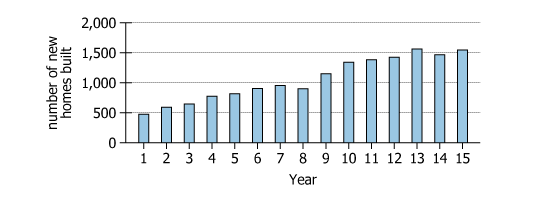
For a certain community, the graph shows the total number of new homes built in each of the last 15 years. The annual change in the number of new homes built for a given year is the total number of homes built that year minus the total number of homes built in the previous year.
Select from the drop-down menus the options that create the statement that most accurately reflects the information provided.
Among the Years 2-15, the first year for which the annual change in the number of new homes built was negative was Year , and that year was immediately followed by exactly consecutive years for which the annual change in the number of new homes built was positive.
You're trying to find out the annual change that is less than the year prior. The first instance where this is shown is in year 8 where the number of new homes built is closer to 800 while in year 7, it's closer to 900. This then follows a period where year 9-13 have increases and then another decrease in year 14.
Attachment:
GMAT-Club-Forum-48hnu7mk.png [ 9.53 KiB | Viewed 2979 times ]
Attachment:
GMAT-Club-Forum-kxyqeyba.png [ 72.42 KiB | Viewed 2363 times ]
ShowHide Answer
Official Answer
Dropdown 1: 8
Dropdown 2: 5
Using official mocks already?
Add GMAT Club Tests for harder practice, analytics, and explanations without overlapping Official Guide or official mock questions.
Try it now →
Try it now →

 04 Feb 2025, 09:35
Kudos
Bookmarks
ccarson
Is the source of the question Official Guide or GMAT Prep Focus? Can you please provide a screenshot? Thank you!
Attachment:
GMAT-Club-Forum-7hditi36.png [ 9.53 KiB | Viewed 2932 times ]
04 Feb 2025, 10:08
Kudos
Bookmarks
I found it on the GMAT practice exam 5. 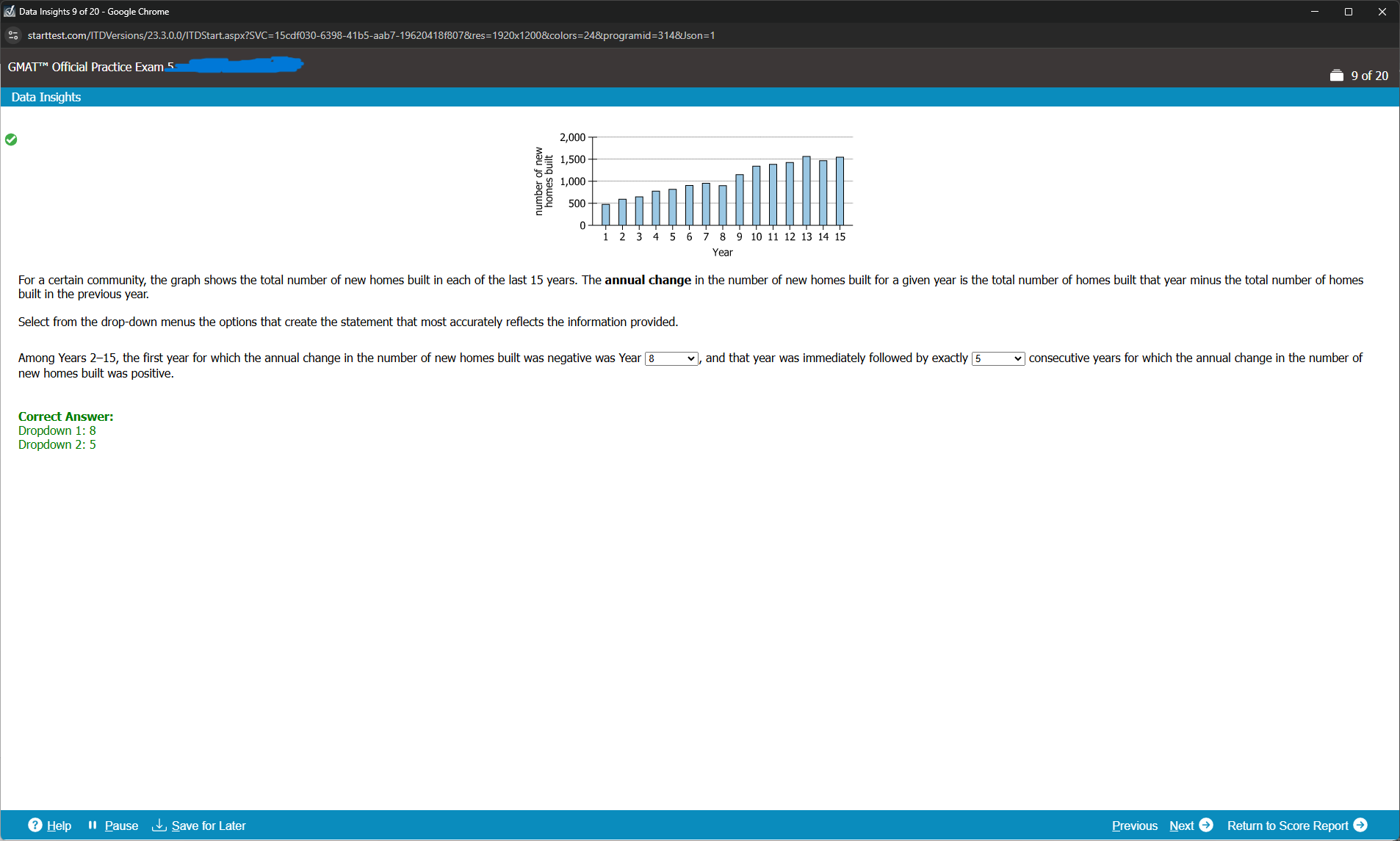

GMAT-Club-Forum-08eozbgp.png [ 72.42 KiB | Viewed 2851 times ]
GMAT-Club-Forum-7xhseh9c.png [ 9.53 KiB | Viewed 2737 times ]
Bunuel
Attachment:
GMAT-Club-Forum-08eozbgp.png [ 72.42 KiB | Viewed 2851 times ]
Attachment:
GMAT-Club-Forum-7xhseh9c.png [ 9.53 KiB | Viewed 2737 times ]