Events & Promotions
|
|

GMAT Club Daily Prep
Thank you for using the timer - this advanced tool can estimate your performance and suggest more practice questions. We have subscribed you to Daily Prep Questions via email.
Customized
for You
Track
Your Progress
Practice
Pays
Not interested in getting valuable practice questions and articles delivered to your email? No problem, unsubscribe here.
 Sep 24
08:00 AM EDT
-08:30 AM EDT
Meet Tuck at an informal student or staff-hosted coffee chat in a city near you! Sep 26
01:00 PM EDT
-04:00 PM EDT
Top scores are possible when you enroll in a powerful GMAT course, taught live online + 6 months access to TTP OnDemand video courses included. Class starts Saturdays Sept. 26, 2026 - Dec. 19, 2026, 1:00pm-4:00pm ES Sep 29
11:00 AM EDT
-01:00 PM EDT
" Description: Top scores are possible when you enroll in a powerful GMAT course, taught live online + 6 months access to TTP OnDemand video courses included! Class starts Tues/Thur Sept. 29, 2026 - Dec. 3, 2026, 11:00am-1:00pm EST Oct 01
07:00 AM BST
-08:00 AM GMT
Welcome to the GMAT Club's Free Interview Prep Event for Top MBA Programs! Buy tickets - Virtual series that’s all set to equip you to -excel in your MBA interviews.

Riyansh7

Joined: 06 Jan 2025
Last visit: 01 Dec 2025
Posts: 3
Location: India
Schools: ISB YLP'24 (S)
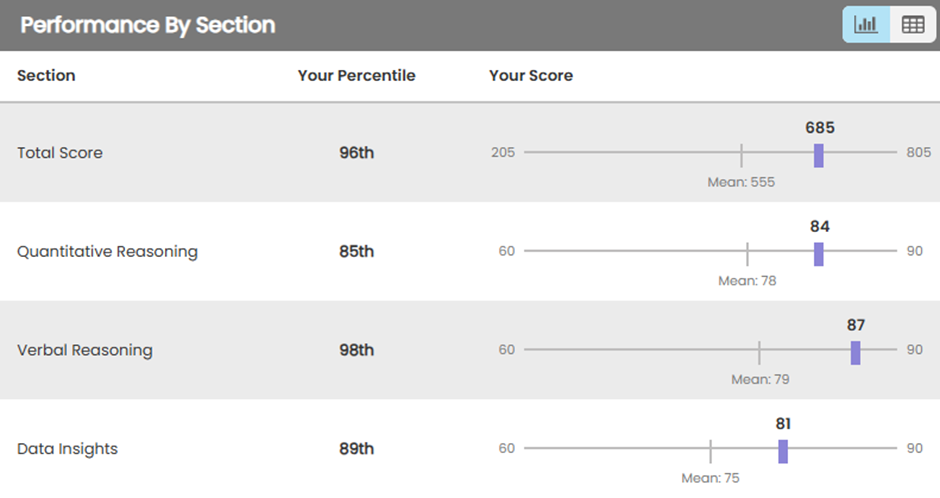
GMAT Focus 1: 685 Q84 V87 DI81 
GPA: 9.89
Products:
 25 Aug 2025, 11:12
Kudos
Bookmarks
Hey GMAT Club!
Finally done with this test! Got my 685 (V87, DI81, Q84) this week and I'm honestly just relieved it's over. This whole thing took about 5-6 months, and what a ride it's been.
I have always been interested in MBA programs but never really took action until a chance conversation with my colleague who changed everything. He'd just gotten into ISB through e-GMAT, and when I mentioned I had a few months between jobs, he basically pushed me to give GMAT a shot.
The crazy part? I went from a 565 diagnostic to 685, with verbal jumping from 48th percentile to 98th percentile. Never thought I'd be writing one of these success stories, but here we are.
How It All Started
I'd given CAT the year before without any prep and got a decent score, but not enough for where I wanted to be. So why not try GMAT?
Now, choosing a prep platform was interesting. I knew from my CAT experience that aptitude tests have structure to their madness, and trying to figure it out alone while working full-time wasn't realistic. I'm not someone who can study a little bit every day - I can give you 12 hours over two days, but not spread across four days. So online made sense.
I did my research - GMAT Club, Reddit, you name it. Local Mumbai coaching centers didn't seem to really get GMAT compared to CAT. After reading reviews, e-GMAT seemed like the right fit.
Funny thing about my diagnostic - I took it during work hours on a day when I didn't have much going on. Just casually clicked through it. 565. Not great, but at least I knew where I stood.
The Verbal Transformation - I Did Not See Coming
Here's what's wild - verbal became my strongest section. Started at 48th percentile, ended up at 98th (V87). Even I didn't see that coming.
Initially, my biggest issue was patience. I'd rush through passages, not really sitting with the content and understanding what the author was trying to say. It's one thing to read something casually, another to extract exactly what GMAT wants you to extract.
The breakthrough came when I realized every single word matters in GMAT. Something as simple as the word "few" - three letters that you'd probably miss - can change the entire meaning of a passage. GMAT is incredibly clever about these breakpoints, as e-GMAT calls them.
I tried using e-GMAT's pre-thinking framework initially but tweaked it a bit - took parts of their approach and combined it with what felt natural. The key was developing that ability to spot words that change entire meanings.
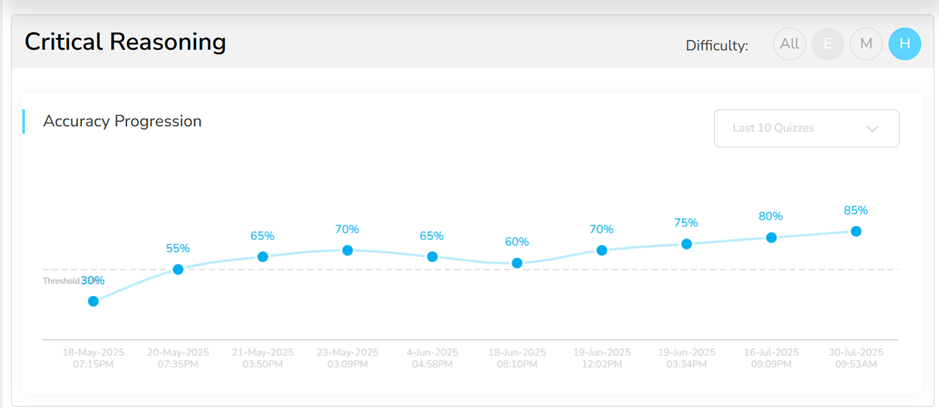
The cementing quiz reality check was brutal.
I'd nail medium questions - sometimes 100% accuracy - then completely crash on hard ones, scoring 10-20%. At first it was super frustrating. I'd always ask myself - How am I getting medium perfect but failing hard so badly?
Then I realized what was happening. In medium questions, GMAT gives you a clear direction - you just need to make 20% of the journey yourself. But in hard questions, they let you travel 50% of the way using your imagination, then test your ability to connect dots with the answer choices. Same concepts, just way more ambiguous information.
This taught me that medium and hard questions felt like completely different subjects. But once I understood the pattern, I could handle both.
Error Logs
When I first saw the error log concept, I though it is pointless, why would I need to do this. Couldn't have been more wrong.
I started maintaining error logs for everything - easy, medium, hard, didn't matter. What was the mistake? Concept gap? careless error? I could see the pattern shifting over time - initially more concept gaps, later more careless mistakes.
The magic wasn't really in reviewing the logs later. It was the conscious effort of filling them out in the first place. When I'd write "concept gap on absolute numbers" and realize I'd made the same entry three questions back, it would subconsciously hit me - where am I going wrong here?
Just that act of manually filling out the details forced me to ask the right questions. Why couldn't I get there? Was this really an ability issue or did I just rush through it?
Quant (Q84)
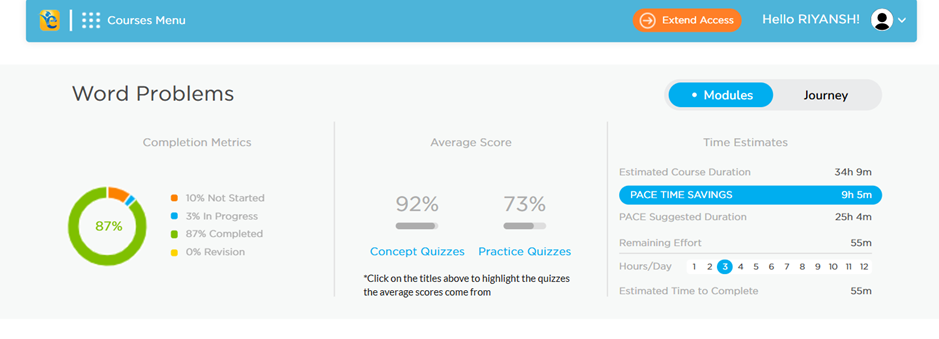
The PACE engine was fantastic for saving time on basics - I could skip most of the foundational stuff after doing one or two quick tests per section. Definitely saved hours on topics I already knew.
But then came algebra and number properties, and I had to spend more time than expected. These topics are very logical, but they're not things I'd done in school (or at least not recently). Like understanding that squares of numbers ending in 6 also end in 6, or the cyclical patterns of different digits. Very logical once you see it, but you need to drill these concepts until they become automatic.
So, while PACE saved time upfront, I ended up spending time on specific areas where my knowledge had gaps.
DI (DI81)
Data Insights had two main problems for me. First was data sufficiency - I'd second-guess myself constantly. Give me a regular math problem and I could solve it fine. But DS questions don't need you to solve completely, just determine if it's solvable. I'd double-check and triple-check, eating up tons of time.
This created my second problem - I'd spend so much time on DS questions that I'd have no time left for other DI topics. MSR was actually fine for me when I had adequate time, but in mocks I'd run out of time because of how much I'd spent on DS.
The foundation I'd built in verbal and quant definitely helped DI. The patience and attention to detail from verbal helped me catch those crucial words that change everything. The math concepts from quant obviously helped with DS.
Mock Strategy: Experimenting with Order
For my second attempt, I experimented with sectional order across 5-6 mocks. Initially tried Verbal → DI → Quant, but realized I was making silly mistakes in quant because it was coming at the end when my mental energy was depleted.
Switched to Quant → DI → Verbal for the last three mocks and immediately saw quant scores above Q83 consistently. Made sense - do my strongest section first when I'm fresh, then leverage that confidence for the rest.
My mock strategy was thorough:
• During mocks, I'd note down any questions where I had even slight doubts, even if I got them right
• After each mock, I'd review all these flagged topics
• Before the next mock, I'd refresh my understanding of these areas
• Sometimes this meant drilling practice questions, sometimes just reviewing concepts
I also believe you can't take enough mocks if you have the time. They're diagnostic tests that show you where you're lacking. Better to find gaps in mocks than on test day.
When Things Went Wrong: 645 to 685
My first attempt scored 645, and honestly, I was ready to give up. Called Abha and told her I was thinking about not taking a second attempt. The self-doubt was overwhelming.
Looking back, my main issue was trying to cram too much in too short a span without giving my brain time to digest and internalize everything. I wasn't accepting internally that I needed more time, which led to increased second-guessing of every answer.
In that first attempt, I had at least one question in each section where I'd gotten it right initially, then changed it to wrong during review. That's pure lack of confidence.
The 20-day break between attempts was crucial. I used it to address specific gaps, but more importantly, to build real confidence in my preparation.
Test Day: When Strategy Meets Reality
Test day had its surprises. Night before the exam, I had a terrible headache and didn't sleep until 1-2 AM, then had to wake up at 5:30 AM. It was raining heavily, and I was worried about getting to the center on time.
But I'd learned from my first attempt to stay calm about things outside my control. Listened to music, spoke to people who could keep me relaxed.
At the center, they let me start immediately instead of following the usual routine - small surprise, but no big deal.
The test went mostly as expected, except I made one strategic error. I'd tested a rule in mocks: if any DI question takes more than 3 minutes, move on. But during the actual test, I spent over 6 minutes on one question, thinking what if this one question affects my score? This led to me missing three questions at the end due to time crunch.
That experience taught me - if you find a strategy that works in mocks, stick to it. Don't make spontaneous changes on test day.
After DI, I was disappointed about those missed questions. But during the 8-minute break, I told myself not to carry that section's problems into verbal. Sat quietly, meditated for 5 minutes, and reset my mindset.
Verbal went great - felt like I was back in my comfort zone. Though I still made the same old mistake of changing two correct answers to incorrect ones during review. Some habits die hard.
The Mindset That Made the Difference
GMAT isn't really about how much you've studied or what you remember - it's about how well you can apply yourself on test day. That makes it as much a mindset challenge as an academic one.
Practice became my confidence builder. When you practice enough, you establish those mental pathways, and more importantly, you can tell yourself - I've done this before, I know I can do this. Without enough practice, there's always that nagging doubt about whether you deserve a good score.
The other crucial mindset shift: no mistakes matter until the last day. If your exam is at 8 AM, everything until 7:59 AM is learning. At 8 AM onwards is what really counts.
Even if things don't go your way like my first attempt, take a break, refresh yourself, and get back to it. Don't lose momentum, but also don't push yourself when you're not mentally fresh.
What Actually Worked
Looking back, here's what made the difference:
1. Error logs saved my prep. Initially skeptical, but the conscious effort of filling them out made me recognize patterns I would've missed otherwise.
2. Cementing quizzes were frustrating but essential. They showed me exactly where my gaps were, even when I thought I understood concepts well.
3. Mock experimentation was crucial. Don't stick to one sectional order if it's not working. I found my optimal order through trial and error.
4. Sectional tests taught time management. They're much more representative of actual test conditions than cementing quizzes.
5. Mental reset techniques matter. Learning to not carry one section's performance into the next saved my verbal score.
For Future Test Takers
Whatever sacrifices you're making now - missing friend gatherings, skipping parties - it'll all be worth it when you're celebrating at business school.
Thanks to Abha and the entire e-GMAT team for getting me back on track after my first attempt. The platform really works if you put in the effort. Nothing works if you don't.
On to applications!
Riyansh

GMAT-Club-Forum-jiamggli.png [ 72.59 KiB | Viewed 564 times ]

GMAT-Club-Forum-eqt83sz4.png [ 51.47 KiB | Viewed 556 times ]

GMAT-Club-Forum-n2lf3tmj.png [ 88.86 KiB | Viewed 532 times ]
Finally done with this test! Got my 685 (V87, DI81, Q84) this week and I'm honestly just relieved it's over. This whole thing took about 5-6 months, and what a ride it's been.
I have always been interested in MBA programs but never really took action until a chance conversation with my colleague who changed everything. He'd just gotten into ISB through e-GMAT, and when I mentioned I had a few months between jobs, he basically pushed me to give GMAT a shot.
The crazy part? I went from a 565 diagnostic to 685, with verbal jumping from 48th percentile to 98th percentile. Never thought I'd be writing one of these success stories, but here we are.
How It All Started
I'd given CAT the year before without any prep and got a decent score, but not enough for where I wanted to be. So why not try GMAT?
Now, choosing a prep platform was interesting. I knew from my CAT experience that aptitude tests have structure to their madness, and trying to figure it out alone while working full-time wasn't realistic. I'm not someone who can study a little bit every day - I can give you 12 hours over two days, but not spread across four days. So online made sense.
I did my research - GMAT Club, Reddit, you name it. Local Mumbai coaching centers didn't seem to really get GMAT compared to CAT. After reading reviews, e-GMAT seemed like the right fit.
Funny thing about my diagnostic - I took it during work hours on a day when I didn't have much going on. Just casually clicked through it. 565. Not great, but at least I knew where I stood.
The Verbal Transformation - I Did Not See Coming
Here's what's wild - verbal became my strongest section. Started at 48th percentile, ended up at 98th (V87). Even I didn't see that coming.
Initially, my biggest issue was patience. I'd rush through passages, not really sitting with the content and understanding what the author was trying to say. It's one thing to read something casually, another to extract exactly what GMAT wants you to extract.
The breakthrough came when I realized every single word matters in GMAT. Something as simple as the word "few" - three letters that you'd probably miss - can change the entire meaning of a passage. GMAT is incredibly clever about these breakpoints, as e-GMAT calls them.
I tried using e-GMAT's pre-thinking framework initially but tweaked it a bit - took parts of their approach and combined it with what felt natural. The key was developing that ability to spot words that change entire meanings.
The cementing quiz reality check was brutal.
I'd nail medium questions - sometimes 100% accuracy - then completely crash on hard ones, scoring 10-20%. At first it was super frustrating. I'd always ask myself - How am I getting medium perfect but failing hard so badly?
Then I realized what was happening. In medium questions, GMAT gives you a clear direction - you just need to make 20% of the journey yourself. But in hard questions, they let you travel 50% of the way using your imagination, then test your ability to connect dots with the answer choices. Same concepts, just way more ambiguous information.
This taught me that medium and hard questions felt like completely different subjects. But once I understood the pattern, I could handle both.
Error Logs
When I first saw the error log concept, I though it is pointless, why would I need to do this. Couldn't have been more wrong.
I started maintaining error logs for everything - easy, medium, hard, didn't matter. What was the mistake? Concept gap? careless error? I could see the pattern shifting over time - initially more concept gaps, later more careless mistakes.
The magic wasn't really in reviewing the logs later. It was the conscious effort of filling them out in the first place. When I'd write "concept gap on absolute numbers" and realize I'd made the same entry three questions back, it would subconsciously hit me - where am I going wrong here?
Just that act of manually filling out the details forced me to ask the right questions. Why couldn't I get there? Was this really an ability issue or did I just rush through it?
Quant (Q84)
The PACE engine was fantastic for saving time on basics - I could skip most of the foundational stuff after doing one or two quick tests per section. Definitely saved hours on topics I already knew.
But then came algebra and number properties, and I had to spend more time than expected. These topics are very logical, but they're not things I'd done in school (or at least not recently). Like understanding that squares of numbers ending in 6 also end in 6, or the cyclical patterns of different digits. Very logical once you see it, but you need to drill these concepts until they become automatic.
So, while PACE saved time upfront, I ended up spending time on specific areas where my knowledge had gaps.
DI (DI81)
Data Insights had two main problems for me. First was data sufficiency - I'd second-guess myself constantly. Give me a regular math problem and I could solve it fine. But DS questions don't need you to solve completely, just determine if it's solvable. I'd double-check and triple-check, eating up tons of time.
This created my second problem - I'd spend so much time on DS questions that I'd have no time left for other DI topics. MSR was actually fine for me when I had adequate time, but in mocks I'd run out of time because of how much I'd spent on DS.
The foundation I'd built in verbal and quant definitely helped DI. The patience and attention to detail from verbal helped me catch those crucial words that change everything. The math concepts from quant obviously helped with DS.
Mock Strategy: Experimenting with Order
For my second attempt, I experimented with sectional order across 5-6 mocks. Initially tried Verbal → DI → Quant, but realized I was making silly mistakes in quant because it was coming at the end when my mental energy was depleted.
Switched to Quant → DI → Verbal for the last three mocks and immediately saw quant scores above Q83 consistently. Made sense - do my strongest section first when I'm fresh, then leverage that confidence for the rest.
My mock strategy was thorough:
• During mocks, I'd note down any questions where I had even slight doubts, even if I got them right
• After each mock, I'd review all these flagged topics
• Before the next mock, I'd refresh my understanding of these areas
• Sometimes this meant drilling practice questions, sometimes just reviewing concepts
I also believe you can't take enough mocks if you have the time. They're diagnostic tests that show you where you're lacking. Better to find gaps in mocks than on test day.
When Things Went Wrong: 645 to 685
My first attempt scored 645, and honestly, I was ready to give up. Called Abha and told her I was thinking about not taking a second attempt. The self-doubt was overwhelming.
Looking back, my main issue was trying to cram too much in too short a span without giving my brain time to digest and internalize everything. I wasn't accepting internally that I needed more time, which led to increased second-guessing of every answer.
In that first attempt, I had at least one question in each section where I'd gotten it right initially, then changed it to wrong during review. That's pure lack of confidence.
The 20-day break between attempts was crucial. I used it to address specific gaps, but more importantly, to build real confidence in my preparation.
Test Day: When Strategy Meets Reality
Test day had its surprises. Night before the exam, I had a terrible headache and didn't sleep until 1-2 AM, then had to wake up at 5:30 AM. It was raining heavily, and I was worried about getting to the center on time.
But I'd learned from my first attempt to stay calm about things outside my control. Listened to music, spoke to people who could keep me relaxed.
At the center, they let me start immediately instead of following the usual routine - small surprise, but no big deal.
The test went mostly as expected, except I made one strategic error. I'd tested a rule in mocks: if any DI question takes more than 3 minutes, move on. But during the actual test, I spent over 6 minutes on one question, thinking what if this one question affects my score? This led to me missing three questions at the end due to time crunch.
That experience taught me - if you find a strategy that works in mocks, stick to it. Don't make spontaneous changes on test day.
After DI, I was disappointed about those missed questions. But during the 8-minute break, I told myself not to carry that section's problems into verbal. Sat quietly, meditated for 5 minutes, and reset my mindset.
Verbal went great - felt like I was back in my comfort zone. Though I still made the same old mistake of changing two correct answers to incorrect ones during review. Some habits die hard.
The Mindset That Made the Difference
GMAT isn't really about how much you've studied or what you remember - it's about how well you can apply yourself on test day. That makes it as much a mindset challenge as an academic one.
Practice became my confidence builder. When you practice enough, you establish those mental pathways, and more importantly, you can tell yourself - I've done this before, I know I can do this. Without enough practice, there's always that nagging doubt about whether you deserve a good score.
The other crucial mindset shift: no mistakes matter until the last day. If your exam is at 8 AM, everything until 7:59 AM is learning. At 8 AM onwards is what really counts.
Even if things don't go your way like my first attempt, take a break, refresh yourself, and get back to it. Don't lose momentum, but also don't push yourself when you're not mentally fresh.
What Actually Worked
Looking back, here's what made the difference:
1. Error logs saved my prep. Initially skeptical, but the conscious effort of filling them out made me recognize patterns I would've missed otherwise.
2. Cementing quizzes were frustrating but essential. They showed me exactly where my gaps were, even when I thought I understood concepts well.
3. Mock experimentation was crucial. Don't stick to one sectional order if it's not working. I found my optimal order through trial and error.
4. Sectional tests taught time management. They're much more representative of actual test conditions than cementing quizzes.
5. Mental reset techniques matter. Learning to not carry one section's performance into the next saved my verbal score.
For Future Test Takers
Whatever sacrifices you're making now - missing friend gatherings, skipping parties - it'll all be worth it when you're celebrating at business school.
Thanks to Abha and the entire e-GMAT team for getting me back on track after my first attempt. The platform really works if you put in the effort. Nothing works if you don't.
On to applications!
Riyansh
Attachment:
GMAT-Club-Forum-jiamggli.png [ 72.59 KiB | Viewed 564 times ]
Attachment:
GMAT-Club-Forum-eqt83sz4.png [ 51.47 KiB | Viewed 556 times ]
Attachment:
GMAT-Club-Forum-n2lf3tmj.png [ 88.86 KiB | Viewed 532 times ]
 05 Sep 2025, 05:20
Kudos
Bookmarks
Congratulations on that incredible verbal transformation, Riyansh! Going from 48th to 98th percentile is remarkable, but what fascinates me most is how you discovered what actually matters in GMAT verbal.
Your insight about "breakpoints" - those single words that change entire meanings - really strikes me. The fact that you recognized this pattern and then systematically trained yourself to spot these crucial words shows a level of meta-learning that separates high scorers from everyone else.
I'm particularly curious about your adaptation process. You mentioned taking parts of the pre-thinking framework and combining it with what felt natural. How did you know when to stick with a systematic approach versus when to trust your instincts? And when you realized that medium and hard questions felt like "completely different subjects," how did you adjust your approach for each difficulty level?
What I find universally applicable here is your willingness to experiment and adapt rather than rigidly following any single method. Your mock sectional order experimentation is a perfect example - you didn't just accept that Verbal → DI → Quant was "the way," you tested what actually worked for you.
For others reading this: Riyansh's breakthrough came from recognizing that GMAT isn't testing reading comprehension in the traditional sense - it's testing your ability to identify the precise words and structures that create meaning. Have you had similar "aha moments" where you realized the test was measuring something completely different from what you initially thought?
The error log insight is gold - that the real value wasn't in reviewing them later, but in the conscious act of categorizing mistakes in real-time. That kind of systematic self-awareness is what turns preparation into genuine skill development.
Best of luck with applications!
Your insight about "breakpoints" - those single words that change entire meanings - really strikes me. The fact that you recognized this pattern and then systematically trained yourself to spot these crucial words shows a level of meta-learning that separates high scorers from everyone else.
I'm particularly curious about your adaptation process. You mentioned taking parts of the pre-thinking framework and combining it with what felt natural. How did you know when to stick with a systematic approach versus when to trust your instincts? And when you realized that medium and hard questions felt like "completely different subjects," how did you adjust your approach for each difficulty level?
What I find universally applicable here is your willingness to experiment and adapt rather than rigidly following any single method. Your mock sectional order experimentation is a perfect example - you didn't just accept that Verbal → DI → Quant was "the way," you tested what actually worked for you.
For others reading this: Riyansh's breakthrough came from recognizing that GMAT isn't testing reading comprehension in the traditional sense - it's testing your ability to identify the precise words and structures that create meaning. Have you had similar "aha moments" where you realized the test was measuring something completely different from what you initially thought?
The error log insight is gold - that the real value wasn't in reviewing them later, but in the conscious act of categorizing mistakes in real-time. That kind of systematic self-awareness is what turns preparation into genuine skill development.
Best of luck with applications!
Moderator:







