Events & Promotions
|
|

GMAT Club Daily Prep
Thank you for using the timer - this advanced tool can estimate your performance and suggest more practice questions. We have subscribed you to Daily Prep Questions via email.
Customized
for You
Track
Your Progress
Practice
Pays
Not interested in getting valuable practice questions and articles delivered to your email? No problem, unsubscribe here.
 Sep 02
08:00 PM PDT
-09:00 PM PDT
Video explanations + diagnosis of 10 weakest areas + 150+ short videos + study plan! Sep 03
01:30 AM EDT
-02:30 AM EDT
At one point, she believed GMAT wasn’t for her. After scoring 595, self-doubt crept in and she questioned her potential. But instead of quitting, she made the right strategic changes. The result? A remarkable comeback to 695. Check out how Saakshi did it. Aug 27
10:00 AM EDT
-11:00 AM EDT
We’ve worked incredibly hard to build TTP into the best test prep experience possible, and it would mean a lot to us to win Newsweek’s 2026 Readers’ Choice Award for Best Test Prep. If TTP has helped you, we’d be incredibly grateful for your vote. Sep 02
12:30 AM EDT
-01:30 AM EDT
Thought your job leaves no time for GMAT prep? After multiple GMAT attempts and a demanding consulting job, Kshitij improved to 695 in under 2 months. Learn the mindset shifts, study strategy, and execution changes that made the breakthrough possible. Sep 04
10:00 AM PDT
-11:00 AM PDT
What does test anxiety really look like on the GMAT? For many test takers, it does not look like a panic attack. Instead, it shows up as brain fog, rereading, negative comparisons, mental noise.... Sep 06
09:30 AM EDT
-12:30 PM EST
Top scores are possible when you enroll in a powerful EA course, taught live online + 6 months access to TTP OnDemand video courses included! Perfect class schedule and easy course access for working professionals. Class starts Sundays Sept. 6, 2026.- Sep 07
12:01 AM PDT
-11:59 PM PDT
On the 7th, GMAT Club Tests will be Free! Including all the Quizzes, Questions, and Tests. 12 AM - 11:59 PM PDT - Sep 09
07:00 AM PDT
-10:00 AM PDT
Meet AdComs and explore top Master’s programs - MiM, MiF, MSc, MSBA and more. - Application Fee Waivers - Free 1-Week of GMAT Club Tests: - Master's Application Toolkit - Grand Prize Giveaway  Sep 15
07:00 PM EDT
-09:00 PM EST
Elite scores are possible when you enroll in a powerful GMAT course, taught live online + 6 months access to TTP OnDemand video courses included! Class starts Tues/Thurs Sept. 15, 2026 - Nov. 15, 2027, 7:00pm-9:00pm EST Sep 21
08:00 PM EDT
-10:00 PM EDT
Boost your GMAT score in less than one month in a live online class + 6 months access to TTP OnDemand video courses included! Class starts Mon, Tues, Wed, Thur, Fri Sept. 21, 2026 - Oct. 9, 2027, 7:00pm-10:00pm EST


I just scored a 675 on the GMAT (V86, Q85, DI80), and honestly, that V86 still feels surreal. As an engineer, verbal was supposed to be my nemesis. Three months ago, I was staring at a V79 wondering how I'd ever crack this section. Here's how I turned things around and what strategies actually made the difference.
The Starting Point: Chaos Inside My Head
The Foundation: Master Comprehension
Critical Reasoning: The Pre-thinking Breakthrough
Learning the Framework
Handling Confusing Answer Choices
Reading Comprehension: Summary Mapping
The Practice Strategy That Worked
Key Takeaways
Final Thoughts
GMAT-Club-Forum-ur1inp7e.png [ 93.96 KiB | Viewed 541 times ]

GMAT-Club-Forum-jt9dwn5n.png [ 70.67 KiB | Viewed 541 times ]
The Starting Point: Chaos Inside My Head
When I first started prep around mid-July, I was just scrambling through questions on GMAT Club, hopping between free resources without any direction. Every mock felt brutal and disheartening. The real problem? I had zero mental models guiding my approach. Each question was "a battle of its own" with no framework to help me navigate. I didn't know the archetypes, didn't understand what responses GMAT actually rewards, and spent way too much mental energy on every single question without any consistent methodology.
That's when I realized I needed structured preparation with a clear learning path. I decided to take the e-GMAT subscription, and it completely changed my trajectory.
The Foundation: Master Comprehension
While going through the e-GMAT course, I discovered something crucial that most people skip. Before diving into CR or RC strategies, I needed to fundamentally fix how I read and process information. The e-GMAT Master Comprehension course introduced me to a completely different approach to consuming written content. Instead of skimming for keywords and stitching information together hastily like we do with news articles, I learned to slow down, take strategic pauses between sentences, and synthesize content as complete units.
This wasn't just a GMAT skill. It was a mindset shift that improved how I consume written content in general. Without this foundation, I would've been scrambling through CR passages just like before.
Critical Reasoning: The Pre-thinking Breakthrough
Learning the Framework
The e-GMAT course introduced me to pre-thinking, and this became my biggest unlock for CR. Before, I'd read the stimulus, jump to answer choices immediately, and get confused by overlapping options that seemed equally valid. Now, before even looking at choices, I anticipate what could work based on the argument structure.
For weakening questions, I think about scenarios where the conclusion might not hold. For strengthening, I consider what assumptions need support. This creative thinking before seeing options completely changed my accuracy and confidence level.
Handling Confusing Answer Choices
Getting stuck between two seemingly correct choices was my constant struggle. The e-GMAT course taught me a crucial distinction. The correct answer should introduce new information directly linked to the conclusion, not something deducible from the existing premises. If the passage discusses irrigation improving farmers' income, the conclusion is about income, not irrigation. This framework cleared up so many confusing scenarios I previously got wrong.
Reading Comprehension: Summary Mapping
RC initially felt easier than CR because you consume information as-is rather than dissecting arguments. But after mastering CR's analytical approach, I found myself over-dissecting RC passages unnecessarily. The e-GMAT RC course helped me calibrate when to analyze versus when to simply absorb information.
My game-changer was creating summary maps while reading. I jot brief mental notes: Paragraph 1 is introduction, Paragraph 2 presents evidence, Paragraph 3 discusses challenges. When questions ask about specific details, I know exactly where to look without re-reading everything.
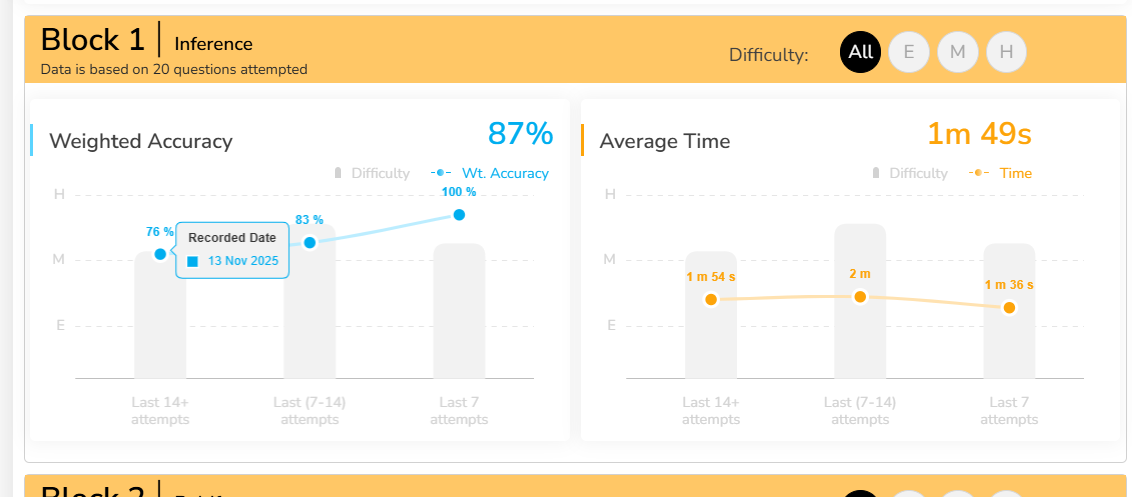
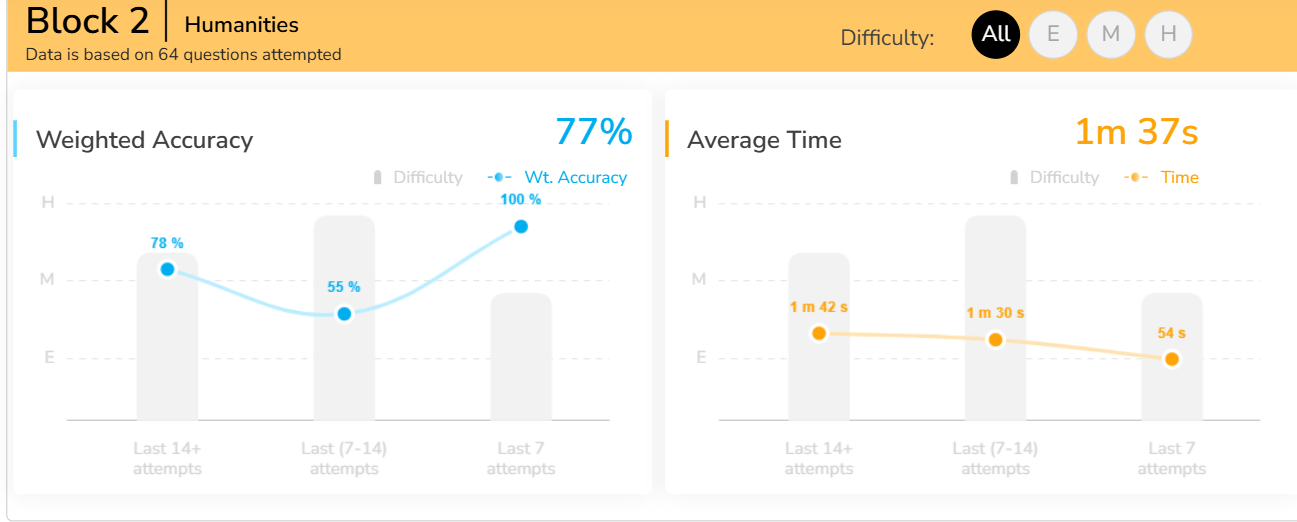
My timing improved dramatically. I went from 5-6 minutes for the first question down to 4 minutes, with subsequent questions taking less than a minute each.
The Practice Strategy That Worked
What I really appreciated was how the platform strategically eases you in with a progressive difficulty curve. The e-GMAT Scholaranium cementing quizzes were crucial for my improvement. Taking them immediately after course material dramatically improved my retention of concepts and strategies. There are so many tips and traps in the lessons that fade if you wait even two or three days.
Practicing at higher difficulty early built confidence that translated to real test performance. By the time I reached sectional mocks, I felt prepared rather than overwhelmed by the challenge.
Key Takeaways
- Fix your reading fundamentals before diving into CR/RC strategy
- Pre-think answers before looking at choices
- Create summary maps for RC passages
- Take cementing quizzes immediately after learning concepts
- Practice at higher difficulty early to build confidence
- Understand the distinction between conclusion and premises for answer choice analysis
Final Thoughts
Going from V79 to V86 wasn't about grinding thousands of questions. It was about building the right mental frameworks first. The e-GMAT platform is completely self-sufficient. Following the course structure systematically delivers results without needing external help. I'm going for another attempt to push toward 705, but even this score has given me immense confidence. If an engineer like me can transform verbal, so can you.

Attachment:
GMAT-Club-Forum-ur1inp7e.png [ 93.96 KiB | Viewed 541 times ]
Attachment:
GMAT-Club-Forum-jt9dwn5n.png [ 70.67 KiB | Viewed 541 times ]

 19 Dec 2025, 06:42
Kudos
Bookmarks
What an incredible transformation, Tanishkkk! V86 as an engineer who considered verbal their 'nemesis' - this is exactly the kind of breakthrough we love to see! 🎉
Your debrief perfectly illustrates what we emphasize: verbal mastery comes from building mental frameworks, not grinding thousands of questions.
A few highlights that stood out:
✅ Starting with Master Comprehension - You're absolutely right that many students skip this, but you discovered why it's foundational. Changing how you consume written content isn't just a GMAT skill - it's transformative for life. That alone shows you understood the deeper game.
✅ Pre-thinking as your CR breakthrough - Anticipating what could work BEFORE seeing answer choices is exactly what separates good from great CR performance. You nailed it.
✅ The summary mapping technique for RC - Your timing improvement (6 min → 4 min → <1 min per question) shows true mastery. Knowing where information lives without re-reading everything is the hallmark of efficient RC.
✅ Cementing quizzes immediately after learning - This is crucial! You maximized retention by applying concepts while they were fresh. So many test-takers wait days and wonder why concepts don't stick.
And your closing line - "If an engineer like me can transform verbal, so can you" - is powerful encouragement for the community.
Best of luck pushing toward 705! With your systematic approach and these frameworks internalized, you're absolutely on the right track. 🚀
Your debrief perfectly illustrates what we emphasize: verbal mastery comes from building mental frameworks, not grinding thousands of questions.
A few highlights that stood out:
✅ Starting with Master Comprehension - You're absolutely right that many students skip this, but you discovered why it's foundational. Changing how you consume written content isn't just a GMAT skill - it's transformative for life. That alone shows you understood the deeper game.
✅ Pre-thinking as your CR breakthrough - Anticipating what could work BEFORE seeing answer choices is exactly what separates good from great CR performance. You nailed it.
✅ The summary mapping technique for RC - Your timing improvement (6 min → 4 min → <1 min per question) shows true mastery. Knowing where information lives without re-reading everything is the hallmark of efficient RC.
✅ Cementing quizzes immediately after learning - This is crucial! You maximized retention by applying concepts while they were fresh. So many test-takers wait days and wonder why concepts don't stick.
And your closing line - "If an engineer like me can transform verbal, so can you" - is powerful encouragement for the community.
Best of luck pushing toward 705! With your systematic approach and these frameworks internalized, you're absolutely on the right track. 🚀
 19 Dec 2025, 08:26
Kudos
Bookmarks
Congrats on the 675! I wish you all the best with your applications.