Events & Promotions
| Last visit was: 06 Sep 2026, 05:30 |
It is currently 06 Sep 2026, 05:30 |
|
|

GMAT Club Daily Prep
Thank you for using the timer - this advanced tool can estimate your performance and suggest more practice questions. We have subscribed you to Daily Prep Questions via email.
Customized
for You
Track
Your Progress
Practice
Pays
Not interested in getting valuable practice questions and articles delivered to your email? No problem, unsubscribe here.
 Sep 06
09:30 AM EDT
-12:30 PM EST
Top scores are possible when you enroll in a powerful EA course, taught live online + 6 months access to TTP OnDemand video courses included! Perfect class schedule and easy course access for working professionals. Class starts Sundays Sept. 6, 2026. Sep 07
12:01 AM PDT
-11:59 PM PDT
On the 7th, GMAT Club Tests will be Free! Including all the Quizzes, Questions, and Tests. 12 AM - 11:59 PM PDT Sep 02
01:00 PM EDT
-11:59 PM EDT
Take 30% off all study plans with code COURSEWORK - Expires on Monday 9/7 Sep 04
10:00 AM EDT
-11:59 PM EDT
We’ve worked incredibly hard to build TTP into the best test prep experience possible, and it would mean a lot to us to win Newsweek’s 2026 Readers’ Choice Award for Best Test Prep. If TTP has helped you, we’d be incredibly grateful for your vote.- Sep 07
10:00 AM PDT
-11:00 AM PDT
A complete walkthrough of GMAT Club’s free 12-week GMAT study plan: what you study each week, how progress and goals are tracked, how the error log works, and how your practice unlocks paid tools at no cost. - Sep 09
07:00 AM PDT
-10:00 AM PDT
Meet AdComs and explore top Master’s programs - MiM, MiF, MSc, MSBA and more. - Application Fee Waivers - Free 1-Week of GMAT Club Tests: - Master's Application Toolkit - Grand Prize Giveaway - Sep 09
10:00 AM PDT
-11:00 AM PDT
Three MBA applications. Three rejections. No interview invites. A year later, Aman was admitted to Cambridge Judge, SMU, and IMD. In this episode of MBA Admit Stories, Aman shares how he rebuilt his MBA application...  Sep 15
07:00 PM EDT
-09:00 PM EST
Elite scores are possible when you enroll in a powerful GMAT course, taught live online + 6 months access to TTP OnDemand video courses included! Class starts Tues/Thurs Sept. 15, 2026 - Nov. 15, 2027, 7:00pm-9:00pm EST Sep 21
08:00 PM EDT
-10:00 PM EDT
Boost your GMAT score in less than one month in a live online class + 6 months access to TTP OnDemand video courses included! Class starts Mon, Tues, Wed, Thur, Fri Sept. 21, 2026 - Oct. 9, 2027, 7:00pm-10:00pm EST

 09 May 2026, 12:21
Kudos
Bookmarks
The GMAT OG contains questions labels with difficulty level as 'Easy', 'Medium' and 'Hard'.
My question is what is the level of these question in terms of numbers ? I.e. whether Medium means 600-700 level question ?
My question is what is the level of these question in terms of numbers ? I.e. whether Medium means 600-700 level question ?


A medium question is technically more accurate description since a section is scored on a 60-90 grade but nobody understands how good Q85 vs. V85 vs. DI85 is, so yes, we need the 600-700 or easy/medium. One issue with 600-700 that's the old GMAT score measurement format so it is quite incorrect to use this band as the GMAT Focus and Classic fall into different segments for 650 vs. 655 score for example.
Anyway here is what each band contains:
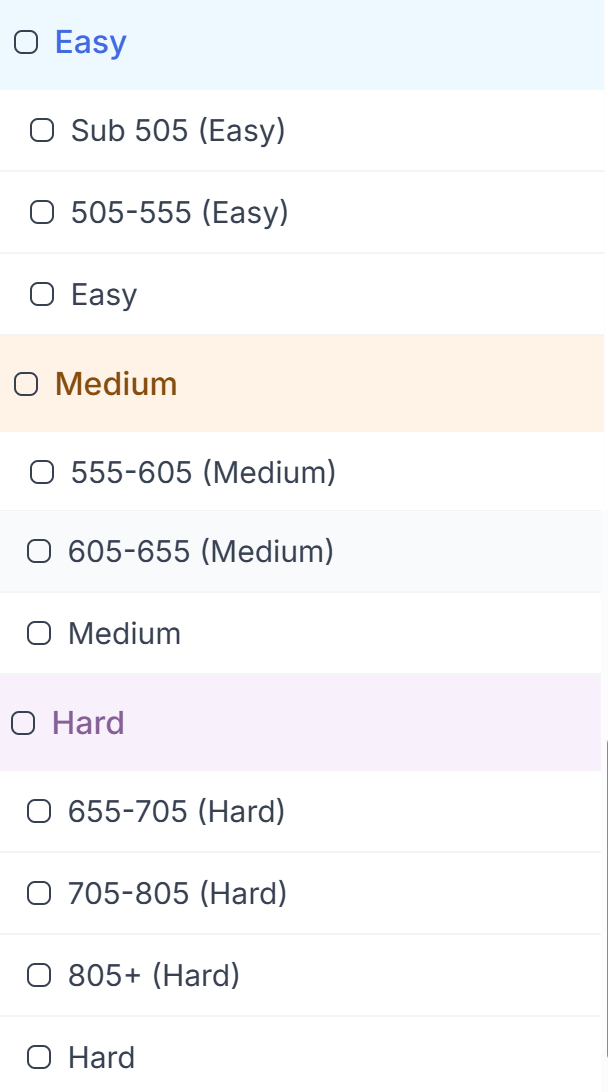
And if you are using a book, we have more exact difficulty measurement:
https://gmatclub.com/forum/error-log-fo ... 45984.html

GMAT-Club-Forum-wz00jzif.png [ 74.5 KiB | Viewed 330 times ]
Anyway here is what each band contains:
And if you are using a book, we have more exact difficulty measurement:
https://gmatclub.com/forum/error-log-fo ... 45984.html
Attachment:
GMAT-Club-Forum-wz00jzif.png [ 74.5 KiB | Viewed 330 times ]
 09 May 2026, 20:03
Kudos
Bookmarks
The Easy, Medium, and Hard labels in the Official Guide are general categorizations, not score-band mappings. There isn't an official GMAC publication that says "Medium = 600-700 level" or anything similar. The labels are bins based on overall test-taker performance, not a translation into specific scaled-score zones.
Here's what's actually going on. The GMAT is adaptive, and individual questions are calibrated using statistical parameters that describe how question difficulty relates to test-taker ability. GMAC uses those parameters to deliver questions during your test based on how you're performing. The Official Guide sorts its questions into rough bins so you can practice across a range, but within "Hard," some questions are harder than others. Within "Medium," some sit closer to Easy and some closer to Hard. The label is a useful relative signal, not a precise score equivalent.
Two more things worth noting. The live test is the GMAT Focus Edition now, scored 205 to 805, so the 600-700 framing comes from the legacy version of the test. Score thresholds and competitive ranges are calibrated to the new scale.
How should you use this practically? Treat the labels as a progression guide. If you're early in your prep, Easy and Medium questions are where you build the mechanics and develop clean habits. If you're pushing toward a high score, Hard questions are where you stress-test your understanding under more layered conditions. But don't try to map "I got this Hard question right, so I'm at the 600 level" or anything like that. That isn't how the scoring works. Your score depends on how the adaptive algorithm responds to your accuracy across the full section, not on which difficulty bin a single question came from.
Here's what's actually going on. The GMAT is adaptive, and individual questions are calibrated using statistical parameters that describe how question difficulty relates to test-taker ability. GMAC uses those parameters to deliver questions during your test based on how you're performing. The Official Guide sorts its questions into rough bins so you can practice across a range, but within "Hard," some questions are harder than others. Within "Medium," some sit closer to Easy and some closer to Hard. The label is a useful relative signal, not a precise score equivalent.
Two more things worth noting. The live test is the GMAT Focus Edition now, scored 205 to 805, so the 600-700 framing comes from the legacy version of the test. Score thresholds and competitive ranges are calibrated to the new scale.
How should you use this practically? Treat the labels as a progression guide. If you're early in your prep, Easy and Medium questions are where you build the mechanics and develop clean habits. If you're pushing toward a high score, Hard questions are where you stress-test your understanding under more layered conditions. But don't try to map "I got this Hard question right, so I'm at the 600 level" or anything like that. That isn't how the scoring works. Your score depends on how the adaptive algorithm responds to your accuracy across the full section, not on which difficulty bin a single question came from.
Moderator:








