Events & Promotions
|
|

GMAT Club Daily Prep
Thank you for using the timer - this advanced tool can estimate your performance and suggest more practice questions. We have subscribed you to Daily Prep Questions via email.
Customized
for You
Track
Your Progress
Practice
Pays
Not interested in getting valuable practice questions and articles delivered to your email? No problem, unsubscribe here.
 May 20
08:00 AM PDT
-08:30 AM PDT
What’s in it for you- Live Profile Evaluation Chat Session with Jenifer Turtschanow, CEO, ARINGO. Come with your details prepared and ARINGO will share insights! Pre-MBA Role/Industry, YOE, Exam Score, C/GPA, ECs Post-MBA Role/ Industry & School List. May 21
10:00 AM EDT
-10:30 AM EDT
Most candidates submit a resume built for a recruiter. Admissions committees are reading for something else entirely. This session covers what adcoms actually evaluate, where strong candidates lose ground before a single essay is written, and why... May 22
08:30 AM PDT
-09:00 AM PDT
Get the inside scoop on what makes Emory’s Goizueta Business School great and how you can present a strong MBA application. Explore the difference between our One-Year MBA and Two-Year MBA programs, talk to our admissions team, and meet students. May 22
03:00 PM EDT
-04:00 PM EDT
The old MBA recruiting playbook is dead. Here’s how top admits are getting ahead this summer. May 23
11:00 AM PDT
-12:00 PM PDT
Transform your MBA application from chaos to clarity with Admit Expert. Get personalized guidance to make your application stress-free and streamlined. Say goodbye to overwhelm and start your journey to success today. Partner with Admit Expert now. May 23
08:00 PM PDT
-09:00 PM PDT
Inquire for a free profile evaluation and guarantee statement for possible admits and scholarships! May 27
07:30 PM EDT
-08:30 PM EDT
Learn how to choose the right recommenders and strengthen your MBA candidacy in this live AMA with Stratus experts. May 29
10:00 AM PDT
-11:00 AM PDT
Download the MBA Launchpad App, for FREE access to the largest MBA database - Data backed read on your profile - Identify gaps before you apply - Build a balanced school list - Track your deadlines - Mock interviews - Extensive content library Jun 10
06:00 AM PDT
-06:15 PM PDT
Register for the GMAT Club Virtual MBA Spotlight Fair – the world’s premier event for serious MBA candidates. This is your chance to hear directly from Admissions Directors at nearly every Top 30 MBA program..

 30 Sep 2021, 05:03
Kudos
Bookmarks

MIT MBA GMAT Scores: What Score Do I Need?
The MIT Sloan School of Management has one of the top MBA programs in the world — and one of the most popular among MBA hopefuls. Among fellow M7 schools, MIT Sloan saw the biggest jump in applications to its full-time MBA program during the 2019-2020 application period, with a 22.1% increase in MBA applicants. (Wharton came in a close second, with a 21% increase.)With so many future leaders vying for a seat at the table at Sloan, applicants need to do everything they can to stand out among the pack, so having an impressive GMAT score can be an important way to get noticed.
In this article, we’ll take a look at the median and middle 80% of GMAT scores of MIT Sloan students, other noteworthy aspects of the MIT MBA class profile, and some essential criteria for determining what GMAT score you need to be a competitive applicant.
First, let’s review some key facts about Sloan’s MBA program.
MIT Sloan MBA Must-Knows
In addition to being a popular choice among prospective MBA students, the MIT Sloan School of Management has long been landing near the top of MBA rankings. Most recently, Sloan ranked #5 among full-time MBA programs on U.S. News’ 2022 list of the Best Business Schools, tied with its neighbor Harvard Business School.While the MIT Sloan has hovered in the 11-15% range in recent years, things were a little different in the 2019-2020 MBA admissions cycle. As we already saw, applications were up significantly, and the MIT Sloan acceptance rate mirrored that increase. Out of 6,350 applicants to Sloan’s MBA program, 1,395 were accepted, just under 22%.
The higher application and acceptance rates were, at least in part, due to a couple of different factors. For one, because of the COVID pandemic, MIT Sloan extended its round 3 deadline by more than 2 months. Moreover, in 2019, Sloan’s MBA program began offering an MBA Early Admissions option that allows students with no work experience who are currently enrolled in college or graduate school to apply, and then defer their enrollment for 2 to 5 years while they gain work experience.
That deferral option could be the reason why the number of MBA students who chose to enroll in Sloan’s class of 2022, just 484, looks suspiciously low compared to the 1,395 who were accepted. That’s an enrollment rate of roughly 34.7%. However, since the reported number of accepted students includes Early Admission applicants, it could be that a significant number of students who were accepted to Sloan’s MBA program deferred. Note that the enrollment rate for the class of 2020, who applied before the new deferral option was available, was about 60.6%. And according to Poets & Quants, Sloan accepted a higher number of students because it was anticipated that more students would defer enrollment during the pandemic.
So, what do we know about the chosen few who did enroll in MIT Sloan’s class of 2022? Let’s take a closer look at the kind of competition you’re likely to face when you apply to Sloan’s MBA program.
MIT Sloan MBA Class Profile: Class of 2022
MIT Sloan’s class of 2022 had an average of 5 years of work experience, with 22% coming from backgrounds in consulting — the top pre-MBA industry among the class — and 17% hailing from the financial services sector, the class’ second-most common pre-MBA industry. Following not too far behind was the technology sector, in which 15% of the class gained their work experience, and the government, education, and nonprofit sectors, at 13%. Unsurprisingly for MIT, the top undergraduate major among these MBA students was Engineering, at 33% of the class, well above the next most common major, which was Economics, at 19%. Business majors rounded out the top 3 at 16%. The class of 2022 also boasted an impressive median undergraduate GPA of 3.54.
For the most part, these numbers are in keeping with those of recent years, though the demographics did shift somewhat for this incoming class. Like some other M7 schools (and many U.S. business schools in general), MIT Sloan enrolled fewer international students in its class of 2022, although international students still made up a third of the class. Compared to 42% the previous year, that number is notably lower, but not all that surprising, considering the effect the COVID pandemic had on many students’ plans to earn MBAs abroad.
Additionally, women made up a slightly smaller proportion of MIT’s MBA class than in previous years, 38% down from 41% in the class of 2021 and 42% in the class of 2020. Also of note, 39% of the class of 2022 self-reported as students of color, while 1% of the class did not report their race or ethnicity.
Now that we know a bit about the academic, professional, and personal backgrounds of MIT Sloan’s incoming class — all of which will come into play as you determine what your GMAT score goal should be — let’s take a look at the GMAT scores this impressive crop of future leaders earned.
MIT MBA GMAT Scores: A 5-Year View
Although no average GMAT score for MIT Sloan MBA students was reported for the class of 2022, Sloan did publish a couple of other important metrics: the median GMAT score and the GMAT score range of the middle 80% of the incoming class. And we do have average GMAT scores for previous years, so there is plenty to analyze for those wondering how high they may need to score on the GMAT for MIT to seriously consider their candidacy. Let’s take a look at what we know about MIT MBA GMAT scores over the past 5 years:
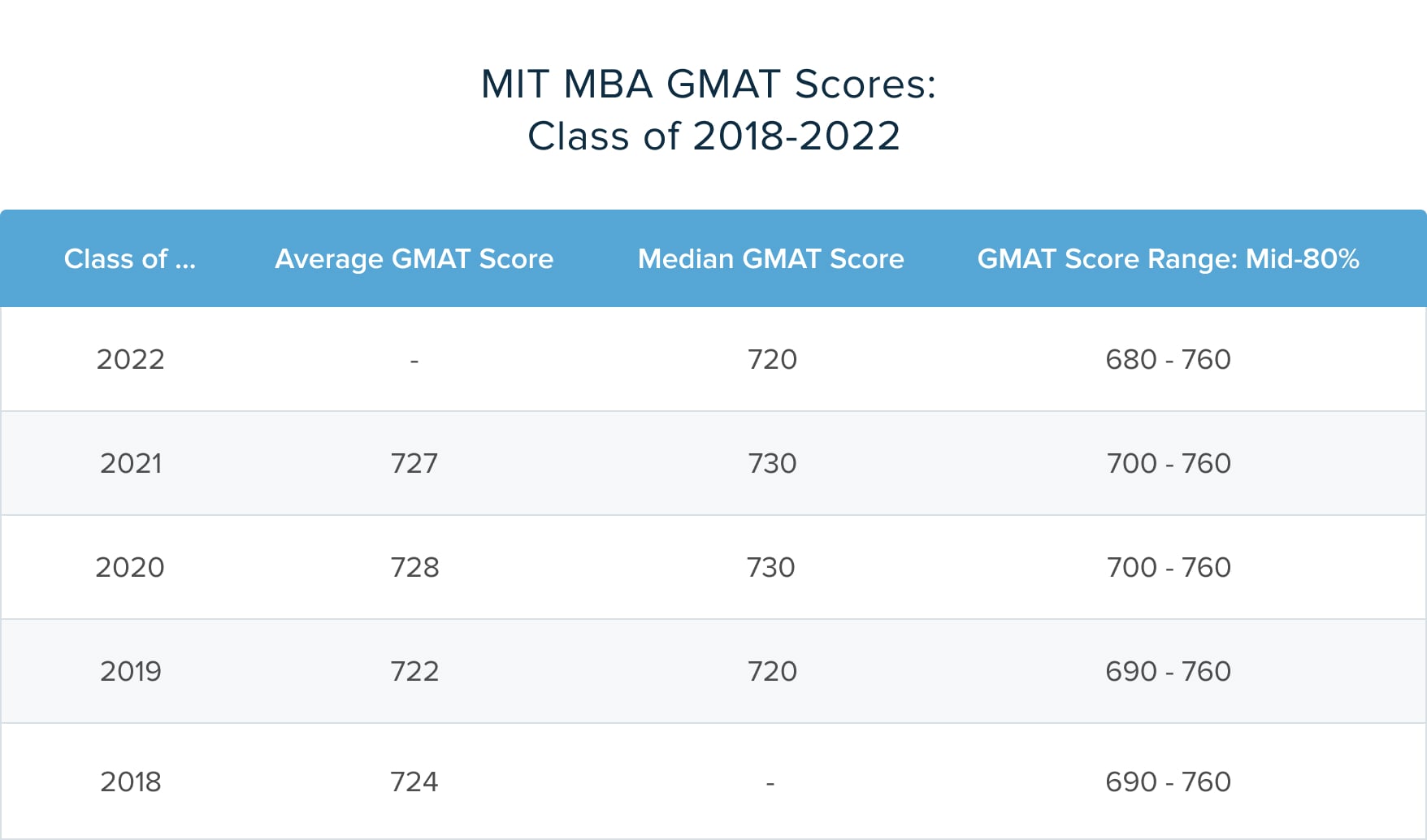
Note that the “middle 80%,” or “mid-80%,” as it’s also called, is the GMAT score range within which 80% of people in a school’s class scored, with 10% of the class scoring higher than that range and 10% scoring lower. You can read more about the middle 80% in this article about what schools consider a good GMAT score.
Now, as you can see, the mid-80% represents a fairly wide GMAT score range — in the case of the class of 2022, an 80-point swing. And we know that the mid-80% does not represent the full range of GMAT scores of admitted MBA students; 10% of the class of 2022 scored lower than 680 (how much lower, we don’t know), and 10% of the class scored higher than 760.
So, how can you determine what score you need to be competitive in the MBA admissions process at MIT Sloan? Should you aim for the average? The top of the middle 80%? Would you still be competitive with a GMAT score below 700? Let’s discuss.
To read the complete article, view my full article on Target Test Prep’s blog.