Events & Promotions
|
|

GMAT Club Daily Prep
Thank you for using the timer - this advanced tool can estimate your performance and suggest more practice questions. We have subscribed you to Daily Prep Questions via email.
Customized
for You
Track
Your Progress
Practice
Pays
Not interested in getting valuable practice questions and articles delivered to your email? No problem, unsubscribe here.
 Sep 07
12:01 AM PDT
-11:59 PM PDT
On the 7th, GMAT Club Tests will be Free! Including all the Quizzes, Questions, and Tests. 12 AM - 11:59 PM PDT- Sep 08
11:00 AM PDT
-12:00 PM PDT
Strong applicants do not always write strong MBA essays. In this session, we break down 5 common MBA essay mistakes that can quietly weaken an otherwise competitive application. - Sep 09
07:00 AM PDT
-10:00 AM PDT
Meet AdComs and explore top Master’s programs - MiM, MiF, MSc, MSBA and more. - Application Fee Waivers - Free 1-Week of GMAT Club Tests: - Master's Application Toolkit - Grand Prize Giveaway - Sep 09
10:00 AM PDT
-11:00 AM PDT
Three MBA applications. Three rejections. No interview invites. A year later, Aman was admitted to Cambridge Judge, SMU, and IMD. In this episode of MBA Admit Stories, Aman shares how he rebuilt his MBA application...  Sep 09
12:00 PM PDT
-01:00 PM PDT
The old MBA recruiting playbook is dead. Here’s how top admits are getting ahead this summer.- Sep 10
11:00 AM PDT
-12:00 PM PDT
What does a truly strong MBA application resume actually look like? In this session, we break down 3 real MBA resumes from successful applicants who got into top business schools. Using redacted before-and-after versions...  Sep 10
12:00 PM IST
-01:00 PM IST
Before you hit “Submit,” get an expert perspective on your MBA application. Our Test Drive Service (Comprehensive Application Review) provides an in-depth evaluation of your application, helping you identify gaps, strengthen your story, and more. Sep 10
03:00 PM PDT
-04:00 PM PDT
Inquire for a free profile evaluation and guarantee statement for possible admits and scholarships! Sep 11
08:30 AM EDT
-09:15 AM EDT
Get the inside scoop on what makes Emory’s Goizueta Business School great, learn how you can present a strong MBA application, and connect with an Admissions Director to get your questions answered.


 06 Apr 2026, 16:57
Kudos
Bookmarks
US News MBA Ranking 2026: Analysis
1. Key Insights:
2. Overall Score Ranking: Top 15 Programs
3. Salary Analysis:
The salary gap between Stanford ($206,157) and UT Dallas Jindal ($132,733) exceeds $73,000 -- a 55 percent spread. This illustrates that overall score and salary are correlated but not linearly, and that mid-ranked programs with strong regional employer networks can achieve high employment rates while averaging materially lower compensation.
4. Year-over-Year Movers:
The Biggest Risers
· UT Dallas Jindal (+8, from #31 to #23): The headline mover of 2026. Its rise is driven primarily by a 93.6% employment rate within three months of graduation -- the highest in the dataset. However, context matters significantly here
· UNC Kenan-Flagler (+7, from #28 to #21): A more well-rounded ascent. Improved employment outcomes and stronger peer assessment both contributed. With an acceptance rate of 37.94% and a $165K average salary, it is becoming a strong value proposition in the top 25.
· Harvard Business School (+2, from #6 to #4): HBS ties Kellogg for No. 4. Its peer assessment score of 4.8 -- the highest alongside Stanford -- anchors its strong overall score and reflects the global prestige the institution continues to command. However, this creates a notable paradox: Harvard’s employment at graduation rate of 61.4% is one of the lowest in the top 10, meaning the brand has never been stronger in academic circles while the placement pipeline is not keeping pace.
· Columbia University (+2, from #9 to #7): Climbed on the back of an 88.4% three-month employment rate, among the highest of any top-10 program, combined with strong recruiter scores.
The Biggest Fallers
· Emory Goizueta (-6, from #17 to #23): A painful drop. The main culprit is a recruiter assessment score of 3.5, well below Carnegie Mellon, UCLA, and McCombs, which all sit at 3.9. Employment outcomes also softened, with three-month placement at 80.7% while programs like Vanderbilt (87.9%) and UNC (84.7%) pulled ahead. The salary at $182K remains competitive, so the fundamentals for placed graduates are solid. One to watch for the 2027 cycle.
· Dartmouth Tuck (-3, from #6 to #9): Tuck’s drop is driven by a peer assessment of 4.1 -- the lowest in the entire top 13 -- despite posting $198K in compensation (4th highest overall) and 87.7% three-month employment. Its recruiter assessment of 4.2 confirms that employers value the program. Haas (4.5), Yale (4.4), and Ross (4.3) all score higher on peer perception despite weaker salary outcomes. If you are optimizing for what happens after graduation, Tuck’s fundamentals are stronger than its rank suggests. The peer assessment metric appears to be undervaluing the program relative to its actual placement results.
· Kellogg (-2, from #2 to #4): Drops to tie Harvard at No. 4. Slippage in employment metrics at graduation accounts for the movement, though Kellogg retains a strong recruiter assessment score of 4.5.
5. Employment outcomes:
6. Peer vs Recruiter Assessment Score:
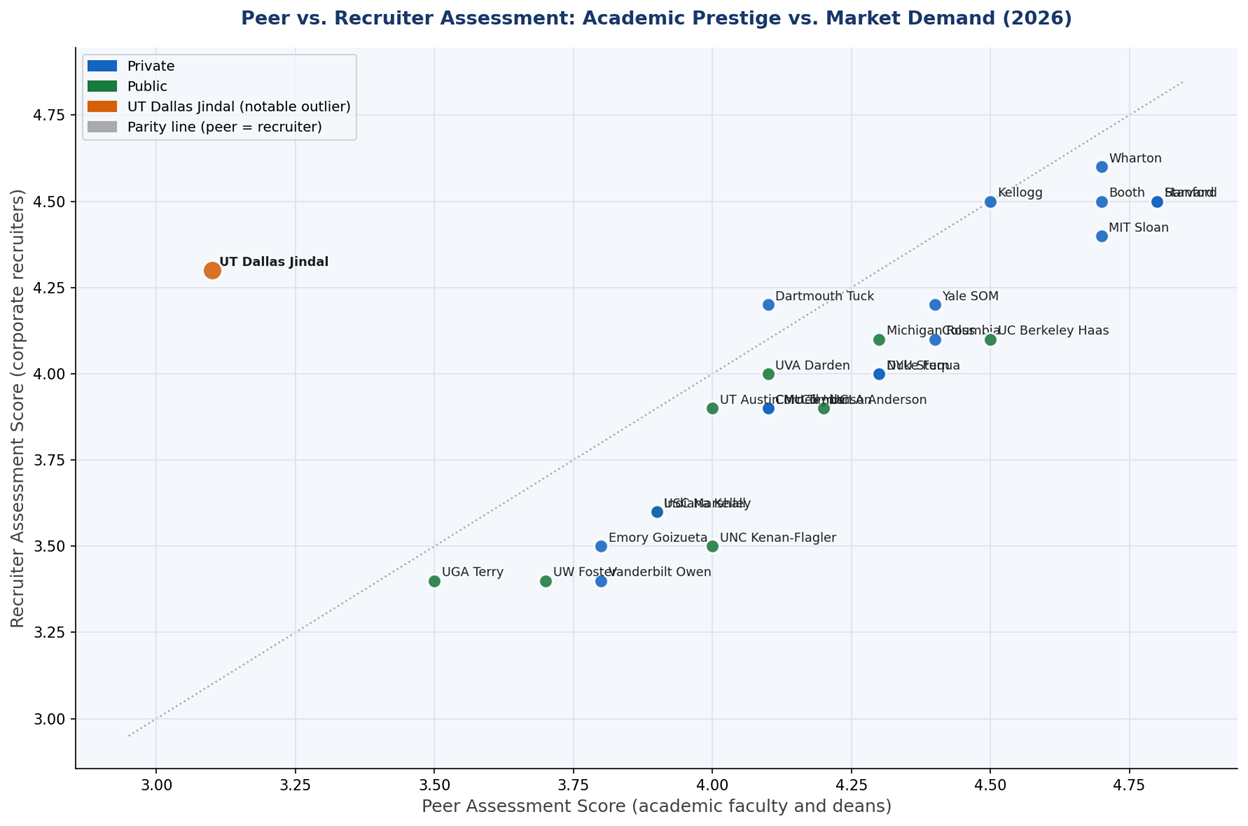
At the other end of the spectrum, Yale SOM (peer: 4.4, recruiter: 4.2) and MIT Sloan (peer: 4.7, recruiter: 4.4) show the profile typical of programs with strong research missions where academic prestige slightly outpaces employer-side demand. This is not a weakness -- it reflects a different institutional emphasis.
Wharton leads all programs on recruiter assessment at 4.6, reflecting its dominant positioning in finance, consulting, and global corporate recruiting networks. Stanford (4.5) and Booth (4.5) follow closely. These three programs sit at the top of both peer and recruiter assessments, which is precisely why they occupy the top three overall rankings.
7. Public vs Private:
8. Strategic Takeaways for Prospective Students:
No ranking tells the full story. The most useful approach is to identify what you are optimizing for and then read the data through that lens, rather than treating overall score as the only relevant number.
If maximizing compensation is your primary goal
· Target Stanford, Wharton, or Booth. All three average above $200K in total compensation and hold the strongest recruiter assessment scores in the dataset to justify that premium.
· NYU Stern’s salary numbers need context. It ranks No. 7 overall and delivers the second-highest salary at $201K, but part of that figure reflects NYC cost of living baked into compensation packages. That said, for IB and PE placement in New York, Stern competes directly with Wharton and Columbia on placement outcomes.
· Cornell Johnson punches above its weight at $194K for a No. 15 program. Worth serious consideration for candidates focused on salary-per-rank value.
If employment certainty matters most to you
· UVA Darden is the best single data point: 89.7% employment within three months, $194K average compensation, No. 11 rank, and public school pricing for Virginia residents.
· Indiana Kelley and Columbia both exceed 88% employment rates. Columbia at $195K average salary makes its 88.4% figure even more meaningful in terms of actual career outcomes.
· Be cautious about over-interpreting Jindal and UGA Terry's 93%+ rates without accounting for salary outcomes, peer assessment scores, and the regional concentration of their placement networks.
If total return on investment drives your decision
· UC Berkeley Haas is the quiet overperformer. Top-10 ranking, $187K salary, and a peer assessment of 4.5 matching MIT Sloan and Harvard -- a level of academic respect rare for a program outside the top 5.
· Michigan Ross and UVA Darden offer compelling ROI profiles for their respective in-state populations. Both rank in the top 13 and deliver near-$190K salary averages.
· UNC Kenan-Flagler's seven-spot rise to No. 21 makes it a legitimate target for cost-conscious applicants willing to bet on a program building upward momentum.
Schools to watch for the 2027 cycle
· UNC Kenan-Flagler: If employment metrics continue improving and peer assessment climbs further, a top-18 finish is realistic within one to two cycles.
· Emory Goizueta: After a six-spot drop, 2027 will be a rebound test. Watch for changes in career services and employer partnership investment.
· Harvard: A peer assessment score of 4.8 ties Stanford for the highest in the dataset. If employment at graduation improves from 61.4%, it has the raw material to challenge Booth for No. 3.
· UT Dallas Jindal: Its trajectory is genuine but the salary gap and peer assessment deficit are structural constraints. Closing those gaps requires a longer-term investment in faculty quality, alumni network development, and industry diversification beyond its current regional base.

GMAT-Club-Forum-nbej0nt8.png [ 117.35 KiB | Viewed 3110 times ]

GMAT-Club-Forum-3pqqc003.png [ 148.12 KiB | Viewed 3065 times ]

GMAT-Club-Forum-gea0f494.png [ 112.34 KiB | Viewed 2998 times ]

GMAT-Club-Forum-s14gf901.png [ 167.88 KiB | Viewed 2984 times ]

GMAT-Club-Forum-pjeky3et.png [ 183.51 KiB | Viewed 2950 times ]

GMAT-Club-Forum-8eubi6wk.png [ 97.05 KiB | Viewed 2920 times ]
1. Key Insights:
- Stanford GSB reclaims the No. 1 spot with a perfect score of 100, surpassing Wharton which drops to No. 2.
- Three schools now average above $200K in total starting compensation: Stanford ($206K), Wharton ($202K), and Booth ($201K).
- UT Dallas Jindal is the biggest mover (+8 spots to No. 23) - but with important caveats: peer assessment of 3.1 is the lowest and average salary of $132K sits $73K below the highest salary at Stanford.
- UNC Kenan-Flagler climbs 7 spots to No. 21, backed by stronger placement and peer assessment improvement.
- Emory Goizueta had a painful year, dropping 6 places from No. 17 to No. 23, driven primarily by a recruiter assessment score of 3.5 that sits well below its tier.
- Harvard climbs 2 spots to No. 4, tying Kellogg, driven by peer assessment scores of 4.8 - tied with Stanford for the highest in the dataset. However, its employment at graduation rate of 61.4% is one of the lowest in the top 10, creating a notable tension between brand perception and placement outcomes.
- Recruiter and peer assessment scores diverge sharply at some schools, telling a very different story than overall rank alone.
2. Overall Score Ranking: Top 15 Programs
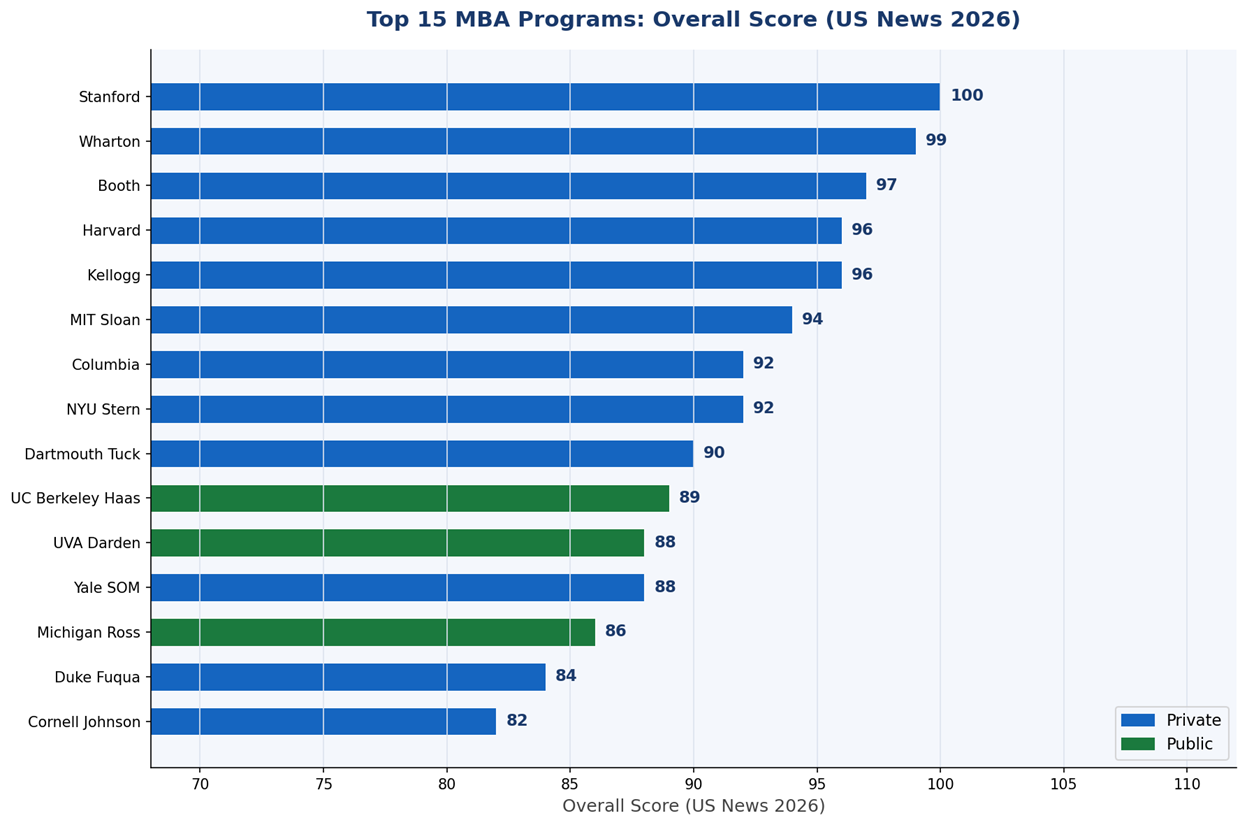
The US News overall score synthesizes employment rates, salary, peer assessments, recruiter assessments, and class profile metrics into a single composite. Stanford leads with a perfect 100. The gap between the top three programs and the rest of the field is significant: Wharton (99), Booth (97), then a cluster of Harvard and Kellogg (both 96), MIT Sloan (94), and Columbia and Stern (both 92).
UC Berkeley Haas at No. 10 (score: 89) is the first public school in the top tier, a reflection of its strong employer relationships in the San Francisco Bay Area technology and venture capital markets. The single-point gap between Dartmouth Tuck (90) and Haas (89) makes that boundary genuinely competitive year to year.
3. Salary Analysis:
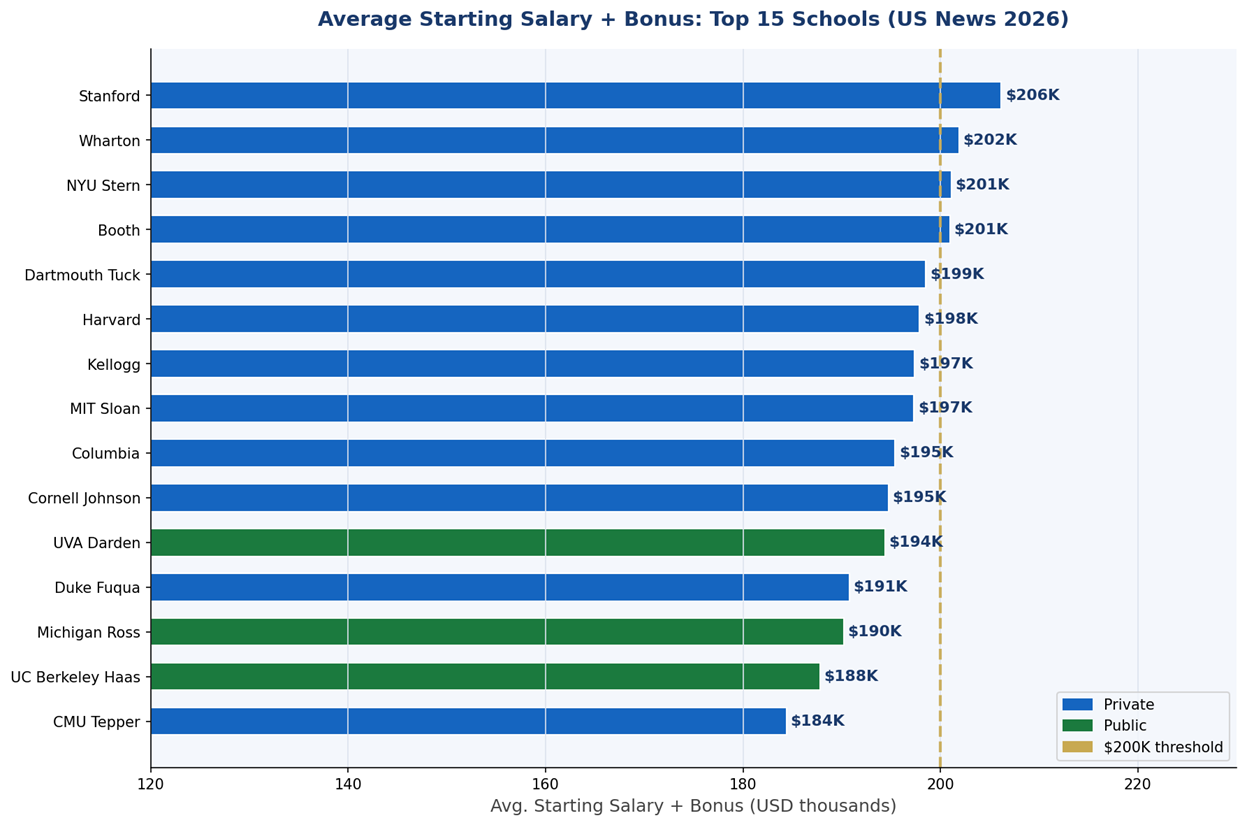
Starting salary and bonus data is one of the most scrutinized metrics for prospective students assessing return on investment. Three programs now average total compensation above $200,000 -- a threshold that reflects sustained demand for talent from the most elite programs, particularly in finance, consulting, and technology.
Several counterintuitive findings appear in the salary data. NYU Stern ranks No. 7 overall but delivers the second-highest average salary at $201,106, driven by its deep Wall Street placement pipeline in investment banking and finance. However, part of this figure reflects NYC cost of living baked into compensation packages, which should be factored into any direct salary comparison. Dartmouth Tuck at No. 9 commands $198,517, reflecting strong management consulting placements. Cornell Johnson at No. 15 earns $194,716 in average compensation, outperforming several programs ranked above it.The salary gap between Stanford ($206,157) and UT Dallas Jindal ($132,733) exceeds $73,000 -- a 55 percent spread. This illustrates that overall score and salary are correlated but not linearly, and that mid-ranked programs with strong regional employer networks can achieve high employment rates while averaging materially lower compensation.
4. Year-over-Year Movers:
The Biggest Risers
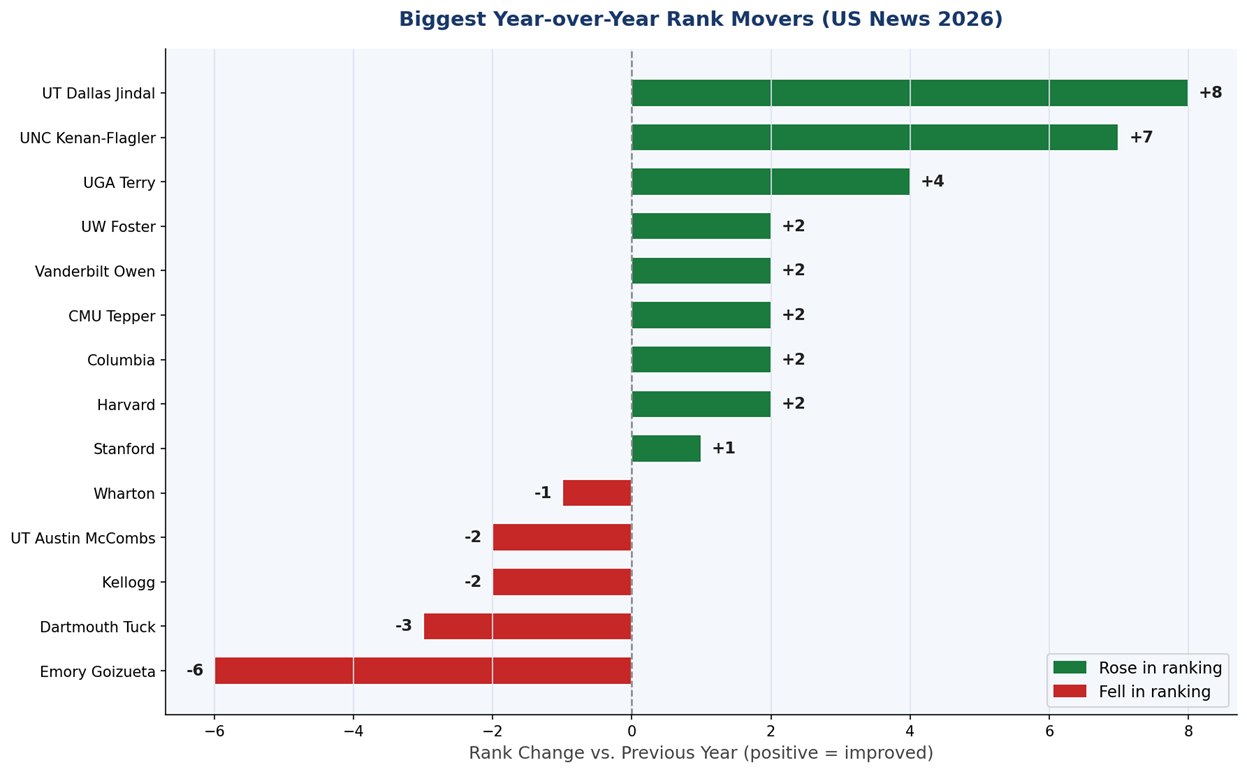
· UT Dallas Jindal (+8, from #31 to #23): The headline mover of 2026. Its rise is driven primarily by a 93.6% employment rate within three months of graduation -- the highest in the dataset. However, context matters significantly here
· UNC Kenan-Flagler (+7, from #28 to #21): A more well-rounded ascent. Improved employment outcomes and stronger peer assessment both contributed. With an acceptance rate of 37.94% and a $165K average salary, it is becoming a strong value proposition in the top 25.
· Harvard Business School (+2, from #6 to #4): HBS ties Kellogg for No. 4. Its peer assessment score of 4.8 -- the highest alongside Stanford -- anchors its strong overall score and reflects the global prestige the institution continues to command. However, this creates a notable paradox: Harvard’s employment at graduation rate of 61.4% is one of the lowest in the top 10, meaning the brand has never been stronger in academic circles while the placement pipeline is not keeping pace.
· Columbia University (+2, from #9 to #7): Climbed on the back of an 88.4% three-month employment rate, among the highest of any top-10 program, combined with strong recruiter scores.
The Biggest Fallers
· Emory Goizueta (-6, from #17 to #23): A painful drop. The main culprit is a recruiter assessment score of 3.5, well below Carnegie Mellon, UCLA, and McCombs, which all sit at 3.9. Employment outcomes also softened, with three-month placement at 80.7% while programs like Vanderbilt (87.9%) and UNC (84.7%) pulled ahead. The salary at $182K remains competitive, so the fundamentals for placed graduates are solid. One to watch for the 2027 cycle.
· Dartmouth Tuck (-3, from #6 to #9): Tuck’s drop is driven by a peer assessment of 4.1 -- the lowest in the entire top 13 -- despite posting $198K in compensation (4th highest overall) and 87.7% three-month employment. Its recruiter assessment of 4.2 confirms that employers value the program. Haas (4.5), Yale (4.4), and Ross (4.3) all score higher on peer perception despite weaker salary outcomes. If you are optimizing for what happens after graduation, Tuck’s fundamentals are stronger than its rank suggests. The peer assessment metric appears to be undervaluing the program relative to its actual placement results.
· Kellogg (-2, from #2 to #4): Drops to tie Harvard at No. 4. Slippage in employment metrics at graduation accounts for the movement, though Kellogg retains a strong recruiter assessment score of 4.5.
5. Employment outcomes:
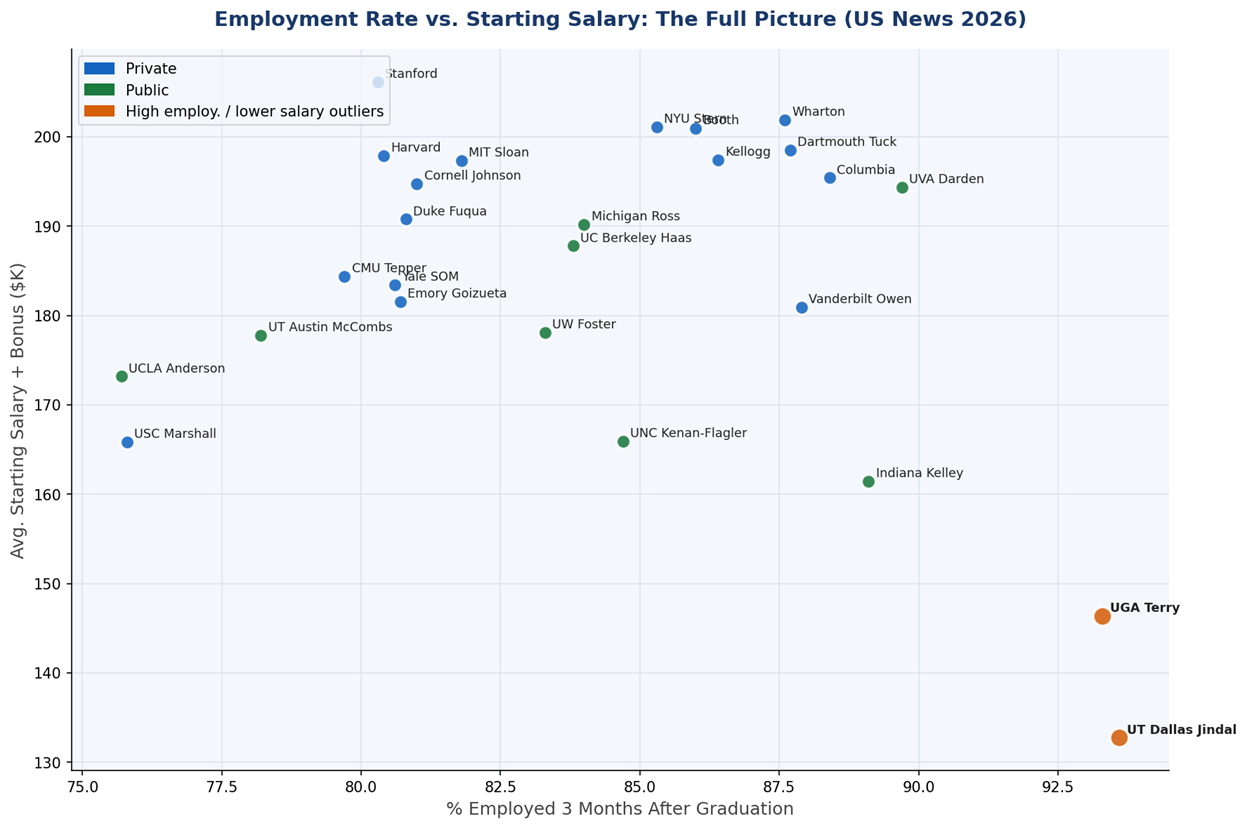
Employment rate is one of the most cited metrics in MBA rankings, yet also one of the most context-dependent. A high employment rate does not automatically mean a program is placing graduates in competitive roles at leading companies. Class size, regional employer concentration, industry mix, and the types of roles graduates accept all shape this number significantly.
6. Peer vs Recruiter Assessment Score:
US News asks two separate groups to evaluate MBA programs: academic peers (faculty and deans at other business schools) and corporate recruiters. These two perspectives usually align, but where they diverge they reveal important structural differences in how programs are perceived inside and outside academia.
The chart reveals a clear outlier: UT Dallas Jindal sits at 3.1 on peer assessment but 4.3 on recruiter assessment -- a gap of 1.2 points. No other school in the dataset has a divergence of this magnitude. This reflects a program that has invested heavily in corporate employer relationships and career services, while its broader academic standing in the business school community remains limited.At the other end of the spectrum, Yale SOM (peer: 4.4, recruiter: 4.2) and MIT Sloan (peer: 4.7, recruiter: 4.4) show the profile typical of programs with strong research missions where academic prestige slightly outpaces employer-side demand. This is not a weakness -- it reflects a different institutional emphasis.
Wharton leads all programs on recruiter assessment at 4.6, reflecting its dominant positioning in finance, consulting, and global corporate recruiting networks. Stanford (4.5) and Booth (4.5) follow closely. These three programs sit at the top of both peer and recruiter assessments, which is precisely why they occupy the top three overall rankings.
7. Public vs Private:
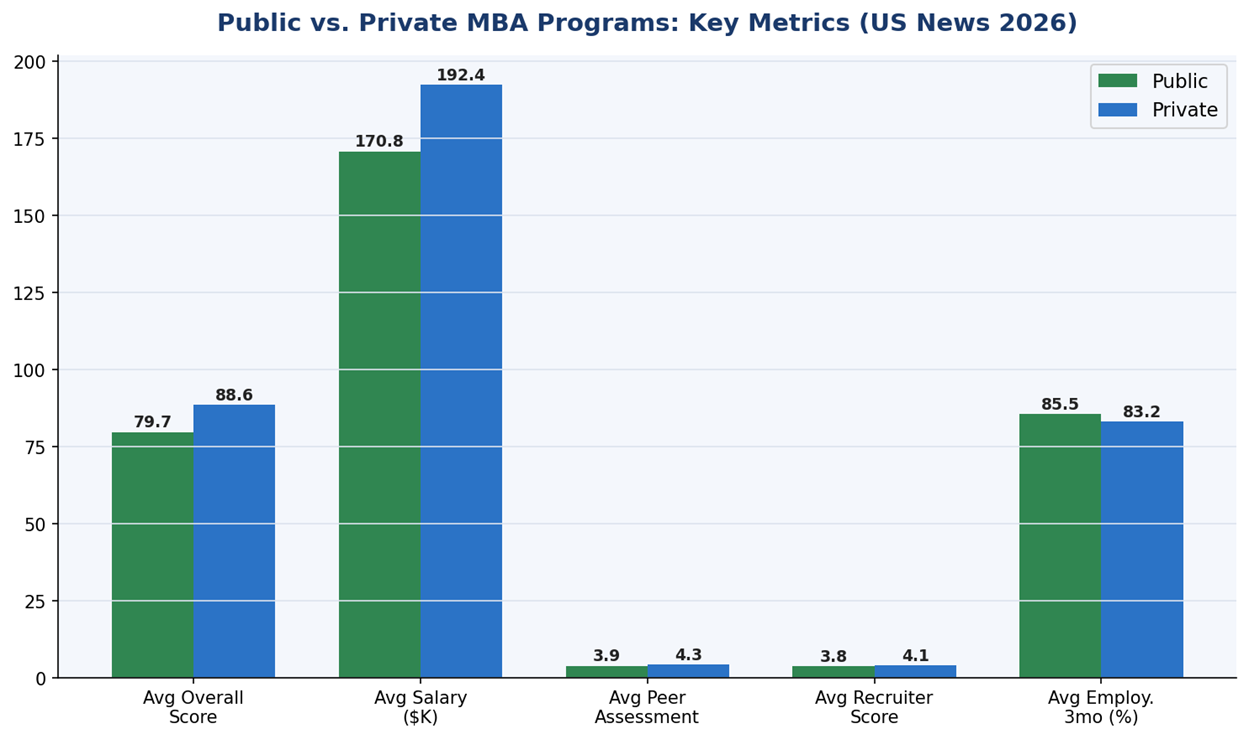
- The 2026 rankings include 16 private and 10 public MBA programs. Elite private schools dominate the top 10, but public programs consistently close the gap on employment outcomes while often costing meaningfully less for in-state students.
- Private programs lead on overall score (average approximately 88 vs. 79 for public schools) and on both peer and recruiter assessments. This is expected given the concentration of historically elite programs in the private category. However, public schools perform within a few percentage points on employment rates while often offering substantially lower tuition, particularly for in-state residents.
- UC Berkeley Haas is the standout public program. Ranked No. 10 with an overall score of 89, $187,801 in average compensation, and a peer assessment of 4.5 that matches MIT Sloan and Harvard, it competes directly with programs ranked three to five places above it. That peer score is particularly notable -- for a program ranked outside the top 5, it signals a level of academic respect that most schools at this rank do not command.
- UVA Darden and Michigan Ross are the other two public programs worth highlighting. Both achieve strong employment rates -- Darden at 89.7%, Ross at 84% -- with salaries in the $190K range, at public university pricing for in-state students. UNC Kenan-Flagler's seven-spot rise to No. 21 adds a new name to watch in this tier.
8. Strategic Takeaways for Prospective Students:
No ranking tells the full story. The most useful approach is to identify what you are optimizing for and then read the data through that lens, rather than treating overall score as the only relevant number.
If maximizing compensation is your primary goal
· Target Stanford, Wharton, or Booth. All three average above $200K in total compensation and hold the strongest recruiter assessment scores in the dataset to justify that premium.
· NYU Stern’s salary numbers need context. It ranks No. 7 overall and delivers the second-highest salary at $201K, but part of that figure reflects NYC cost of living baked into compensation packages. That said, for IB and PE placement in New York, Stern competes directly with Wharton and Columbia on placement outcomes.
· Cornell Johnson punches above its weight at $194K for a No. 15 program. Worth serious consideration for candidates focused on salary-per-rank value.
If employment certainty matters most to you
· UVA Darden is the best single data point: 89.7% employment within three months, $194K average compensation, No. 11 rank, and public school pricing for Virginia residents.
· Indiana Kelley and Columbia both exceed 88% employment rates. Columbia at $195K average salary makes its 88.4% figure even more meaningful in terms of actual career outcomes.
· Be cautious about over-interpreting Jindal and UGA Terry's 93%+ rates without accounting for salary outcomes, peer assessment scores, and the regional concentration of their placement networks.
If total return on investment drives your decision
· UC Berkeley Haas is the quiet overperformer. Top-10 ranking, $187K salary, and a peer assessment of 4.5 matching MIT Sloan and Harvard -- a level of academic respect rare for a program outside the top 5.
· Michigan Ross and UVA Darden offer compelling ROI profiles for their respective in-state populations. Both rank in the top 13 and deliver near-$190K salary averages.
· UNC Kenan-Flagler's seven-spot rise to No. 21 makes it a legitimate target for cost-conscious applicants willing to bet on a program building upward momentum.
Schools to watch for the 2027 cycle
· UNC Kenan-Flagler: If employment metrics continue improving and peer assessment climbs further, a top-18 finish is realistic within one to two cycles.
· Emory Goizueta: After a six-spot drop, 2027 will be a rebound test. Watch for changes in career services and employer partnership investment.
· Harvard: A peer assessment score of 4.8 ties Stanford for the highest in the dataset. If employment at graduation improves from 61.4%, it has the raw material to challenge Booth for No. 3.
· UT Dallas Jindal: Its trajectory is genuine but the salary gap and peer assessment deficit are structural constraints. Closing those gaps requires a longer-term investment in faculty quality, alumni network development, and industry diversification beyond its current regional base.
Attachment:
GMAT-Club-Forum-nbej0nt8.png [ 117.35 KiB | Viewed 3110 times ]
Attachment:
GMAT-Club-Forum-3pqqc003.png [ 148.12 KiB | Viewed 3065 times ]
Attachment:
GMAT-Club-Forum-gea0f494.png [ 112.34 KiB | Viewed 2998 times ]
Attachment:
GMAT-Club-Forum-s14gf901.png [ 167.88 KiB | Viewed 2984 times ]
Attachment:
GMAT-Club-Forum-pjeky3et.png [ 183.51 KiB | Viewed 2950 times ]
Attachment:
GMAT-Club-Forum-8eubi6wk.png [ 97.05 KiB | Viewed 2920 times ]





