Events & Promotions
|
|

GMAT Club Daily Prep
Thank you for using the timer - this advanced tool can estimate your performance and suggest more practice questions. We have subscribed you to Daily Prep Questions via email.
Customized
for You
Track
Your Progress
Practice
Pays
Not interested in getting valuable practice questions and articles delivered to your email? No problem, unsubscribe here.
 Sep 02
01:00 PM EDT
-11:59 PM EDT
Take 30% off all study plans with code COURSEWORK - Expires on Monday 9/7 Sep 04
01:30 AM EDT
-02:30 AM EDT
This Labor Day, turn your hard work into real score gains. From 615→715 in 15 days to 705 in 30 days, our students prove what's possible with personalized, expert guidance. Save up to 25% on 1-on-1 tutoring. Sep 04
10:00 AM EDT
-11:59 PM EDT
We’ve worked incredibly hard to build TTP into the best test prep experience possible, and it would mean a lot to us to win Newsweek’s 2026 Readers’ Choice Award for Best Test Prep. If TTP has helped you, we’d be incredibly grateful for your vote. Sep 06
09:30 AM EDT
-12:30 PM EST
Top scores are possible when you enroll in a powerful EA course, taught live online + 6 months access to TTP OnDemand video courses included! Perfect class schedule and easy course access for working professionals. Class starts Sundays Sept. 6, 2026. Sep 07
12:01 AM PDT
-11:59 PM PDT
On the 7th, GMAT Club Tests will be Free! Including all the Quizzes, Questions, and Tests. 12 AM - 11:59 PM PDT Sep 07
12:30 AM EDT
-01:30 AM EDT
Tejas studied hard but kept repeating the same mistakes. After 3 attempts at 645, a focused 4-week strategy helped him identify and fix what was holding him back—leading to a 695 with just 12–15 hours of study per week.- Sep 07
10:00 AM PDT
-11:00 AM PDT
A complete walkthrough of GMAT Club’s free 12-week GMAT study plan: what you study each week, how progress and goals are tracked, how the error log works, and how your practice unlocks paid tools at no cost. - Sep 09
07:00 AM PDT
-10:00 AM PDT
Meet AdComs and explore top Master’s programs - MiM, MiF, MSc, MSBA and more. - Application Fee Waivers - Free 1-Week of GMAT Club Tests: - Master's Application Toolkit - Grand Prize Giveaway - Sep 09
10:00 AM PDT
-11:00 AM PDT
Three MBA applications. Three rejections. No interview invites. A year later, Aman was admitted to Cambridge Judge, SMU, and IMD. In this episode of MBA Admit Stories, Aman shares how he rebuilt his MBA application...  Sep 10
08:00 PM PDT
-09:00 PM PDT
Free- full-length test + 15 concept videos + 150+ short videos + study plan! Sep 15
07:00 PM EDT
-09:00 PM EST
Elite scores are possible when you enroll in a powerful GMAT course, taught live online + 6 months access to TTP OnDemand video courses included! Class starts Tues/Thurs Sept. 15, 2026 - Nov. 15, 2027, 7:00pm-9:00pm EST Sep 21
08:00 PM EDT
-10:00 PM EDT
Boost your GMAT score in less than one month in a live online class + 6 months access to TTP OnDemand video courses included! Class starts Mon, Tues, Wed, Thur, Fri Sept. 21, 2026 - Oct. 9, 2027, 7:00pm-10:00pm EST

Question 1


C
Be sure to select an answer first to save it in the Error Log before revealing the correct answer (OA)!
Difficulty:
 35%
(medium)
35%
(medium)
Question Stats:
66% (02:17) correct 34%
(02:26) wrong
based on 677
sessions
34%
(02:26) wrong
based on 677
sessions
History
Date
Time
Result
Not Attempted Yet
Question 2
D
Be sure to select an answer first to save it in the Error Log before revealing the correct answer (OA)!
Difficulty:
 65%
(hard)
65%
(hard)
Question Stats:
45% (01:16) correct 55%
(01:20) wrong
based on 659
sessions
History
Date
Time
Result
Not Attempted Yet
Question 3
B
Be sure to select an answer first to save it in the Error Log before revealing the correct answer (OA)!
Difficulty:
25%
(medium)
Question Stats:
73% (01:10) correct 27%
(01:26) wrong
based on 629
sessions
History
Date
Time
Result
Not Attempted Yet
GMAT-Club-Forum-9fevwwue.png [ 115.91 KiB | Viewed 3646 times ]
GMAT-Club-Forum-a8l4qc30.png [ 39.79 KiB | Viewed 3643 times ]
GMAT-Club-Forum-lj7qtllf.png [ 42.19 KiB | Viewed 3634 times ]
GMAT-Club-Forum-h0fhwvkh.png [ 68.93 KiB | Viewed 3634 times ]
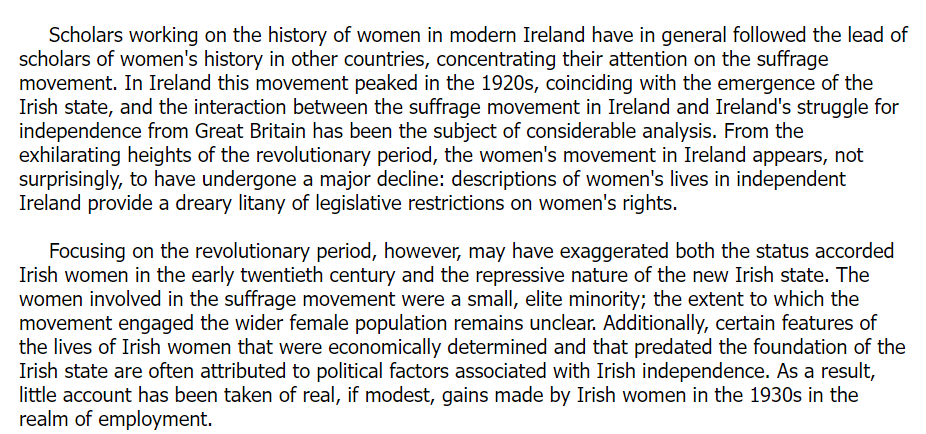
Scholars working on the history of women in modern Ireland have in general followed the lead of scholars of women’s history in other countries, concentrating their attention on the suffrage movement. In Ireland this movement peaked in the 1920s, coinciding with the emergence of the Irish state, and the interaction between the suffrage movement in Ireland and Ireland’s struggle for independence from Great Britain has been the subject of considerable analysis. From the exhilarating heights of the revolutionary period, the women’s movement in Ireland appears, not surprisingly, to have undergone a major decline: descriptions of women’s lives in independent Ireland provide a dreary litany of legislative restrictions on women’s rights.
Focusing on the revolutionary period, however, may have exaggerated both the status accorded Irish women in the early twentieth century and the repressive nature of the new Irish state. The women involved in the suffrage movement were a small, elite minority; the extent to which the movement engaged the wider female population remains unclear. Additionally, certain features of the lives of Irish women that were economically determined and that predated the foundation of the Irish state are often attributed to political factors associated with Irish independence. As a result, little account has been taken of real, if modest, gains made by Irish women in the 1930s in the realm of employment.
Focusing on the revolutionary period, however, may have exaggerated both the status accorded Irish women in the early twentieth century and the repressive nature of the new Irish state. The women involved in the suffrage movement were a small, elite minority; the extent to which the movement engaged the wider female population remains unclear. Additionally, certain features of the lives of Irish women that were economically determined and that predated the foundation of the Irish state are often attributed to political factors associated with Irish independence. As a result, little account has been taken of real, if modest, gains made by Irish women in the 1930s in the realm of employment.
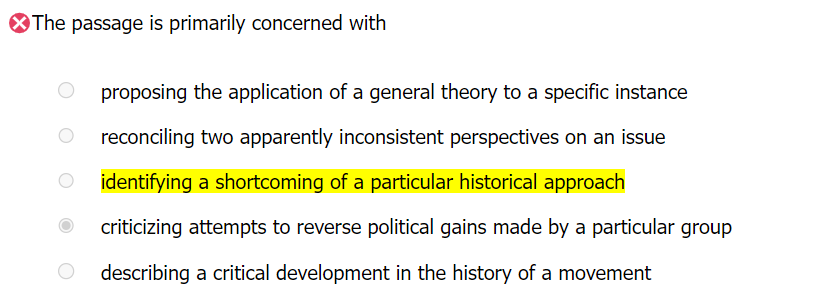
1. The passage is primarily concerned with
A. proposing the application of a general theory to a specific instance
B. reconciling two apparently inconsistent perspectives on an issue
C. identifying a shortcoming of a particular historical approach
D. criticizing attempts to reverse political gains made by a particular group
E. describing a critical development in the history of a movement
A. proposing the application of a general theory to a specific instance
B. reconciling two apparently inconsistent perspectives on an issue
C. identifying a shortcoming of a particular historical approach
D. criticizing attempts to reverse political gains made by a particular group
E. describing a critical development in the history of a movement
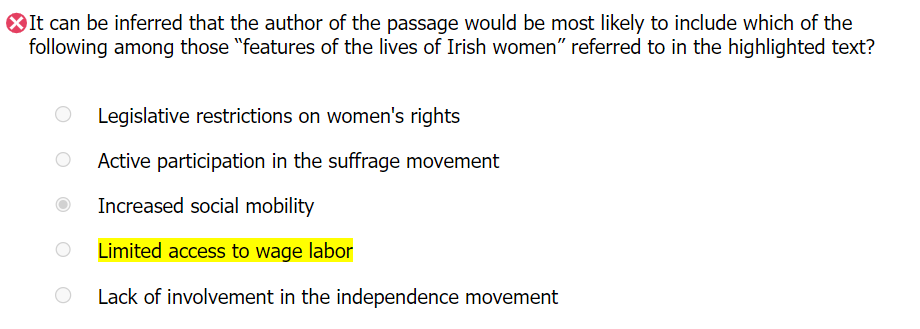
2. It can be inferred that the author of the passage would be most likely to include which of the following among those “features of the lives of Irish women" referred to in the highlighted text?
A. Legislative restrictions on women’s rights
B. Active participation in the suffrage movement
C. Increased social mobility
D. Limited access to wage labor
E. Lack of involvement in the independence movement
A. Legislative restrictions on women’s rights
B. Active participation in the suffrage movement
C. Increased social mobility
D. Limited access to wage labor
E. Lack of involvement in the independence movement
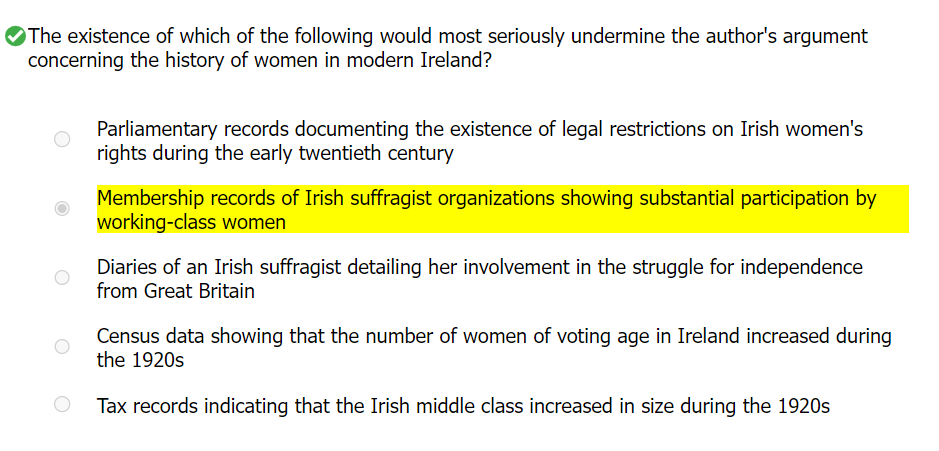
3. The existence of which of the following would most seriously undermine the author’s argument concerning the history of women in modern Ireland?
A. Parliamentary records documenting the existence of legal restrictions on Irish women’s rights during the early twentieth century
B. Membership records of Irish suffragist organizations showing substantial participation by working-class women
C. Diaries of an Irish suffragist detailing her involvement in the struggle for independence from Great Britain
D. Census data showing that the number of women of voting age in Ireland increased during the 1920s
E. Tax records indicating that the Irish middle class increased in size during the 1920s
A. Parliamentary records documenting the existence of legal restrictions on Irish women’s rights during the early twentieth century
B. Membership records of Irish suffragist organizations showing substantial participation by working-class women
C. Diaries of an Irish suffragist detailing her involvement in the struggle for independence from Great Britain
D. Census data showing that the number of women of voting age in Ireland increased during the 1920s
E. Tax records indicating that the Irish middle class increased in size during the 1920s
Attachment:
GMAT-Club-Forum-9fevwwue.png [ 115.91 KiB | Viewed 3646 times ]
Attachment:
GMAT-Club-Forum-a8l4qc30.png [ 39.79 KiB | Viewed 3643 times ]
Attachment:
GMAT-Club-Forum-lj7qtllf.png [ 42.19 KiB | Viewed 3634 times ]
Attachment:
GMAT-Club-Forum-h0fhwvkh.png [ 68.93 KiB | Viewed 3634 times ]
Pro tip:
Combine official questions for familiarity with GMAT Club Tests for analytics and tougher Focus-level practice so the real exam feels manageable.
Explore →

 19 Jul 2024, 13:01
Kudos
Bookmarks
2. It can be inferred that the author of the passage would be most likely to include which of the following among those “features of the lives of Irish women" referred to in the highlighted text?
A. Legislative restrictions on women’s rights
B. Active participation in the suffrage movement
C. Increased social mobility
D. Limited access to wage labor
E. Lack of involvement in the independence movement
The author, by stating “features of the lives of Irish women", means that there is another factor, apart from the suffrage movement, that explains women's status. This factor, according to the passage, was economically determined.
By POE, A, B amd E should be out immediately because they are related to the suffrage movement.
Then C vs D.
The author concludes that little account had been taken of real, if modest, gains made by Irish women in the 1930s in the realm of employment.
So D is the winner.
A. Legislative restrictions on women’s rights
B. Active participation in the suffrage movement
C. Increased social mobility
D. Limited access to wage labor
E. Lack of involvement in the independence movement
The author, by stating “features of the lives of Irish women", means that there is another factor, apart from the suffrage movement, that explains women's status. This factor, according to the passage, was economically determined.
By POE, A, B amd E should be out immediately because they are related to the suffrage movement.
Then C vs D.
The author concludes that little account had been taken of real, if modest, gains made by Irish women in the 1930s in the realm of employment.
So D is the winner.
General Discussion
 12 Dec 2024, 00:19
Kudos
Bookmarks
this explanation is great, this is how I solved. For those looking to understand the WHY deeply:
what the line means: Some features of Irish women's lives were caused by broader economic realities rather than solely by the political transformation linked to independence. By mistakenly blaming these on political factors, scholars have overlooked modest improvements in women’s employment opportunities during the 1930s, which deserve recognition.
"Limited access to wage labor" refers to restricted opportunities for people, in this case, women, to participate in paid work outside the home.
This economic factor just as well have been persistent before and after independence due to economic situations.
what the line means: Some features of Irish women's lives were caused by broader economic realities rather than solely by the political transformation linked to independence. By mistakenly blaming these on political factors, scholars have overlooked modest improvements in women’s employment opportunities during the 1930s, which deserve recognition.
"Limited access to wage labor" refers to restricted opportunities for people, in this case, women, to participate in paid work outside the home.
This economic factor just as well have been persistent before and after independence due to economic situations.
JoeKan1234