Events & Promotions
|
|

GMAT Club Daily Prep
Thank you for using the timer - this advanced tool can estimate your performance and suggest more practice questions. We have subscribed you to Daily Prep Questions via email.
Customized
for You
Track
Your Progress
Practice
Pays
Not interested in getting valuable practice questions and articles delivered to your email? No problem, unsubscribe here.
 Sep 15
07:00 PM EDT
-09:00 PM EST
Elite scores are possible when you enroll in a powerful GMAT course, taught live online + 6 months access to TTP OnDemand video courses included! Class starts Tues/Thurs Sept. 15, 2026 - Nov. 15, 2027, 7:00pm-9:00pm EST Sep 21
07:00 PM EDT
-10:00 PM EDT
Boost your GMAT score in less than one month in a live online class + 6 months access to TTP OnDemand video courses included! Class starts Mon, Tues, Wed, Thur, Fri Sept. 21, 2026 - Oct. 9, 2027, 7:00pm-10:00pm EST

 Updated on: 25 Jan 2023, 02:42
Originally posted by vjsharma25 on 28 Mar 2011, 09:28.
Last edited by mysterymanrog on 25 Jan 2023, 02:42, edited 3 times in total.
Last edited by mysterymanrog on 25 Jan 2023, 02:42, edited 3 times in total.
Corrected typos.
Kudos
Bookmarks


A
Be sure to select an answer first to save it in the Error Log before revealing the correct answer (OA)!
Difficulty:
 95%
(hard)
95%
(hard)
Question Stats:
45% (02:19) correct 55%
(02:22)
wrong
based on 1096
sessions
55%
(02:22)
wrong
based on 1096
sessions
History
Date
Time
Result
Not Attempted Yet
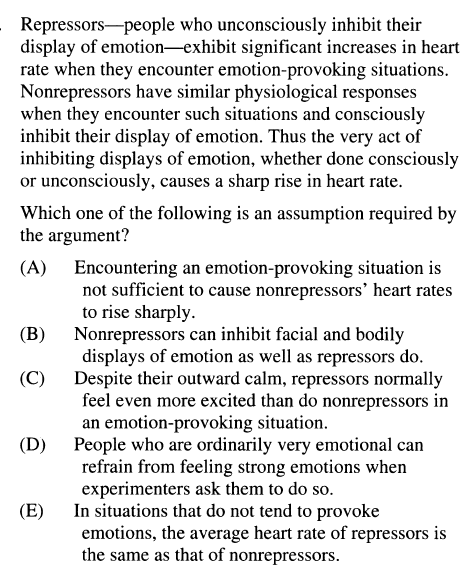
Repressors-people who unconsciously inhibit their display of emotion - exhibit significant increases in heart rate when they encounter emotion-provoking situations. Nonrepressors have similar physiogical responses when they encounter such situations and consciously inhibit their display of emotion. Thus the very act of inhibiting displays of emotions, whether done consciously or unconsciously, causes a sharp rise in heart rate.
Which one of the following is an assumption required by the argument?
A. Encountering an emotion provoking situation is not sufficient to cause nonrepressors' heart rates to rise sharply.
B. Non-repressors can inhibit facial and bodily displays of emotion as well as repressors do.
C. Despite their outward calm, repressors normally feel even more excited than do non-repressors in an emotion provoking situation.
D. People who are ordinarily very emotional can refrain from feeling strong emotions when experiments ask them to do so.
E. In situations that do not tend to provoke emotions, the average heart rate of repressors is the same as that of non-repressors.
repressors.png [ 77.88 KiB | Viewed 12026 times ]
Which one of the following is an assumption required by the argument?
A. Encountering an emotion provoking situation is not sufficient to cause nonrepressors' heart rates to rise sharply.
B. Non-repressors can inhibit facial and bodily displays of emotion as well as repressors do.
C. Despite their outward calm, repressors normally feel even more excited than do non-repressors in an emotion provoking situation.
D. People who are ordinarily very emotional can refrain from feeling strong emotions when experiments ask them to do so.
E. In situations that do not tend to provoke emotions, the average heart rate of repressors is the same as that of non-repressors.
Attachment:
repressors.png [ 77.88 KiB | Viewed 12026 times ]

 28 Mar 2011, 14:38
Kudos
Bookmarks
Based on the text:
1) Repressors exhibit significant increases in heart rate when they encounter emotion-provoking situations
2) Nonrepressors have similar physiological responses when they consciously inhibit displays of emotion
Conclusion) Thus, inhibiting displays of emotion causes a rise in heart rate, consciously or unconsciously.
Pre-phrase of assumption: "that the inhibition of emotions is what causes the physiological responses, not the emotions themselves"
Answer (A).
1) Repressors exhibit significant increases in heart rate when they encounter emotion-provoking situations
2) Nonrepressors have similar physiological responses when they consciously inhibit displays of emotion
Conclusion) Thus, inhibiting displays of emotion causes a rise in heart rate, consciously or unconsciously.
Pre-phrase of assumption: "that the inhibition of emotions is what causes the physiological responses, not the emotions themselves"
Answer (A).
 28 Mar 2011, 20:48
Kudos
Bookmarks
(A) is correct.
The conclusion here is that repressing emotions is key to increasing heart rate. What would help justify this? If heart rate is not increased whenever emotions are not repressed.
In logical terms, a -> b, then !b -> !a must be true. So, if we are given !b -> !a, this justifies a -> b.
To help see why A is correct, let's look at why B-E are incorrect.
(B) The degree to which non-repressors can inhibit their emotions is immaterial, as long as the act of inhibition causes a spike in heart-rate. Eliminated.
(C) The level of excitement is not necessarily tied to heart-rate; if it is, the passage does not indicate anything about this connection. Eliminated.
(D) Note the wording: refrain from *feeling*, not from expressing. Refraining from actually feeling the emotions does not have to do with the conclusion, which draws a link between expression of emotions and heart rate. Eliminated.
(E) Our conclusion talks about a "spike" in heart rate, or, in other words, an increased heart rate as a result of repressing displays of emotion. It says nothing about the actual number to which the heart rate increased or by how much. Since this is a relative measure (one greater than the other) and not an absolute one (ie, exact number), the average heart rate of the two groups is immaterial (does not matter for the comparison). Eliminated.
The conclusion here is that repressing emotions is key to increasing heart rate. What would help justify this? If heart rate is not increased whenever emotions are not repressed.
In logical terms, a -> b, then !b -> !a must be true. So, if we are given !b -> !a, this justifies a -> b.
To help see why A is correct, let's look at why B-E are incorrect.
(B) The degree to which non-repressors can inhibit their emotions is immaterial, as long as the act of inhibition causes a spike in heart-rate. Eliminated.
(C) The level of excitement is not necessarily tied to heart-rate; if it is, the passage does not indicate anything about this connection. Eliminated.
(D) Note the wording: refrain from *feeling*, not from expressing. Refraining from actually feeling the emotions does not have to do with the conclusion, which draws a link between expression of emotions and heart rate. Eliminated.
(E) Our conclusion talks about a "spike" in heart rate, or, in other words, an increased heart rate as a result of repressing displays of emotion. It says nothing about the actual number to which the heart rate increased or by how much. Since this is a relative measure (one greater than the other) and not an absolute one (ie, exact number), the average heart rate of the two groups is immaterial (does not matter for the comparison). Eliminated.