Events & Promotions
|
|

GMAT Club Daily Prep
Thank you for using the timer - this advanced tool can estimate your performance and suggest more practice questions. We have subscribed you to Daily Prep Questions via email.
Customized
for You
Track
Your Progress
Practice
Pays
Not interested in getting valuable practice questions and articles delivered to your email? No problem, unsubscribe here.
 Apr 23
01:30 AM EDT
-02:30 AM EDT
Struggling with GMAT Verbal as a non-native speaker? Harsh improved his score from 595 to 695 in just 45 days—and scored a 99 %ile in Verbal (V88)! Learn how smart strategy, clarity, and guided prep helped him gain 100 points. Apr 22
12:30 AM EDT
-01:30 AM EDT
At one point, she believed GMAT wasn’t for her. After scoring 595, self-doubt crept in and she questioned her potential. But instead of quitting, she made the right strategic changes. The result? A remarkable comeback to 695. Check out how Saakshi did it. Apr 23
08:00 PM PDT
-09:00 PM PDT
Video explanations + diagnosis of 10 weakest areas + 150+ short videos + study plan! Apr 26
10:00 AM EDT
-11:00 AM EDT
The Target Test Prep course represents a quantum leap forward in GMAT preparation, a radical reinterpretation of the way that students should study. Try before you buy with a 5-day, full-access trial of the course for FREE! Apr 27
11:00 AM EDT
-12:00 PM EDT
Prefer video-based learning? The Target Test Prep OnDemand course is a one-of-a-kind video masterclass featuring 400 hours of lecture-style teaching by Scott Woodbury-Stewart, founder of Target Test Prep and one of the most accomplished GMAT instructors Apr 28
08:00 AM PDT
-11:00 AM PDT
Whether you are just beginning your MBA journey or fine-tuning your path to a 700+ score, GMAT Day is designed to give you a competitive edge.

 23 Dec 2023, 09:37
Kudos
Bookmarks


E
Be sure to select an answer first to save it in the Error Log before revealing the correct answer (OA)!
Difficulty:
 25%
(medium)
25%
(medium)
Question Stats:
82% (01:43) correct 18%
(02:08)
wrong
based on 815
sessions
18%
(02:08)
wrong
based on 815
sessions
History
Date
Time
Result
Not Attempted Yet

Grimshaw, Inc., found that the cost of paying for the health care benefits of its employees had been gradually increasing for over five years to a point where the company felt that company-provided health care benefits might soon be in jeopardy. Last year, Grimshaw requested its employees to be cost conscious about their use of health care services whenever possible, yet the company's health-care-benefit costs have continued to increase at approximately the same rate.
Which of the following, if true, argues most strongly that Grimshaw's employees did in fact heed the company's request?
A. Grimshaw gave its employees the names of several physicians who provide high-quality health care services at below-average cost.
B. The percentage of Grimshaw's employees who exercise regularly has not declined since last year.
C. Grimshaw made its request believing that many employees had been using the services of physicians who occasionally ordered unneeded tests.
D. The cost of paying for employee health care benefits represents a larger proportion of Grimshaw's overall corporate expenses this year than last year.
E. In the year since Grimshaw made its request, health care costs in general have increased sharply in the part of the country where Grimshaw is located.
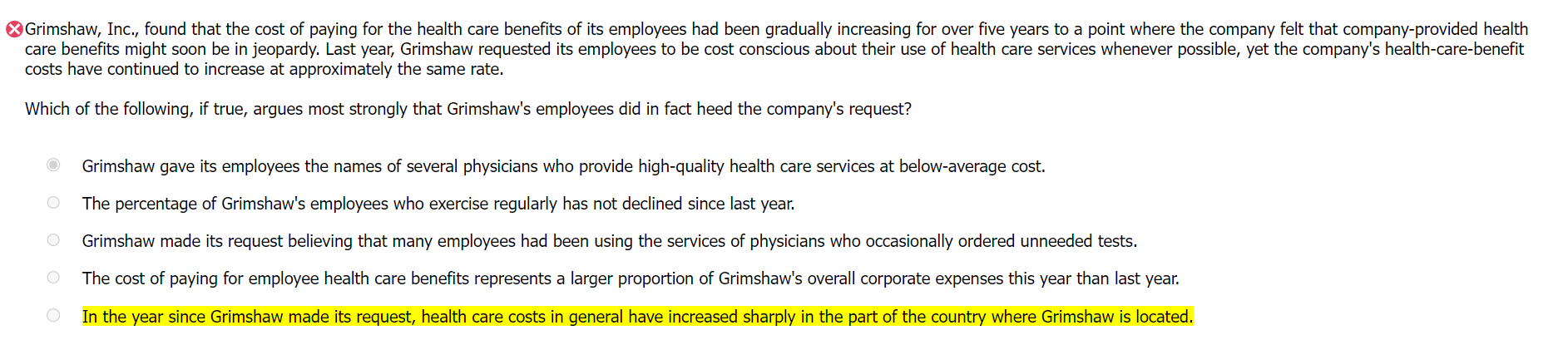
GMAT-Club-Forum-9sjqe8e1.png [ 109.6 KiB | Viewed 2533 times ]
Which of the following, if true, argues most strongly that Grimshaw's employees did in fact heed the company's request?
A. Grimshaw gave its employees the names of several physicians who provide high-quality health care services at below-average cost.
B. The percentage of Grimshaw's employees who exercise regularly has not declined since last year.
C. Grimshaw made its request believing that many employees had been using the services of physicians who occasionally ordered unneeded tests.
D. The cost of paying for employee health care benefits represents a larger proportion of Grimshaw's overall corporate expenses this year than last year.
E. In the year since Grimshaw made its request, health care costs in general have increased sharply in the part of the country where Grimshaw is located.
Attachment:
GMAT-Club-Forum-9sjqe8e1.png [ 109.6 KiB | Viewed 2533 times ]
Need more Tests to Practice?
GMAT Club Tests give expert solutions for every question in full and sectional GMAT Focus mocks.
Learn more →

 23 Dec 2023, 11:58
Kudos
Bookmarks
sunnypv
Here was my reasoning:
First I read the question:
Quote:
And IDed that this was an 'assumption family' question. That is to say: an argument, with premise, conclusion, and assumptions.
Quote:
Interestingly, this paragraph does NOT include a conclusion! But I'm still trying to 'strengthen' the idea that the employees heeded the request (which I now know was to be cost conscious about their health care services).
The information in the paragraph led me to believe that maybe they *weren't*, since costs increased for the company again!
So I realize this is a kind of 'weaken' the argument, or perhaps an 'explain the discrepancy' question (which I regard a kind of 'weakener.'
My goal is this:
"How could the employees have been cost conscious about health care services EVEN THOUGH the overall health care costs to the company continued to increase?"
Essentially, we have a 'price' vs 'quantity situation going on here. Either the employees got MORE (but at a lower price) health care enough to increase overall spending, or they got it at a higher price (or some combination of both!)
But how could they get it at a higher price AND be price conscious??? Well... if prices increased, and they actually chose the cheap option. That is to say, there might have been a world where they were not price conscious and overall healthcare spending to the company *increased even more*!
Okay so I go to the answers with these goals/thoughts in mind: "Did they increase their consumption of health care services or were prices increasing such that they could have chosen even MORE expensive health care?"
Quote:
If the doctor's prices are below average... why did overall spending go up? This does't explain the phenomenon in question.
Quote:
If *anything*, this does the opposite of what I need. If they *were* exercising less, maybe they'd need less health care (but that seems like a huge logical leap for the GMAT...), but this says they aren't exercising less. So why do they need more health care? What's going on with prices? Not helpful.
Quote:
This explains why Grimshaw made the request, but not why the request could have been followed but Grimshaw's healthcare expenditures still increased.
Quote:
The overall corporate expenses aren't relevant to the question at hand.
Quote:
Boom. That's one of the possibilities I was curious about: did prices increase a lot, and the employees chose cheaper options from what was available? This could explain how they *were* cost conscious, but healthcare expenditures still increased.
TAKEAWAYS:
1). Goal setting in CR is crucial, and in my experience students don't practice it enough. They jump too fast to the answers before really knowing what they need the right answer to *do*.
2). When dealing with 'total cost' questions, remember price*quantity.
3). Be aware of what's possible and don't make snap assumptions. If you thought about price and quantity and figured, "Well since they're being price conscious, they're not paying higher prices, so it must be that the employees got more healthcare this year," then you might not think enough about 'E' to realize it is correct.
"Paying higher prices" is not *always* the same thing as "not being price conscious."
Here's another study-tip: as you study for the GMAT, you want to look for problems that have similarities. Early on it's difficult to do, but over time, problems should remind you of other problems. As I did this problem, I was reminded of one of the following three. See if you can identify which one and why:
https://gmatclub.com/forum/the-law-of-d ... 36898.html
https://gmatclub.com/forum/a-year-ago-d ... 90202.html
https://gmatclub.com/forum/manufacturer ... 64132.html