Events & Promotions
|
|

GMAT Club Daily Prep
Thank you for using the timer - this advanced tool can estimate your performance and suggest more practice questions. We have subscribed you to Daily Prep Questions via email.
Customized
for You
Track
Your Progress
Practice
Pays
Not interested in getting valuable practice questions and articles delivered to your email? No problem, unsubscribe here.
 Sep 15
07:00 PM EDT
-09:00 PM EST
Elite scores are possible when you enroll in a powerful GMAT course, taught live online + 6 months access to TTP OnDemand video courses included! Class starts Tues/Thurs Sept. 15, 2026 - Nov. 15, 2027, 7:00pm-9:00pm EST Sep 21
07:00 PM EDT
-10:00 PM EDT
Boost your GMAT score in less than one month in a live online class + 6 months access to TTP OnDemand video courses included! Class starts Mon, Tues, Wed, Thur, Fri Sept. 21, 2026 - Oct. 9, 2027, 7:00pm-10:00pm EST

 19 Feb 2024, 02:13
Kudos
Bookmarks


A
Be sure to select an answer first to save it in the Error Log before revealing the correct answer (OA)!
Difficulty:
 45%
(medium)
45%
(medium)
Question Stats:
73% (02:06) correct 27%
(02:12)
wrong
based on 1235
sessions
27%
(02:12)
wrong
based on 1235
sessions
History
Date
Time
Result
Not Attempted Yet
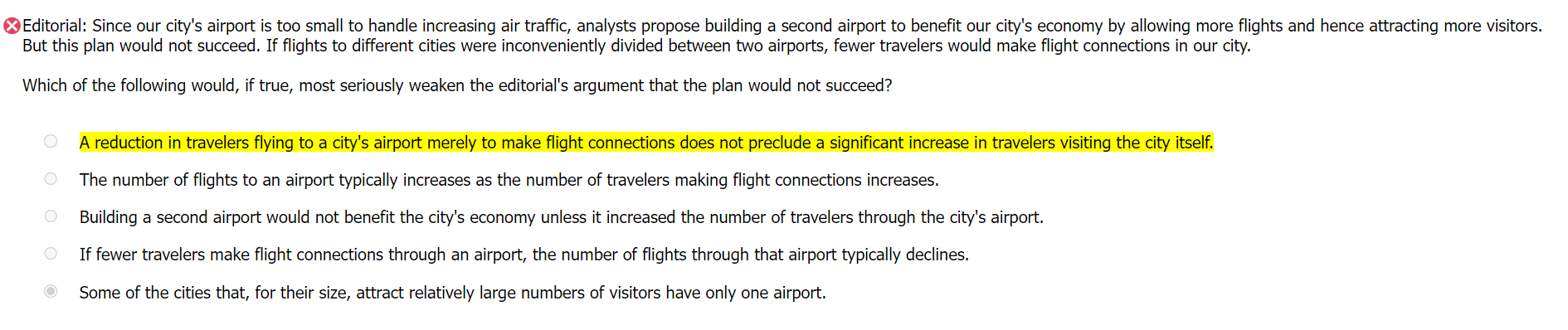
Editorial: Since our city's airport is too small to handle increasing air traffic, analysts propose building a second airport to benefit our city's economy by allowing more flights and hence attracting more visitors. But this plan would not succeed. If flights to different cities were inconveniently divided between two airports, fewer travelers would make flight connections in our city.
Which of the following would, if true, most seriously weaken the editorial's argument that the plan would not succeed?
A. A reduction in travelers flying to a city's airport merely to make flight connections does not preclude a significant increase in travelers visiting the city itself.
B. The number of flights to an airport typically increases as the number of travelers making flight connections increases.
C. Building a second airport would not benefit the city's economy unless it increased the number of travelers through the city's airport.
D. If fewer travelers make flight connections through an airport, the number of flights through that airport typically declines.
E. Some of the cities that, for their size, attract relatively large numbers of visitors have only one airport.
GMAT-Club-Forum-5bl0f58j.png [ 101.37 KiB | Viewed 3673 times ]
Which of the following would, if true, most seriously weaken the editorial's argument that the plan would not succeed?
A. A reduction in travelers flying to a city's airport merely to make flight connections does not preclude a significant increase in travelers visiting the city itself.
B. The number of flights to an airport typically increases as the number of travelers making flight connections increases.
C. Building a second airport would not benefit the city's economy unless it increased the number of travelers through the city's airport.
D. If fewer travelers make flight connections through an airport, the number of flights through that airport typically declines.
E. Some of the cities that, for their size, attract relatively large numbers of visitors have only one airport.
Attachment:
GMAT-Club-Forum-5bl0f58j.png [ 101.37 KiB | Viewed 3673 times ]
Pro tip:
Combine official questions for familiarity with GMAT Club Tests for analytics and tougher Focus-level practice so the real exam feels manageable.
Explore →
 19 Feb 2024, 20:51
Kudos
Bookmarks
DerekLin
Plan: Build a second airport to benefit our city's economy by allowing more flights and hence attracting more visitors.
Conclusion: The plan would not succeed.
Support Given for the Conclusion: If flights to different cities were inconveniently divided between two airports, fewer travelers would make flight connections.
We need to find the option that weakens this argument the most.
Answer Choice Elimination:
A. A reduction in travelers flying to a city's airport merely to make flight connections does not preclude a significant increase in travelers visiting the city itself.
This option weakens the argument by suggesting that even if there's a reduction in travelers making flight connections, there could still be an increase in travelers visiting the city itself. This implies that the overall impact on the city's economy could still be positive, even with fewer connecting flights. Keep A.
B. The number of flights to an airport typically increases as the number of travelers making flight connections increases.
This option talks about the correlation between the number of flights and the number of travelers making connections. The option doesn't weaken the premise presented in support of the conclusion. Eliminate B.
C. Building a second airport would not benefit the city's economy unless it increased the number of travelers through the city's airport.
This option is slightly strengthens the concerns presented by the Editorial. Hence, we can eliminate C.
D. If fewer travelers make flight connections through an airport, the number of flights through that airport typically declines.
This option strengthens the argument by suggesting that if fewer travelers make flight connections, the number of flights through that airport typically declines. This supports the argument that dividing flights between two airports would be detrimental, as it implies a reduction in the number of flights at each airport. Eliminate D.
E. Some of the cities that, for their size, attract relatively large numbers of visitors have only one airport.
This option is irrelevant to the argument. It doesn't address the issue of connections or the impact of the second airport.
Option A
 13 Jul 2024, 06:42
Kudos
Bookmarks
DerekLin
Aim: to benefit the city's economy by allowing more flights and hence attracting more visitors
Conclusion: this plan will not succeed beacuse fewer travelers would make flight connections out of inconvenience
A tells us that people may still visit the city. Therefore, the city's economy can benefit from it. Keep.
B weakens the conclusion as the reasoning is that there may be fewer travellers making flight connections.
C also weakens the conclusion.
D weakens the the conclusion.
E tells us a correlation, but a correlation cannot reliably strenghten an argument.
Attachment:
GMAT-Club-Forum-3qdrw0ab.png [ 101.37 KiB | Viewed 3622 times ]





