Events & Promotions
|
|

GMAT Club Daily Prep
Thank you for using the timer - this advanced tool can estimate your performance and suggest more practice questions. We have subscribed you to Daily Prep Questions via email.
Customized
for You
Track
Your Progress
Practice
Pays
Not interested in getting valuable practice questions and articles delivered to your email? No problem, unsubscribe here.
 Apr 26
01:30 AM EDT
-02:30 AM EDT
Learn how Keshav, a Chartered Accountant, scored an impressive 705 on GMAT in just 30 days with GMATWhiz's expert guidance. In this video, he shares preparation tips and strategies that worked for him, including the mock, time management, and more. Apr 26
10:00 AM EDT
-11:00 AM EDT
The Target Test Prep course represents a quantum leap forward in GMAT preparation, a radical reinterpretation of the way that students should study. Try before you buy with a 5-day, full-access trial of the course for FREE! Apr 25
12:30 AM EDT
-01:30 AM EDT
At one point, she believed GMAT wasn’t for her. After scoring 595, self-doubt crept in and she questioned her potential. But instead of quitting, she made the right strategic changes. The result? A remarkable comeback to 695. Check out how Saakshi did it. Apr 27
11:00 AM EDT
-12:00 PM EDT
Prefer video-based learning? The Target Test Prep OnDemand course is a one-of-a-kind video masterclass featuring 400 hours of lecture-style teaching by Scott Woodbury-Stewart, founder of Target Test Prep and one of the most accomplished GMAT instructors Apr 28
08:00 AM PDT
-11:00 AM PDT
Whether you are just beginning your MBA journey or fine-tuning your path to a 700+ score, GMAT Day is designed to give you a competitive edge. May 01
11:00 AM PDT
-12:00 PM PDT
Free- full-length test + 15 concept videos + 150+ short videos + study plan!

 02 Mar 2024, 02:07
Kudos
Bookmarks


E
Be sure to select an answer first to save it in the Error Log before revealing the correct answer (OA)!
Difficulty:
 35%
(medium)
35%
(medium)
Question Stats:
79% (02:03) correct 21%
(02:17)
wrong
based on 796
sessions
21%
(02:17)
wrong
based on 796
sessions
History
Date
Time
Result
Not Attempted Yet

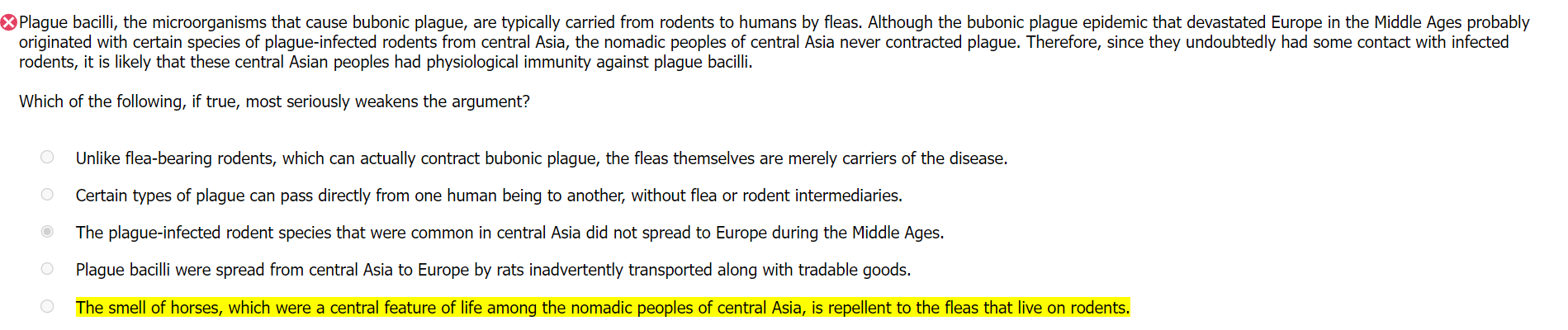
Plague bacilli, the microorganism that cause bubonic plague, are typically carried from rodents to humans by fleas. Although the bubonic plague epidemic that devastated Europe in the Middle Ages probably originated with certain species of plague-infected rodents from central Asia, the nomadic people of central Asia never contracted plague. Therefore, since they undoubtedly had some contact with infected rodents, it is likely that these central Asian people had psysiological immunity against plague bacilli.
Which of the following, if true, most seriously weakens the argument?
A) Unlike flea-bearing rodents, which can actually contract bubonic plague, the fleas themselves are merely carriers of disease.
B) Certain types of plague can pass directly from one human being to another, without fleas or rodent intermediaries.
C) The plague-infected rodent species that were common in central Asia did not spread to Europe during the Middle Ages.
D) Plague bacilli were spread from central Asia to Europe by rats inadvertantly transported along with the tradable goods.
E) The smell of horses, which were a central feature of life among the nomadic people of central Aisa, is repellant to the fleas that live on rodents.
GMAT-Club-Forum-qdnm60ou.png [ 108.11 KiB | Viewed 3311 times ]
Which of the following, if true, most seriously weakens the argument?
A) Unlike flea-bearing rodents, which can actually contract bubonic plague, the fleas themselves are merely carriers of disease.
B) Certain types of plague can pass directly from one human being to another, without fleas or rodent intermediaries.
C) The plague-infected rodent species that were common in central Asia did not spread to Europe during the Middle Ages.
D) Plague bacilli were spread from central Asia to Europe by rats inadvertantly transported along with the tradable goods.
E) The smell of horses, which were a central feature of life among the nomadic people of central Aisa, is repellant to the fleas that live on rodents.
Attachment:
GMAT-Club-Forum-qdnm60ou.png [ 108.11 KiB | Viewed 3311 times ]
Need more Tests to Practice?
GMAT Club Tests give expert solutions for every question in full and sectional GMAT Focus mocks.
Learn more →

 03 Oct 2024, 18:15
Kudos
Bookmarks
Plague bacilli, the microorganism that cause bubonic plague, are typically carried from rodents to humans by fleas. Although the bubonic plague epidemic that devastated Europe in the Middle Ages probably originated with certain species of plague-infected rodents from central Asia, the nomadic people of central Asia never contracted plague. Therefore, since they undoubtedly had some contact with infected rodents, it is likely that these central Asian people had physiological immunity against plague bacilli.
The conclusion of the argument is the following:
it is likely that these central Asian people had physiological immunity against plague bacilli
The support for the conclusion is the following:
Although the bubonic plague epidemic that devastated Europe in the Middle Ages probably originated with certain species of plague-infected rodents from central Asia, the nomadic people of central Asia never contracted plague.
and
they undoubtedly had some contact with infected rodents
So, the reasoning of the argument is basically that, since nomadic people of central Asia never contracted plague even though they "undoubtedly" had contact with infected rodents, it is likely that nomadic central Asian people had immunity against plague bacilli.
Which of the following, if true, most seriously weakens the argument?
This is a Weaken question, and the correct answer will show that, even though the premises about central Asian people are true, the conclusion may not be.
A) Unlike flea-bearing rodents, which can actually contract bubonic plague, the fleas themselves are merely carriers of disease.
This choice doesn't materially change what we know.
After all, even if the fleas do not contract plague, they still carry it from rodents to humans.
So, even if this choice is true, the argument still works.
Eliminate.
B) Certain types of plague can pass directly from one human being to another, without fleas or rodent intermediaries.
The possibility that it's true that plague can pass directly to humans without intermediaries certainly doesn't weaken the argument.
After all, that indicates that central Asian nomads had two different ways to contract plague, from rodents and from other humans, and they still didn't contract it.
So, if anything, this choice provides even more reason to believe that the nomads had immunity against plague bacilli.
Eliminate.
C) The plague-infected rodent species that were common in central Asia did not spread to Europe during the Middle Ages.
This choice has no effect on the case for the conclusion.
After all, the conclusion is about people in Asia not contracting plague even though they undoubtedly came into contact with plague-infected rodents.
The fact that the rodents did not spread to Europe doesn't change the fact that the rodents were in Asia.
Eliminate.
D) Plague bacilli were spread from central Asia to Europe by rats inadvertently transported along with the tradable goods.
This choice is tricky because we could the impression that it means that the nomadic people didn't come into contact with plague-infected rodents.
We could think something along the lines of that nomads probably weren't much involved in trade. So, maybe they didn't come into contact with plague-infected rodents.
Here's the thing though.
The passage states as fact that the rodents were from "central Asia" where the nomads were and that the nomads "undoubtedly" came into contact with infected rodents. So, regardless of whether the rodents were transported to Europe along with tradeable goods, the nomadic people came into contact with them.
So, this choice doesn't change what we know and has no effect on the argument.
Eliminate.
E) The smell of horses, which were a central feature of life among the nomadic people of central Asia, is repellant to the fleas that live on rodents.
This choice is interesting because the background information provided by the passage is the following:
Plague bacilli, the microorganism that cause bubonic plague, are typically carried from rodents to humans by fleas.
We see that the passage indicates that, while rodents carry plague, it's actually fleas that carry plague to humans.
So, if this choice is true, then even though nomadic people of central Asia came into contact with infected rodents, they didn't necessarily come into contact with plague bacilli because they may not have come into contact with plague-carrying fleas.
After all, if the smell of horses repels fleas that live on rodents and horses were a central feature of life among the nomadic people, then it could be that fleas that carried plague stayed away from the nomadic people because the fleas were repelled by the smell of horses.
In that case, the fact that the nomadic people didn't contract plague doesn't mean that had immunity. Rather, it could be that they didn't contract it because they didn't come into contact with infected fleas.
So, this choice casts doubt on the conclusion.
Keep
Correct answer: E
The conclusion of the argument is the following:
it is likely that these central Asian people had physiological immunity against plague bacilli
The support for the conclusion is the following:
Although the bubonic plague epidemic that devastated Europe in the Middle Ages probably originated with certain species of plague-infected rodents from central Asia, the nomadic people of central Asia never contracted plague.
and
they undoubtedly had some contact with infected rodents
So, the reasoning of the argument is basically that, since nomadic people of central Asia never contracted plague even though they "undoubtedly" had contact with infected rodents, it is likely that nomadic central Asian people had immunity against plague bacilli.
Which of the following, if true, most seriously weakens the argument?
This is a Weaken question, and the correct answer will show that, even though the premises about central Asian people are true, the conclusion may not be.
A) Unlike flea-bearing rodents, which can actually contract bubonic plague, the fleas themselves are merely carriers of disease.
This choice doesn't materially change what we know.
After all, even if the fleas do not contract plague, they still carry it from rodents to humans.
So, even if this choice is true, the argument still works.
Eliminate.
B) Certain types of plague can pass directly from one human being to another, without fleas or rodent intermediaries.
The possibility that it's true that plague can pass directly to humans without intermediaries certainly doesn't weaken the argument.
After all, that indicates that central Asian nomads had two different ways to contract plague, from rodents and from other humans, and they still didn't contract it.
So, if anything, this choice provides even more reason to believe that the nomads had immunity against plague bacilli.
Eliminate.
C) The plague-infected rodent species that were common in central Asia did not spread to Europe during the Middle Ages.
This choice has no effect on the case for the conclusion.
After all, the conclusion is about people in Asia not contracting plague even though they undoubtedly came into contact with plague-infected rodents.
The fact that the rodents did not spread to Europe doesn't change the fact that the rodents were in Asia.
Eliminate.
D) Plague bacilli were spread from central Asia to Europe by rats inadvertently transported along with the tradable goods.
This choice is tricky because we could the impression that it means that the nomadic people didn't come into contact with plague-infected rodents.
We could think something along the lines of that nomads probably weren't much involved in trade. So, maybe they didn't come into contact with plague-infected rodents.
Here's the thing though.
The passage states as fact that the rodents were from "central Asia" where the nomads were and that the nomads "undoubtedly" came into contact with infected rodents. So, regardless of whether the rodents were transported to Europe along with tradeable goods, the nomadic people came into contact with them.
So, this choice doesn't change what we know and has no effect on the argument.
Eliminate.
E) The smell of horses, which were a central feature of life among the nomadic people of central Asia, is repellant to the fleas that live on rodents.
This choice is interesting because the background information provided by the passage is the following:
Plague bacilli, the microorganism that cause bubonic plague, are typically carried from rodents to humans by fleas.
We see that the passage indicates that, while rodents carry plague, it's actually fleas that carry plague to humans.
So, if this choice is true, then even though nomadic people of central Asia came into contact with infected rodents, they didn't necessarily come into contact with plague bacilli because they may not have come into contact with plague-carrying fleas.
After all, if the smell of horses repels fleas that live on rodents and horses were a central feature of life among the nomadic people, then it could be that fleas that carried plague stayed away from the nomadic people because the fleas were repelled by the smell of horses.
In that case, the fact that the nomadic people didn't contract plague doesn't mean that had immunity. Rather, it could be that they didn't contract it because they didn't come into contact with infected fleas.
So, this choice casts doubt on the conclusion.
Keep
Correct answer: E
General Discussion

 02 Mar 2024, 04:44
Kudos
Bookmarks
We need an alternate factor to prove that the central Asian people dint have an immunity against plague. The smell of horses is that alternate element and has protected them from plague . Hence , no immunity is at play in this case. E is the answer.
Posted from my mobile device
Posted from my mobile device