Events & Promotions
|
|

GMAT Club Daily Prep
Thank you for using the timer - this advanced tool can estimate your performance and suggest more practice questions. We have subscribed you to Daily Prep Questions via email.
Customized
for You
Track
Your Progress
Practice
Pays
Not interested in getting valuable practice questions and articles delivered to your email? No problem, unsubscribe here.
 May 01
11:00 AM PDT
-12:00 PM PDT
Free- full-length test + 15 concept videos + 150+ short videos + study plan! May 03
12:30 AM EDT
-01:30 AM EDT
Learn how Kamakshi achieved a GMAT 675 with an impressive 96th %ile in Data Insights. Discover the unique methods and exam strategies that helped her excel in DI along with other sections for a balanced and high score.


 09 Mar 2024, 03:02
Kudos
Bookmarks


E
Be sure to select an answer first to save it in the Error Log before revealing the correct answer (OA)!
Difficulty:
 65%
(hard)
65%
(hard)
Question Stats:
62% (01:51) correct 38%
(02:16)
wrong
based on 989
sessions
38%
(02:16)
wrong
based on 989
sessions
History
Date
Time
Result
Not Attempted Yet
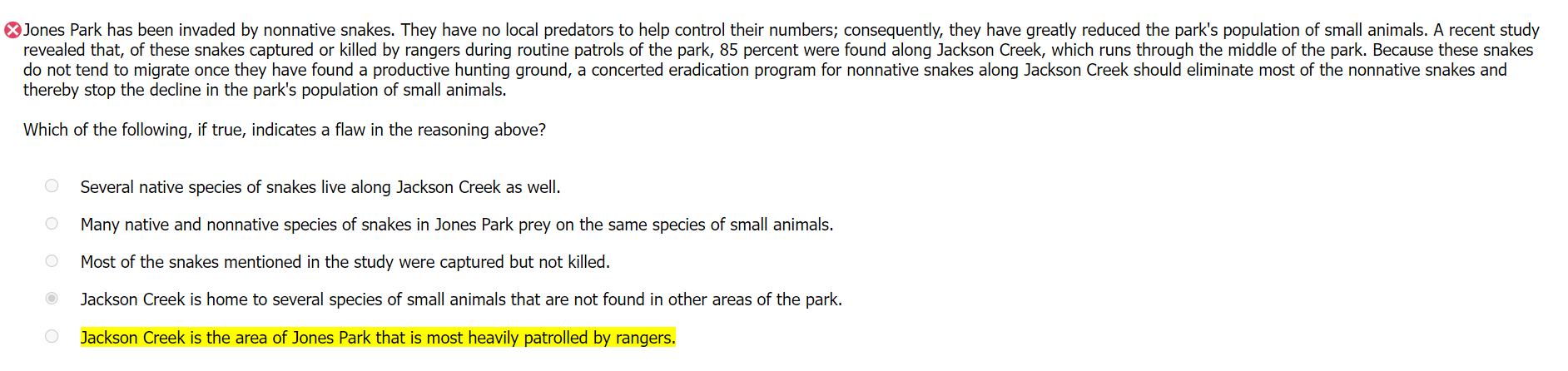
Jones Park has been invaded by nonnative snakes. They have no local predators to help control their numbers; consequently, they have greatly reduced the park’s population of small animals. A recent study revealed that, of these snakes captured or killed by rangers during routine patrols of the park, 85 percent were found along Jackson Creek, which runs through the middle of the park. Because these snakes do not tend to migrate once they have found a productive hunting ground, a concerted eradication program for nonnative snakes along Jackson Creek should eliminate most of the nonnative snakes and thereby stop the decline in the park’s population of small animals.
Which of the following, if true, indicates a flaw in the reasoning above?
A. Several native species of snakes live along Jackson Creek as well.
B. Many native and nonnative species of snakes in Jones Park prey on the same species of small animals.
C. Most of the snakes mentioned in the study were captured but not killed.
D. Jackson Creek is home to several species of small animals that are not found in other areas of the park.
E. Jackson Creek is the area of Jones Park that is most heavily patrolled by rangers.
GMAT-Club-Forum-i6hnslhc.png [ 107.3 KiB | Viewed 3463 times ]
Which of the following, if true, indicates a flaw in the reasoning above?
A. Several native species of snakes live along Jackson Creek as well.
B. Many native and nonnative species of snakes in Jones Park prey on the same species of small animals.
C. Most of the snakes mentioned in the study were captured but not killed.
D. Jackson Creek is home to several species of small animals that are not found in other areas of the park.
E. Jackson Creek is the area of Jones Park that is most heavily patrolled by rangers.
Attachment:
GMAT-Club-Forum-i6hnslhc.png [ 107.3 KiB | Viewed 3463 times ]
Trying to understand why the right answer is right?
GMAT Club Tests explanations walk through concepts, shortcuts, and common traps on many questions.
See how →

 Updated on: 09 Feb 2025, 10:36
Originally posted by MartyMurray on 09 Mar 2024, 05:44.
Last edited by MartyMurray on 09 Feb 2025, 10:36, edited 3 times in total.
Last edited by MartyMurray on 09 Feb 2025, 10:36, edited 3 times in total.
Kudos
Bookmarks
Jones Park has been invaded by nonnative snakes. They have no local predators to help control their numbers; consequently, they have greatly reduced the park’s population of small animals. A recent study revealed that, of these snakes captured or killed by rangers during routine patrols of the park, 85 percent were found along Jackson Creek, which runs through the middle of the park. Because these snakes do not tend to migrate once they have found a productive hunting ground, a concerted eradication program for nonnative snakes along Jackson Creek should eliminate most of the nonnative snakes and thereby stop the decline in the park’s population of small animals.
The conclusion of the argument is the following:
a concerted eradication program for nonnative snakes along Jackson Creek should eliminate most of the nonnative snakes and thereby stop the decline in the park’s population of small animals
The support for the conclusion is the following:
A recent study revealed that, of these snakes captured or killed by rangers during routine patrols of the park, 85 percent were found along Jackson Creek, which runs through the middle of the park.
and
these snakes do not tend to migrate once they have found a productive hunting ground
We see that the reasoning of the argument is that, since most of the snakes encountered by rangers were found along Jackson Creek and the snakes tend to stay in one area, by focusing on eradicating snakes around the creek should take care of most of the problem.
Which of the following, if true, indicates a flaw in the reasoning above?
This question is Logical Flaw question. However, the choices don't directly mention aspects of the argument that could be flaws. Rather the choices provide new information about the situation. So, this question works similarly to a Weaken question, and the correct answer will highlight a flaw in the argument by weakening the argument in a way that highlights the flaw.
A. Several native species of snakes live along Jackson Creek as well.
This choice has no effect on the argument.
The proposed strategy is to eradicate the nonnative snakes around the creek. So, it does not involve nonnative species of snakes.
Also, the passage doesn't say that native species of snakes have reduced the park's population of small animals. Rather, it indicates that the nonnative species are causing the problem. So, there's no reason to believe that the presence of native snakes will result in the proposed strategy not working.
Eliminate.
B. Many native and nonnative species of snakes in Jones Park prey on the same species of small animals.
This choice is tempting because we could get the impression that it indicates that eradicating the nonnative snakes won't stop the decline in the park’s population of small animals since other snakes will prey on them anyway.
However, the passage doesn't say that native species of snakes have reduced the park's population of small animals. Rather, it indicates that the nonnative species are causing the problem. So, there's no reason to believe that the fact that native and nonnative species of snakes in Jones Park prey on the same species of small animals means that the conclusion that proposed strategy may not work.
Eliminate.
C. Most of the snakes mentioned in the study were captured but not killed.
What was done to the snakes mentioned in the study doesn't affect the argument.
After all, the study is not the strategy. The study simply provides evidence, that most of the snakes found were along the creek, that supports the conclusion that the strategy will work.
Eliminate.
D. Jackson Creek is home to several species of small animals that are not found in other areas of the park.
This choice could explain why the nonnative snakes seem to be concentrated along the creek. Maybe they are preying on species of small animals that are found only along the creek.
At the same time, we don't need such an explanation. We need a choice that highlights a flaw in the argument by weakening it, and the fact that some species of small animals are found only along the creek certainly doesn't mean that eradicating nonnative snakes along the creek won't stop the decline in the park’s population of small animals.
In fact, if anything, this choice strengthens the argument a little by indicating that, if there are no nonnative snakes along the creek, then some species of small animals won't be preyed on by the snakes any more.
Eliminate.
E. Jackson Creek is the area of Jones Park that is most heavily patrolled by rangers.
This choice highlights a flaw in the argument.
The flaw is that the argument involves the assumption that the reason why most snakes found by the rangers have been along the creek is that the snakes are concentrated there. By relying on that assumption, the argument fails to consider that something else could be going on, such as that snakes have more difficulty hiding in the area around the creek or that nonnative snakes are everywhere but the rangers are not.
After all, if Jackson Creek is the area of Jones Park that is most heavily patrolled by rangers, then it could be that the reason most nonnative snakes found by rangers have been by the creek is that that's where the rangers are. In that case, there could be nonnative snakes all through the park even though most found by the rangers are by the creek.
So, by indicating that there could be an alternative reason why most nonnative snakes have been found by the creek, this choice weakens and thus highlights a flaw in the argument.
Correct answer: E
The conclusion of the argument is the following:
a concerted eradication program for nonnative snakes along Jackson Creek should eliminate most of the nonnative snakes and thereby stop the decline in the park’s population of small animals
The support for the conclusion is the following:
A recent study revealed that, of these snakes captured or killed by rangers during routine patrols of the park, 85 percent were found along Jackson Creek, which runs through the middle of the park.
and
these snakes do not tend to migrate once they have found a productive hunting ground
We see that the reasoning of the argument is that, since most of the snakes encountered by rangers were found along Jackson Creek and the snakes tend to stay in one area, by focusing on eradicating snakes around the creek should take care of most of the problem.
Which of the following, if true, indicates a flaw in the reasoning above?
This question is Logical Flaw question. However, the choices don't directly mention aspects of the argument that could be flaws. Rather the choices provide new information about the situation. So, this question works similarly to a Weaken question, and the correct answer will highlight a flaw in the argument by weakening the argument in a way that highlights the flaw.
A. Several native species of snakes live along Jackson Creek as well.
This choice has no effect on the argument.
The proposed strategy is to eradicate the nonnative snakes around the creek. So, it does not involve nonnative species of snakes.
Also, the passage doesn't say that native species of snakes have reduced the park's population of small animals. Rather, it indicates that the nonnative species are causing the problem. So, there's no reason to believe that the presence of native snakes will result in the proposed strategy not working.
Eliminate.
B. Many native and nonnative species of snakes in Jones Park prey on the same species of small animals.
This choice is tempting because we could get the impression that it indicates that eradicating the nonnative snakes won't stop the decline in the park’s population of small animals since other snakes will prey on them anyway.
However, the passage doesn't say that native species of snakes have reduced the park's population of small animals. Rather, it indicates that the nonnative species are causing the problem. So, there's no reason to believe that the fact that native and nonnative species of snakes in Jones Park prey on the same species of small animals means that the conclusion that proposed strategy may not work.
Eliminate.
C. Most of the snakes mentioned in the study were captured but not killed.
What was done to the snakes mentioned in the study doesn't affect the argument.
After all, the study is not the strategy. The study simply provides evidence, that most of the snakes found were along the creek, that supports the conclusion that the strategy will work.
Eliminate.
D. Jackson Creek is home to several species of small animals that are not found in other areas of the park.
This choice could explain why the nonnative snakes seem to be concentrated along the creek. Maybe they are preying on species of small animals that are found only along the creek.
At the same time, we don't need such an explanation. We need a choice that highlights a flaw in the argument by weakening it, and the fact that some species of small animals are found only along the creek certainly doesn't mean that eradicating nonnative snakes along the creek won't stop the decline in the park’s population of small animals.
In fact, if anything, this choice strengthens the argument a little by indicating that, if there are no nonnative snakes along the creek, then some species of small animals won't be preyed on by the snakes any more.
Eliminate.
E. Jackson Creek is the area of Jones Park that is most heavily patrolled by rangers.
This choice highlights a flaw in the argument.
The flaw is that the argument involves the assumption that the reason why most snakes found by the rangers have been along the creek is that the snakes are concentrated there. By relying on that assumption, the argument fails to consider that something else could be going on, such as that snakes have more difficulty hiding in the area around the creek or that nonnative snakes are everywhere but the rangers are not.
After all, if Jackson Creek is the area of Jones Park that is most heavily patrolled by rangers, then it could be that the reason most nonnative snakes found by rangers have been by the creek is that that's where the rangers are. In that case, there could be nonnative snakes all through the park even though most found by the rangers are by the creek.
So, by indicating that there could be an alternative reason why most nonnative snakes have been found by the creek, this choice weakens and thus highlights a flaw in the argument.
Correct answer: E
08 Feb 2025, 20:04
Kudos
Bookmarks
HarshZsssh
Generally, key to solving Flaw questions is identifying the conclusion and how it's supported because, generally, the flaw will be in how the premise(s) supports the conclusion.
Once you've identified the support and the conclusion, you can look for a gap or difference between the topic of the premise(s) and the topic of the conclusion.
Then, when you go to the answer choices, you have to find a choice with two characteristics:
- It must accurately describe something about the way the argument works.
- What it describes must be a flaw in the argument.