Events & Promotions
|
|

GMAT Club Daily Prep
Thank you for using the timer - this advanced tool can estimate your performance and suggest more practice questions. We have subscribed you to Daily Prep Questions via email.
Customized
for You
Track
Your Progress
Practice
Pays
Not interested in getting valuable practice questions and articles delivered to your email? No problem, unsubscribe here.
 Sep 06
09:30 AM EDT
-12:30 PM EST
Top scores are possible when you enroll in a powerful EA course, taught live online + 6 months access to TTP OnDemand video courses included! Perfect class schedule and easy course access for working professionals. Class starts Sundays Sept. 6, 2026. Sep 02
01:00 PM EDT
-11:59 PM EDT
Take 30% off all study plans with code COURSEWORK - Expires on Monday 9/7 Sep 04
10:00 AM EDT
-11:59 PM EDT
We’ve worked incredibly hard to build TTP into the best test prep experience possible, and it would mean a lot to us to win Newsweek’s 2026 Readers’ Choice Award for Best Test Prep. If TTP has helped you, we’d be incredibly grateful for your vote. Sep 07
12:01 AM PDT
-11:59 PM PDT
On the 7th, GMAT Club Tests will be Free! Including all the Quizzes, Questions, and Tests. 12 AM - 11:59 PM PDT- Sep 07
10:00 AM PDT
-11:00 AM PDT
A complete walkthrough of GMAT Club’s free 12-week GMAT study plan: what you study each week, how progress and goals are tracked, how the error log works, and how your practice unlocks paid tools at no cost. - Sep 09
07:00 AM PDT
-10:00 AM PDT
Meet AdComs and explore top Master’s programs - MiM, MiF, MSc, MSBA and more. - Application Fee Waivers - Free 1-Week of GMAT Club Tests: - Master's Application Toolkit - Grand Prize Giveaway - Sep 09
10:00 AM PDT
-11:00 AM PDT
Three MBA applications. Three rejections. No interview invites. A year later, Aman was admitted to Cambridge Judge, SMU, and IMD. In this episode of MBA Admit Stories, Aman shares how he rebuilt his MBA application...  Sep 15
07:00 PM EDT
-09:00 PM EST
Elite scores are possible when you enroll in a powerful GMAT course, taught live online + 6 months access to TTP OnDemand video courses included! Class starts Tues/Thurs Sept. 15, 2026 - Nov. 15, 2027, 7:00pm-9:00pm EST Sep 21
08:00 PM EDT
-10:00 PM EDT
Boost your GMAT score in less than one month in a live online class + 6 months access to TTP OnDemand video courses included! Class starts Mon, Tues, Wed, Thur, Fri Sept. 21, 2026 - Oct. 9, 2027, 7:00pm-10:00pm EST


 09 Mar 2024, 03:56
Kudos
Bookmarks


A
Be sure to select an answer first to save it in the Error Log before revealing the correct answer (OA)!
Difficulty:
 85%
(hard)
85%
(hard)
Question Stats:
59% (02:30) correct 41%
(02:39)
wrong
based on 1317
sessions
41%
(02:39)
wrong
based on 1317
sessions
History
Date
Time
Result
Not Attempted Yet
Sonex Corporation Executive: Vision-related problems such as blurred vision and headaches have been experienced by employees ofSonex Corporation who use video-display terminals every day for extended periods. These problems are quickly and entirely reversible through modifications to individual terminals and work spaces. Precisely what modifications need to be made depends on knowing the individual user’s specific problems. Since we cannot predict what these problems will turn out to be and since our standard design for employees’ work spaces keeps the incidence of such problems lower than any other design we know of, it is clear that our policy of undertaking modifications only when an employee reports vision-related problems is as responsive to employees’ legitimate health concerns as current circumstances permit.
In the Sonex Corporation executive’s argument, the two boldfaced portions play which of the following roles?
A. The first describes a circumstance that is addressed by the policy response that the argument seeks to justify; the second provides evidence to support the main conclusion of the argument.
B. The first describes a circumstance that is addressed by the policy response that the argument seeks to justify; the second is evidence that has been used to argue that no coherent policy can be formulated.
C. The first provides evidence to support the main conclusion of the argument; the second is a claim that the argument acknowledges as an unanswered objection to that main conclusion.
D. The first provides evidence to support the main conclusion of the argument; the second is a consideration that has been used to argue that there might never be more evidence than is already available.
E. The first is an objection that has been raised against a policy defended in the argument; the second provides evidence to support the main conclusion of the argument.
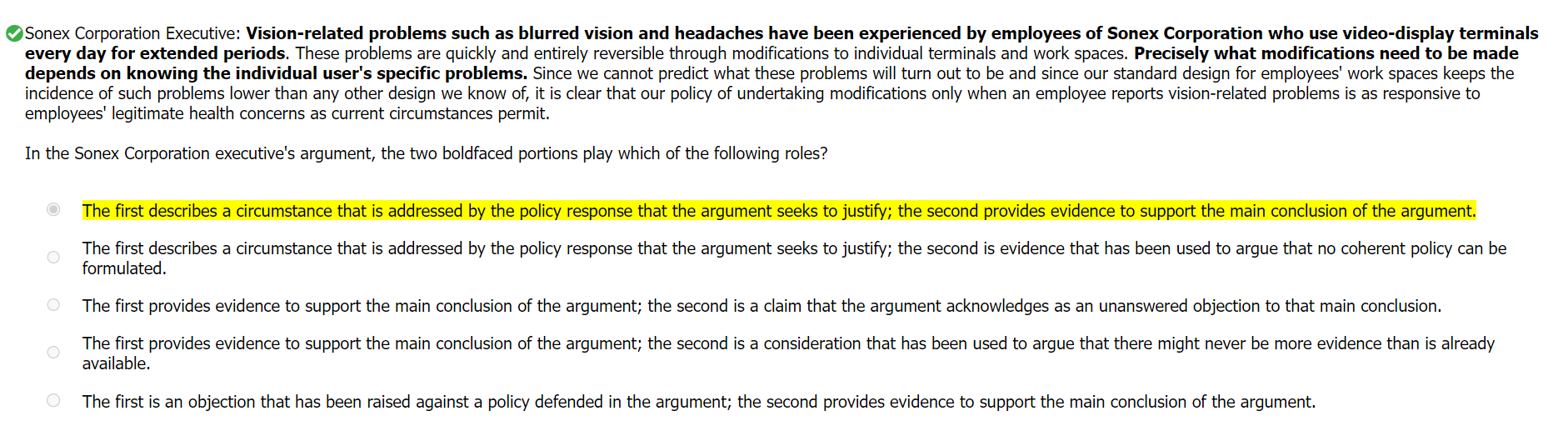
GMAT-Club-Forum-8oxob9i9.png [ 160.4 KiB | Viewed 4600 times ]
In the Sonex Corporation executive’s argument, the two boldfaced portions play which of the following roles?
A. The first describes a circumstance that is addressed by the policy response that the argument seeks to justify; the second provides evidence to support the main conclusion of the argument.
B. The first describes a circumstance that is addressed by the policy response that the argument seeks to justify; the second is evidence that has been used to argue that no coherent policy can be formulated.
C. The first provides evidence to support the main conclusion of the argument; the second is a claim that the argument acknowledges as an unanswered objection to that main conclusion.
D. The first provides evidence to support the main conclusion of the argument; the second is a consideration that has been used to argue that there might never be more evidence than is already available.
E. The first is an objection that has been raised against a policy defended in the argument; the second provides evidence to support the main conclusion of the argument.
Attachment:
GMAT-Club-Forum-8oxob9i9.png [ 160.4 KiB | Viewed 4600 times ]
Question exposed a gap?
Take sectional Adaptive Quant, Verbal, or DI tests on GMAT Club and review the detailed score report.
Get started →

 09 Mar 2024, 06:52
Kudos
Bookmarks
Sonex Corporation Executive: Vision-related problems such as blurred vision and headaches have been experienced by employees ofSonex Corporation who use video-display terminals every day for extended periods. These problems are quickly and entirely reversible through modifications to individual terminals and work spaces. Precisely what modifications need to be made depends on knowing the individual user’s specific problems. Since we cannot predict what these problems will turn out to be and since our standard design for employees’ work spaces keeps the incidence of such problems lower than any other design we know of, it is clear that our policy of undertaking modifications only when an employee reports vision-related problems is as responsive to employees’ legitimate health concerns as current circumstances permit.
The main conclusion presented by the passage is the following:
it is clear that our policy of undertaking modifications only when an employee reports vision-related problems is as responsive to employees’ legitimate health concerns as current circumstances permit
The support for that conclusion is the following:
Precisely what modifications need to be made depends on knowing the individual user’s specific problems.
we cannot predict what these problems will turn out to be
our standard design for employees’ work spaces keeps the incidence of such problems lower than any other design we know of
The passage also includes some background information:
Vision-related problems such as blurred vision and headaches have been experienced by employees ofSonex Corporation who use video-display terminals every day for extended periods. These problems are quickly and entirely reversible through modifications to individual terminals and work spaces.
So, the passage is fairly straightforward: it begins with background information, then provides some factual premises, and finally states a conclusion supported by those premises.
In the Sonex Corporation executive’s argument, the two boldfaced portions play which of the following roles?
A. The first describes a circumstance that is addressed by the policy response that the argument seeks to justify; the second provides evidence to support the main conclusion of the argument.
The first part of this choice is correct since the first boldfaced portion does describe a circumstance that exists at Sonex Corporation, the argument does seek to justify the policy presented by the final sentence, undertaking modifications only when an employee reports vision-related problems, and that policy is the corporation's way of addressing employees' vision-related problems.
The second part of this choice is also correct since the second bolfaced portion does provide support for the conclusion "it is clear that our policy of undertaking modifications only when an employee reports vision-related problems is as responsive to employees’ legitimate health concerns as current circumstances permit."
So, both parts of this choice are correct.
Keep.
B. The first describes a circumstance that is addressed by the policy response that the argument seeks to justify; the second is evidence that has been used to argue that no coherent policy can be formulated.
The first part of this choice is correct since the first boldfaced portion does describe a circumstance that exists at Sonex Corporation, the argument does seek to justify the policy presented by the final sentence, undertaking modifications only when an employee reports vision-related problems, and that policy is the corporation's way of addressing employees' vision-related problems.
However, the second part of this choice is not correct since the executive does not argue that "no coherent policy can be formulated."
The executive says something somewhat similar to "no coherent policy can be formulated," but it's not quite the same. The executive indicates that there's no strategy other than waiting for an employee to report vision-related problems that the corporation can use. At the same time, that approach of waiting is the company's "policy." So, the executive uses the information provided by the second boldfaced portion to make a case for the company's policy rather than to support the conclusion that "no coherent policy can be formulated."
Eliminate.
C. The first provides evidence to support the main conclusion of the argument; the second is a claim that the argument acknowledges as an unanswered objection to that main conclusion.
The first does not provide evidence to support the main conclusion. Rather it provides background information about a situation that the main conclusion is about.
The second is not an objection to the main conclusion. It supports the main conclusion.
Eliminate.
D. The first provides evidence to support the main conclusion of the argument; the second is a consideration that has been used to argue that there might never be more evidence than is already available.
The first does not provide evidence to support the main conclusion. Rather it provides background information about a situation that the main conclusion is about.
The second is a consideration used for support. However, it's not used to "argue that there might never be more evidence than is already available." It's used to argue that, currently, there's no more responsive way to handle the vision-related problems.
Eliminate.
E. The first is an objection that has been raised against a policy defended in the argument; the second provides evidence to support the main conclusion of the argument.
The second does provide evidence to support the main conclusion of the argument.
However, the first is not an objection to the policy. Rather, it presents the issue that the policy of "undertaking modifications only when an employee reports vision-related problems" is meant to address.
So, since this choice is half incorrect, it's not the correct answer.
Eliminate.
Correct answer: A
The main conclusion presented by the passage is the following:
it is clear that our policy of undertaking modifications only when an employee reports vision-related problems is as responsive to employees’ legitimate health concerns as current circumstances permit
The support for that conclusion is the following:
Precisely what modifications need to be made depends on knowing the individual user’s specific problems.
we cannot predict what these problems will turn out to be
our standard design for employees’ work spaces keeps the incidence of such problems lower than any other design we know of
The passage also includes some background information:
Vision-related problems such as blurred vision and headaches have been experienced by employees ofSonex Corporation who use video-display terminals every day for extended periods. These problems are quickly and entirely reversible through modifications to individual terminals and work spaces.
So, the passage is fairly straightforward: it begins with background information, then provides some factual premises, and finally states a conclusion supported by those premises.
In the Sonex Corporation executive’s argument, the two boldfaced portions play which of the following roles?
A. The first describes a circumstance that is addressed by the policy response that the argument seeks to justify; the second provides evidence to support the main conclusion of the argument.
The first part of this choice is correct since the first boldfaced portion does describe a circumstance that exists at Sonex Corporation, the argument does seek to justify the policy presented by the final sentence, undertaking modifications only when an employee reports vision-related problems, and that policy is the corporation's way of addressing employees' vision-related problems.
The second part of this choice is also correct since the second bolfaced portion does provide support for the conclusion "it is clear that our policy of undertaking modifications only when an employee reports vision-related problems is as responsive to employees’ legitimate health concerns as current circumstances permit."
So, both parts of this choice are correct.
Keep.
B. The first describes a circumstance that is addressed by the policy response that the argument seeks to justify; the second is evidence that has been used to argue that no coherent policy can be formulated.
The first part of this choice is correct since the first boldfaced portion does describe a circumstance that exists at Sonex Corporation, the argument does seek to justify the policy presented by the final sentence, undertaking modifications only when an employee reports vision-related problems, and that policy is the corporation's way of addressing employees' vision-related problems.
However, the second part of this choice is not correct since the executive does not argue that "no coherent policy can be formulated."
The executive says something somewhat similar to "no coherent policy can be formulated," but it's not quite the same. The executive indicates that there's no strategy other than waiting for an employee to report vision-related problems that the corporation can use. At the same time, that approach of waiting is the company's "policy." So, the executive uses the information provided by the second boldfaced portion to make a case for the company's policy rather than to support the conclusion that "no coherent policy can be formulated."
Eliminate.
C. The first provides evidence to support the main conclusion of the argument; the second is a claim that the argument acknowledges as an unanswered objection to that main conclusion.
The first does not provide evidence to support the main conclusion. Rather it provides background information about a situation that the main conclusion is about.
The second is not an objection to the main conclusion. It supports the main conclusion.
Eliminate.
D. The first provides evidence to support the main conclusion of the argument; the second is a consideration that has been used to argue that there might never be more evidence than is already available.
The first does not provide evidence to support the main conclusion. Rather it provides background information about a situation that the main conclusion is about.
The second is a consideration used for support. However, it's not used to "argue that there might never be more evidence than is already available." It's used to argue that, currently, there's no more responsive way to handle the vision-related problems.
Eliminate.
E. The first is an objection that has been raised against a policy defended in the argument; the second provides evidence to support the main conclusion of the argument.
The second does provide evidence to support the main conclusion of the argument.
However, the first is not an objection to the policy. Rather, it presents the issue that the policy of "undertaking modifications only when an employee reports vision-related problems" is meant to address.
So, since this choice is half incorrect, it's not the correct answer.
Eliminate.
Correct answer: A
General Discussion
 16 Nov 2024, 23:27
Kudos
Bookmarks
Analysis of Option B:
1. Does the first boldfaced portion describe a circumstance addressed by the policy?
Yes, this part of option B is correct. The first boldfaced portion describes the vision-related issues experienced by employees, which the company's policy (making modifications after issues are reported) aims to address.
2. Does the second boldfaced portion argue that no coherent policy can be formulated?
No, this is where option B is incorrect. The second boldfaced portion does not argue that no coherent policy can be formulated. Instead, it provides evidence to support the idea that the current policy is the best available option. Specifically:
It acknowledges the limitation that individual problems cannot be predicted in advance.
It highlights that the standard design minimizes problems better than any other design.
These points reinforce the idea that the company's policy (modifying only after problems are reported) is the most responsive approach under the circumstances.
Why is "no coherent policy" a misinterpretation?
The argument does not claim that it's impossible to have any policy for addressing vision problems. On the contrary, it defends the existing policy as coherent and responsive.
The phrase "no coherent policy" would imply that there’s no practical way to address the issue, which is not what the argument states. Instead, the argument says the policy of modifying workspaces only when issues are reported is effective and justified.
1. Does the first boldfaced portion describe a circumstance addressed by the policy?
Yes, this part of option B is correct. The first boldfaced portion describes the vision-related issues experienced by employees, which the company's policy (making modifications after issues are reported) aims to address.
2. Does the second boldfaced portion argue that no coherent policy can be formulated?
No, this is where option B is incorrect. The second boldfaced portion does not argue that no coherent policy can be formulated. Instead, it provides evidence to support the idea that the current policy is the best available option. Specifically:
It acknowledges the limitation that individual problems cannot be predicted in advance.
It highlights that the standard design minimizes problems better than any other design.
These points reinforce the idea that the company's policy (modifying only after problems are reported) is the most responsive approach under the circumstances.
Why is "no coherent policy" a misinterpretation?
The argument does not claim that it's impossible to have any policy for addressing vision problems. On the contrary, it defends the existing policy as coherent and responsive.
The phrase "no coherent policy" would imply that there’s no practical way to address the issue, which is not what the argument states. Instead, the argument says the policy of modifying workspaces only when issues are reported is effective and justified.