Events & Promotions
|
|

GMAT Club Daily Prep
Thank you for using the timer - this advanced tool can estimate your performance and suggest more practice questions. We have subscribed you to Daily Prep Questions via email.
Customized
for You
Track
Your Progress
Practice
Pays
Not interested in getting valuable practice questions and articles delivered to your email? No problem, unsubscribe here.
 Sep 13
12:30 AM EDT
-01:30 AM EDT
Struggling to find the right strategies to score a 99 %ile on GMAT Focus? Riya (GMAT 715) boosted her score by 100-points in just 15 days! Discover how the right mentorship, tailored strategies, and an unwavering mindset can transform your GMAT prep. Sep 13
01:30 AM EDT
-02:30 AM EDT
At one point, she believed GMAT wasn’t for her. After scoring 595, self-doubt crept in and she questioned her potential. But instead of quitting, she made the right strategic changes. The result? A remarkable comeback to 695. Check out how Saakshi did it. Sep 15
07:00 PM EDT
-09:00 PM EST
Elite scores are possible when you enroll in a powerful GMAT course, taught live online + 6 months access to TTP OnDemand video courses included! Class starts Tues/Thurs Sept. 15, 2026 - Nov. 15, 2027, 7:00pm-9:00pm EST Sep 18
08:00 PM PDT
-09:00 PM PDT
Video explanations + diagnosis of 10 weakest areas + 150+ short videos + study plan! Sep 21
07:00 PM EDT
-10:00 PM EDT
Boost your GMAT score in less than one month in a live online class + 6 months access to TTP OnDemand video courses included! Class starts Mon, Tues, Wed, Thur, Fri Sept. 21, 2026 - Oct. 9, 2027, 7:00pm-10:00pm EST


 10 Mar 2024, 04:55
Kudos
Bookmarks


A
Be sure to select an answer first to save it in the Error Log before revealing the correct answer (OA)!
Difficulty:
 95%
(hard)
95%
(hard)
Question Stats:
51% (02:12) correct 49%
(02:35)
wrong
based on 1041
sessions
49%
(02:35)
wrong
based on 1041
sessions
History
Date
Time
Result
Not Attempted Yet
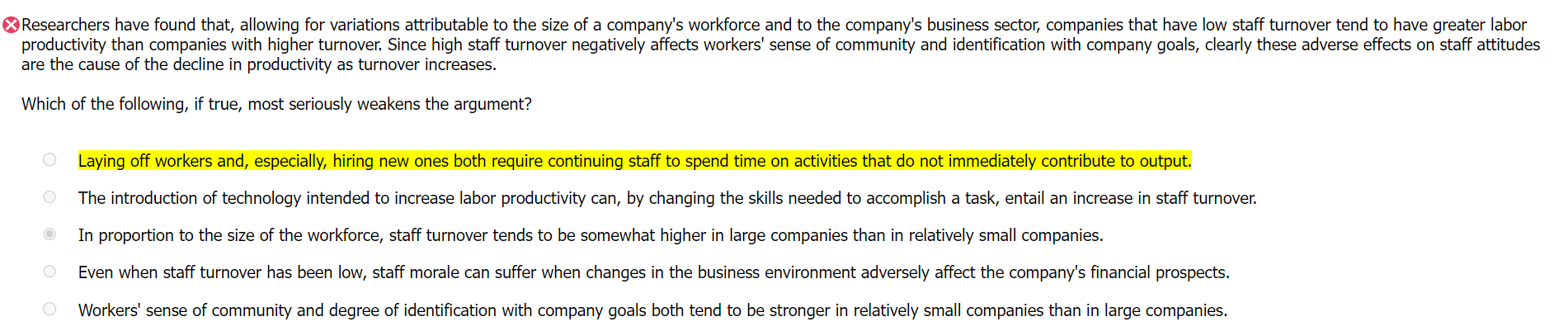
Researchers have found that, allowing for variations attributable to the size of a company’s workforce and to the company’s business sector, companies that have low staff turnover tend to have greater labor productivity than companies with higher turnover. Since high staff turnover negatively affects workers’ sense of community and identification with company goals, clearly these adverse effects on staff attitudes are the cause of the decline in productivity as turnover increases.
Which of the following, if true, most seriously weakens the argument?
A. Laying off workers and, especially, hiring new ones both require continuing staff to spend time on activities that do not immediately contribute to output.
B. The introduction of technology intended to increase labor productivity can, by changing the skills needed to accomplish a task, entail an increase in staff turnover.
C. In proportion to the size of the workforce, staff turnover tends to be somewhat higher in large companies than in relatively small companies.
D. Even when staff turnover has been low, staff morale can suffer when changes in the business environment adversely affect the company’s financial prospects.
E. Workers’ sense of community and degree of identification with company goals both tend to be stronger in relatively small companies than in large companies.
GMAT-Club-Forum-en5v3ar2.png [ 113.29 KiB | Viewed 4343 times ]
Which of the following, if true, most seriously weakens the argument?
A. Laying off workers and, especially, hiring new ones both require continuing staff to spend time on activities that do not immediately contribute to output.
B. The introduction of technology intended to increase labor productivity can, by changing the skills needed to accomplish a task, entail an increase in staff turnover.
C. In proportion to the size of the workforce, staff turnover tends to be somewhat higher in large companies than in relatively small companies.
D. Even when staff turnover has been low, staff morale can suffer when changes in the business environment adversely affect the company’s financial prospects.
E. Workers’ sense of community and degree of identification with company goals both tend to be stronger in relatively small companies than in large companies.
Attachment:
GMAT-Club-Forum-en5v3ar2.png [ 113.29 KiB | Viewed 4343 times ]
Need more Tests to Practice?
GMAT Club Tests give expert solutions for every question in full and sectional GMAT Focus mocks.
Learn more →

 Updated on: 27 Aug 2024, 10:49
Originally posted by MartyMurray on 10 Mar 2024, 05:59.
Last edited by MartyMurray on 27 Aug 2024, 10:49, edited 3 times in total.
Last edited by MartyMurray on 27 Aug 2024, 10:49, edited 3 times in total.
Kudos
Bookmarks
Researchers have found that, allowing for variations attributable to the size of a company’s workforce and to the company’s business sector, companies that have low staff turnover tend to have greater labor productivity than companies with higher turnover. Since high staff turnover negatively affects workers’ sense of community and identification with company goals, clearly these adverse effects on staff attitudes are the cause of the decline in productivity as turnover increases.
The conclusion of the argument is the following:
these adverse effects on staff attitudes are the cause of the decline in productivity as turnover increases
The support for the conclusion is the following:
high staff turnover negatively affects workers’ sense of community and identification with company goals
So, the author has gone from the fact that high turnover has adverse effects on staff attitudes to the conclusion that the cause of "the decline in productivity as turnover increases" is "adverse effects on staff attitudes."
Which of the following, if true, most seriously weakens the argument?
This is a Weaken question, and the correct answer will somehow weaken the support for or cast doubt on the conclusion.
A. Laying off workers and, especially, hiring new ones both require continuing staff to spend time on activities that do not immediately contribute to output.
This choice casts doubt on the conclusion.
After all, if this choice is true, then we have an alternative cause for the decline in productivity as turnover increases.
If this choice is true, then it may not be that adverse effects on staff attitudes cause the decline, and it may instead be that the decline occurs because laying off workers and hiring new ones require staff to spend time on activities that do not immediately contribute to output.
Keep.
B. The introduction of technology intended to increase labor productivity can, by changing the skills needed to accomplish a task, entail an increase in staff turnover.
We can often weaken an argument by presenting an alternative cause for an effect. So, this choice could seem to weaken the argument because it presents a cause for the effect "an increase in staff turnover."
At the same time, this choice doesn't weaken this argument in that way because the effect the conclusion is about is not "an increase in staff turnover." It's "the decline in productivity as turnover increases."
Since this choice doesn't present an alternative cause for the decline in productivity, it doesn't weaken the argument by presenting an alternative cause.
Alternatively, this choice could seem to weaken the argument because this choice describes a situation that contrasts with the pattern that the argument is about.
The argument is about a general pattern: higher turnover is associated with lower productivity.
In contrast, this choice describes a situation in which higher turnover is associated with higher productivity, or at least with the process of achieving higher productivity.
At the same time, this choice does not weaken the argument because all this choice is saying is that there can be an exception to the general pattern when a certain type of process, "introduction of technology intended to increase labor productivity," occurs.
The argument's conclusion is that the reason for the general pattern is that adverse effects on staff attitudes cause of a decline in productivity as turnover increases.
The fact that there can be an exception to the general pattern does not mean that the argument's conclusion about the cause of that general pattern is not correct.
Eliminate.
C. In proportion to the size of the workforce, staff turnover tends to be somewhat higher in large companies than in relatively small companies.
This choice is an irrelevant comparison choice.
After all, the fact that staff turnover tends to be somewhat higher in large companies than in relatively small companies doesn't clearly indicate anything about the cause of the decline in productivity as turnover increases.
Eliminate.
D. Even when staff turnover has been low, staff morale can suffer when changes in the business environment adversely affect the company’s financial prospects.
This choice masquerades as a weakener by weakening the case for a conclusion other than the conclusion of this argument.
It weakens the case for the conclusion that staff morale declines only because of turnover issues.
That's not the conclusion we need to cast doubt on.
Eliminate.
E. Workers’ sense of community and degree of identification with company goals both tend to be stronger in relatively small companies than in large companies.
This choice is an irrelevant comparison choice.
After all, the fact that workers’ sense of community and degree of identification with company goals both tend to be stronger in relatively small companies than in large companies doesn't clearly indicate anything about the cause of the decline in productivity as turnover increases.
Eliminate.
Correct answer: A
The conclusion of the argument is the following:
these adverse effects on staff attitudes are the cause of the decline in productivity as turnover increases
The support for the conclusion is the following:
high staff turnover negatively affects workers’ sense of community and identification with company goals
So, the author has gone from the fact that high turnover has adverse effects on staff attitudes to the conclusion that the cause of "the decline in productivity as turnover increases" is "adverse effects on staff attitudes."
Which of the following, if true, most seriously weakens the argument?
This is a Weaken question, and the correct answer will somehow weaken the support for or cast doubt on the conclusion.
A. Laying off workers and, especially, hiring new ones both require continuing staff to spend time on activities that do not immediately contribute to output.
This choice casts doubt on the conclusion.
After all, if this choice is true, then we have an alternative cause for the decline in productivity as turnover increases.
If this choice is true, then it may not be that adverse effects on staff attitudes cause the decline, and it may instead be that the decline occurs because laying off workers and hiring new ones require staff to spend time on activities that do not immediately contribute to output.
Keep.
B. The introduction of technology intended to increase labor productivity can, by changing the skills needed to accomplish a task, entail an increase in staff turnover.
We can often weaken an argument by presenting an alternative cause for an effect. So, this choice could seem to weaken the argument because it presents a cause for the effect "an increase in staff turnover."
At the same time, this choice doesn't weaken this argument in that way because the effect the conclusion is about is not "an increase in staff turnover." It's "the decline in productivity as turnover increases."
Since this choice doesn't present an alternative cause for the decline in productivity, it doesn't weaken the argument by presenting an alternative cause.
Alternatively, this choice could seem to weaken the argument because this choice describes a situation that contrasts with the pattern that the argument is about.
The argument is about a general pattern: higher turnover is associated with lower productivity.
In contrast, this choice describes a situation in which higher turnover is associated with higher productivity, or at least with the process of achieving higher productivity.
At the same time, this choice does not weaken the argument because all this choice is saying is that there can be an exception to the general pattern when a certain type of process, "introduction of technology intended to increase labor productivity," occurs.
The argument's conclusion is that the reason for the general pattern is that adverse effects on staff attitudes cause of a decline in productivity as turnover increases.
The fact that there can be an exception to the general pattern does not mean that the argument's conclusion about the cause of that general pattern is not correct.
Eliminate.
C. In proportion to the size of the workforce, staff turnover tends to be somewhat higher in large companies than in relatively small companies.
This choice is an irrelevant comparison choice.
After all, the fact that staff turnover tends to be somewhat higher in large companies than in relatively small companies doesn't clearly indicate anything about the cause of the decline in productivity as turnover increases.
Eliminate.
D. Even when staff turnover has been low, staff morale can suffer when changes in the business environment adversely affect the company’s financial prospects.
This choice masquerades as a weakener by weakening the case for a conclusion other than the conclusion of this argument.
It weakens the case for the conclusion that staff morale declines only because of turnover issues.
That's not the conclusion we need to cast doubt on.
Eliminate.
E. Workers’ sense of community and degree of identification with company goals both tend to be stronger in relatively small companies than in large companies.
This choice is an irrelevant comparison choice.
After all, the fact that workers’ sense of community and degree of identification with company goals both tend to be stronger in relatively small companies than in large companies doesn't clearly indicate anything about the cause of the decline in productivity as turnover increases.
Eliminate.
Correct answer: A
General Discussion
 18 Apr 2024, 18:35
Kudos
Bookmarks
Hi MartyMurray ,
I am having some confusion understanding the options mentioned in the question.
Option A definitely provides an alternate reason for decrease in labor productivity. But does not favor one company ( small ) over the other ( large ).
The process of hiring, retraining etc will consume similar efforts in both large and smaller companies and will equally affect both, this would definitely make more sense if it ( option ) says that this process affects larger companies more than it affects smaller companies.
How can we assume that this will work against a Company if it is larger, when it's not mentioned in the option explicitly. ( it does the same for option B too, the reason mentioned in option B can benifit both large and small companies equally for example ).
I am having some confusion understanding the options mentioned in the question.
Option A definitely provides an alternate reason for decrease in labor productivity. But does not favor one company ( small ) over the other ( large ).
The process of hiring, retraining etc will consume similar efforts in both large and smaller companies and will equally affect both, this would definitely make more sense if it ( option ) says that this process affects larger companies more than it affects smaller companies.
How can we assume that this will work against a Company if it is larger, when it's not mentioned in the option explicitly. ( it does the same for option B too, the reason mentioned in option B can benifit both large and small companies equally for example ).