Events & Promotions
|
|

GMAT Club Daily Prep
Thank you for using the timer - this advanced tool can estimate your performance and suggest more practice questions. We have subscribed you to Daily Prep Questions via email.
Customized
for You
Track
Your Progress
Practice
Pays
Not interested in getting valuable practice questions and articles delivered to your email? No problem, unsubscribe here.
 Sep 10
08:00 PM PDT
-09:00 PM PDT
Free- full-length test + 15 concept videos + 150+ short videos + study plan! Sep 08
12:30 AM EDT
-01:30 AM EDT
Looking for your GMAT motivation to break through the score plateau? Pragati improved her score by massive 160 points with strategic guidance and hard-work! Find out how personalized mentorship and a strong mindset can turn GMAT struggles into success. Sep 10
01:00 AM EDT
-02:00 AM EDT
Learn how Keshav, a Chartered Accountant, scored an impressive 705 on GMAT in just 30 days with GMATWhiz's expert guidance. In this video, he shares preparation tips and strategies that worked for him, including the mock, time management, and more. Sep 15
07:00 PM EDT
-09:00 PM EST
Elite scores are possible when you enroll in a powerful GMAT course, taught live online + 6 months access to TTP OnDemand video courses included! Class starts Tues/Thurs Sept. 15, 2026 - Nov. 15, 2027, 7:00pm-9:00pm EST Sep 21
07:00 PM EDT
-10:00 PM EDT
Boost your GMAT score in less than one month in a live online class + 6 months access to TTP OnDemand video courses included! Class starts Mon, Tues, Wed, Thur, Fri Sept. 21, 2026 - Oct. 9, 2027, 7:00pm-10:00pm EST


A
Be sure to select an answer first to save it in the Error Log before revealing the correct answer (OA)!
Difficulty:
 85%
(hard)
85%
(hard)
Question Stats:
57% (02:10) correct 43%
(02:23)
wrong
based on 1242
sessions
43%
(02:23)
wrong
based on 1242
sessions
History
Date
Time
Result
Not Attempted Yet
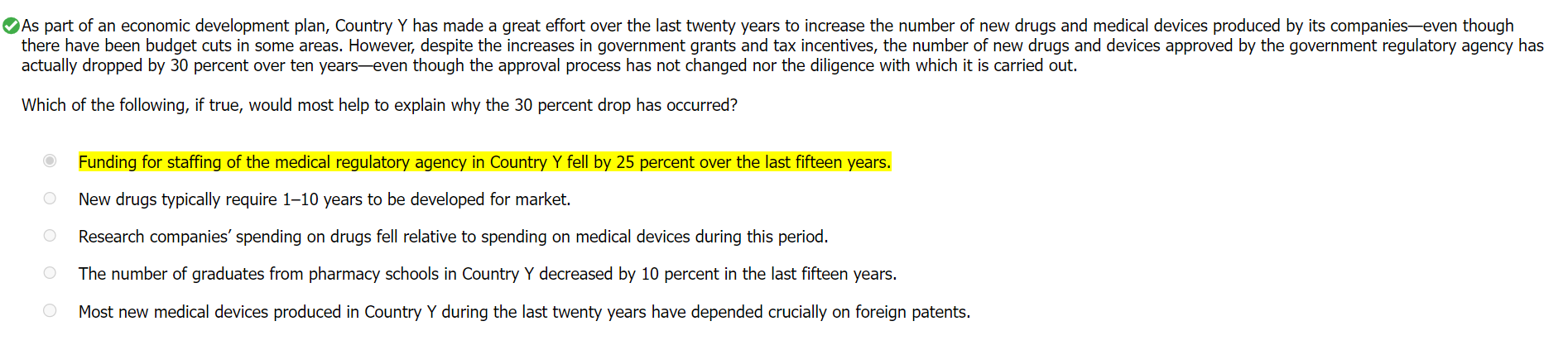
As part of an economic development plan. Country Y has made a great effort over the last twenty years to increase the number of new drugs and medical devices produced by its companies—even though there have been budget cuts in some areas. However, despite the increases in government grants and tax incentives, the number of new drugs and devices approved by the government regulatory agency has actually dropped by 30 percent over ten years—even though the approval process has not changed nor the diligence with which it is carried out.
Which of the following, if true, would most help to explain why the 30 percent drop has occurred?
A. Funding for staffing of the medical regulatory agency in Country Y fell by 25 percent over the last fifteen years.
B. New drugs typically require 1-10 years to be developed for market.
C. Research companies’ spending on drugs fell relative to spending on medical devices during this period.
D. The number of graduates from pharmacy schools in Country Y decreased by 10 percent in the last fifteen years.
E. Most new medical devices produced in Country Y during the last twenty years have depended crucially on foreign patents.

GMAT-Club-Forum-pjrun7yc.png [ 107.06 KiB | Viewed 5639 times ]
Which of the following, if true, would most help to explain why the 30 percent drop has occurred?
A. Funding for staffing of the medical regulatory agency in Country Y fell by 25 percent over the last fifteen years.
B. New drugs typically require 1-10 years to be developed for market.
C. Research companies’ spending on drugs fell relative to spending on medical devices during this period.
D. The number of graduates from pharmacy schools in Country Y decreased by 10 percent in the last fifteen years.
E. Most new medical devices produced in Country Y during the last twenty years have depended crucially on foreign patents.
Attachment:
GMAT-Club-Forum-pjrun7yc.png [ 107.06 KiB | Viewed 5639 times ]
Using official mocks already?
Add GMAT Club Tests for harder practice, analytics, and explanations without overlapping Official Guide or official mock questions.
Try it now →
Try it now →


 Updated on: 01 Mar 2026, 05:51
Originally posted by MartyMurray on 13 Mar 2024, 11:29.
Last edited by MartyMurray on 01 Mar 2026, 05:51, edited 1 time in total.
Last edited by MartyMurray on 01 Mar 2026, 05:51, edited 1 time in total.
Kudos
Bookmarks
As part of an economic development plan. Country Y has made a great effort over the last twenty years to increase the number of new drugs and medical devices produced by its companies—even though there have been budget cuts in some areas. However, despite the increases in government grants and tax incentives, the number of new drugs and devices approved by the government regulatory agency has actually dropped by 30 percent over ten years—even though the approval process has not changed nor the diligence with which it is carried out.
The passage presents a surprising situation in which, even though the government has "over the last twenty years" taken actions to increase the number of new drugs and medical devices produced by the country's companies and the approval process has not changed, the number of new drugs and devices approved by the government regulatory agency has "dropped by 30 percent over ten years."
Which of the following, if true, would most help to explain why the 30 percent drop has occurred?
This question is a Paradox or Best Explains question, and the correct answer will explain why there was a 30 percent decrease over ten years despite a twenty-year effort to achieve an increase.
A. Funding for staffing of the medical regulatory agency in Country Y fell by 25 percent over the last fifteen years.
Seeing this choice, we get the sense that answering this question is going to involve noticing specific details.
What we can notice about the specific details of this choice is that a 25 percent decrease in funding for staffing over fifteen years doesn't quite match up with a 30 percent decrease in approvals over ten years.
Yes, what this choice says would explain a decrease in approvals. In fact, it would explain well a 25 percent decrease over 15 years. After all, the fact that funding for staffing of the agency decreased would explain why approvals by the agency slowed down.
At the same time, this choice's specific information about a 25 percent decrease over fifteen years doesn't seen to explain a larger, 30 percent decrease over a shorter time period, ten years.
So, this choice is likely incorrect, but we can keep it until we find a better one.
Keep for now, but expect to be incorrect.
B. New drugs typically require 1-10 years to be developed for market.
Presumably this fact has been true all along. So, it would not explain why a decrease started 10 years ago.
Eliminate.
C. Research companies’ spending on drugs fell relative to spending on medical devices during this period.
This choice presents a comparison of spending on drugs with spending on medical devices but doesn't say that overall spending on the two categories of products decreased. In fact, for all we know given what this choice says, overall spending could have increased if spending on medical devices increased substantially.
So, this comparison does not explain the decrease in approvals.
Eliminate.
D. The number of graduates from pharmacy schools in Country Y decreased by 10 percent in the last fifteen years.
This choice is like choice (A) and once again is likely incorrect because of specifics,
After all, a 10 percent decrease in graduates from pharmacy schools over 15 years doesn't quite match up with a 30 percent decrease in approvals over 10 years.
What this choice says would perhaps explain a 10 percent decrease over 15 years but doesn't seen to explain a larger, 30 percent, decrease over a shorter time period, 10 years.
So, this choice is likely incorrect.
Keep for now, but expect to be incorrect.
E. Most new medical devices produced in Country Y during the last twenty years have depended crucially on foreign patents.
This choice doesn't explain a decreae in approvals over the past 10 years at all.
Does depending on foreign patents cause a decrease in approvals? We have no reason to believe it does.
Also, something that occurred over the last twenty years would not likely have caused a decrease over only the past ten years.
Eliminate.
Having gone through all the choices, we're left with (A) and (D) as the only ones that could at all explain a decrease.
(A), with its 25 percent decrease in staffing over 15 years, is closer to a 30 percent decrease over 10 years than (D), with its 10 percent decrease in graduates.
So, its a good thing we kept (A) since (A) is the best choice.
Correct answer: A
The passage presents a surprising situation in which, even though the government has "over the last twenty years" taken actions to increase the number of new drugs and medical devices produced by the country's companies and the approval process has not changed, the number of new drugs and devices approved by the government regulatory agency has "dropped by 30 percent over ten years."
Which of the following, if true, would most help to explain why the 30 percent drop has occurred?
This question is a Paradox or Best Explains question, and the correct answer will explain why there was a 30 percent decrease over ten years despite a twenty-year effort to achieve an increase.
A. Funding for staffing of the medical regulatory agency in Country Y fell by 25 percent over the last fifteen years.
Seeing this choice, we get the sense that answering this question is going to involve noticing specific details.
What we can notice about the specific details of this choice is that a 25 percent decrease in funding for staffing over fifteen years doesn't quite match up with a 30 percent decrease in approvals over ten years.
Yes, what this choice says would explain a decrease in approvals. In fact, it would explain well a 25 percent decrease over 15 years. After all, the fact that funding for staffing of the agency decreased would explain why approvals by the agency slowed down.
At the same time, this choice's specific information about a 25 percent decrease over fifteen years doesn't seen to explain a larger, 30 percent decrease over a shorter time period, ten years.
So, this choice is likely incorrect, but we can keep it until we find a better one.
Keep for now, but expect to be incorrect.
B. New drugs typically require 1-10 years to be developed for market.
Presumably this fact has been true all along. So, it would not explain why a decrease started 10 years ago.
Eliminate.
C. Research companies’ spending on drugs fell relative to spending on medical devices during this period.
This choice presents a comparison of spending on drugs with spending on medical devices but doesn't say that overall spending on the two categories of products decreased. In fact, for all we know given what this choice says, overall spending could have increased if spending on medical devices increased substantially.
So, this comparison does not explain the decrease in approvals.
Eliminate.
D. The number of graduates from pharmacy schools in Country Y decreased by 10 percent in the last fifteen years.
This choice is like choice (A) and once again is likely incorrect because of specifics,
After all, a 10 percent decrease in graduates from pharmacy schools over 15 years doesn't quite match up with a 30 percent decrease in approvals over 10 years.
What this choice says would perhaps explain a 10 percent decrease over 15 years but doesn't seen to explain a larger, 30 percent, decrease over a shorter time period, 10 years.
So, this choice is likely incorrect.
Keep for now, but expect to be incorrect.
E. Most new medical devices produced in Country Y during the last twenty years have depended crucially on foreign patents.
This choice doesn't explain a decreae in approvals over the past 10 years at all.
Does depending on foreign patents cause a decrease in approvals? We have no reason to believe it does.
Also, something that occurred over the last twenty years would not likely have caused a decrease over only the past ten years.
Eliminate.
Having gone through all the choices, we're left with (A) and (D) as the only ones that could at all explain a decrease.
(A), with its 25 percent decrease in staffing over 15 years, is closer to a 30 percent decrease over 10 years than (D), with its 10 percent decrease in graduates.
So, its a good thing we kept (A) since (A) is the best choice.
Correct answer: A
General Discussion
 19 Mar 2024, 07:02
Kudos
Bookmarks
Summary: Efforts put in to increase drug and med equipment sales - yet no improvement over last 10 years
Provided: level of scrutiny of the drug and med equipment remains the same
A. Reduction in staffing for regulatory board may lead to increase pending approvals ( correct )
Reduction in staffs can correlate to lower productivity ( though not completely air tight, approvals may be automated )
B. New drugs typically require 1-10 years to be developed for market.
This looks nice but has multiple flaws
1. It's not just about drugs , maybe med equipements don't take 10 years to develop they only take 1 month (and more of them are developed)
2. It may take 1-10 years, but then that was the scenario all along, now with government approval it should atleast increase slightly but instead it has decreased
C. Research companies’ spending on drugs fell relative to spending on medical devices during this period
Spending may fall but it doesn't strongly relate to decrease in number of drugs + medical equipment developed
D. The number of graduates from pharmacy schools in Country Y decreased by 10 percent in the last fifteen years.
Lower no. of graduates doesn't correlate to lower no. of workers, THOUGH lower no. of workers may correlate to lower productivity as in A
E. Most new medical devices produced in Country Y during the last twenty years have depended crucially on foreign patents.
Dependency doesn't mean corelation with reduction in number of patent's ( imagine increased imports )
Provided: level of scrutiny of the drug and med equipment remains the same
A. Reduction in staffing for regulatory board may lead to increase pending approvals ( correct )
Reduction in staffs can correlate to lower productivity ( though not completely air tight, approvals may be automated )
B. New drugs typically require 1-10 years to be developed for market.
This looks nice but has multiple flaws
1. It's not just about drugs , maybe med equipements don't take 10 years to develop they only take 1 month (and more of them are developed)
2. It may take 1-10 years, but then that was the scenario all along, now with government approval it should atleast increase slightly but instead it has decreased
C. Research companies’ spending on drugs fell relative to spending on medical devices during this period
Spending may fall but it doesn't strongly relate to decrease in number of drugs + medical equipment developed
D. The number of graduates from pharmacy schools in Country Y decreased by 10 percent in the last fifteen years.
Lower no. of graduates doesn't correlate to lower no. of workers, THOUGH lower no. of workers may correlate to lower productivity as in A
E. Most new medical devices produced in Country Y during the last twenty years have depended crucially on foreign patents.
Dependency doesn't mean corelation with reduction in number of patent's ( imagine increased imports )