Events & Promotions
|
|

GMAT Club Daily Prep
Thank you for using the timer - this advanced tool can estimate your performance and suggest more practice questions. We have subscribed you to Daily Prep Questions via email.
Customized
for You
Track
Your Progress
Practice
Pays
Not interested in getting valuable practice questions and articles delivered to your email? No problem, unsubscribe here.
 Sep 02
01:00 PM EDT
-11:59 PM EDT
Take 30% off all study plans with code COURSEWORK - Expires on Monday 9/7 Sep 04
10:00 AM PDT
-11:00 AM PDT
What does test anxiety really look like on the GMAT? For many test takers, it does not look like a panic attack. Instead, it shows up as brain fog, rereading, negative comparisons, mental noise.... Sep 06
09:30 AM EDT
-12:30 PM EST
Top scores are possible when you enroll in a powerful EA course, taught live online + 6 months access to TTP OnDemand video courses included! Perfect class schedule and easy course access for working professionals. Class starts Sundays Sept. 6, 2026.- Sep 07
12:01 AM PDT
-11:59 PM PDT
On the 7th, GMAT Club Tests will be Free! Including all the Quizzes, Questions, and Tests. 12 AM - 11:59 PM PDT - Sep 09
07:00 AM PDT
-10:00 AM PDT
Meet AdComs and explore top Master’s programs - MiM, MiF, MSc, MSBA and more. - Application Fee Waivers - Free 1-Week of GMAT Club Tests: - Master's Application Toolkit - Grand Prize Giveaway  Sep 15
07:00 PM EDT
-09:00 PM EST
Elite scores are possible when you enroll in a powerful GMAT course, taught live online + 6 months access to TTP OnDemand video courses included! Class starts Tues/Thurs Sept. 15, 2026 - Nov. 15, 2027, 7:00pm-9:00pm EST Sep 21
08:00 PM EDT
-10:00 PM EDT
Boost your GMAT score in less than one month in a live online class + 6 months access to TTP OnDemand video courses included! Class starts Mon, Tues, Wed, Thur, Fri Sept. 21, 2026 - Oct. 9, 2027, 7:00pm-10:00pm EST

 01 Sep 2010, 16:00
Kudos
Bookmarks


A
Be sure to select an answer first to save it in the Error Log before revealing the correct answer (OA)!
Difficulty:
 95%
(hard)
95%
(hard)
Question Stats:
46% (02:14) correct 54%
(03:14)
wrong
based on 40
sessions
54%
(03:14)
wrong
based on 40
sessions
History
Date
Time
Result
Not Attempted Yet
Each of four girls, A,B,C and D, had a few chocolates with her. A first gave 1/3rd of the chocolates with her to B, B gave 1/4th of what she then had to C and C gave 1/5th of what she then had to D. Finally, all the four girls had an equal number of chocolates. If A had 80 more chocolates then B initially, find the difference between the number of chocolates that C and D initially had
A) 20
B) 30
C) 15
D) 25
E) 50
A) 20
B) 30
C) 15
D) 25
E) 50

whiplash2411
Joined: 09 Jun 2010
Last visit: 02 Mar 2015
Posts: 1,760
Given Kudos: 210
Status:Three Down.
Concentration: General Management, Nonprofit
Schools: HBS '17 (M) Stanford '17 (A)
01 Sep 2010, 16:34
Kudos
Bookmarks
The easiest way to solve this would be by setting up a table of sorts.
Let us assume that initially A had a chocolates, B had b chocolates, C had c chocolates and D had d chocolates.
Given: \(a = b+80\)
We need to find: \(c-d\)
Here's a table I created with the information we've been given.
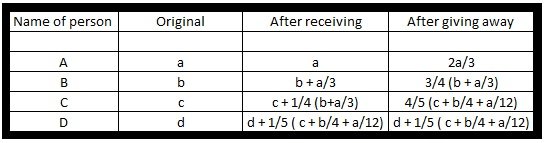
Table .jpg [ 33.25 KiB | Viewed 19784 times ]
So now let us look at the other things we've been given. Finally, each girl has the same number of chocolates. So that means:
\(\frac{2a}{3}= \frac{3}{4} (b + \frac{a}{3}) = \frac{4}{5} (c + \frac{b}{4} + \frac{a}{12}) = d + \frac{1}{5} ( c + \frac{b}{4} + {a}{12})\)
So now take this one at a time.
\(\frac{2a}{3}= \frac{3}{4} (b + \frac{a}{3})\)
But you know that a = b + 80. So substitute that into this equation.
\(\frac{2b + 160}{3}= \frac{3}{4} (b + \frac{b + 80}{3})\)
Simplifying this we get:
\(\frac {3b+a}{4} = \frac{4c}{5} + \frac{b}{5} + \frac{a}{15}\)
Substituting a = 80 and b = 100 in this, we get c = 110
Now solve for the last part of the equation:
\(\frac{4}{5} (c + \frac{b}{4} + \frac{a}{12}) = d + \frac{1}{5} ( c + \frac{b}{4} + \frac{a}{12})\)
Taking everything except d to the left hand side we get:
\(\frac{3}{5} (c + \frac{b}{4} + \frac{a}{12} = d\)
Now substituting values of a, b and c into the equation as 180, 100 and 110 respectively we get the value of d as:
\(d = 90\)
Thus \(c - d = 110 - 90 = 20.\)
Hence the answer is A.
P.S - This problem seems way too lengthy.
Let us assume that initially A had a chocolates, B had b chocolates, C had c chocolates and D had d chocolates.
Given: \(a = b+80\)
We need to find: \(c-d\)
Here's a table I created with the information we've been given.
Attachment:
Table .jpg [ 33.25 KiB | Viewed 19784 times ]
So now let us look at the other things we've been given. Finally, each girl has the same number of chocolates. So that means:
\(\frac{2a}{3}= \frac{3}{4} (b + \frac{a}{3}) = \frac{4}{5} (c + \frac{b}{4} + \frac{a}{12}) = d + \frac{1}{5} ( c + \frac{b}{4} + {a}{12})\)
So now take this one at a time.
\(\frac{2a}{3}= \frac{3}{4} (b + \frac{a}{3})\)
But you know that a = b + 80. So substitute that into this equation.
\(\frac{2b + 160}{3}= \frac{3}{4} (b + \frac{b + 80}{3})\)
Simplifying this we get:
\(\frac {3b+a}{4} = \frac{4c}{5} + \frac{b}{5} + \frac{a}{15}\)
Substituting a = 80 and b = 100 in this, we get c = 110
Now solve for the last part of the equation:
\(\frac{4}{5} (c + \frac{b}{4} + \frac{a}{12}) = d + \frac{1}{5} ( c + \frac{b}{4} + \frac{a}{12})\)
Taking everything except d to the left hand side we get:
\(\frac{3}{5} (c + \frac{b}{4} + \frac{a}{12} = d\)
Now substituting values of a, b and c into the equation as 180, 100 and 110 respectively we get the value of d as:
\(d = 90\)
Thus \(c - d = 110 - 90 = 20.\)
Hence the answer is A.
P.S - This problem seems way too lengthy.

gurpreetsingh

Joined: 12 Oct 2009
Last visit: 15 Jun 2019
Posts: 2,266
Given Kudos: 235
Status:<strong>Nothing comes easy: neither do I want.</strong>
Location: Malaysia
Concentration: Technology, Entrepreneurship
Schools: ISB '15 (M)
GMAT 1: 670 Q49 V31
GMAT 2: 710 Q50 V35
Products:
01 Sep 2010, 17:15
Kudos
Bookmarks
I do not think this question can be asked in the exam. These type of questions can only appear on the practice test of prep companies as brutal challenges. 
Even if it is asked in the exam, wise decision is to do random guess and save the time for further questions.
This is a perfect question for IIMCAT.
Even if it is asked in the exam, wise decision is to do random guess and save the time for further questions.
This is a perfect question for IIMCAT.






