Events & Promotions
|
|

GMAT Club Daily Prep
Thank you for using the timer - this advanced tool can estimate your performance and suggest more practice questions. We have subscribed you to Daily Prep Questions via email.
Customized
for You
Track
Your Progress
Practice
Pays
Not interested in getting valuable practice questions and articles delivered to your email? No problem, unsubscribe here.
 May 01
11:00 AM PDT
-12:00 PM PDT
Free- full-length test + 15 concept videos + 150+ short videos + study plan! Apr 30
01:30 AM EDT
-02:30 AM EDT
At one point, she believed GMAT wasn’t for her. After scoring 595, self-doubt crept in and she questioned her potential. But instead of quitting, she made the right strategic changes. The result? A remarkable comeback to 695. Check out how Saakshi did it. May 03
06:30 AM PDT
-08:30 AM PDT
Verbal trouble on GMAT? Fix it NOW! Join Sunita Singhvi for a focused webinar on actionable strategies to boost your Verbal score and take your performance to the next level.


 17 Jan 2016, 11:56
Kudos
Bookmarks


B
Be sure to select an answer first to save it in the Error Log before revealing the correct answer (OA)!
Difficulty:
 35%
(medium)
35%
(medium)
Question Stats:
74% (03:01) correct 26%
(02:50)
wrong
based on 90
sessions
26%
(02:50)
wrong
based on 90
sessions
History
Date
Time
Result
Not Attempted Yet
In the preceding figure, circle O has its center at the origin. If E AOP = 30°, what is the area of ∆OAB?
A. \(\sqrt{3}\)
B. \(\frac{9 \sqrt{3}}{4}\)
C. \(3 \sqrt{2}\)
D. \(3 \sqrt{3}\)
E. 9
Attachment:
2016-01-17_2253.png [ 7.5 KiB | Viewed 3583 times ]
 19 Jan 2016, 12:03
Kudos
Bookmarks
To find the area of triangle OAB, we'll need the length of one side and the perpendicular height. Area = bh/2
We can take OB as the base, since we already know its length is 3. We will then need the height of the triangle, which will be the x coordinate of point A. We are told that the angle AOP is \(30^{\circ}\), so we can make the point C on the x-axis with the same x coordinate as point A, and form a 30-60-90 triangle AOC. The hypotenuse of \(\triangle\)AOC is 3 (radius of the circle), and therefore the length of OC is \(\frac{3\sqrt{3}}{2}\)
We get this from the ratio of side lengths of a 30-60-90 triangle \(1:\sqrt{3}:2\). So since the hypotenuse is 3, the length of the long leg is \(\frac{3\sqrt{3}}{2}\)
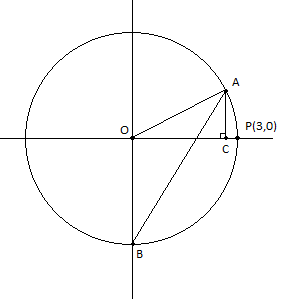
Circle Triangle.png [ 3.75 KiB | Viewed 3325 times ]
Now we have the base and the height, so we can calculate the area
\(Area = \frac{1}{2}*3*\frac{3\sqrt{3}}{2}\)
\(Area = \frac{9\sqrt{3}}{4}\)
Answer: B
An alternative method would be to consider \(\triangle\)OAB and see that it is an isosceles triangle with legs OA and OB = 3. We also have the angle at O = \(120^{\circ}\). If we cut the triangle in half with a line perpendicular to AB and passing through O, then we have two 30-60-90 triangles with hypotenuse = 3. Using the \(1:\sqrt{3}:2\) ratio, the length of the short side is \(\frac{3}{2}\), which is also the height of \(\triangle\)OAB, and the length of the long side is \(\frac{3\sqrt{3}}{2}\), which is half the base of \(\triangle\)OAB. So the height of \(\triangle\)OAB is \(\frac{3}{2}\) and the base is \(\frac{6\sqrt{3}}{2}\).
From there we can calculate the area to be:
\(Area = \frac{1}{2}*\frac{6\sqrt{3}}{2}*\frac{3}{2}\)
\(Area = \frac{9\sqrt{3}}{4}\)
Answer: B
We can take OB as the base, since we already know its length is 3. We will then need the height of the triangle, which will be the x coordinate of point A. We are told that the angle AOP is \(30^{\circ}\), so we can make the point C on the x-axis with the same x coordinate as point A, and form a 30-60-90 triangle AOC. The hypotenuse of \(\triangle\)AOC is 3 (radius of the circle), and therefore the length of OC is \(\frac{3\sqrt{3}}{2}\)
We get this from the ratio of side lengths of a 30-60-90 triangle \(1:\sqrt{3}:2\). So since the hypotenuse is 3, the length of the long leg is \(\frac{3\sqrt{3}}{2}\)
Attachment:
Circle Triangle.png [ 3.75 KiB | Viewed 3325 times ]
Now we have the base and the height, so we can calculate the area
\(Area = \frac{1}{2}*3*\frac{3\sqrt{3}}{2}\)
\(Area = \frac{9\sqrt{3}}{4}\)
Answer: B
An alternative method would be to consider \(\triangle\)OAB and see that it is an isosceles triangle with legs OA and OB = 3. We also have the angle at O = \(120^{\circ}\). If we cut the triangle in half with a line perpendicular to AB and passing through O, then we have two 30-60-90 triangles with hypotenuse = 3. Using the \(1:\sqrt{3}:2\) ratio, the length of the short side is \(\frac{3}{2}\), which is also the height of \(\triangle\)OAB, and the length of the long side is \(\frac{3\sqrt{3}}{2}\), which is half the base of \(\triangle\)OAB. So the height of \(\triangle\)OAB is \(\frac{3}{2}\) and the base is \(\frac{6\sqrt{3}}{2}\).
From there we can calculate the area to be:
\(Area = \frac{1}{2}*\frac{6\sqrt{3}}{2}*\frac{3}{2}\)
\(Area = \frac{9\sqrt{3}}{4}\)
Answer: B
 19 Jan 2016, 19:34
Kudos
Bookmarks
Since P(3,0) , Radios is 3.
So two sides AO=OB =3
Now AOP=30 is given so the angle between two adjuscent sides = 120
Area = 0.5.AO.OB.Sin120
=0.5x3x3x(root(3)/2)
=B
So two sides AO=OB =3
Now AOP=30 is given so the angle between two adjuscent sides = 120
Area = 0.5.AO.OB.Sin120
=0.5x3x3x(root(3)/2)
=B